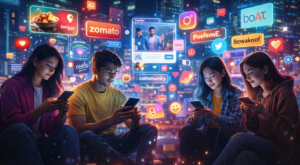

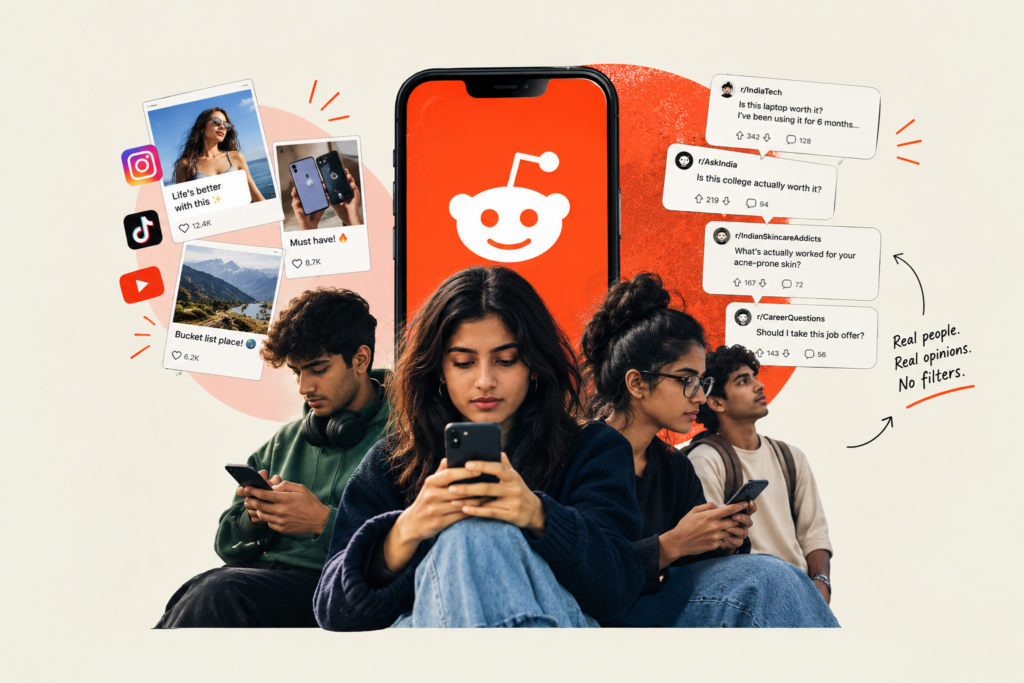
For years, the internet seemed to be moving in one direction: everything was becoming more public, more visual and more personality-driven. Instagram turned people into personal brands, TikTok turned ordinary users into creators, LinkedIn turned careers into content and influencers became trusted sources of recommendations, opinions and even purchasing advice.
And then there is Reddit. It looks, at first glance, almost like a relic from an earlier internet: usernames instead of carefully curated identities, text-heavy conversations instead of polished videos, communities instead of followers and arguments instead of perfectly managed comment sections. Yet Gen Z is increasingly finding its way there.
That is the interesting part. Reddit’s resurgence among young people isn’t simply about discovering another social platform. It reflects a broader change in how Gen Z is using the internet: moving from broadcasting identity towards seeking information, validation and unfiltered opinions. In India, where young people navigate an exceptionally dense ecosystem of social media, creators, search engines and increasingly AI tools, that shift is particularly worth watching.
The anti-social social network
Reddit doesn’t behave like most of the platforms Gen Z grew up with. There is no requirement to build a personal brand, post photographs of your life or accumulate thousands of followers before your opinion can carry weight. You can simply walk into a community and ask a question.
Is this college actually worth it? Has anyone used this laptop for two years? Should I take this job? Is this salary good for someone with two years of experience? Has anyone actually tried this product?
The value isn’t necessarily in the original post. It is in what happens underneath it. Hundreds of people can respond, disagree, challenge one another, add their own experiences and, occasionally, tell the original poster that they are completely wrong. That messiness is precisely what makes Reddit interesting.
For a generation that has grown up surrounded by sponsored content, influencer marketing and algorithmically optimised feeds, a conversation that isn’t polished can sometimes feel more authentic than one that is.
Gen Z doesn’t just want content. It wants confirmation.
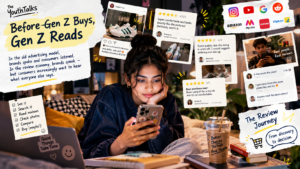
One of the biggest changes in Gen Z’s internet behaviour is the movement from discovery to validation. A TikTok might introduce a product, an Instagram Reel might make it desirable and a creator might recommend it. But increasingly, the next question is: what do actual people think?
That is where Reddit becomes powerful. Reddit’s own research into Gen Z points towards growing scepticism around online reviews and social content. Young consumers increasingly recognise that reviews can be biased, promotional or manipulated, creating what Reddit has described as a growing “cynicism of the algorithm.”
The result is an interesting behavioural loop: a product is discovered on social media, Reddit is searched for people’s experiences, the discussions are read and a purchase decision follows. Reddit therefore isn’t necessarily competing with Instagram or TikTok for attention. It can sit after them in the consumer journey.
Instagram and TikTok can create desire and discovery; Reddit can provide validation.
The new search behaviour
There is another reason Reddit has become increasingly relevant: Gen Z isn’t using it only as a social network. It is using it as a search engine.
For years, people have added “Reddit” to Google searches when they wanted an answer that felt more human: Best phone under ₹30,000 Reddit. Best MBA college Reddit. Is this company good to work for Reddit. Best skincare for Indian skin Reddit. Delhi restaurant recommendations Reddit.
The attraction is straightforward. Traditional search can tell you what a product is. Reddit can tell you what happened when someone actually used it.
That distinction becomes more important as young consumers become more sophisticated about marketing. Reddit discussions increasingly appear in the wider search ecosystem, while Reddit’s own AI-powered search is designed to help users find answers across posts and comments. The platform is therefore becoming more than a social network; it is becoming a repository of human experiences.
That could become especially significant as AI changes how people search. An AI system can summarise a phone’s specifications, features and reviews. A Reddit user can tell you that the battery began deteriorating after 18 months, that customer service was terrible in their city or that a supposedly essential feature is practically useless.
As synthetic content proliferates, first-hand experience may become a more valuable form of information.
And then there is anonymity
It would be tempting to explain Reddit’s Gen Z appeal by saying that the platform is “private” or “encrypted”. That isn’t quite right. Reddit is not an end-to-end encrypted social platform. Its attraction is closer to pseudonymity: users can participate without necessarily placing their real-world identity at the centre of the conversation.
For Gen Z, that distinction matters.
Consider asking a sensitive question on Instagram. Your name, photograph, followers and social connections are visible, and your college friends or colleagues could potentially see what you post. On Reddit, the same question can exist without carrying quite the same social baggage.
That makes the platform particularly useful for conversations around relationships, careers, money, education, sexuality, family pressure and personal insecurities. The question becomes more important than the identity of the person asking it.
Academic research into young Indian Reddit users has also begun examining this relationship between pseudonymity, community and identity, suggesting that Reddit’s appeal among Indian Gen Z cannot be reduced simply to entertainment or information consumption.
Why India makes this particularly interesting
India’s Gen Z population is simultaneously hyper-connected and highly conscious of how it presents itself. Young Indians move fluidly between Instagram, YouTube, Snapchat, WhatsApp, LinkedIn, Reddit and AI tools, but these platforms are not interchangeable. Each carries a different social context.
Your classmates may be on Instagram. Your colleagues are likely to be on LinkedIn. Family members may be watching what happens on WhatsApp or Facebook. Reddit provides a comparatively low-pressure environment in which a person can enter a community about a university, competitive exams, coding, careers, relationships, gaming, technology or a city without necessarily announcing their identity to everyone they know.
That makes Reddit particularly suited to India’s question economy.
Young Indians have an enormous number of consequential decisions to make: which college, which course, which career, which coding programme, which laptop, which phone, which city, which company, which MBA and increasingly, whether to work abroad or stay in India. The instinct is not always to ask an institution or a brand. Increasingly, it is to ask people who have already been there.
That is a powerful role for a platform built around communities rather than personal brands.
The anti-influencer effect
There is perhaps an even deeper reason Reddit works for Gen Z: young consumers have become remarkably good at recognising when they are being marketed to.
They know influencers have commercial relationships. They know creators are building businesses. They know “authentic” content can itself be professionally produced. They understand that an apparently spontaneous product recommendation can have a commercial incentive behind it.
Reddit operates differently. A brand can enter a conversation, but it cannot completely control what people say about it. One person can praise a product, another can criticise it and a third can respond with a detailed account of what happened after six months of use.
For consumers, that disagreement can actually increase credibility. The point isn’t that Reddit users are always right—they clearly aren’t. It is that the platform allows competing experiences to remain visible alongside one another.
For brands, this is considerably less comfortable. Reputation is being constructed in conversations they do not fully control, often by people who have no commercial incentive to make the brand look good.
What this means for brands
For years, influencer marketing has encouraged brands to think about finding the right individual: the creator whose audience matches their target consumer. Gen Z’s relationship with Reddit suggests that marketers may also need to think about the right community.
A creator can create awareness. A community can create confidence. And that means Reddit shouldn’t be viewed only as another advertising channel. It should also be understood as a place where brand reputation is continuously constructed by consumers.
The conversation may happen whether the brand participates or not. The relevant question is therefore no longer simply what a company says about itself, but what people who have actually used its products say about it when the company isn’t writing the script.
Reddit isn’t replacing Instagram. It’s doing something different.
The biggest mistake would be to interpret Reddit’s resurgence as Gen Z abandoning every other social platform. That isn’t what appears to be happening. Gen Z is becoming more multi-platform and increasingly purposeful about how it uses each service.
Instagram can be a space for identity and social connection. TikTok can provide entertainment and discovery. YouTube can offer education and long-form engagement. WhatsApp remains central to private communication. LinkedIn serves professional identity. Reddit occupies a different space: conversation, research, community and validation.
That may explain why the platform has found renewed relevance with a generation that has spent its formative years inside algorithmic feeds.
The attraction isn’t encryption. Nor is it simply nostalgia for an older internet. It is the possibility of finding something that is becoming harder to find elsewhere: people talking about their actual experiences without necessarily turning those experiences into personal brands.
In an internet increasingly dominated by algorithms, influencers, commercial content and AI-generated information, an anonymous person saying, “I actually tried this—here’s what happened,” can carry remarkable weight.
For India’s Gen Z, Reddit may therefore become more than another social platform. It could become one of the internet’s most important truth-checking layers—the place young consumers go after the algorithm has shown them what to want, to find out whether anyone who actually bought, used, studied, experienced or lived it agrees.