

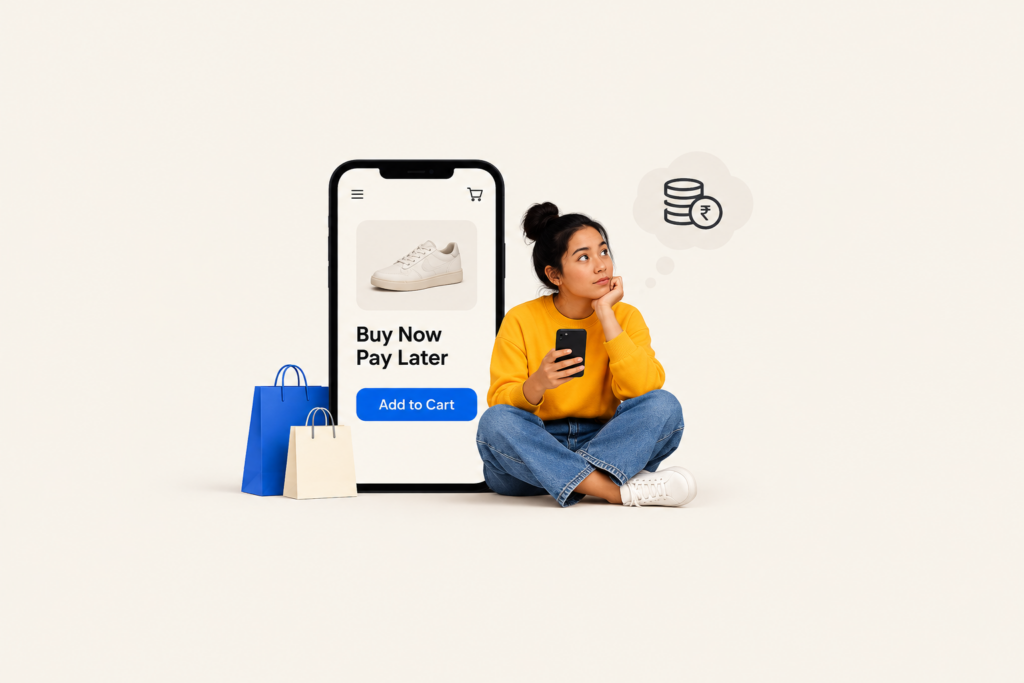
TheYouthTalks’ dipstick survey explores how young Indians perceive Buy Now, Pay Later, what attracts them to the option, and why convenience does not always translate into confidence.
Buying something today and paying for it later sounds simple. For young Indians navigating their first salaries, limited budgets and an increasingly digital shopping environment, Buy Now, Pay Later (BNPL) can offer an appealing degree of flexibility.
A purchase that might otherwise require an immediate outlay can be split into smaller payments or deferred until a later date. At checkout, the proposition appears straightforward: get what you need now and settle the bill later.
But there is a difference between understanding how to use a payment option and understanding the credit arrangement behind it.
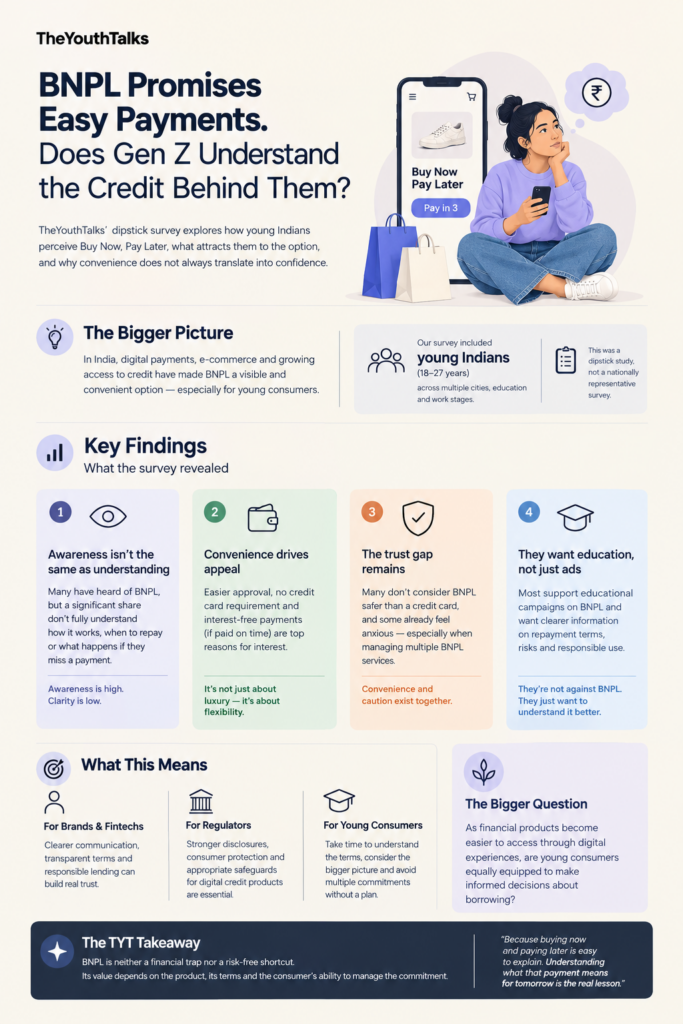
TheYouthTalks conducted a dipstick survey among young Indians to examine their awareness of BNPL, the reasons it appeals to them, and their understanding of repayment terms, risks and financial responsibility. The responses point to an interesting tension: while BNPL has visibility among young consumers, familiarity does not necessarily mean that they fully understand how it works.
For India’s fintech and consumer ecosystem, this raises a question worth examining: as financial products become easier to access through digital experiences, are young consumers equally equipped to make informed decisions about borrowing?
1. Awareness Is Not the Same as Understanding
BNPL occupies an interesting space in the digital consumer journey. Unlike traditional borrowing, which may involve a separate application or a more formal interaction with a lender, some deferred-payment products are presented directly at checkout.
For consumers accustomed to shopping and making payments online, this can make credit feel like a natural extension of the purchase experience.
However, the TYT dipstick survey suggests that awareness of BNPL does not automatically translate into a clear understanding of the product. Many respondents had heard of it without necessarily understanding how it works, while a considerable number had not used it and were not planning to do so.
This distinction matters. Knowing that a payment option exists is not the same as understanding when repayment is due, what happens if a payment is missed, whether charges apply or how the arrangement could affect one’s financial position.
The findings do not establish that young Indians broadly lack financial literacy. They do, however, raise a more specific question: how much do prospective users understand about a financial product before deciding whether to use it?
For a product designed around convenience, that question deserves attention.
2. Why BNPL Can Appeal to Young Consumers
The appeal of BNPL is not difficult to understand. The survey responses indicate that convenience, easier eligibility and the absence of a credit card feature among the reasons respondents find it attractive.
For someone entering the workforce or managing a limited monthly budget, the ability to defer a payment can appear useful. It may offer flexibility when expenses and income do not align perfectly.
There is also a behavioural dimension. When credit is presented alongside other payment options, the decision can become part of the shopping process rather than a separate financial decision.
This does not mean that young consumers are necessarily borrowing to fund aspirational purchases or spending beyond their means. The motivations can vary, from managing short-term cash flow to preferring a particular payment method.
But it does highlight the importance of understanding the difference between affordability and postponement.
A purchase that seems manageable because the payment is delayed still represents a future financial commitment. If several purchases are made across different platforms, the combined repayment obligation may become harder to track.
The central issue, therefore, is not whether BNPL is convenient. It is whether that convenience helps consumers manage their money or makes it easier to overlook the commitments they are taking on.
3. The Trust Gap Behind the Checkout Button
Convenience alone does not guarantee confidence.
When asked whether BNPL is safer than a credit card, respondents in the TYT survey generally expressed reservations, with many indicating that it was not necessarily safer or could be riskier. Only a small number regarded it as a better alternative.
The responses suggest that the appeal of the product coexists with uncertainty about its risks.
That is an important distinction for businesses offering deferred-payment products. A consumer may appreciate the flexibility of a payment option without being convinced that it is the right financial choice.
BNPL products can also differ in their structure, repayment schedules, charges and lending arrangements. The terms of a particular product matter more than the label attached to it.
A user who understands the repayment schedule, knows the consequences of missing a payment and has assessed the commitment against their budget is in a different position from someone who accepts an offer without examining its conditions.
Trust, in this context, should not be measured simply by adoption. It should also be understood through the consumer’s ability to make an informed choice.
4. Repayment Terms: The Fine Print Matters
One of the more significant signals from the TYT survey concerns respondents’ reported understanding of repayment terms. Many indicated that they rarely or never fully understood these terms, while only a few said they understood them completely.
This finding deserves attention because repayment conditions are central to any credit arrangement.
Consumers should know the amount they owe, when the payment is due, what charges may apply, and what happens if they fail to pay on time. They should also understand whether the product involves a regulated lender and what their rights and obligations are.
In India, the Reserve Bank of India’s Digital Lending Directions, 2025, establish requirements for regulated entities engaged in digital lending, including provisions relating to disclosures, borrower protection and grievance redressal. The applicable requirements depend on the product’s structure and the entities involved.
The broader principle is straightforward: financial information should be understandable at the point when a consumer is making a decision, not merely available somewhere in a lengthy set of terms and conditions.
For platforms, this presents an opportunity to rethink how repayment information is communicated. Clear summaries of due dates, total obligations, applicable charges and consequences of missed payments can help consumers evaluate an offer before accepting it.
For young consumers, the lesson is equally important: if the repayment conditions are unclear, the convenience of the purchase should not be the reason to proceed.
5. When Convenience Becomes a Financial Commitment
The survey also explored whether BNPL creates repayment-related stress. Most respondents did not report feeling stressed, although some indicated anxiety, particularly around managing multiple BNPL services.
These responses should not be interpreted as evidence that BNPL is already creating widespread financial distress among young Indians. Equally, the absence of reported stress does not establish that all users are managing their obligations comfortably.
The relationship between borrowing and financial well-being depends on several factors, including income stability, repayment capacity, the number of outstanding commitments and the consequences of missed payments.
For young people at the beginning of their financial journeys, these considerations can be especially relevant as they learn to balance discretionary spending with rent, travel, education and other expenses.
A useful habit is to consider all outstanding repayments together rather than evaluating each purchase in isolation. A small instalment may appear manageable on its own, but multiple commitments can compete for the same future income.
The objective is not to discourage every form of deferred payment. It is to encourage consumers to assess the full obligation before committing.
6. Regulation, Responsibility and Financial Education
When asked whether BNPL should be regulated like credit cards, many respondents were unsure or selected a qualified response, while some supported stronger checks, including checks on a borrower’s ability to repay.
This uncertainty is understandable. Consumers may recognise that financial products need safeguards without knowing how different credit arrangements are regulated.
Rather than treating BNPL and credit cards as interchangeable, the conversation should focus on the protections and disclosures appropriate to the product being offered. Clear information, responsible lending practices, suitable grievance mechanisms and safeguards for personal data all matter.
The survey also points towards an appetite for financial education, with educational campaigns on BNPL receiving positive responses from participants.
For fintech companies, this presents an opportunity to make education part of the consumer experience rather than treating it as an occasional awareness campaign. For educators, financial institutions and youth-focused organisations, it offers a starting point for practical conversations about borrowing, repayment and budgeting.
Financial education is most useful when it goes beyond definitions. Young consumers need opportunities to understand real-world scenarios: how multiple instalments add up, how missed payments can affect them, and how to distinguish a genuinely manageable expense from one that simply postpones the financial pressure.
7. What Happens Next?
The TYT survey suggests that the relationship between young consumers and BNPL is still evolving. Many respondents who had not used the product indicated that they might consider trying it over the next two years.
That signals possible interest, not a guarantee of future adoption. Whether interest translates into use will depend on individual needs, product availability, trust and the terms being offered.
For businesses, the challenge is to build products that are not only easy to access but also easy to understand. For consumers, the challenge is to look beyond the immediate appeal of a purchase and consider the obligation that follows.
For TheYouthTalks, the findings open up a wider question about how young Indians navigate financial decisions in a digital-first economy. As payments, shopping and credit increasingly intersect, understanding consumer behaviour requires looking beyond whether a product is used to examine why it is used, what people understand about it and where uncertainty remains.
The TYT Takeaway
BNPL is neither automatically a financial trap nor a risk-free shortcut. Its value depends on the product, its terms and the consumer’s ability to manage the resulting commitment.
The dipstick findings suggest that convenience and confidence do not always move together. Young consumers may be curious about deferred payments while remaining uncertain about repayment terms, relative risks and the protections available to them.
That gap creates a responsibility for the wider ecosystem. Financial platforms must communicate clearly, lenders must meet applicable obligations, and financial education must help consumers understand the decisions they are making.
Ultimately, the measure of a successful financial product should not be how quickly a consumer can complete a transaction. It should also be whether that consumer understands the commitment they have accepted.
Because buying now and paying later is easy to explain. Understanding what that payment means for tomorrow is the more important lesson.