India has millions of young gamers. Discord is betting that the next opportunity is not simply getting them to play — but helping games become social ecosystems.
For years, Discord was easy to describe.
It was the place gamers went to talk while they played.
A headset on, a game running, friends in a voice channel and Discord quietly sitting alongside the action.
That description is becoming increasingly outdated.
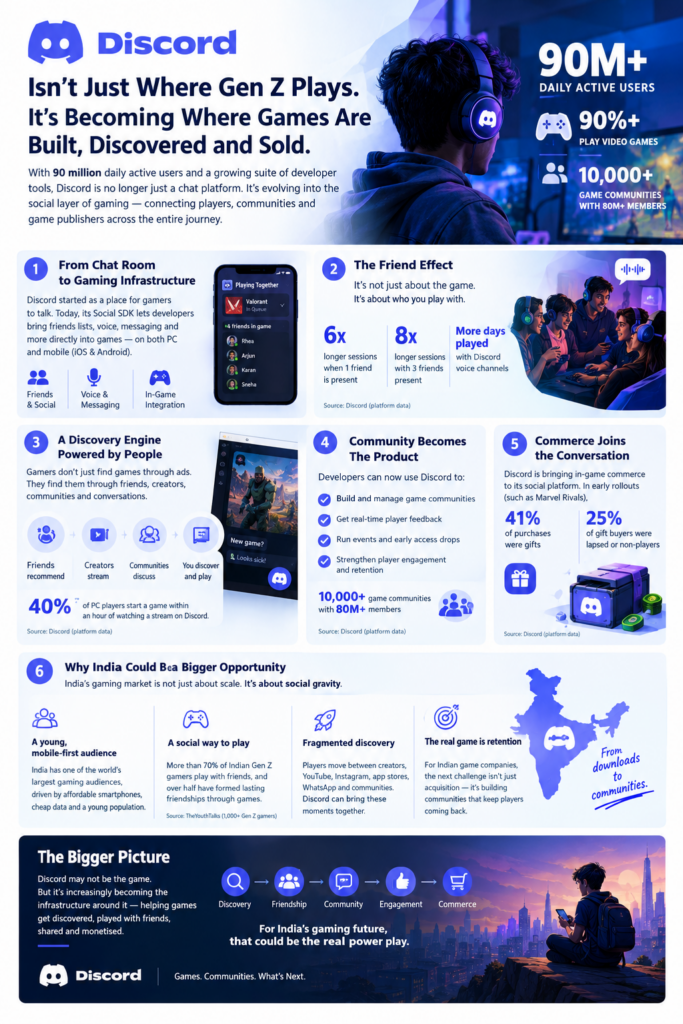
Discord now reports more than 90 million daily active users, with more than 90% of its users playing video games. The company says its platform has become a place where more than 90 million people connect through text, voice and video every day. It also says that around 40% of PC players start a game within an hour of watching someone stream that game on Discord.
But the bigger story is not the size of Discord’s audience.
It is what Discord is trying to become for the gaming industry.
The company is increasingly positioning itself as the social layer around games — helping developers with discovery, friends, communication, communities, player engagement and, increasingly, commerce.
And that makes Discord particularly interesting in India.
India has built one of the world’s largest gaming audiences on the back of smartphones, affordable data and a young population. But as the market matures, the industry’s challenge is changing.
It is no longer simply about getting someone to download a game.
It is about giving them a reason to make that game part of their social life.
That is where Discord could become much more important.
India’s gaming opportunity is bigger than downloads
India’s gaming story has traditionally been told through scale.
Millions of young Indians play games. Mobile gaming dominates much of the market. YouTube creators and streamers have helped turn gaming into entertainment, while esports has created another layer of competition, fandom and celebrity.
But there is another side to the growth story.
A game can acquire a player without necessarily creating a player who stays.
A young Indian consumer may discover a game through a creator, download it because it looks interesting, play for a few days and then move on to something else.
For multiplayer and live-service games, the difference between a short-lived download and a long-term player can be surprisingly simple:
Are your friends playing it?
That is where Discord’s proposition becomes interesting.
A friend is online. A squad is forming. Someone is streaming. A tournament is happening. A new update has dropped. A community is discussing the latest character, map or strategy.
The game becomes more than something sitting on a phone.
It becomes somewhere your people are.
For India’s gaming industry, the next opportunity may therefore be less about downloads and more about social stickiness.
Discord wants to sit inside that journey
The gaming journey is increasingly fragmented.
A player might discover a game on YouTube, see a creator playing it on Instagram, download it from an app store, discuss it on WhatsApp, watch an esports tournament and eventually find a dedicated gaming community on Discord.
Discord’s opportunity is to connect several of those behaviours.
Its ambition is no longer simply to host a server where a game’s most enthusiastic fans can talk.
In March 2025, Discord launched its Social SDK, allowing game developers to integrate Discord-powered social features directly into their games. These include unified friends lists, game invites, rich presence and communication features.
By August 2025, Discord had also opened voice, messaging and other communication capabilities through the SDK for commercial use.
And in 2026, the proposition became even more relevant to a mobile-first market like India: Discord announced general availability of mobile support for the Social SDK across iOS and Android.
That is an important shift.
Discord is no longer asking game developers merely to build a community next to their game.
It is increasingly asking them to build social experiences into the game.
The friend effect could be Discord’s biggest advantage
Gaming has always been social.
But the infrastructure around that social behaviour has often been fragmented.
Players have separate friends lists. They use different communication tools. They exchange invite codes. They move between platforms to organise a game.
Discord is trying to remove some of that friction.
A player can see which friends are playing, invite them into a session and communicate with them without having to rebuild that social graph from scratch inside every individual game.
That matters because the social connection can become part of the reason someone returns.
Discord says its own data from more than 15 games using the Social SDK showed linked players recording a median 25% increase in game launch days, a 16% increase in session duration and a 34% increase in median retention compared with unlinked players.
Those are Discord’s own reported figures, so they should be read as platform-level evidence rather than an industry-wide guarantee.
But the underlying idea is compelling.
If playing together becomes easier, playing together can happen more often.
And when a game becomes part of a friendship routine, it becomes harder to replace.
This is particularly relevant to India’s Gen Z
The social nature of gaming is especially important when looking at young Indian players.
TheYouthTalks’ own research with Indian Gen Z gamers has found that gaming is deeply connected to friendship and social interaction, with more than 70% of respondents saying they play with friends and more than half saying they have formed lasting friendships through games.
That changes the way gaming should be understood.
For Gen Z, a game is not necessarily just a product.
It can be a meeting place.
It can be where friends spend time together after college. It can be where someone meets people with similar interests. It can become part of a creator community or an esports fandom.
And India’s diversity makes the community layer even more interesting.
A student in Delhi may have limited access to people around them who share their exact gaming interests. The same may be true for a player in Indore, Jaipur, Kochi or Guwahati.
Online communities remove some of those geographic constraints.
A player does not have to find their gaming tribe in their immediate physical environment.
They can find it online.
That is precisely the behaviour Discord was built around.
From community management to gaming infrastructure
This is where Discord’s commercial proposition gets more interesting.
For years, a game developer could create a Discord server for announcements, customer support, player feedback and community management.
That made Discord a useful marketing and communications channel.
But the company now wants to move much further upstream.
Discord says that as of December 31, 2025, there were more than 10,000 game communities on the platform with over 80 million members. The company describes these communities as a direct feedback loop between players and developers, particularly for early-access and live-service games.
That creates an interesting proposition for Indian game developers.
A Discord community can become the place where players:
- discover updates,
- find teammates,
- give feedback,
- discuss strategies,
- participate in events,
- interact with creators,
- share game activity,
- and potentially discover new content or purchases.
The community stops being an afterthought.
It becomes part of the game’s operating system.
For smaller Indian studios, this could be particularly valuable. Instead of having to build every layer of social connectivity, communication and community infrastructure independently, developers can potentially plug into a platform that already has a large gaming audience.
And now Discord wants to sit closer to the transaction
The evolution does not stop at community.
Discord has also started building commerce into its gaming ecosystem.
Its Social Commerce offering allows players to discover, purchase and gift in-game items through social interactions on Discord. The company’s initial examples include the Marvel Rivals Shop, where digital goods can be discovered inside the game’s official Discord community.
That is strategically significant.
Think about the traditional gaming funnel.
A company spends money to acquire a player.
The player downloads the game.
The player joins a community.
The player becomes engaged.
Eventually, the player may buy something.
Discord is trying to occupy more of that journey.
Discovery. Community. Engagement. Social interaction. Commerce.
The closer those activities become, the more valuable Discord becomes to game developers.
What this could mean for Indian game companies
This is where the India opportunity becomes particularly interesting.
Indian game companies have historically had to compete for attention across an increasingly crowded entertainment ecosystem.
Gaming competes not only with other games, but with YouTube, Instagram, short-form video, streaming platforms, music and every other form of digital entertainment competing for a young person’s time.
The question for a game company is therefore not simply:
How do I acquire this player?
It is:
How do I become part of this player’s routine?
Discord offers one possible answer.
A player discovers the game through a creator. Their friends join. They enter the game’s Discord community. They communicate while playing. They see what friends are playing. They participate in events. They hear about updates. They share the experience with others.
The game starts generating its own social momentum.
That is much more powerful than a banner ad.
It also creates a potential advantage for games that understand community early.
A developer that treats Discord only as a customer-support channel is using a small part of what the platform could offer.
A developer that treats Discord as an extension of the game’s social experience is playing a different game.
Discord may become gaming’s social infrastructure
There is an important distinction here.
It would be premature to call Discord the default engine for gaming. The global gaming ecosystem is far too large and fragmented for any single platform to claim that position.
But calling Discord a default social layer for gaming is increasingly defensible.
The company already has the audience.
It has deep gaming behaviour.
It has official game communities.
It has developer tools.
It has social integrations.
It is building discovery and commerce.
And, critically for India, its Social SDK now extends into mobile gaming.
That puts Discord in an unusual position.
It does not need to own the game to influence the game’s success.
It can sit around the game — before, during and after play.
And that may ultimately be its biggest advantage.
The bigger Indian gaming question
India’s gaming market is entering a more mature phase.
The next wave of growth will not come only from convincing more people to download games. It will come from creating games that people return to, talk about, play with friends and build communities around.
That changes what a gaming platform needs to provide.
The winning game may not necessarily be the one with the biggest launch.
It may be the one that becomes part of a player’s social routine.
And that is why Discord deserves attention from Indian game publishers, developers and gaming marketers.
Because Discord is no longer simply asking:
“Where do gamers talk?”
It is increasingly answering a much bigger question:
“What if the social layer around a game became part of the game itself?”
For India’s young gaming audience, that could be a powerful proposition.
Discord may not be the game. But increasingly, it wants to be the infrastructure that makes the game social — and perhaps, in doing so, makes the game harder to leave.