
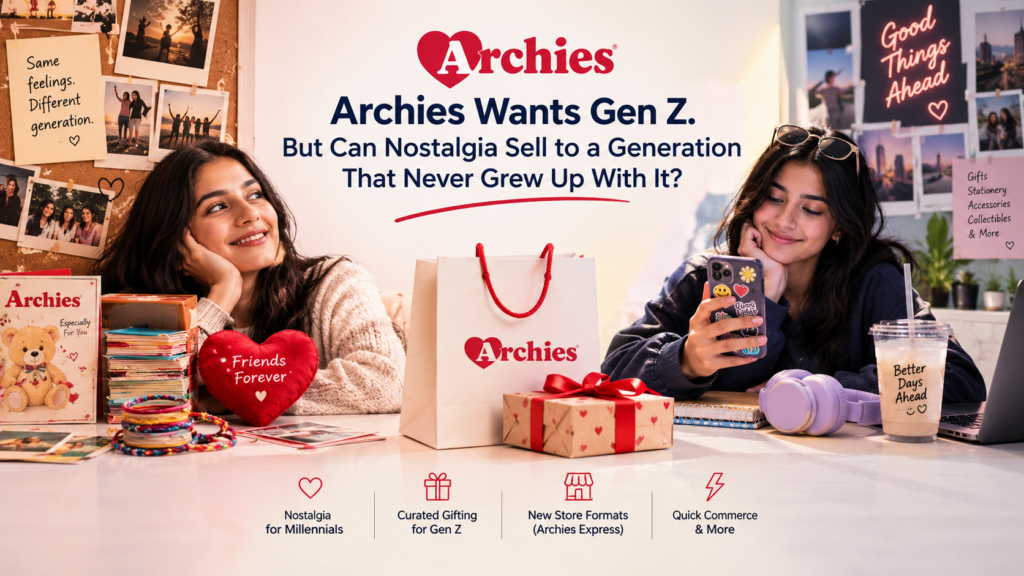
For a generation that grew up with Instagram messages, instant delivery and digital expressions of affection, Archies is attempting to make physical gifting relevant again. Its challenge is not simply to modernise its stores, but to give young Indians a reason to care.
There was a time when expressing your feelings required a trip to a store.
You walked through rows of greeting cards, read messages that were sometimes painfully cheesy, searched for the one that sounded like you, and perhaps spent longer choosing a card for your crush than you would ever admit. A friendship band, a soft toy, a mug or a handwritten note could turn an ordinary birthday into something memorable.
For millions of Indian millennials, Archies was part of this ritual. It was not merely a place to buy a gift. It was where you went when you wanted to say something but could not quite find the words yourself.
But what happens when the next generation has grown up expressing affection through Instagram stories, WhatsApp messages, shared playlists, memes and digital payments?
That is the question facing Archies as it attempts to attract Gen Z, a generation that may recognise the brand without necessarily sharing the emotional memories that made it meaningful to older consumers.
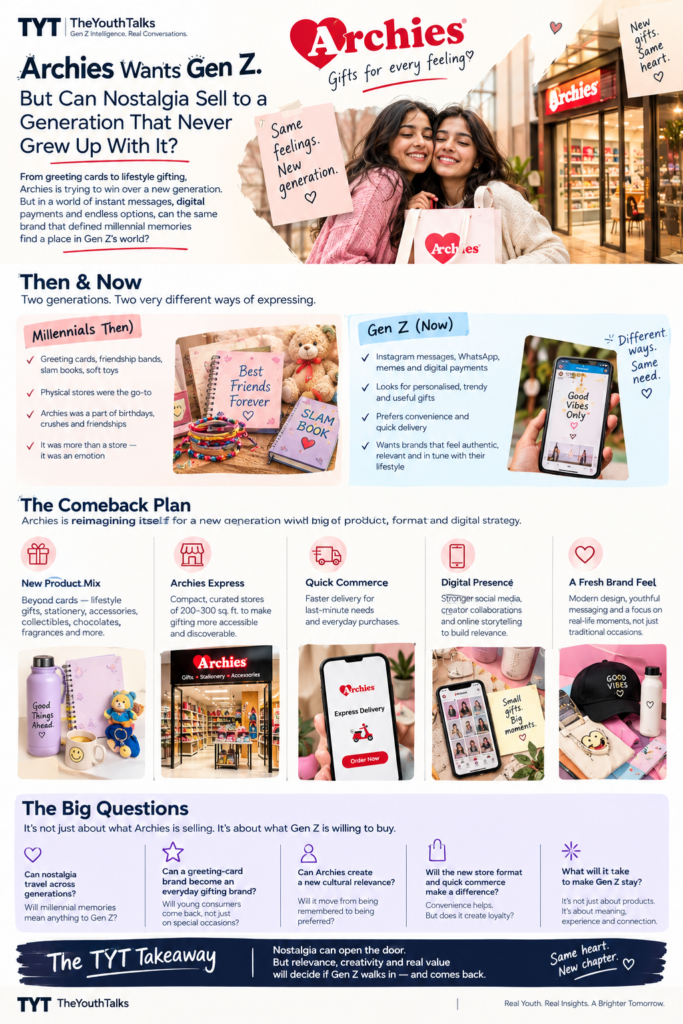
The company is already making its move. In February 2026, ETRetail reported that Archies was planning to expand its quick-commerce business and launch Archies Express, a compact store format focused on lifestyle accessories, stationery, collectibles and contemporary gifting. The company outlined plans for 17–19 new Express stores in FY2026–27, alongside efforts to grow quick-commerce revenue. Source: ETRetail
The strategy signals a bigger ambition: to move beyond being a brand people remember when they need a birthday card and become one they might visit when looking for something thoughtful, personal or simply fun.
It is a sensible ambition. But it also raises a difficult question: can nostalgia sell to people who never experienced the original thing being remembered?
The nostalgia advantage — and its limits
For millennials, Archies does not have to explain its history. The brand can evoke memories of school friendships, teenage crushes, birthdays and early relationships. Its products were often affordable ways of communicating feelings that were difficult to express directly.
Nostalgia gives a brand an unusual advantage. It can reduce the distance between a product and a memory, making an otherwise ordinary object feel significant.
Yet nostalgia is not automatically transferable across generations.
A 30-year-old who remembers choosing a greeting card for a school friend may attach emotional meaning to the Archies name. A 19-year-old might see the same card as one of several options available online. The product may still be useful, but the inherited emotional connection cannot be assumed.
This is where legacy brands can make a strategic mistake: confusing recognition with relevance.
Gen Z may know Archies exists. That does not mean it is a preferred gifting destination, a brand they identify with or somewhere they would visit without a specific occasion.
The distinction matters because a brand can be remembered fondly by its original audience while struggling to become meaningful to the next one.
Archies has an asset many new gifting businesses would like to possess: decades of familiarity with the idea of emotional expression. But that asset creates an opportunity, not a guarantee of demand.
From greeting cards to everyday expression
Archies appears to recognise that its future cannot depend entirely on the traditional greeting-card business.
The Express format broadens its product mix to include stationery, lifestyle accessories, soft toys, chocolates, fragrances and seasonal gifting. Its smaller, contemporary stores are intended to encourage quicker browsing and product discovery. The company has also been investing in digital channels and quick-commerce partnerships. Source: ETRetail
The logic is straightforward. A brand that appears only when someone needs an anniversary card has relatively few opportunities to enter a customer’s life. A brand offering attractive stationery, small accessories, collectables and affordable gifts has more reasons to be considered.
This could help Archies move from occasion-led purchasing to more frequent, everyday discovery.
But expanding the catalogue is not the same as building a new identity.
Young consumers can already find stationery, accessories, soft toys, fragrances and gifts across marketplaces, specialist retailers and countless online brands. Simply placing these categories under the Archies name does not establish why a customer should choose it.
The real test is whether Archies can curate a distinctive range that feels contemporary, personal and worth buying — rather than appearing to be a familiar greeting-card brand selling a wider assortment of products.
Its new stores will need to communicate that difference within seconds. The experience must make sense to a first-time visitor, not just someone who walks in with childhood memories.
Gen Z does not reject emotion. It expresses it differently.
It would be easy to assume that digital communication has made physical gifts or handwritten messages irrelevant. That would be an equally simplistic mistake.
A digital message is convenient. A physical gift can still feel deliberate. A handwritten note can carry a different kind of meaning precisely because someone has taken the time to choose it, write it and give it.
The opportunity for Archies lies in this distinction.
The question is not whether Gen Z wants to express affection. It is whether Archies can make its products fit the ways young people build and maintain relationships today.
That could mean gifts between friends who have moved to different cities, small gestures for a partner, a thank-you for a mentor, a personalised item for a sibling or a spontaneous purchase to cheer someone up.
It could also mean making the act of gifting less formal. Not every meaningful gesture needs a birthday, Valentine’s Day or anniversary attached to it.
Archies has an opportunity to make small acts of expression feel accessible. However, it must discover which occasions, products and messages resonate with young consumers instead of assuming that traditional gifting rituals will automatically carry over.
Personalisation may be one route. A product connected to a shared joke, a name, a photograph or a particular memory can feel more individual than a generic gift. But personalisation alone is not a competitive advantage unless the execution, design, price and shopping experience make it worthwhile.
The store is part of the product
The launch of Archies Express is significant because the brand is not relying exclusively on a digital revival. It is also reconsidering what a physical Archies store should look and feel like.
The planned compact format, spanning approximately 200–300 square feet according to ETRetail, is designed around a more curated range and a contemporary retail identity.
For a gifting brand, the physical experience can still matter. Shoppers often want to see the colour, size, texture and quality of an item before buying it. Browsing can also generate ideas: someone who enters looking for a small birthday present might leave with something entirely different.
But the store must earn that visit.
A smaller format can support faster expansion and lower store-level investment, but scale alone will not establish cultural relevance. The merchandise needs to be fresh, the pricing needs to feel reasonable, and the range must give young shoppers a reason to return.
There is also a discovery challenge. Gen Z may encounter a product through a creator, a friend’s recommendation or a social-media post before visiting a store. If Archies’ online presentation feels disconnected from the physical experience, the brand risks losing the customer between discovery and purchase.
The opportunity is to create a coherent journey: discover something interesting online, browse it in person if desired, and purchase it through whichever channel is most convenient.
Quick commerce can solve urgency. It cannot create desire.
Archies is also betting on quick commerce. ETRetail reported that the channel contributed 7–8% of the company’s revenue in the previous year, with the company targeting 15% for the year discussed in the report. These are company-reported figures and targets, rather than proof that the Gen Z strategy has succeeded.
The appeal is clear. A forgotten birthday, a last-minute celebration or an unexpected occasion can create immediate demand for a card, flowers, chocolates or a soft toy.
Quick commerce reduces the friction between remembering to buy a gift and actually buying it.
But convenience is not the same as brand preference.
A consumer may purchase an Archies product because it appears on a delivery app at the right moment, without feeling any deeper connection to the brand. Repeat purchases, organic recommendations and the willingness to seek out Archies specifically would be stronger indicators of lasting relevance.
The company therefore faces two separate tasks: being available when a customer needs a gift, and becoming a brand that customers think of before they need one.
The first is a distribution challenge. The second is a brand-building challenge.
What Archies needs to prove
The most important question is not whether Gen Z will buy a greeting card. Some undoubtedly will. Nor is it whether young consumers purchase gifts. They do, across many categories and occasions.
The question is whether Archies can earn a distinct place in their consideration set.
That requires more than updated store interiors, new product categories or social-media advertising. It requires understanding what young consumers actually want to give, receive, keep and share — and what makes one gifting brand feel more relevant than another.
Archies could start by making its contemporary products and creative language feel native to younger consumers without forcing slang or internet trends into every campaign. It could spotlight real gifting situations, explore small everyday gestures and make personalisation genuinely useful. It could also make the store a place for discovery rather than simply a point of sale.
Crucially, the company should measure more than campaign reach or opening-day footfall. First-time visits, repeat purchases, the performance of everyday products outside major gifting occasions and unaided brand recall among younger shoppers would help show whether the repositioning is working.
These are not claims that Archies has already achieved such outcomes. They are the questions that will determine whether its strategy is creating a durable relationship with a new generation.
The verdict: nostalgia can open the door, but it cannot close the sale
Archies has something valuable: an established association with emotional gifting. Its shift towards contemporary products, smaller stores and quicker delivery suggests it understands that the old model cannot simply be reproduced unchanged.
But the brand should resist the temptation to make millennials’ memories the centre of its Gen Z pitch.
For one generation, Archies may represent the excitement of buying a first greeting card. For another, the brand must create a reason to walk in, browse, buy and come back.
That reason could be a well-designed product, an affordable personal gift, an enjoyable store experience or a thoughtful way to express something that a message on a screen cannot quite capture.
The opportunity is real, but so is the competition. Gen Z does not owe a legacy brand its loyalty simply because previous generations loved it.
Nostalgia can introduce Archies to the next generation. Only relevance can make that generation stay.