
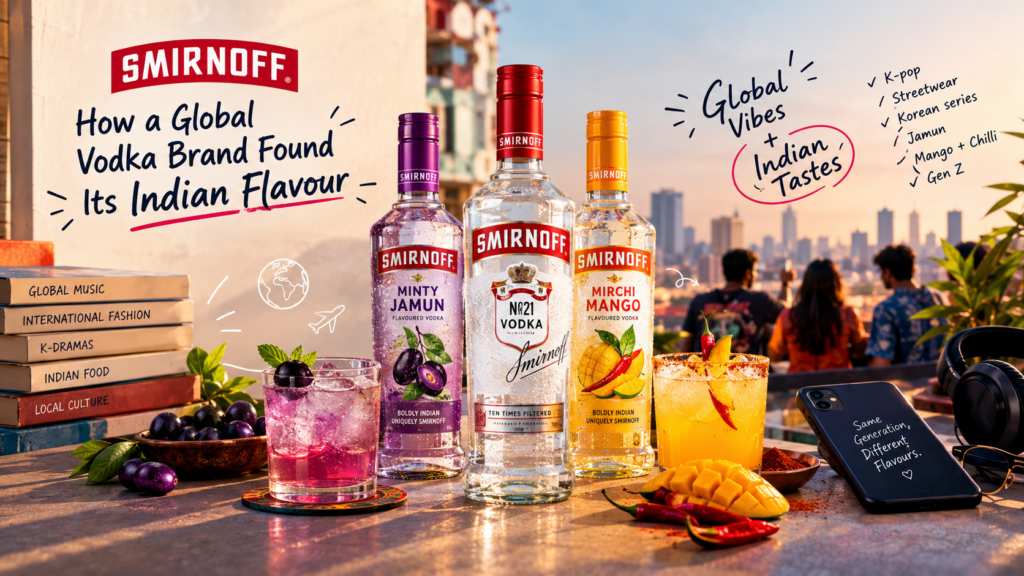
As Gen Z mixes global influences with distinctly Indian tastes, nostalgia and cultural cues, Smirnoff’s Minty Jamun and Mirchi Mango offer a fascinating lesson in how global brands can localise without losing their identity.
A young Indian consumer can discover a cocktail on Instagram, listen to Korean pop, binge an American series, wear a Japanese-inspired streetwear silhouette — and still get excited when someone puts jamun on the table.
There is no contradiction in that.
In fact, it may be one of the defining characteristics of India’s youngest consumers.
Gen Z is perhaps the most globally exposed generation India has seen. Its cultural references cross borders almost effortlessly. Music, fashion, entertainment, food and technology increasingly travel globally before being adapted locally.
But global exposure has not necessarily made young Indians less connected to local culture.
In many cases, it has made them more comfortable mixing the two.
That is what makes Smirnoff’s recent India strategy interesting.
In 2025, the global vodka brand introduced three flavours specifically for India: Minty Jamun, Mirchi Mango and Zesty Lime. Diageo, Smirnoff’s parent company, positioned the launch around experimentation, local taste preferences and the evolving social occasions of Gen Z and millennials.
On the surface, it was a flavour launch.
Underneath, it was a lesson in cultural localisation.
The global brand meets the Indian palate
Smirnoff doesn’t need an introduction.
It is one of the world’s best-known vodka brands, with a history stretching back to the nineteenth century. Its global equity is built around consistency, scale and recognition.
Yet when it came to developing flavours for India, the answer wasn’t another globally familiar berry or tropical fruit.
It was jamun.
And then there was mango with chilli.
That choice is revealing.
Jamun is not simply a fruit. For many Indians, it carries memories of childhood, summer afternoons, street vendors, school holidays and the familiar sweet-sour taste of something unmistakably local.
Mango needs even less explanation.
But Mirchi Mango adds another layer: the chilli creates the familiar Indian habit of combining sweetness with heat.
The innovation therefore wasn’t about introducing Indians to exotic ingredients.
It was about taking something they already recognised and placing it somewhere unexpected.
Vodka + jamun.
Mango + chilli.
The familiarity creates curiosity.
The unexpected combination creates the experience.
And that is precisely where the Gen Z connection begins.
Gen Z isn’t choosing between global and local
One of the easiest mistakes brands can make is to assume that young consumers must choose between being global and being local.
They don’t.
A 20-year-old Indian consumer can be completely comfortable with international culture while simultaneously having an intense connection to local references.
That is increasingly visible across categories.
Indian food is being reinvented through contemporary formats.
Regional music is travelling globally.
Indian fashion references are being mixed with international streetwear.
Local slang becomes internet language.
Traditional ingredients appear in modern products.
Nostalgia is being repackaged for digital culture.
The result is not a rejection of globalisation.
It is cultural remixing.
Gen Z has grown up with access to an enormous cultural menu.
It doesn’t necessarily ask:
Is this Indian or international?
It is more likely to ask:
Is this interesting?
That is a very different filter.
And Smirnoff’s Indian flavour strategy appears to understand it.
The appeal of “What does that taste like?”
There is another important behavioural shift here.
Young consumers are increasingly accustomed to discovering products through curiosity.
Social media has made the unusual commercially valuable.
A strange food combination can become content.
A limited-edition product can become a conversation.
A new flavour can become something people want to try simply because they want to know what it is like.
This creates an important shift in how products are marketed.
The product doesn’t always need to communicate:
“This is better.”
Sometimes it simply needs to communicate:
“Have you tried this?”
Minty Jamun is almost perfectly built for that question.
It has a familiar ingredient.
It has an unfamiliar application.
And it gives people something to talk about.
That is particularly relevant in a generation for whom discovery and social sharing increasingly overlap.
Nostalgia is having a new life
There is another fascinating ingredient in the story:
nostalgia.
But this isn’t nostalgia in the traditional sense.
Brands have been using nostalgia for decades — bringing back old logos, old packaging, old songs and old products.
Gen Z’s relationship with nostalgia can be different.
It can be borrowed.
A young consumer may feel nostalgic about something they encountered in childhood, online, through family or through a piece of culture that predates them.
And familiar Indian flavours offer a powerful form of sensory nostalgia.
Jamun doesn’t have to be explained.
The taste already exists in memory.
That gives brands a shortcut to emotional familiarity.
Smirnoff then puts that familiarity into a contemporary context.
The result is almost a cultural bridge:
familiar memory → unexpected format → contemporary experience.
That is much more interesting than simply calling the product “Indianised.”
Localisation is no longer just packaging
For years, global brands entering India often localised through communication.
The product stayed largely the same.
The advertising changed.
The celebrities changed.
The language changed.
The campaign became more Indian.
That model is increasingly being challenged.
Today’s localisation can go deeper.
It can influence the product itself.
Smirnoff’s India-specific flavours are an example of that approach.
The global brand didn’t simply tell an Indian story around a global product.
It created products based on Indian flavour preferences.
That is a much more meaningful form of localisation.
And it raises an important question for every multinational brand:
What if the local market shouldn’t just receive the global product — what if it should help reinvent it?
India is increasingly large and culturally confident enough to be a source of innovation rather than simply a market for imported ideas.
And the numbers suggest the experiment travelled
The strategy wasn’t merely an interesting marketing exercise.
Diageo subsequently reported that its new Smirnoff flavours exceeded internal benchmarks, with Minty Jamun showing particularly strong preference among its younger, exploratory consumer cohort.
By 2026, Mint reported that Smirnoff’s flavoured portfolio had crossed the ₹100-crore mark, with Minty Jamun emerging as an important growth driver.
The bigger signal may be what happened next.
Jamun began appearing across the wider Indian spirits market, with multiple brands introducing their own jamun-led products. Industry reporting in 2026 described jamun as one of the season’s prominent flavour trends.
When competitors start following an idea, the significance of that idea changes.
It is no longer simply a product launch.
It has become a market signal.
From flavour to social currency
This is where the story becomes especially relevant to youth marketing.
For younger consumers, products increasingly have lives beyond their functional purpose.
A product can be consumed.
It can also be photographed.
Discussed.
Reviewed.
Shared.
Recommended.
Compared.
Turned into a story.
That doesn’t mean every Gen Z consumer behaves in the same way, nor does it mean social media automatically determines purchasing decisions.
But it does mean that distinctiveness can have value beyond the shelf.
A familiar product may solve a need.
An unusual product can create curiosity.
And curiosity can create conversation.
That is why a flavour like Minty Jamun is strategically interesting.
Its value isn’t only in what it tastes like.
It is also in the question it creates.
“Jamun vodka?”
That reaction is part of the product experience.
The global brand has to become locally fluent
There is a larger lesson here for global brands.
Localisation used to mean speaking the local language.
Now it can mean understanding the local imagination.
That requires going deeper than demographics.
A consumer isn’t simply:
18–24, urban, digitally active.
They are also someone who remembers eating jamun with salt, watches global streaming shows, follows international creators, understands internet humour, orders regional food through an app and may discover a new product through a Reel.
Those behaviours coexist.
The opportunity for brands is not to choose one identity for the consumer.
It is to understand how those identities are being mixed.
Smirnoff’s India strategy is interesting precisely because it does not treat “Indian” and “global” as opposites.
It treats them as ingredients.
But the real lesson isn’t about alcohol
That distinction matters.
The Smirnoff example is useful to marketers well beyond the spirits category.
A skincare brand can take an ingredient rooted in Indian beauty traditions and put it into a modern formulation.
A fashion brand can reinterpret Indian silhouettes through contemporary streetwear.
A food brand can turn a familiar regional flavour into a new format.
A technology company can build global products around local behaviours.
The principle is the same.
Don’t simply localise the advertising. Localise the idea.
And perhaps most importantly, don’t assume that younger consumers want brands to choose between their global and local identities.
They are already mixing them.
Brands need to catch up.
The bigger Brand Focus lesson
The Smirnoff story ultimately isn’t about jamun.
It is about confidence.
A truly global brand does not necessarily become less global by becoming more local.
Sometimes, the opposite happens.
It becomes more relevant because it demonstrates that it understands where it is.
For Gen Z, that relevance may be especially important.
This is a generation that has grown up with the world in its pocket.
It doesn’t need a brand to teach it what is global.
It already knows.
What it may find more interesting is a brand that can take something familiar and make it feel new.
A global vodka brand putting jamun into a bottle is, therefore, more than a flavour experiment.
It is a small example of a much bigger cultural shift.
Gen Z isn’t choosing between global and local. It is remixing them.
And the brands that understand that may discover that the future of globalisation isn’t making every market taste the same.
It is allowing every market to add its own flavour.
For Smirnoff, that flavour happened to be jamun, mint, mango, chilli and lime.
But the larger idea is much bigger:
Global brands don’t always have to make India more global. Sometimes, they need to let India make them more Indian.