
For a long time, the relationship between media and its audience was relatively simple.
A newspaper decided what was important.
A television channel decided what deserved prime time.
A website decided what appeared on its homepage.
The audience then decided whether to read, watch, subscribe or switch off.
That relationship is changing.
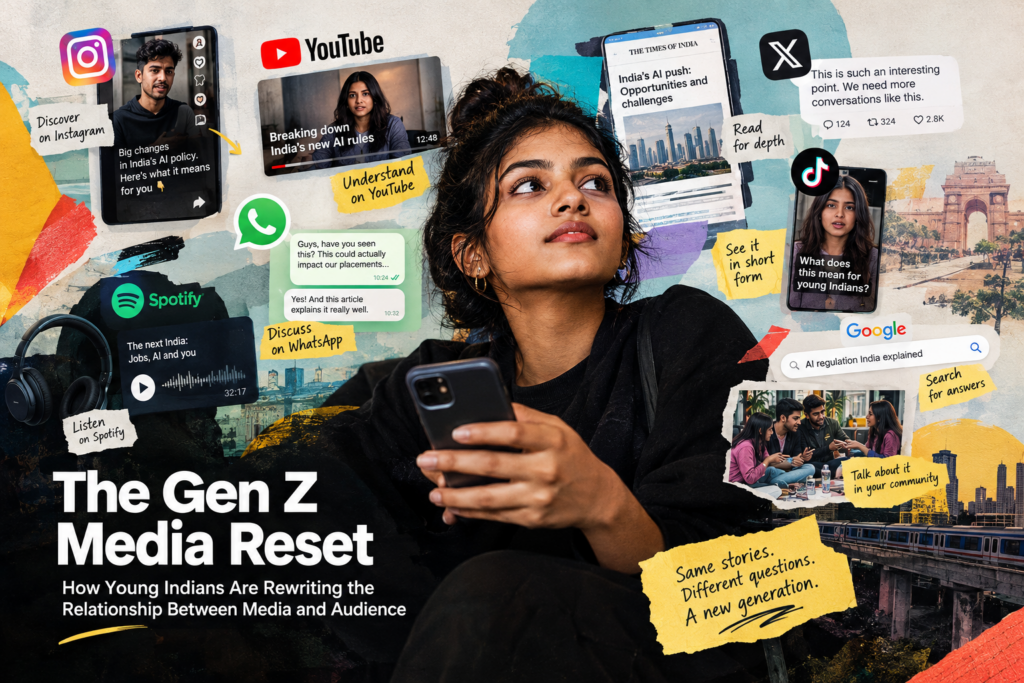
For young Indians, particularly Gen Z, media is no longer necessarily a destination they deliberately travel to. It can arrive while they are scrolling Instagram, watching YouTube, checking a WhatsApp group, listening to a podcast, following a creator or simply searching for an answer to something they suddenly want to understand.
But the bigger change isn’t where young people consume media.
It is what they expect from it once it reaches them.
Gen Z is not necessarily asking media brands to become younger, louder or more entertaining.
It is asking a much harder question:
Why should I care?
And the answer to that question could determine which media brands matter over the next decade.
Gen Z Doesn’t Need More Content. It Needs More Context.
The internet has solved one media problem almost completely.
There is no shortage of information.
There are headlines, videos, explainers, podcasts, reels, memes, opinions, newsletters, screenshots and commentary arriving every minute.
The problem is no longer access.
It is making sense of what we are seeing.
A young Indian encountering a story about an AI regulation, a new college policy, an interest-rate change, a celebrity controversy or a geopolitical event may not stop at the headline.
The questions that follow are more personal.
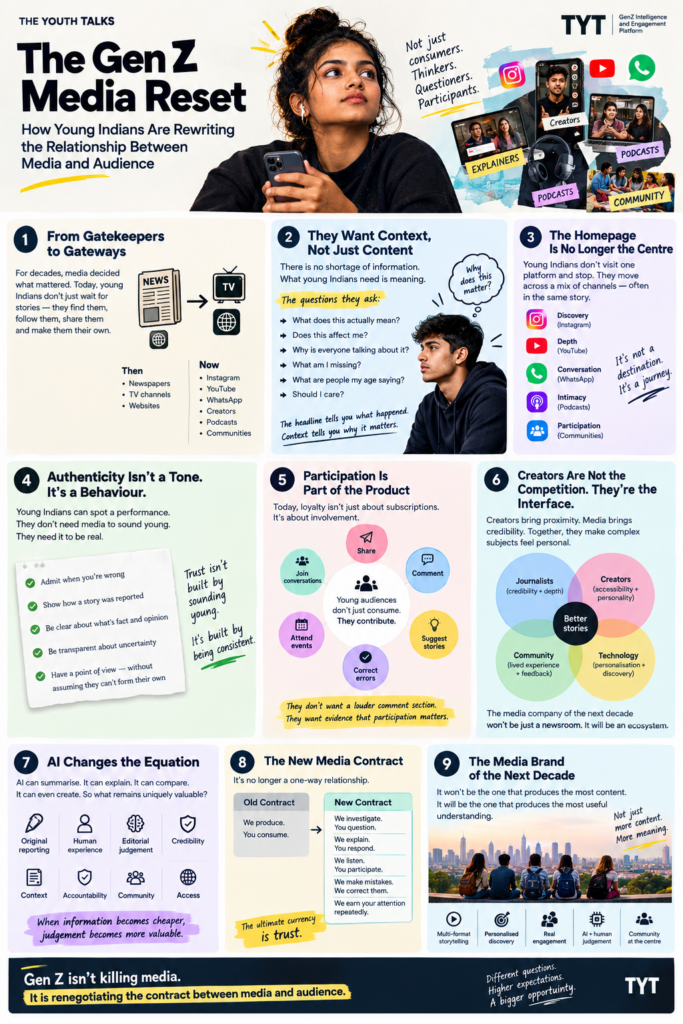
What does this actually mean?
Does this affect me?
Why is everyone talking about it?
What am I missing?
What are people my age saying about it?
And sometimes, simply:
Should I care?
That is an important shift.
For decades, media competed to tell people what happened.
Increasingly, young audiences are looking for media that can explain why it matters.
The headline tells you what happened.
Context tells you why it matters.
And as information becomes increasingly abundant — and increasingly easy for AI systems to summarise — context could become one of the most valuable things a media brand can offer.
The Homepage Is No Longer the Centre of the Universe
Traditional media was built around destinations.
You opened a newspaper.
You turned on a television channel.
You visited a publication’s website.
The publication controlled the front door.
Young audiences increasingly don’t experience media that way.
An Instagram post may introduce an issue.
A YouTube video may explain it.
A creator may give it a human face.
A WhatsApp conversation may suddenly make it personally relevant.
A Google search may take the person deeper.
The media brand’s website may never be visited at all.
This changes the question for publishers.
It is no longer simply:
How do we get young people to come to us?
It is:
How do we become valuable wherever young people encounter us?
That is a very different proposition.
Instagram can be discovery.
YouTube can provide depth.
WhatsApp can turn information into conversation.
A podcast can create intimacy.
A community can create participation.
The underlying story remains the intellectual property.
The format changes depending on the moment.
For young audiences, media is increasingly less about a single destination and more about a journey.
Young Indians Don’t Need Media to Sound Young
There is perhaps no word used more frequently in conversations about Gen Z than “authenticity”.
And that is precisely why it has become almost meaningless.
Media brands have learnt to write conversationally.
Corporate accounts use humour.
Some adopt slang.
Some try to behave like creators.
But young audiences are increasingly good at recognising when a brand is simply performing youthfulness.
Real authenticity is much less glamorous.
It is admitting when something was wrong.
It is distinguishing fact from opinion.
It is being transparent about uncertainty.
It is showing how something was reported.
It is not pretending to know everything.
And it is being willing to have a point of view without assuming that the audience cannot form its own.
Trust isn’t built by sounding young.
It is built by behaving consistently.
For a generation growing up amid misinformation, manipulated content, AI-generated material and an endless stream of opinions, that distinction matters.
A media brand doesn’t have to talk like a 20-year-old.
It has to give that 20-year-old a reason to believe it.
Participation Is Becoming Part of the Product
For decades, media loyalty was relatively easy to measure.
Did someone subscribe?
Did they buy the newspaper?
Did they watch the channel?
Did they visit the website?
Digital audiences have complicated that definition.
A young person may never subscribe to a publication and still spend hours with its content.
They may send a story to a friend.
Share it in a college WhatsApp group.
Comment on a YouTube video.
Respond to a poll.
Attend a discussion.
Suggest a story.
Correct an error.
Or tell a journalist what the story is missing.
But there is an important distinction here.
Young audiences don’t necessarily want a louder comment section.
They want evidence that participation matters.
If people repeatedly respond to a media brand but nothing changes, participation becomes decoration.
But if audiences can influence the questions being asked, contribute experiences, challenge assumptions or shape future stories, something more valuable happens.
The audience stops being merely an audience.
It becomes part of the product.
That could fundamentally change how media brands think about loyalty.
The strongest relationship may no longer be:
“I consume your content.”
It may become:
“I feel that this media brand understands people like me — and listens to me.”
Creators Are Not Killing Media. They Are Changing the Interface.
The rise of creators is often presented as a threat to traditional media.
That may be the wrong way to look at it.
Creators have something institutions have historically struggled to manufacture:
proximity.
A creator can explain something from a college campus, bedroom, office, car or coffee shop and make a complicated subject feel personal.
That doesn’t mean creators replace journalists.
It means the relationship between institutions and audiences is increasingly mediated by people.
The media company of the next decade could therefore look very different from the traditional newsroom.
It could combine:
Original reporting + editorial expertise + creators + community + data + technology + distribution.
The institution provides credibility and depth.
The creator provides accessibility and personality.
The community provides lived experience and feedback.
Technology helps with discovery and personalisation.
And the audience moves between all of them.
The creator, in this model, isn’t simply an influencer hired to distribute content.
The creator becomes an interface between the institution and the individual.
That is a much more interesting role.
Instagram May Start the Conversation. WhatsApp May Decide Whether It Matters.
India adds another interesting layer to this shift.
Media consumption isn’t only happening on public feeds.
It is also happening inside private networks.
A person might discover something on Instagram and then send it to three friends.
Or a college group.
Or a family WhatsApp chat.
Or a colleague.
The story has moved from a publisher to an individual — and then from that individual into a community.
The old model was:
Publisher → Audience
Increasingly, it looks more like:
Publisher → Person → Community
The second step matters enormously.
People don’t share everything they see.
They share things they think someone they know should see.
That makes relevance deeply personal.
It also creates a new editorial test.
The question isn’t only:
“Will someone click this?”
It is:
“Will someone send this to somebody?”
That is a very different measure of value.
Personalisation Is Not the Destination. Discovery Is.
The media industry has spent years talking about personalisation.
Young audiences are already surrounded by recommendation systems.
YouTube recommends videos.
Instagram recommends content.
Spotify recommends music.
Netflix recommends entertainment.
But a personalised feed can still become noise.
The more interesting opportunity is personalised discovery.
Imagine a student interested in artificial intelligence.
Instead of receiving ten more AI stories, the media experience could create a journey.
What is happening?
What does it mean?
Who is affected?
What are companies doing?
What are students saying?
What jobs are emerging?
What skills matter?
What should I learn?
What should I question?
The product is no longer a collection of articles.
It becomes a pathway through a subject.
And that matters because younger audiences increasingly move between information, education, entertainment and community without seeing them as separate categories.
A career story can lead to a technology story.
A technology story can lead to a learning opportunity.
A cultural story can reveal a social shift.
A social shift can become a business story.
The media experience becomes less about individual pieces of content and more about helping someone understand the world around them.
Gen Z Wants to Be Informed, Not Instructed
Young Indians are interested in politics, technology, money, careers, education, climate, culture, identity and mental health.
But interest does not automatically translate into loyalty to traditional formats.
A young person may care deeply about an issue and still have little patience for media that assumes they should simply accept its framing.
That creates an opportunity.
Media can educate without preaching.
Explain without oversimplifying.
Challenge without condescending.
A strong media brand doesn’t necessarily have to tell a 20-year-old what to think.
It has to help that 20-year-old think better.
That distinction becomes even more important in an environment filled with polarised commentary, synthetic content and AI-generated summaries.
The role of media could increasingly shift from simply delivering answers to helping people navigate competing answers.
And Then AI Changes the Equation
AI may be the biggest disruption to media yet.
For generations, one of the primary values of media was access to information.
Now an AI assistant can summarise a report in seconds.
It can explain a complex subject.
Compare two arguments.
Translate a story.
Create a timeline.
Answer follow-up questions.
So “we have information” becomes a weaker competitive advantage.
What remains?
Original reporting.
Human experience.
Editorial judgement.
Credibility.
Context.
Accountability.
Community.
Access.
And perhaps most importantly:
The ability to identify the questions worth asking.
This may be one of the biggest shifts in the media business.
When information becomes cheaper, judgement becomes more valuable.
A media brand that simply republishes information may find itself increasingly replaceable.
A media brand that helps people understand what information means may become more important.
The New Media Contract
The relationship between media and young audiences is therefore being renegotiated.
The old contract was relatively straightforward:
We produce.
You consume.
The emerging contract looks different.
We investigate. You question.
We explain. You respond.
We listen. You participate.
We make mistakes. We correct them.
We earn your attention repeatedly.
That last part matters.
Attention is no longer something a media brand can assume it owns.
Every story has to earn it.
Every format has to earn it.
Every opinion has to earn it.
Every interaction has to reinforce the relationship.
And every mistake can weaken it.
For young audiences, loyalty may increasingly be less about habit and more about trust.
So What Will the Media Brand of the Next Decade Look Like?
The biggest mistake would be to interpret all of this as a demand for media brands to become more “Gen Z”.
That is too superficial.
Gen Z doesn’t need another publication using slang.
It doesn’t need every newsroom to become a creator account.
It doesn’t need every journalist to become an influencer.
And it certainly doesn’t need media brands trying to imitate youth culture.
It needs media that understands how information now moves through young people’s lives.
The media company of the next decade may not be the one that produces the most content.
It may be the one that produces the most useful understanding.
It may know when a story needs a 30-second Instagram explanation and when it deserves a 20-minute YouTube conversation.
It may know when a community needs a question rather than another article.
It may recognise that a WhatsApp conversation among students can reveal a cultural shift before it appears in a formal survey.
It may use AI to make information easier to navigate without allowing AI to replace editorial judgement.
And it may understand that the ultimate product isn’t content.
It is trust.
Because when information becomes infinite, context becomes scarce.
When everyone can publish, credibility becomes valuable.
When algorithms can recommend, judgement becomes differentiated.
And when audiences can talk back, listening becomes part of the product.
Gen Z isn’t killing media.
It is renegotiating the contract between media and audience.
The question for media companies is therefore no longer whether young people will consume their content.
The harder question is:
Will young people believe that the media brand deserves a place in their lives?
That is the real media reset.