

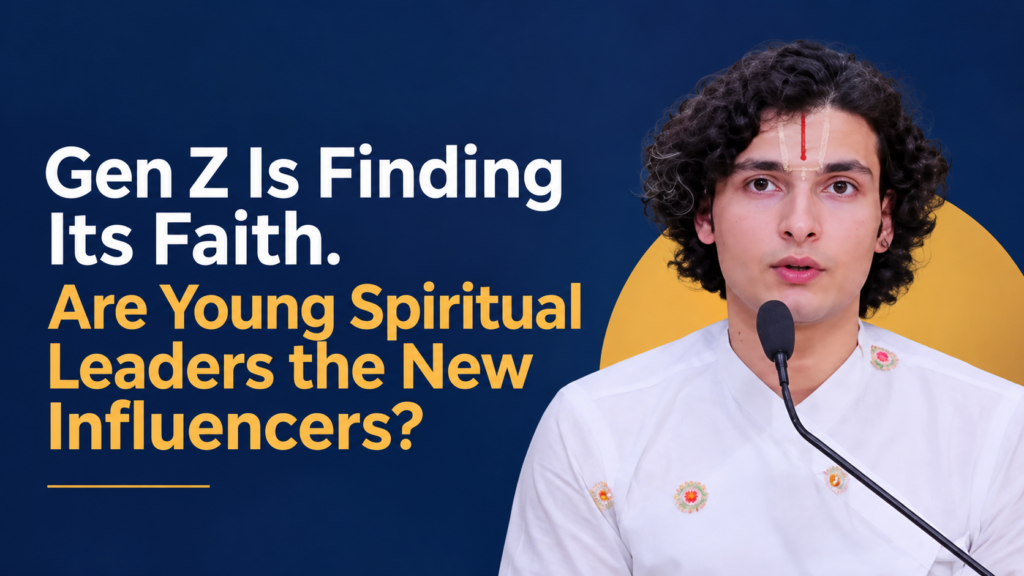
A 19-year-old spiritual storyteller from Vrindavan is attracting attention on Instagram. Young Indians are paying thousands of rupees to attend kirtan concerts. Bhajan gatherings are finding audiences that might otherwise spend their weekends at music festivals or nightclubs. And spiritual content, once largely associated with religious institutions and older audiences, is finding a new generation of followers on social media.
Something interesting is happening in India’s youth culture.
For a generation often described through its relationship with technology, social media, career ambitions and changing lifestyles, spirituality is emerging as another important part of the conversation. But it isn’t necessarily looking like the religious practices their parents grew up with.
Young Indians are discovering faith through Instagram reels, YouTube discourses, devotional music, spiritual communities and contemporary interpretations of traditional teachings. Some are visiting temples more frequently, others are exploring meditation and philosophy, while many are simply looking for moments of peace and belonging in an increasingly demanding world.
The growing popularity of young spiritual voices, including Vrindavan’s Shashwat Acharya, popularly called the ‘Gen Z Baba’, adds another dimension to this development.
Is India’s Gen Z becoming more religious? Are younger spiritual leaders finding a way to communicate faith to a generation that consumes almost everything through digital platforms? And could spirituality itself become an emerging professional and entrepreneurial ecosystem for young Indians?
The answers may reveal a fascinating shift in how India’s next generation is approaching faith, identity and culture.
Is India’s Gen Z Becoming More Religious?
There is evidence to suggest that religion and spirituality remain significant in the lives of young Indians, although the way they engage with them is changing.
TheYouthTalks’ own June 2025 research, Is Gen Z Becoming More Religious?, which surveyed more than 1,000 Indian Gen Z respondents aged 16–26, found that over 60% engaged in some form of spiritual or religious practice at least once a month. Nearly 30% reported doing so weekly.
The research also pointed towards the growing role of digital platforms in shaping spiritual discovery, with social media content, including Instagram tarot readers and YouTube spiritual creators, emerging alongside family and elders as sources of influence.
External research offers a similar indication.
A YouGov-Mint survey, cited in a Deutsche Welle report published in August 2025, found that 53% of Indian Gen Z respondents considered religion important, while 62% said they prayed regularly.
An earlier MTV Youth Study from 2021 found that 62% of India’s Gen Z believed spirituality helped them gain clarity, while nearly 70% said they felt more confident after prayer.
These findings suggest that spirituality is not necessarily disappearing from the lives of young Indians as they become more digitally connected or professionally ambitious.
However, it would be premature to conclude that Gen Z is more religious than previous generations. The available findings establish continued interest and participation, but do not provide a consistent longitudinal comparison across generations.
What appears to be changing is the way young people experience and express their beliefs.
For some, faith remains closely connected to family traditions and religious institutions. For others, spirituality is more personal, combining meditation, prayer, philosophy, astrology and wellness.
In a 2025 report by Deutsche Welle, a 24-year-old Gurugram resident described himself as spiritual rather than religious, explaining how visits to places of worship and spiritual practices had helped him find some peace during a difficult period.
It is a distinction worth understanding. Young Indians may not necessarily be moving towards more conventional religious observance. They may instead be exploring spirituality as a way to find meaning, clarity and emotional grounding.
Meet India’s New Generation of Spiritual Voices
One of the more interesting developments is the emergence of younger spiritual communicators who are attracting attention beyond traditional religious audiences.
Shashwat Acharya, the 19-year-old Bhagwat Katha Vachak from Vrindavan, is an example.
Popularly known as the ‘Gen Z Baba’ on social media, Acharya has attracted attention through videos and photographs from his religious discourses and spiritual programmes. His youthful appearance, traditional Vaishnav attire and growing online visibility have made him an unexpected talking point on Instagram.
According to an Education Times report, Acharya was born into a spiritual family and began reciting verses from the Bhagavad Gita at around four years of age. He is also reported to be pursuing a BA LLB course in Mathura, alongside his spiritual journey.
His popularity raises an interesting question: does a younger spiritual speaker have a different ability to connect with young audiences?
The answer may have less to do with age alone and more to do with communication.
A generation accustomed to short videos, podcasts, creator-led conversations and accessible explanations may find newer formats of religious storytelling easier to discover and engage with.
But Shashwat is not an isolated example of younger audiences gravitating towards contemporary spiritual voices.
London-based kirtan artist Radhika Das, whose real name is Ravi Pattni, has developed an international following through devotional music and live performances. His recent India tours have attracted significant audiences, including young professionals and urban Gen Z consumers.
In December 2025, The Indian Express reported that approximately 15,000 people attended his Delhi concert at Yashobhoomi, with tickets priced between ₹2,000 and ₹12,000.
The appeal was not limited to conventional religious participation. The concert brought together devotional chanting, live musicians and a contemporary performance experience.
It is a striking example of how spiritual expression can find new audiences without necessarily abandoning its traditional foundations.
Instagram, YouTube and the New Language of Faith
For previous generations, discovering a spiritual teacher often meant visiting a temple, attending a religious gathering or being introduced through family and community networks.
Today, the discovery process can begin with a 30-second Instagram reel.
A young person might encounter a Bhagavad Gita explanation while scrolling through Instagram, watch a longer discourse on YouTube, follow a spiritual creator and eventually decide to attend a live gathering.
Digital platforms have changed the accessibility and distribution of religious content.
A 2025 academic study published in the journal Religions, titled A Qualitative Study of Digital Religious Influence: Perspectives from Christian, Hindu, and Muslim Gen Y and Gen Z in Mumbai, India, examined the experiences of 64 participants through in-depth interviews.
The study found that religious influencers were increasingly playing a role in the lives of participants. However, family continued to have a stronger influence on religious behaviour than social media sources.
This is an important finding because it challenges the assumption that social media is replacing traditional sources of religious guidance.
Instead, digital platforms may be expanding the ways in which young people encounter, explore and discuss faith.
There are also risks.
Religious content shared through short videos can lose context, while the popularity of a creator does not necessarily establish their knowledge or credibility. Young audiences need to distinguish between informed spiritual teaching, personal opinion and content designed primarily to generate engagement.
For spiritual leaders, the challenge is to use digital reach responsibly without reducing faith to viral clips and personality-driven entertainment.
From Temples to Bhajan Clubbing: Spirituality Is Finding a New Social Life
Perhaps the most visible expression of this changing relationship with spirituality is the emergence of bhajan clubbing and contemporary kirtan gatherings.
Imagine a large venue with professional lighting, guitars, drums, harmoniums and hundreds of young people singing devotional songs together.
It may sound like a music festival, but the soundtrack is made up of bhajans and mantras.
The format has been attracting attention across Indian cities, particularly among young urban audiences looking for alternatives to conventional nightlife.
In December 2025, The Indian Express reported on the growing popularity of modern kirtans, including the sizeable audience for Radhika Das’s Delhi performance.
The Economic Times also documented the emergence of bhajan-led gatherings and devotional music events, reporting that organisers were seeing demand from younger audiences.
The appeal appears to extend beyond religious belief alone.
These gatherings offer music, community, collective participation and an opportunity to experience something different from conventional nightlife.
For some young people, it is about reconnecting with traditions they encountered growing up. For others, it is a new introduction to devotional music and spiritual practices.
There is also a commercial dimension emerging around these experiences.
Ticketed devotional events, spiritual music performances and curated gatherings are creating opportunities for event organisers, musicians, independent creators and cultural entrepreneurs.
The important point is that spirituality is increasingly being experienced outside the traditional settings in which many young Indians first encountered it.
Could Being a Spiritual Creator Become a Career?
This is perhaps the most intriguing question emerging from the rise of young spiritual personalities.
India has a long tradition of kathavachaks, spiritual teachers, devotional musicians, yoga practitioners and religious scholars. These are not new professions.
What is changing is the ecosystem around them.
A young person with a strong understanding of religious philosophy, communication skills and an ability to engage audiences can potentially build a much wider platform today.
The opportunities extend beyond delivering religious discourses.
They include:
- Digital spiritual education: Creating accessible content around scriptures, philosophy, meditation and traditional knowledge.
- Devotional music: Building careers through kirtan, bhajan performances, music production and live experiences.
- Spiritual events: Organising gatherings, retreats, cultural festivals and community experiences.
- Spiritual tourism: Developing travel experiences around pilgrimage destinations, yoga, meditation and India’s cultural heritage.
- Content and media: Producing podcasts, documentaries, books and educational programmes around spirituality.
This is not to suggest that becoming a spiritual leader is an easy or conventional career choice. Credibility in spiritual teaching requires knowledge, discipline, understanding and, in many traditions, formal initiation or lineage.
Nor should popularity on Instagram be confused with spiritual authority.
But the broader professional ecosystem around spirituality is becoming increasingly interesting.
For India’s young creators and entrepreneurs, it raises the possibility of building businesses around cultural knowledge, devotional music, education and experiences.
The distinction is important: the opportunity may not simply be to become a new-age Baba, but to build a credible career around communicating and interpreting India’s spiritual and cultural traditions.
Is India’s Spiritual Heritage Becoming a Global Opportunity?
India has long attracted international interest in yoga, meditation, Ayurveda, philosophy and spiritual practices.
The global popularity of yoga and meditation, the international following of Indian spiritual teachers and the continued interest in destinations such as Rishikesh and Vrindavan demonstrate that India’s cultural heritage has an audience well beyond its borders.
There is now an opportunity for younger Indians to participate in this ecosystem.
A new generation of creators could introduce international audiences to Indian philosophy, devotional music, traditional knowledge and spiritual experiences through contemporary formats.
Digital platforms make it possible for a young Indian musician, spiritual educator or content creator to reach audiences across continents without necessarily operating through conventional institutions.
However, the opportunity comes with responsibility.
As spirituality becomes more visible and commercially attractive, questions around authenticity, cultural interpretation, misinformation and the commercialisation of religious traditions will become increasingly important.
India’s credibility as a cultural destination will depend not just on how effectively its traditions are marketed, but on how responsibly they are represented.
The New Influencers May Not Always Be Selling a Product
For years, the influencer economy has largely been associated with fashion, beauty, travel, entertainment and consumer brands.
But the growing visibility of young spiritual voices suggests that influence can also operate in a different space.
A spiritual creator may not be encouraging followers to buy a new product or adopt a particular lifestyle. Instead, the content may revolve around philosophy, faith, music, reflection and a sense of belonging.
That does not make the influence automatically positive or beyond scrutiny. Spiritual personalities, like other public figures, should be evaluated on their knowledge, conduct, transparency and accountability.
But it does suggest that the subjects young Indians want to engage with are broader than conventional definitions of youth culture.
For brands, media companies and cultural organisations, this also presents an interesting development. Young audiences are demonstrating interest in experiences that combine community, identity, music, heritage and personal meaning.
The next generation of cultural influencers may therefore emerge from spaces that were once considered outside mainstream youth entertainment.
Is Gen Z Finding Its Faith, or Simply Finding Its Own Way?
Perhaps the biggest mistake would be to interpret these developments as evidence that all of India’s Gen Z is becoming more religious.
Young India is diverse. Some are deeply religious, some identify as spiritual rather than religious, some are exploring faith for the first time, and others have little interest in organised religion.
What is becoming increasingly visible is the freedom with which young people are exploring different forms of belief and spiritual expression.
A 19-year-old Bhagwat Katha Vachak attracting attention on Instagram, thousands attending contemporary kirtan concerts, and young consumers discovering spiritual philosophy through digital platforms may appear to be separate developments.
Together, however, they point towards a changing cultural landscape.
For Shashwat Acharya and other young spiritual voices, the challenge will be to build credibility beyond social media popularity.
For India’s Gen Z, the journey may be about finding a form of faith that fits into its own experiences, questions and aspirations.
And for India, there could be a much larger opportunity in introducing its spiritual and cultural traditions to a new generation, both at home and internationally.
Perhaps the next big generation of Indian influencers will not just tell young people what to wear, watch or buy. Some may help them explore what to believe, what to question and what gives their lives meaning.
That could be one of the more interesting shifts in India’s Gen Z story.
Research and references
- TheYouthTalks (June 2025): Is Gen Z Becoming More Religious? TYT research involving more than 1,000 Indian Gen Z respondents aged 16–26.
- YouGov-Mint survey, as reported by Deutsche Welle (August 2025): How India’s Gen Z is redefining spirituality.
- Missier, Clyde Anieldath (2025): A Qualitative Study of Digital Religious Influence: Perspectives from Christian, Hindu, and Muslim Gen Y and Gen Z in Mumbai, India. Religions, 16(1), 73. Read the academic study.
- The Indian Express (December 2025): Why Gen Z is flocking to modern kirtans.
- The Economic Times (November–December 2025): Bhajan clubbing is taking Indian cities by storm.
- Education Times / The Times of India (November 2026): Meet Vrindavan’s viral ‘Gen Z Baba’, Shashwat Acharya.