For years, the Delhi Metro has been one of the city’s great equalisers.
It gets students from college to home, young professionals from one part of the city to another, connects neighbourhoods that once felt impossibly far apart and has fundamentally changed the way Delhi-NCR moves.
But spend some time around the city’s Metro stations and another behaviour starts to become visible.
A group of young people walks out of a station.
They are not rushing towards a college, office or home.
They are meeting friends.
There is a café nearby. A burger outlet. A food court. Maybe a shopping street. They order something, sit down, talk, scroll through their phones, take photographs and spend an hour or two together.
And eventually, they walk back into the Metro.
The journey was supposed to be the commute.
But increasingly, the Metro is also becoming the meeting point.
From getting somewhere to being somewhere
This is an interesting distinction.
The traditional role of public transport is functional:
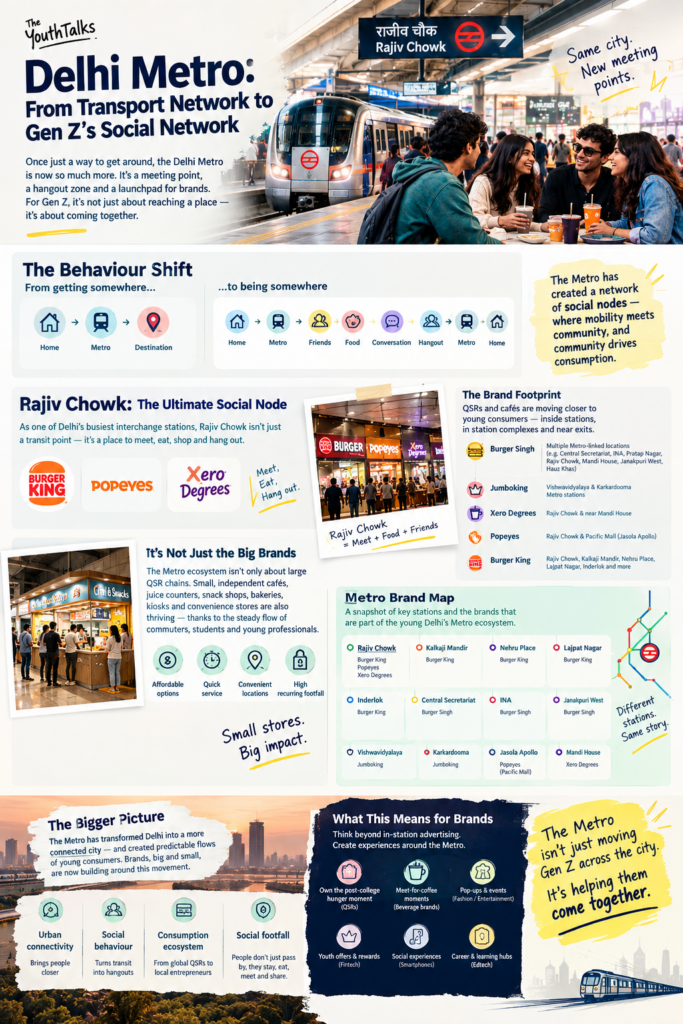
Home → Metro → Destination
But for a young consumer, the journey can increasingly look like:
Home → Metro → Friends → Food → Conversation → Hangout → Metro → Home
The Metro isn’t necessarily the final destination.
It is the infrastructure that makes the destination possible.
This matters in Delhi because the city is enormous. Friends can live in Dwarka, study in North Campus, work in Gurugram and meet somewhere in between. Without an accessible transport network, a casual coffee can become a logistical exercise.
With the Metro, “Let’s meet at Rajiv Chowk” or “Let’s meet at Hauz Khas” is enough.
The Metro turns geography into something negotiable.
And that has quietly created something else: a network of social nodes.
Rajiv Chowk: When the station becomes the destination
Rajiv Chowk may be one of the clearest examples of this shift.
For millions of commuters, it remains one of Delhi’s most important Metro interchanges. But for younger consumers, the meaning of Rajiv Chowk extends well beyond changing trains.
It is also a place to meet.
And increasingly, there is a consumption ecosystem waiting for them.
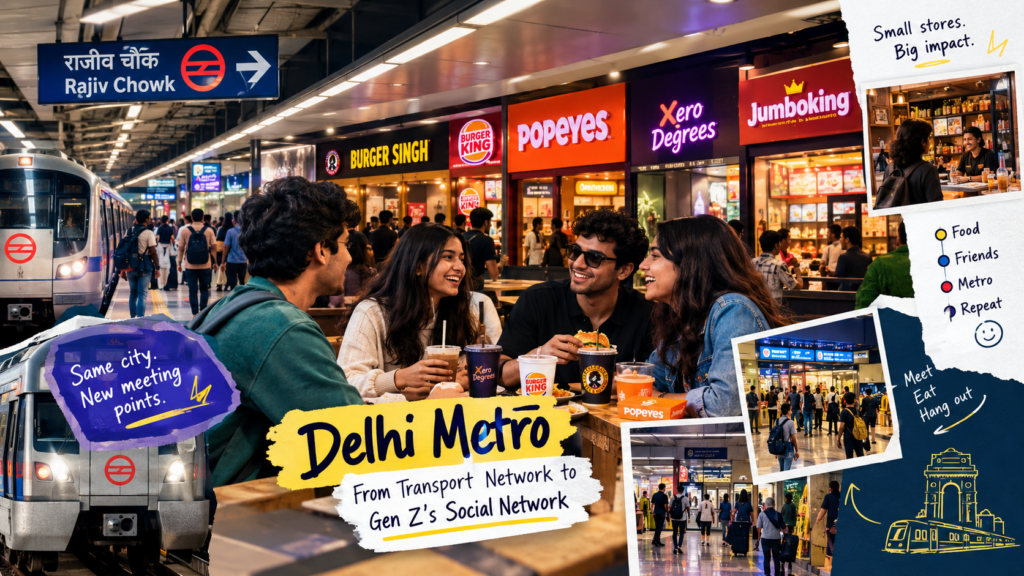
Brands such as Burger King, Popeyes and Xero Degrees have a presence in and around the Rajiv Chowk Metro ecosystem. Instead of the consumer having to make a separate journey to a restaurant, food becomes part of the journey itself.
A group of friends can decide to meet at the station, grab burgers or a meal, spend time together and then take the Metro home.
The station creates the footfall.
The surrounding brands convert that footfall into social consumption.
That is a subtle but important shift.
The consumer isn’t necessarily entering the station with a pre-decided intention to eat.
Eating becomes part of the reason for staying.
And perhaps that is the larger opportunity: the Metro is turning transit locations into social destinations.
The rise of the Metro hangout
For Gen Z, socialising doesn’t always require a big occasion.
A coffee after class.
A burger after an exam.
A quick catch-up before heading home.
A spontaneous plan after work.
An evening with friends because everyone happens to be free.
These are low-commitment, relatively affordable forms of socialising — but they are important because they create frequent occasions for consumption.
The Metro makes these occasions easier.
And brands are noticing.
What is particularly interesting is how food and QSR brands are not merely opening outlets near Metro stations. Increasingly, they are finding spaces inside stations, in station complexes, at interchange points and immediately outside exits.
That changes the role of the outlet.
It is no longer simply a restaurant serving a customer who has already decided to eat.
It can become part of the reason for staying.
Burger Singh: Going where the commuter already is
Burger Singh is perhaps one of the clearest examples of this strategy.
Its current Delhi store locator lists multiple Metro-linked locations, including Central Secretariat DMRC, INA Interchange, Pratap Nagar DMRC, Rajiv Chowk Metro, Mandi House DMRC, Janakpuri West Metro and Hauz Khas Yellow Line DMRC, among others.
That footprint is revealing.
The brand isn’t simply following residential catchments.
It is following movement.
A Metro station provides something extremely valuable to a QSR: predictable footfall, visibility and accessibility.
But there is another advantage.
When a young person says, “Let’s grab something before we leave,” the restaurant is already there.
The distance between meeting and consuming becomes almost zero.
Jumboking and the student corridor
Jumboking offers another interesting example.
Its presence at Vishwavidyalaya and Karkardooma Metro stations shows how an affordable QSR can position itself directly within the everyday mobility patterns of young consumers.
Vishwavidyalaya is particularly interesting because Metro connectivity intersects with one of Delhi’s major student ecosystems.
For a student, the Metro station can simultaneously be:
a transport point + a meeting point + a food point.
That is a powerful combination for an affordable QSR.
The consumer doesn’t necessarily have to make a special trip to eat.
The food outlet is already sitting on the route.
Xero Degrees, Popeyes and the Metro-mall ecosystem
The phenomenon extends beyond traditional burger chains.
Xero Degrees has a presence at Rajiv Chowk Metro and around other Metro-connected locations, while Popeyes has also established itself within Delhi’s Metro-linked consumption ecosystem, including Rajiv Chowk.
Popeyes’ presence at Pacific Mall, Jasola Apollo Metro Station is another interesting model, connecting three forms of urban behaviour:
Metro → Mall → Food
The consumer doesn’t have to make three separate decisions.
The infrastructure brings them into the commercial environment.
Burger King demonstrates the scale of this opportunity even more clearly, with multiple Delhi locations at or around Metro stations including Rajiv Chowk, Kalkaji Mandir, Nehru Place, Lajpat Nagar and Inderlok.
This is no longer simply an isolated restaurant-location decision.
It points towards a broader retail principle:
Where young India moves, consumption follows.
And it isn’t only the big brands
Perhaps the most interesting part of the Metro story is that the opportunity isn’t limited to large QSR chains.
Walk through different Metro stations and one can find a much more fragmented ecosystem of small cafés, juice counters, snack shops, bakeries, kiosks, convenience stores and independent food outlets operating alongside the larger brands.
Many of these businesses don’t have the marketing budgets or brand recognition of a Burger King or Popeyes.
What they do have is something equally valuable:
proximity.
For a small outlet, being positioned at the right Metro exit can potentially mean access to thousands of consumers every day without having to create that footfall independently.
And the behaviour of younger consumers works particularly well for this format.
A student may not need a destination restaurant.
They may simply want a ₹50–₹150 snack, a cold drink, chai, coffee or something quick to eat while meeting a friend or waiting for a train.
That creates room for a completely different kind of retail economy.
The Metro ecosystem is therefore not simply big brands occupying high-footfall locations.
It is an ecosystem where scale and small entrepreneurship can coexist.
The large QSR offers familiarity and experience.
The small outlet offers convenience, affordability and immediacy.
Both benefit from the same underlying asset:
people constantly moving through the network.
The Metro is creating a new kind of “third place”
There is a larger cultural idea underneath this.
For decades, urban sociology has spoken about the importance of the “third place” — somewhere outside home and work where people gather, interact and spend time.
For young Delhi, that third place is becoming more fluid.
It might be a café.
A QSR.
A mall.
A market.
A food court.
Or the area immediately outside a Metro station.
And sometimes, the Metro station itself becomes the connector between several of these spaces.
This is important because Gen Z doesn’t necessarily need a permanent physical destination.
It needs accessible places where social life can happen.
The Metro provides the accessibility.
Brands provide the experience.
Small businesses provide the convenience.
Together, they create a new urban social ecosystem.
From footfall to social footfall
This distinction is important for marketers.
Traditional retail thinking tends to ask:
How many people pass this location?
But the more interesting question may be:
How many people can this location bring together?
A commuter travelling alone is one customer.
Three friends who meet at a Metro station, eat together, spend 90 minutes at a café and then travel home represent a very different consumption opportunity.
The Metro isn’t merely generating footfall.
It can generate social footfall.
And social footfall has a different economic character.
It can mean more orders per visit, longer dwell time, group consumption, repeat visits and — increasingly important for youth brands — content.
A café that becomes a popular meeting point isn’t just selling food.
It becomes part of someone’s social routine.
What this means for brands
This should make marketers rethink how they look at Metro advertising.
The obvious opportunity is advertising inside the Metro.
But the bigger opportunity may be building experiences around the Metro.
A QSR can own the post-college hunger moment.
A beverage brand can own the “let’s meet for a coffee” moment.
A fashion brand can create a pop-up around a high-footfall station.
An entertainment brand can activate around a popular interchange.
A fintech company can create youth offers around everyday commuting.
A smartphone brand can create social experiences around places where young people naturally congregate.
The opportunity isn’t simply:
“Reach young people on their commute.”
It is:
“Reach young people when their commute turns into social life.”
The bigger shift
Delhi Metro was built to solve a transportation problem.
But its cultural impact may be larger.
It has made parts of Delhi feel closer.
It has reduced the friction of meeting.
It has created predictable flows of young consumers.
And around those flows, an entire consumption ecosystem is developing — from global and national QSR brands to independent neighbourhood businesses.
The brands that understand this won’t see a Metro station merely as a location with high footfall.
They will see it as a social node.
Because for a generation that is constantly connected digitally, physical connection still matters.
Sometimes all it takes is a Metro ride.
And a message that says:
“Where are you? Let’s meet at the station.”
That may be the next evolution of the Delhi Metro:
not just a network that moves Gen Z across the city, but a network that helps Gen Z come together.