






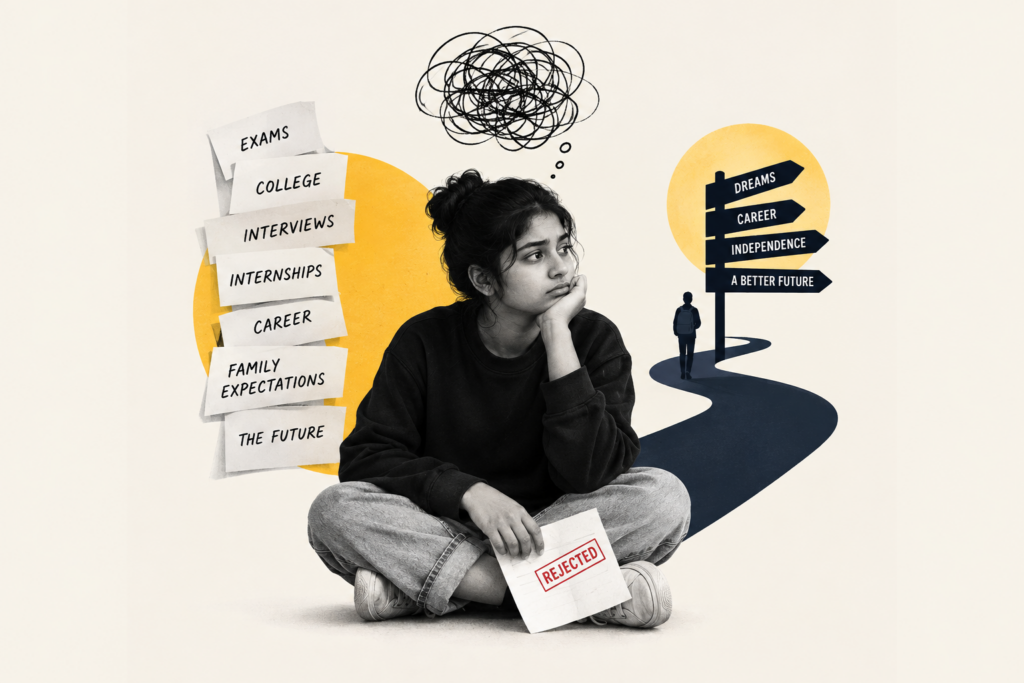
For young Indians navigating academic competition, family expectations and uncertain career paths, failure is rarely just about getting something wrong. It can feel like losing time, money, approval and the future they had planned for themselves.
There is a particular kind of disappointment that comes with opening an examination result you had spent months preparing for.
It is not always the marks themselves that hurt the most. It is the conversation that follows. The questions about what went wrong. The comparison with a friend who scored better. The money spent on coaching, the time invested in preparation and the uncertainty about what happens next.

For some students, a disappointing result is a setback. For others, it can feel as though an entire future has suddenly become less certain.
The same fear follows young people into college, job interviews, internships, creative pursuits and their first attempts at building something of their own. A rejected application can feel like a verdict on employability. A failed interview can become evidence that someone is not good enough. A business idea that does not work can trigger doubts about whether taking the risk was sensible in the first place.

We often respond to this fear with familiar advice: failure is a stepping stone to success, every setback teaches a lesson, and the only real failure is giving up.
The intention is encouraging. The explanation is incomplete.

Perhaps Gen Z does not need another reminder that failure is part of success. Perhaps it needs a more honest conversation about why failure feels so costly — and how to recover when things do not go to plan.
When failure becomes more than a result
Failure is an ordinary part of learning. People make mistakes, discover that an approach does not work, adjust their methods and try again.
But the emotional experience of failure depends partly on what is at stake.
A poor score on a practice test may provide useful information. A poor score on an entrance examination that determines access to a desired course can have consequences for the next year of someone’s life.
A rejected internship application may be disappointing. A series of rejections, combined with financial pressure and uncertainty about employment, can make the future feel increasingly difficult to navigate.
The distinction matters because the instruction to “learn from failure” assumes that people have enough emotional space, time and resources to do so.
Sometimes they do. Sometimes they are trying to recover while simultaneously working out how to pay for another course, explain a decision to their family or find an alternative career path.
Research from India offers a useful reminder that academic pressure is not simply an individual attitude problem. A 2024 cross-sectional study of 570 adolescents preparing for competitive entrance examinations in Karnataka found high reported academic stress and perceived parental academic pressure within its sample. The findings are specific to those participants and should not be generalised to every Indian student, but they illustrate how closely performance expectations and family pressures can intersect.
Read the study in the Journal of Education and Health Promotion.
In such circumstances, telling a young person to adopt a positive mindset may help only at the margins.
The more useful starting point is to understand what the setback threatens: an opportunity, financial security, family approval, social standing or a carefully imagined version of the future.
Sometimes, it threatens several of these at once.
The pressure to get life right the first time
Young people are often encouraged to dream big, work hard and make the most of their opportunities. These are not unreasonable expectations. The problem arises when ambition becomes entangled with the belief that every major decision must be correct.
Choose the right subjects. Get into the right college. Build the right skills. Secure a good first job. Keep up with your peers. Make your family proud.
The milestones may vary, but the underlying pressure can be remarkably similar: do not fall behind.
Social media can make this pressure more visible. A student sees a former classmate enter a prestigious institution. Someone else announces a job at a well-known company. A peer launches a business, wins a competition or shares a professional milestone.
What appears on the screen is usually the outcome, not the full process behind it.
The rejection emails, financial support, uncertain decisions, abandoned projects and ordinary days of frustration are less likely to become public announcements.
The result is an uneven comparison. Young people compare their private uncertainty with other people’s carefully selected moments of progress.
But social media is only part of the explanation. Competitive examinations, hiring processes, family expectations and the real scarcity of some educational and employment opportunities would still exist without Instagram or LinkedIn.
Removing social media would not remove the consequences of a missed cutoff or a difficult job market.
The challenge is to recognise when comparison is providing useful information and when it is turning another person’s progress into evidence of personal inadequacy.
Someone else’s success may reveal a route worth exploring. It does not automatically establish that you have failed.
Why the cost of failure is not the same for everyone
One of the weaknesses of conventional motivational advice is that it assumes everyone has roughly the same freedom to experiment.
They do not.
A young person with financial security may be able to take a gap year, explore a different field or attempt a venture that generates no income for several months.
Someone whose family has borrowed money to finance education may have much less room to take the same risks.
For one person, changing career direction might be an exciting discovery. For another, it could mean losing a year of earnings, explaining the decision to worried parents or taking on additional debt.
This does not mean that young people from financially secure backgrounds are immune to fear, or that those with fewer resources cannot take risks. It means that the consequences of a setback differ according to the circumstances in which it occurs.
That distinction should change the way we discuss resilience.
Resilience is not simply the ability to tolerate disappointment. It also depends on the support, resources and alternatives available after disappointment arrives.
A student who fails an examination needs more than encouragement if they do not know which options remain open. A graduate who has not secured a job may benefit from a realistic assessment of their skills, access to guidance and a plan for the next application cycle.
In both cases, emotional reassurance matters. But practical information matters too.
We should be careful not to turn a structural problem into a personal weakness by telling young people that they would succeed if only they were more confident.
Confidence cannot create an opportunity that does not exist. Nor can positive thinking replace financial support, good teaching, career guidance or access to relevant experience.
The problem with romanticising failure
Failure has acquired an almost glamorous reputation in modern success stories.
Entrepreneurs describe early rejections before explaining how their businesses eventually succeeded. Artists discuss years of obscurity before finding an audience. Professionals recount career setbacks as turning points in their development.
These stories can be useful. They remind us that successful outcomes rarely follow a perfectly predictable path.
But they also introduce a subtle distortion: we tend to hear about the failures that preceded eventual success, not every failure that did not lead there.
A failed venture may teach someone valuable lessons and still remain a failed venture. An unsuccessful application may reveal a skills gap, but it may also reflect intense competition. A person can work hard, prepare seriously and still not obtain the result they wanted.
Not every setback becomes a breakthrough.
This is why the instruction to “fail forward” needs to be treated with care. It can encourage experimentation, but it can also create a new expectation that every painful experience must produce personal growth.
Sometimes a failure is simply disappointing. Sometimes recovery takes time. Sometimes the right decision is to stop, change direction or accept that an opportunity has passed.
Young people should not have to turn every disappointment into an inspirational story to justify having experienced it.
The more useful lesson is that a setback does not have to become either a triumph or a permanent verdict on a person’s abilities.
It can be an event with consequences that need to be understood and managed.
A growth mindset is useful — but it is not magic
Psychologist Carol Dweck’s work on growth mindset helped popularise the idea that abilities can develop through learning, effective strategies and support, rather than being permanently fixed.
The idea offers an important alternative to the belief that a person who struggles with mathematics, writing or public speaking is simply not cut out for it.
But popular discussions sometimes turn growth mindset into a promise: change the way you think about failure and better outcomes will follow.
The research is more complicated.
A 2023 systematic review and meta-analysis published in Psychological Bulletin examined 63 studies involving nearly 98,000 participants. The authors found that the overall effect of growth-mindset interventions on academic achievement was very small and was no longer statistically significant after correcting for potential publication bias. In the highest-quality studies they reviewed, the effects were also not statistically significant.
This does not mean that learning-oriented attitudes are useless, or that people cannot benefit from constructive feedback. It means we should not overstate what a short motivational intervention can accomplish.
A willingness to learn is valuable. So are good instruction, sufficient practice, relevant feedback, time, resources and an environment in which mistakes can be examined without humiliation.
Telling a student that they can improve is not a substitute for helping them understand the subject. Telling a graduate to believe in themselves is not a substitute for helping them identify the skills a role requires.
A growth mindset should open the door to learning. It should not become another standard against which young people judge themselves when things go wrong.
What to do when something actually goes wrong
A more useful conversation about failure begins after the motivational slogans have run out.
The examination result has arrived. The application has been rejected. The presentation did not go well. The project has failed to attract customers.
What now?
First, separate the outcome from your identity.
“I did not perform well in this examination” is a statement about an event. “I am not intelligent enough to succeed” is a much broader conclusion.
The first statement can be examined. The second may be an emotional reaction masquerading as a fact.
A disappointing result can reveal something about preparation, understanding or performance on a particular day. It does not automatically establish a person’s long-term capacity.
Second, identify what was within your control.
Did you have enough time to prepare? Did you understand what was expected? Did you use an effective method? Were there circumstances that affected your performance?
The purpose is not to assign blame. It is to distinguish between factors that can be changed and factors that cannot.
A job rejection, for example, might prompt a review of the application, interview preparation and role suitability. It does not mean that every rejection is the applicant’s fault.
Third, decide what the setback actually tells you.
Some failures point towards a skill that needs improvement. Others reveal that a strategy was poorly suited to the task. Still others suggest that an alternative route deserves consideration.
If a particular approach has repeatedly produced the same result, repeating it without modification is not necessarily resilience.
It may be time to seek feedback, acquire a new skill, change the strategy or reconsider the goal.
Fourth, make the next step manageable.
A person who has failed an examination does not need to solve their entire future in one evening. They may first need to understand the result, establish the available options and speak to someone who can offer informed guidance.
A graduate who has received several rejections might begin by reviewing a handful of applications rather than making sweeping conclusions about their employability.
Small actions do not guarantee success. They can, however, replace some of the paralysis of uncertainty with information about what is possible.
Finally, allow disappointment to exist without making it permanent.
There is no requirement to feel grateful for a setback immediately. Frustration, sadness and embarrassment are not evidence that someone has failed to develop resilience.
The goal is not to eliminate those feelings on demand. It is to prevent a painful event from becoming the only lens through which a person sees themselves and their future.
If fear or distress is persistent and begins to interfere substantially with daily life, seeking support from a qualified mental-health professional can also be a practical step, not an admission of weakness.
We need to change how we talk about failure
The responsibility for changing this conversation cannot rest entirely with young people.
Families can help by asking what support is needed rather than treating every disappointing result as a reflection of character. Educational institutions can make academic and career guidance more accessible, and create ways for students to seek help before a setback becomes a crisis.
Employers can make recruitment processes clearer, offer useful feedback where feasible and avoid presenting every rejection as evidence that candidates lack ambition. Colleges and professional communities can create environments where unfinished work, constructive criticism and uncertainty are normal parts of learning.
None of these measures will remove competition or guarantee that everyone gets the outcome they want.
They can make failure less isolating and recovery more practical.
There is also value in being more honest about success itself. The people who reach their goals do not all follow the same path, and the people who change direction have not necessarily abandoned their ambitions.
A person may discover that the career they worked towards is not right for them. Another may need more time to develop a skill. Someone else may have to prioritise financial stability over an uncertain opportunity.
These are different circumstances requiring different decisions. They should not be reduced to a single test of courage.
Failure should be an event, not an identity
Young people will continue to face competitive examinations, difficult interviews, uncertain careers and ambitions that do not always work out.
There is no realistic promise that they can avoid disappointment by thinking differently. Nor should they be expected to treat every setback as a gift.
What they can learn is how to examine a failure without allowing it to define their entire identity; how to recognise the difference between a mistake and a structural barrier; how to ask for help; and how to decide whether to persist, adapt or move on.
Families, schools, colleges and employers have a role in making those choices less punishing and more informed.
Perhaps the most useful thing we can tell a young person after a setback is not that everything happens for a reason, or that failure is the foundation of every success.
It is something more honest.
You may not get the outcome you wanted. It may cost you time, money or confidence. You may need to change your plans. You may even need to grieve the future you had imagined.
But you do not have to turn one disappointing outcome into a final judgement on who you are.
The goal is not to become fearless about failure. It is to build a life in which failure, when it happens, does not have the power to decide everything that comes next.