
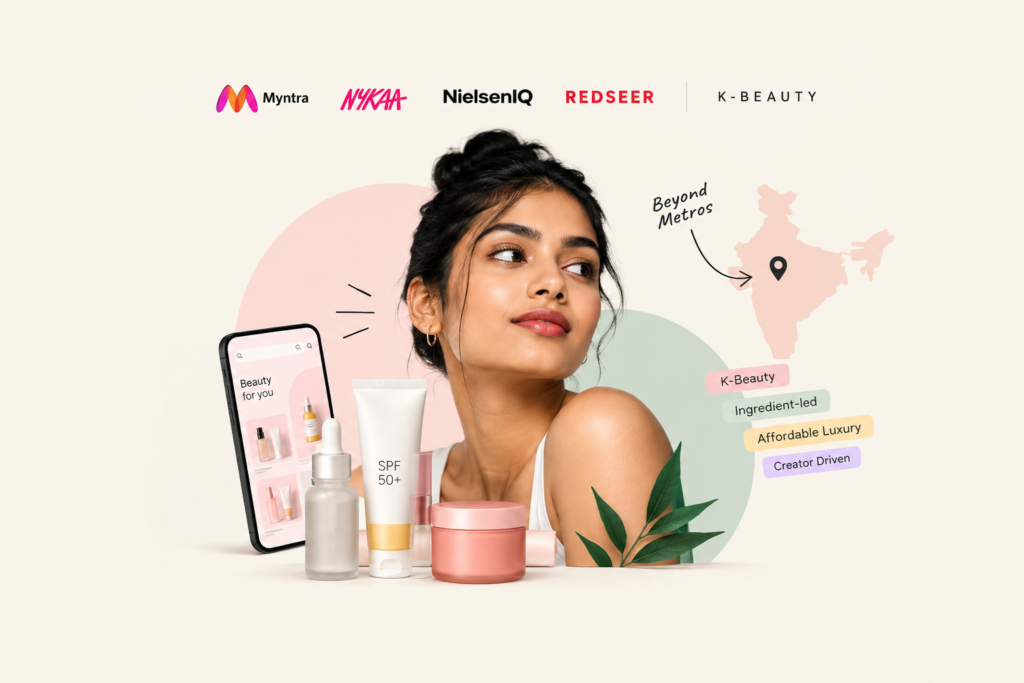
From K-Beauty and ingredient-led skincare to affordable luxury and creator-driven discovery, young consumers are changing where beauty brands find growth—and what it takes to earn their trust.
India’s beauty market is undergoing a shift that goes beyond the popularity of a new skincare ingredient or the arrival of another international brand. Younger consumers are influencing what gets purchased, how products are discovered, how much shoppers are willing to spend and which markets brands need to understand better.
The latest evidence comes from Myntra’s report, Beauty in the Age of Gen Z, which draws on platform activity between August 2025 and August 2026. The findings point to rising beauty consumption among young shoppers, growing demand from Tier 2 and Tier 3 cities, greater interest in Korean beauty, and increasing use of creators to discover products.
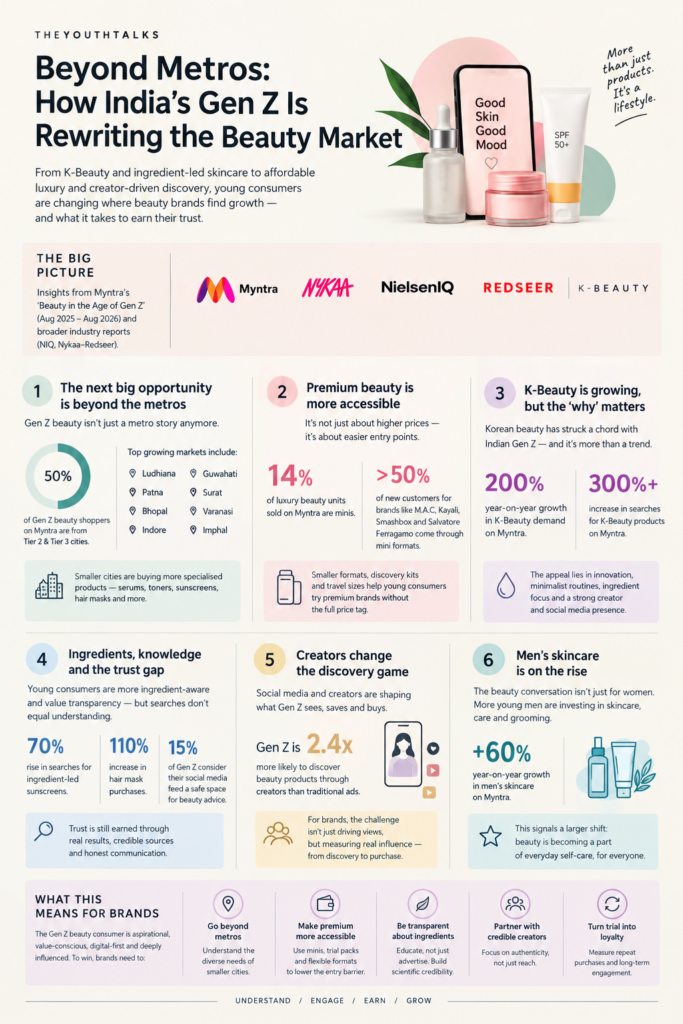
According to the report, half of Gen Z beauty shoppers on Myntra are based in Tier 2 and Tier 3 cities. Beauty and personal care spending per customer in this cohort has increased 1.2 times year on year, while the category’s share of their wallets is reported to be 75% higher than among millennials.
The figures suggest that beauty brands may need to reconsider some longstanding assumptions about their next generation of consumers. Growth may increasingly depend on understanding younger shoppers beyond metropolitan markets, making premium products easier to try and communicating product benefits in ways that build confidence.
But Myntra’s findings are part of a wider industry shift. Research from NielsenIQ (NIQ) and the Nykaa–Redseer Beauty Summit Report also points towards changing consumer expectations, the growing importance of ingredient transparency, digital discovery and the expansion of beauty consumption beyond traditional urban centres.
For marketers, the central question is no longer simply how to make Gen Z notice a beauty brand. It is how to convert discovery into trial, trial into repeat purchases and product interest into lasting trust.
1. The next beauty opportunity may lie beyond the metros
One of Myntra’s most significant findings is the contribution of smaller cities to Gen Z beauty consumption. The platform reports that half of its Gen Z beauty shoppers come from Tier 2 and Tier 3 cities, where shopping baskets increasingly include serums, toners, sunscreens and hair masks alongside everyday personal care products.
Cities such as Ludhiana, Patna, Bhopal, Indore, Guwahati, Surat, Varanasi and Imphal feature among the markets contributing to this growth.
The implication is important. Specialised skincare and international beauty products can no longer be viewed exclusively through a metropolitan lens.
The Nykaa–Redseer Beauty Summit Report 2024 similarly identified Gen Z and consumers in Tier 2+ markets as important forces in the evolution of Indian beauty. It highlighted how social media, online retail and expanding product access are broadening consumer engagement with beauty categories.
NIQ’s 2025 report, The New Face of Indian Beauty, also emphasised the importance of understanding consumers beyond metros, particularly their expectations around ingredients, pricing, trust and suitability for Indian skin tones.
Taken together, these perspectives suggest an opportunity for brands to move beyond city-based assumptions about consumer aspiration.
However, smaller-city consumers should not be treated as a single, homogeneous audience. Purchasing power, product availability, local climate, language, shopping habits and familiarity with skincare can vary considerably between markets.
For marketers, the opportunity lies in understanding those differences rather than simply extending metropolitan campaigns to a larger geography.
2. Premium beauty is becoming more accessible through smaller formats
Premiumisation is often associated with consumers moving towards more expensive products. Myntra’s findings suggest that the route into premium beauty may also depend on making the initial purchase easier.
The platform reports that minis account for 14% of luxury beauty units sold. It also says more than half of the new customers acquired by several luxury brands, including M.A.C, Kayali, Smashbox and Salvatore Ferragamo, come through mini formats.
Smaller products can lower the upfront cost of experimentation. For a young consumer interested in a premium fragrance, lipstick or primer, a mini offers an opportunity to experience the product without committing to the full-size version.
This is particularly relevant when consumers are balancing aspirations with limited discretionary budgets.
The marketing lesson is that affordability does not necessarily mean competing only on lower prices. It can also mean offering a more accessible entry point into a brand.
Discovery kits, travel sizes, sample bundles and introductory formats can help brands reduce the perceived risk of trying unfamiliar products. They can also create opportunities to introduce consumers to categories or price points they might otherwise avoid.
But trial alone does not guarantee loyalty. Brands need to understand whether consumers who begin with smaller formats subsequently purchase full-size products, repeat the original purchase or move to other products within the range.
For beauty marketers, the more useful measure is not simply how many minis are sold, but how effectively those products help acquire and retain customers.
3. K-Beauty is growing, but the underlying appeal deserves closer attention
Korean beauty has emerged as one of the most striking categories in Myntra’s report. The platform reports 200% year-on-year growth in K-Beauty demand, alongside an increase of more than 300% in searches.
The growth is significant, but the more interesting question is what attracts younger Indian consumers to these products.
Possible explanations include exposure to Korean popular culture, social-media recommendations, distinctive packaging, new formulations and interest in multi-step skincare routines. These are plausible drivers, but the reported growth figures alone do not establish their relative importance.
For brands, this distinction matters. A trend can generate initial curiosity without necessarily producing repeat demand.
Indian beauty companies competing in the category will need to understand which elements consumers value most: product performance, ingredients, brand origin, price, packaging or the cultural associations attached to Korean beauty.
There may also be opportunities for Indian brands to combine global beauty trends with locally relevant needs, including climate suitability, product textures, skin-tone compatibility and accessible pricing.
The broader lesson is that international trends can create demand, but local relevance and product performance may determine whether that demand lasts.
4. Ingredient awareness is changing the beauty conversation
Another important development is the growing attention to skincare ingredients and product efficacy.
Myntra reports rising interest in ingredients including Centella asiatica, copper peptides, azelaic acid and panthenol. Searches for ingredient-led sunscreens have increased 70% year on year, while purchases of sun-protection products have risen 60%.
NIQ’s The New Face of Indian Beauty identifies ingredient transparency and digitally informed consumer journeys as important forces shaping the category. Its 2026 report, India’s Beauty Moment: Growth, Shifts & Strategies for 2026, broadens the picture to include science-led innovation, premiumisation, wellness and changing expectations around value.
Together, these findings point towards an opportunity for beauty brands to make product education a more integral part of their marketing.
Consumers encountering unfamiliar ingredients through videos, reviews or online searches need clear explanations of what a product does, how it should be used and what its limitations are. Brands that communicate these details responsibly may be better placed to earn trust than those relying on technical terminology or exaggerated claims.
Yet ingredient searches should not automatically be interpreted as proof of scientific understanding. A consumer may recognise an ingredient’s name without understanding its appropriate use or evidence base.
For marketers, the challenge is to make product information accessible without oversimplifying it. Transparent formulations, substantiated claims and credible education can help distinguish meaningful innovation from short-lived ingredient trends.
5. Creators are becoming part of the beauty purchase journey
Myntra reports approximately 82,000 active beauty creators on its platform and a 40% year-on-year increase in beauty-related user-generated content. Nearly two-thirds of new beauty creator registrations over the preceding four months were from Gen Z.
These figures highlight the growing importance of creator participation in beauty commerce. Young consumers can encounter a product through a routine video, a review, a tutorial or a creator’s comparison of competing products.
This content can help make unfamiliar products easier to understand and can provide demonstrations that conventional advertising may not offer.
The opportunity for marketers, however, extends beyond recruiting more creators.
Brands need to distinguish between different outcomes: awareness, engagement, product consideration, first-time purchase and repeat buying. A video that generates views may not generate sales, while a smaller creator whose audience trusts their recommendations may influence purchase decisions more effectively.
The Nykaa–Redseer report also highlights peer recommendations and social-media inspiration as important dimensions of beauty consumption.
For brands, the task is to build a creator strategy around credibility and relevance rather than reach alone. Clear disclosures, authentic product experiences and responsible claims are important if creator-led discovery is to translate into lasting trust.
6. Beauty is expanding into more categories—and more consumers
The Myntra report also points to growth beyond conventional skincare and makeup.
Purchases of hair masks reportedly increased 110% year on year, while men’s skincare orders rose 78%. These figures suggest that beauty and personal care opportunities may be expanding across product categories and consumer groups.
The growth of men’s skincare is particularly worth examining. It could reflect changing grooming habits, greater product availability, the influence of social media or a broader acceptance of skincare as an everyday routine. The available platform data does not establish the contribution of each factor.
Brands should avoid assuming that all male consumers share the same motivations or that traditional gender-based marketing will necessarily resonate with younger shoppers.
Similarly, haircare and fragrance can offer opportunities to build broader routines and encourage repeat engagement, provided products meet a genuine consumer need.
The challenge is to distinguish between categories experiencing temporary attention and those becoming established parts of everyday consumption.
What should beauty marketers do differently?
The combined research points towards five practical priorities.
First, rethink geographic segmentation. Smaller cities deserve closer attention, but strategies should be informed by local consumer research rather than assumptions about a uniform Tier 2 or Tier 3 audience.
Second, make experimentation easier. Minis, starter kits and accessible product formats can help attract first-time buyers, provided brands track whether trial leads to repeat purchases.
Third, invest in useful product education. Ingredient transparency, clear explanations and evidence-based claims can help consumers navigate an increasingly crowded market.
Fourth, measure creator effectiveness beyond engagement. Brands should connect creator activity with product consideration, customer acquisition and retention wherever reliable measurement is possible.
Finally, build for repeat consumption. The strongest long-term opportunity may lie not in chasing every emerging trend but in earning a place in consumers’ regular routines.
The bigger opportunity is understanding the consumer, not chasing the trend
Myntra’s findings provide a valuable snapshot of how Gen Z is influencing beauty consumption on its platform. NIQ and Nykaa–Redseer offer broader perspectives on the market forces behind these developments, from digital discovery and ingredient awareness to premiumisation and geographic expansion.
The evidence does not establish that every young Indian consumer is becoming a skincare enthusiast, that every smaller city represents a premium beauty market or that creator engagement automatically translates into purchases.
It does, however, give marketers several questions worth investigating.
Who is willing to pay for premium beauty, and under what circumstances? Which creators actually influence purchase decisions? How do consumers evaluate product claims? What makes a first purchase turn into a habit? And how do these behaviours differ across cities, genders and income groups?
Answering these questions will require more than platform sales data. It will require consumer interviews, representative surveys, behavioural analysis and research that distinguishes between interest, trial and sustained use.
For beauty brands, the next phase of growth may depend as much on the quality of their consumer understanding as on the products they launch.
And for marketers looking to understand India’s next generation of beauty consumers, the real opportunity is to move beyond the headline growth numbers and discover what is driving them.