






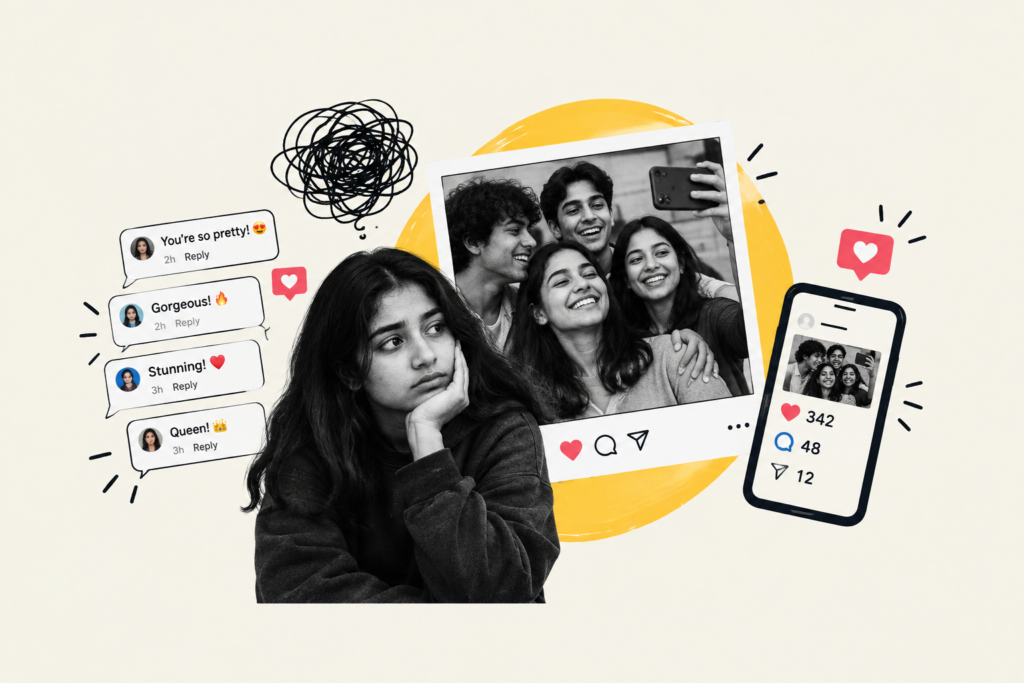
Somewhere between the group selfie, the Instagram comments and the compliments directed at one particular friend, a quiet comparison begins. Nobody announces the competition. Nobody agrees to participate. Yet, for many young people, it can feel as though they are losing.
There is a particular kind of insecurity that is difficult to explain to someone who has never experienced it.
You are with your friends. Everyone is laughing, somebody suggests taking a photograph, and the group gathers together. For a few moments, nobody is thinking too hard about anything. It is just another afternoon, another memory, another picture to put on Instagram.

Then the photograph goes online.
The compliments begin. One friend is gorgeous. Another looks stunning. Someone comments on how beautiful a particular person is. The likes accumulate, the heart emojis arrive, and the photograph becomes another small celebration of somebody’s appearance.

And somewhere in that same picture, another person is quietly wondering why nobody seems to notice them.
They may genuinely love their friends. They may think the friend receiving all the attention is beautiful. They may have absolutely no desire to take anything away from her.

But there is still a thought they struggle to admit, even to themselves.
Why am I never the one people notice first?
It is not necessarily a question about wanting to be the most attractive person in the room. Sometimes, it is simply the exhaustion of feeling like the least attractive person in every room you enter.
And for many young people, that feeling can be surprisingly difficult to shake.
The Competition Nobody Admits Exists
Nobody sits down with their friends and agrees to compete over who looks the best.
There are no rules, no judges and no official results. Yet young people can find themselves keeping score all the same.
Who gets the most compliments? Who looks best in photographs? Who attracts attention when the group enters a room? Whose Instagram posts receive the most engagement? Who seems to have an easier time attracting romantic interest?
The comparisons can become almost automatic.
A boy may look at his friends and feel that somebody else has the better face, the better hair, the better physique or simply the kind of appearance that makes people turn around. A girl may find herself comparing her face, skin, body or overall appearance with the friend who seems to look effortlessly good in every photograph.
These experiences are not identical, and not every young person is preoccupied with appearance. But the underlying question can be remarkably similar: What does the attention someone else receives say about me?
The uncomfortable answer is that it may say very little.
Yet when you are young, and still figuring out who you are and how others see you, it can feel as though it says everything.
The friend who receives the compliments becomes the beautiful one. Somebody else becomes the funny one, the smart one, the dependable one or the one who is always there for everyone.
Without anyone explicitly assigning these roles, a group can begin to feel as though everyone has a place in an unspoken hierarchy.
And the person who believes they have drawn the short straw may start seeing themselves through that label.
They stop looking at a photograph as a record of a good afternoon. They start examining it for evidence.
Perhaps their face looks wider from that angle. Perhaps their smile looks awkward. Perhaps their friend really does look better. Perhaps they should have stood somewhere else.
A moment that was supposed to be a memory becomes an evaluation.
That is when an ordinary insecurity can begin to take up far more space than it deserves.
When a Photograph Becomes a Verdict
One of the strangest things about growing up in the social media era is that an image of yourself is no longer necessarily a fleeting thing.
It can be captured, edited, posted, circulated, liked, commented on and revisited. It can be compared with photographs of friends, celebrities, influencers and even an idealised version of yourself that exists only because you have taken the same picture twenty times.
The group photograph has become more than a photograph. For some young people, it is another opportunity to assess where they stand.
And social media offers a particularly tempting way to turn that assessment into a number.
A friend receives 300 likes. Another receives 80. One person’s comments are filled with compliments. Another person’s post attracts very little visible attention.
It is easy to interpret these differences as a ranking of attractiveness, even when there are countless other reasons why one post might perform differently from another.
The timing of a post, the size of someone’s network, the way the algorithm distributes content, the nature of the photograph and the habits of a person’s friends can all affect engagement.
But numbers have a peculiar authority. They look objective, even when they measure something much more complicated than we realise.
For someone already feeling insecure, a difference in likes can become confirmation of a belief they were carrying before the photograph was even posted.
See? People notice her. They don’t notice me.
The danger is not simply that a young person might dislike a photograph. Most of us have pictures we would rather not see circulated.
The danger is that they begin to treat the response to a photograph as a verdict on their desirability, their social standing or even their worth.
A post becomes a test. A comment becomes reassurance. The absence of a compliment becomes something to interpret.
And there is always another photograph coming.
The Particular Pain of Comparing Yourself With a Friend
It is one thing to feel insecure about a celebrity or someone you follow online. It is another to experience that insecurity beside somebody you genuinely care about.
Your friend’s beauty is no longer an abstract idea. It is sitting next to you at lunch, laughing at your jokes, borrowing your clothes, appearing in your photographs and sharing the same social circles.
You see the attention they receive up close.
You may notice how easily people compliment them, how confidently they appear in photographs or how quickly someone expresses romantic interest in them.
And even if your friend has done nothing wrong, you can find yourself feeling diminished by the comparison.
This is the part that makes the experience so difficult to discuss honestly.
You don’t want to sound jealous. You don’t want to seem shallow. You certainly don’t want to admit that someone you love being beautiful can sometimes make you feel worse about yourself.
So you say nothing.
You congratulate your friend. You like the photograph. You join in when everyone says she looks amazing.
Then, perhaps later that evening, you look at the same photograph again and feel something you wish you didn’t.
Two things can be true at once: you can be happy for your friend, and you can be unhappy with how you see yourself.
Acknowledging that contradiction does not make you a bad friend. It makes you human.
The real difficulty begins when the comparison becomes a permanent feature of the relationship. When every photograph is an opportunity to measure yourself against your friend, when compliments directed at them feel like compliments withheld from you, or when you start resenting someone for receiving attention they never asked you to deny yourself.
Friendship becomes harder when another person’s good fortune feels like evidence of your own inadequacy.
And that is an extraordinarily lonely way to experience a relationship that is supposed to make you feel less alone.
Boys Feel It Too. They Just Don’t Always Talk About It.
Appearance-based insecurity is often discussed through the experiences of girls and young women. Those conversations are necessary, particularly in a culture that places considerable emphasis on female appearance.
But boys are not immune to the same underlying pressures.
They may be less likely to describe their experience as feeling like the less attractive friend. They may talk instead about height, physique, hair, skin, facial features, fitness or the difficulty of attracting romantic attention.
Sometimes, the comparison is not even explicitly about beauty. It is about being the friend who seems to get noticed, the person who attracts interest or the one who appears most confident in a group.
For a teenage boy still developing his sense of identity, watching his friends receive attention that he wants for himself can be difficult.
He may not have the language to explain it. He may make a joke about his appearance, dismiss a compliment before anyone else can, or act as though none of it matters.
That does not necessarily mean he is deeply troubled by his looks. But it is worth recognising that humour and apparent indifference do not always tell us everything about how a young person feels.
As parents, we can sometimes underestimate these insecurities because they do not look the way we expect them to.
We may tell a boy not to worry about his appearance, to focus on his studies, to exercise, to develop his personality or to remember that there are more important things in life.
All of that may be well-intentioned.
But when somebody is struggling with how they see themselves, being told that the problem should not matter is not quite the same as being helped to understand why it matters to them.
The first step is often to listen without immediately trying to fix the feeling.
A young person who admits to feeling unattractive does not necessarily need a lecture about confidence. They may simply need to know that they can talk about it without being laughed at, dismissed or told that they are being silly.
We Keep Telling Young People That Looks Don’t Matter. They Know That Isn’t Entirely True.
Perhaps part of the problem is the way we discuss beauty and self-worth.
We tell young people that looks do not matter, that personality is what counts and that confidence is more attractive than any physical feature.
There is truth in the sentiment. Relationships require much more than physical attraction. Friendship depends on trust, humour, loyalty, generosity and countless small acts of care. A life cannot be measured by how attractive somebody appears in a photograph.
But young people are also observing the world around them.
They see that appearance can influence first impressions. They notice who gets complimented, who receives attention and which faces are celebrated in popular culture. They encounter advertising, filters, beauty trends and an endless supply of carefully selected images.
They do not need adults to pretend these pressures do not exist.
They need help understanding what those pressures can and cannot tell them.
Yes, appearance can influence how people respond to us. But that does not make attractiveness an objective measure of character, compatibility, intelligence, kindness or the ability to build a meaningful life.
And the amount of attention somebody receives is not a reliable measure of how much they deserve to be loved.
A person can be conventionally attractive and insecure. Another can receive fewer compliments and have a rich, fulfilling social life. Someone can be overlooked in one environment and deeply appreciated in another.
Human attraction is complicated. It is shaped by personal preferences, cultural expectations, circumstances and individual relationships.
There is no single audience whose response can establish our value once and for all.
The problem is that social media can make it feel as though such an audience exists, and that its judgement is permanently available for inspection.
It doesn’t.
But when you are seventeen, nineteen or twenty-two, it can be difficult to remember that the numbers on a screen are not the final word on who you are.
You Don’t Have to Become the Most Attractive Person in the Room
I think we sometimes make the mistake of responding to insecurity by trying to reverse it.
We tell someone who feels unattractive that they are beautiful. We encourage them to find their best angles, dress confidently, work on their appearance or learn to love the person they see in the mirror.
There is nothing inherently wrong with taking care of yourself or wanting to feel good about how you look.
But what happens when the reassurance wears off? What happens when you see a photograph in which your friend looks better than you think you do? What happens when someone else receives the compliments you were hoping for?
If your confidence depends on believing that you are beautiful, the comparison can begin all over again.
Perhaps a more useful goal is to reach a point where your entire sense of self does not depend on answering the question.
You might not love every photograph of yourself. You might have days when you wish you looked different. You might still notice that a particular friend attracts more attention than you do.
You do not have to pretend otherwise.
But you can learn to recognise the difference between I don’t like how I look in this photograph and I am less worthy because of how I look in this photograph.
One is a feeling about a particular image. The other is a judgement about your entire self.
They are not the same thing.
You can also begin to notice when comparison is making you unhappy. Perhaps you repeatedly check how many likes a photograph has received. Perhaps you find yourself zooming in on your face, avoiding group photographs or following accounts that leave you feeling inadequate.
Recognising these patterns gives you an opportunity to change your relationship with them. That might mean taking a break from checking engagement, being more selective about the content you consume, or talking honestly with somebody you trust.
And it may mean learning to celebrate a friend without making their appearance a referendum on your own.
None of this happens overnight. Confidence is not a switch that can be turned on by reading a good article.
But it can begin with a small shift: allowing yourself to exist in a photograph without demanding that it prove something about you.
Maybe the Real Problem Is the Way We’ve Learned to Look at Ourselves
I keep coming back to the group photograph.
A few friends, standing together, sharing a moment that may eventually become a happy memory. Years later, they might look at it and remember the college trip, the ridiculous joke, the person who arrived late or the afternoon when everyone laughed until their stomachs hurt.
Yet, in the present, one person might be looking at that photograph and thinking only about who looks best.
That contrast says something about the pressure we can place on ourselves.
We want to belong, but we also want to be noticed. We want our friends to be happy, but we want to feel desirable too. We want to believe that we are enough, but we keep looking for evidence in places that were never designed to measure our worth.
And because appearance is so visible, it can become an easy place to look for answers to much deeper questions.
Am I interesting? Am I wanted? Do people like having me around? Would anyone choose me first?
A photograph cannot answer those questions. Neither can a like count. Even a hundred compliments cannot permanently settle the question of whether we are enough if we have learned to doubt ourselves every time somebody else receives more attention.
Perhaps this is where the conversation needs to change.
We need to make it easier for young people to admit that they feel insecure without turning the admission into a joke or a diagnosis. We need to teach them to question the comparisons they make, rather than simply telling them to stop comparing. And we need to build friendships in which another person’s confidence, attractiveness or success does not have to come at somebody else’s expense.
Most importantly, we need to stop making young people feel that the answer to every insecurity is to become better, prettier, fitter, more successful or more confident than they are today.
Sometimes, the first step is simply to understand that the feeling is there, that it does not define them and that they do not have to organise their lives around it.
You may not be the person everyone notices first.
You may not be the friend whose photograph attracts the most compliments.
You may sometimes wish you looked different.
None of those things means that you are a supporting character in your own life.
Your friendships, your ambitions, your humour, your mistakes, your relationships and the person you are still becoming cannot be reduced to how you compare with the people standing beside you.
The competition was never formally announced. Nobody asked you to enter it. And you do not have to keep participating simply because it feels as though everybody else is keeping score.
Perhaps growing up is learning that somebody else’s beauty is not your failure, somebody else’s attention is not your rejection, and a photograph does not get to decide how much space you deserve to occupy in the world.