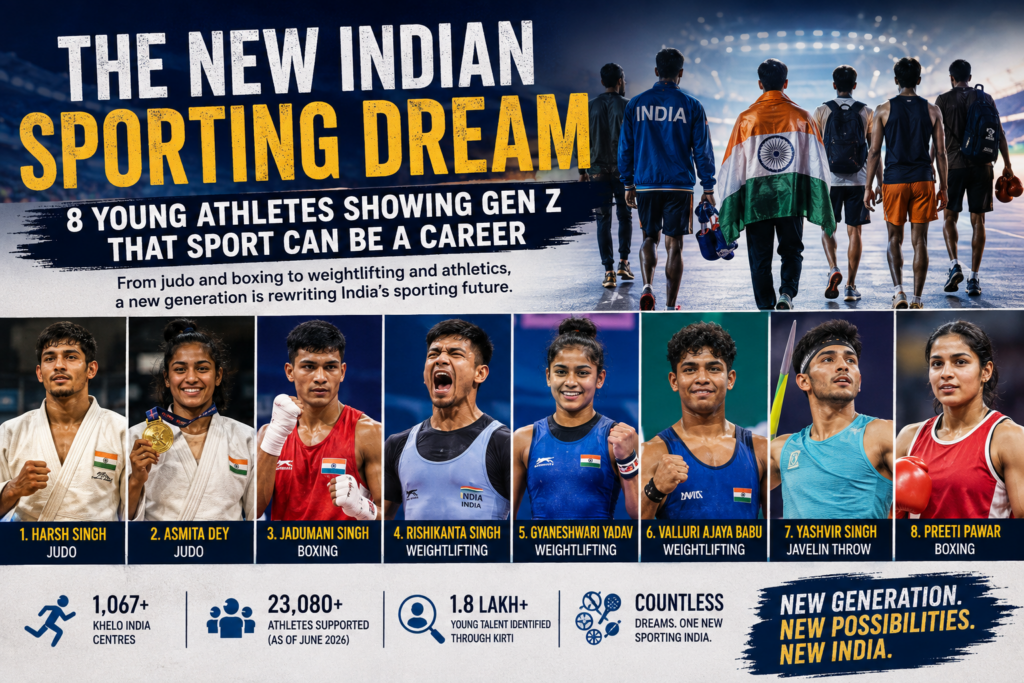
From judo and boxing to weightlifting and athletics, a new generation of Indian athletes is beginning to challenge one of the country’s oldest career assumptions: that sport is something you do until it is time to get a “real” job.
There was a time when telling your parents that you wanted to become a professional sportsperson in India could trigger a fairly predictable conversation.
“But what will you do after sports?”
For decades, that question was almost inevitable.
Sport was encouraged, but usually within limits. Play football. Run. Swim. Box. Lift weights. Represent your school. Maybe your college. Win a medal if you can.
But eventually, the conversation was expected to return to engineering, medicine, management, government jobs or whatever else constituted a “safe” career.
Cricket was the great exception.
For everyone else, professional sport often seemed like a gamble — one where the odds were uncertain, the financial rewards were uneven and the pathway from a talented child to an established athlete was difficult to see.
That picture is changing.
Not completely. Not equally across the country. And certainly not fast enough for every talented young athlete.
But the pathway is becoming more visible.
India now has a nationwide network of 1,067 Khelo India Centres and 35 State Centres of Excellence, while more than 23,000 athletes are being supported through different Khelo India programmes. The Khelo India Rising Talent Identification programme, or KIRTI, has conducted more than 1.8 lakh assessments to identify sporting talent among young people.
The significance of that goes beyond infrastructure.
A young person needs more than talent to imagine sport as a career.
They need to see a pathway.
They need to see people like themselves succeeding.
They need to believe that there is a system on the other side of the dream.
And that is where a new generation of Indian athletes becomes particularly interesting.
The Commonwealth Games are giving us a glimpse of that generation.
These aren’t all household names. They aren’t all playing the sports that dominate Indian television. Some are champions; others are just beginning to establish themselves.
But together, they tell a much bigger story.
India’s sporting ambition is becoming broader, younger and more diverse.
And for Gen Z, that may be changing what a “career” can look like.
1. Harsh Singh: The judoka who changed the history books
At just 23, Harsh Singh has already put his name into Indian sporting history.
His Commonwealth Games gold in judo isn’t simply another medal. It represents a first for India: Harsh became the country’s first male Commonwealth Games judo gold medallist.
That distinction matters because judo has never enjoyed the cultural visibility of cricket, badminton or even boxing in India. Yet Harsh has built his career in precisely that environment — competing internationally, travelling through the demanding judo circuit and eventually arriving at the Commonwealth Games with the opportunity to change the record books.
His story is a useful reminder that sporting success doesn’t always begin with choosing the country’s most popular sport.
Sometimes it begins with choosing something most people around you don’t fully understand.
For a young Indian watching Harsh, the message is subtle but powerful: you don’t necessarily have to play the sport everybody else is watching. You can find your own discipline, develop your own expertise and still end up on an international podium.
That is a very Gen Z idea of a career — specialisation over conformity.
2. Asmita Dey: The athlete who found her sport by changing sports
Asmita Dey’s journey is perhaps even more revealing.
The 23-year-old from Tripura did not begin her sporting journey with judo. She initially competed in the 800 metres before discovering judo at a district-level trial.
That decision eventually changed everything.
She entered the structured sporting system, trained through the Sports Authority of India ecosystem and developed into an international-level judoka. Her Commonwealth campaign then turned that unusual beginning into something extraordinary.
Asmita became a Commonwealth Games judo champion.
There is a lesson here that extends beyond sport.
We often imagine career choices as irreversible decisions made at 16, 18 or 21. Choose engineering. Choose medicine. Choose commerce. Choose sport.
But elite sport itself tells a different story.
Talent can migrate.
Skills can transfer.
A person can discover that they are better suited to something they had never imagined doing.
Asmita’s journey from running to judo is therefore not simply a sporting anecdote. It is a reminder to a generation obsessed with finding the “right career” early that sometimes the right career is discovered through experimentation.
You don’t always know what you’re good at until you try something completely different.
3. Jadumani Singh: The young boxer building a career with discipline
Jadumani Singh Mandengbam represents another side of India’s emerging sporting generation.
The young Manipuri boxer, who represents the Indian Army, has emerged as one of India’s notable names in the Commonwealth boxing campaign.
His journey is particularly interesting because it sits at the intersection of sport and institutional support.
For a young athlete, the biggest challenge isn’t always talent.
It is sustainability.
Can you train full-time?
Can you travel for competitions?
Can you afford equipment?
Can your family support the uncertainty?
Can you build a life while pursuing elite performance?
Institutional pathways can make that gamble more manageable.
Jadumani’s association with the Army provides an example of how sporting ambition can coexist with a larger institutional ecosystem. It makes the professional athlete’s journey feel less like a solitary leap into the unknown and more like a structured career.
And for a young person watching from Manipur or elsewhere in the Northeast, there is another important message.
Your geography does not have to define the size of your ambition.
4. Rishikanta Singh: The weightlifter quietly announcing himself
Weightlifting is one of those sports that rarely receives attention until an Indian athlete wins something major.
Then suddenly, everyone is interested.
Rishikanta Singh is part of the generation trying to make that interest more permanent.
His Commonwealth performance brought him into the spotlight with a silver medal and a Games record in the snatch.
But perhaps the more important thing is what happens after the medal.
A young athlete watching Rishikanta may not simply think about the Commonwealth Games.
They may start thinking about weightlifting itself.
Could I compete?
Could I train seriously?
Could I represent my state?
Could I reach nationals?
Could I become an international athlete?
That sequence of questions is how sporting ecosystems grow.
A champion does not merely win.
A champion creates possibility.
And sports such as weightlifting need that possibility. They need young people to see the discipline not simply as something associated with a gym, but as a legitimate competitive pathway.
5. Gyaneshwari Yadav: Redefining what strength looks like
Gyaneshwari Yadav’s story adds another important dimension to the conversation.
For decades, Indian sporting culture often placed young women into a relatively narrow set of expectations. Athleticism was acceptable, but there were invisible boundaries around what kind of physicality was considered desirable.
Elite weightlifting challenges those assumptions.
Strength becomes the point.
Precision becomes the point.
Power becomes the point.
And success is measured by what an athlete can do, not by whether she fits somebody else’s idea of what an athlete should look like.
Gyaneshwari’s emergence therefore matters beyond her medal.
For a young Indian woman watching her compete, sport can begin to look different.
Not as something she is allowed to participate in until academics become serious.
Not as something she does “for fitness.”
But as an arena in which she can build expertise, compete internationally and become exceptionally good at something.
That shift in perception may be one of the most important changes happening in Indian sport.
6. Valluri Ajaya Babu: Why depth matters more than one superstar
Valluri Ajaya Babu represents a phenomenon that is easy to miss when we focus only on India’s biggest sporting stars.
He is part of a deeper pipeline of Indian weightlifting talent and emerged with a Commonwealth silver medal in the men’s 79kg category.
The significance isn’t necessarily that every young athlete will become the next superstar.
It is that there are increasingly more athletes coming through.
That matters.
A sporting culture becomes sustainable when children can look beyond one exceptional champion and see an entire ladder of possibility.
One athlete wins.
Another follows.
A third enters the national camp.
A fourth makes the Commonwealth team.
A fifth wins an Asian medal.
Suddenly, the sport has a community.
For Gen Z, this is particularly important because young people are heavily influenced by visible pathways. They don’t simply need inspiration. They need evidence.
“People like me actually do this.”
Ajaya Babu and athletes like him provide that evidence.
7. Yashvir Singh: The generation coming after India’s javelin revolution
India’s javelin story has changed dramatically.
A decade ago, the event was hardly part of everyday sporting conversation. Today, the word “javelin” is enough to bring Neeraj Chopra to mind.
But every sporting revolution eventually faces the same question:
Who comes next?
Yashvir Singh belongs to the generation trying to answer that question.
His emergence in Indian athletics is important precisely because the future of javelin cannot depend on one extraordinary athlete forever.
A sport becomes culturally powerful when one champion becomes the beginning of a pipeline rather than its end.
The young Indian watching Neeraj Chopra may initially think:
I want to be like him.
But the young Indian watching athletes such as Yashvir can begin thinking something more realistic:
There is a pathway for me too.
That distinction matters.
Heroes create dreams.
Peers create possibilities.
8. Preeti Pawar: “I’m also good”
If there is one quote that perfectly captures the confidence of the new Indian athlete, it may be Preeti Pawar’s.
Ahead of her Commonwealth campaign, the young boxer — already the 2026 Asian Elite champion — was asked about the quality of competition.
Her response was wonderfully simple:
“There are many good boxers in this competition, but I’m also good.”
That is not arrogance.
It is self-belief.
And perhaps that is one of the defining characteristics of Gen Z athletes.
Preeti entered her first Commonwealth Games with the confidence of someone who already believed she belonged at that level. Commonwealth Sport described her as a standout, noting her Asian Elite title and her progression in Glasgow.
For decades, Indian athletes were often celebrated for humility and sacrifice.
Those qualities still matter.
But the new generation is increasingly comfortable with another idea:
I can be ambitious and say it out loud.
Preeti’s confidence is therefore part of her story.
She isn’t merely trying to prove that Indian boxing has talent.
She is behaving like someone who expects to compete with the best.
The bigger story isn’t the medals
It is tempting to look at these athletes and see eight individual stories.
A judoka.
A boxer.
A weightlifter.
An athlete.
But something bigger is happening underneath.
The sporting ecosystem around young Indians is becoming more structured.
Khelo India now has 1,067 centres, while the government says 23,080 athletes were being supported as of June 2026, with financial assistance covering areas such as coaching, equipment, diet and competition exposure.
The KIRTI programme has also conducted more than 1.8 lakh talent assessments, using standardised assessments and technology to identify sporting potential among children and teenagers.
That changes the conversation.
Because talent identification is only the first step.
The bigger objective is to create a pathway.
School.
Training.
Competition.
Coaching.
Sports science.
National exposure.
International competition.
And, eventually, a career.
The system is far from perfect. India still has major gaps in access, coaching quality, sports science, facilities and financial security for athletes.
But something important has happened.
The pathway is now visible.
Gen Z is also redefining what a “sports career” means
There is another reason sport may resonate differently with Gen Z.
They have grown up in an economy where careers are becoming less linear.
A person can be a creator and entrepreneur.
A gamer can become a professional streamer.
A software engineer can build a company on the side.
A designer can build an audience.
A fitness enthusiast can become a coach and content creator.
And an athlete can build an entire professional identity around sport.
The sporting economy is no longer limited to the athlete.
There are coaches.
Sports psychologists.
Physiotherapists.
Strength and conditioning specialists.
Nutritionists.
Data analysts.
Performance scientists.
Sports journalists.
Content creators.
Broadcasters.
Sports marketers.
Agents.
Event managers.
Sports-tech founders.
The Indian government itself has increasingly positioned sport as an economic and career ecosystem rather than simply a competitive activity. The Khelo India framework includes athlete development, infrastructure, coaching and sports science, while newer policy initiatives are explicitly aimed at expanding the sports economy.
That is significant.
Because perhaps the question for a 17-year-old today isn’t:
“Can I become a professional athlete?”
It might be:
“Where do I want to sit inside the sports economy?”
That is a much bigger question.
The athlete is also becoming a creator
There is one more change that previous generations of athletes never had to navigate in quite the same way.
Social media.
A young athlete today can document the entire journey.
The early-morning training session.
The competition.
The disappointment.
The recovery.
The travel.
The diet.
The celebration.
The comeback.
The audience doesn’t have to discover an athlete only when they win a medal.
They can follow the process.
That creates something powerful.
The journey itself becomes a story.
And for Gen Z, which has grown up in the creator economy, that is familiar territory.
Athletes can build communities.
Communities can create visibility.
Visibility can create sponsorship.
Sponsorship can create economic independence.
And economic independence can make elite sport more sustainable.
The athlete is no longer just a competitor.
They can also become a media property.
The next Indian sporting icon may come from a sport we barely watch today
That may ultimately be the most exciting part of this story.
Harsh Singh is not a cricketer.
Asmita Dey did not begin in the sport in which she became a champion.
Jadumani Singh represents boxing through the Army.
Rishikanta Singh and Gyaneshwari Yadav are part of India’s weightlifting pipeline.
Yashvir Singh represents the next generation of athletics.
Preeti Pawar is already speaking with the confidence of a champion.
None of these stories fits the old template of Indian sporting success.
And that is precisely why they are worth telling.
The future of Indian sport will not be built only by the athletes whose names we already know.
It will be built by thousands of young people training in centres across the country.
Some will become champions.
Some will not.
Some will change sports.
Some will become coaches.
Some will move into sports science.
Some will create businesses.
Some will simply inspire the person who comes next.
That is how sporting cultures are built.
Not through one superstar.
Through visibility, repetition and possibility.
The most important medal may be the one we can’t see
There is a final reason these young athletes matter.
Imagine a 15-year-old watching a Commonwealth Games final.
They see a young Indian athlete standing on the podium.
They see the flag.
They hear the national anthem.
They see the medal.
But perhaps something else happens quietly.
They start searching for the sport.
They find a local academy.
They ask their parents.
They begin training.
Maybe they compete.
Maybe they win.
Maybe, ten years later, they are the person another teenager is watching on television.
That is the sporting flywheel.
Champions create champions.
Not because everyone who watches them becomes one, but because every visible success expands the boundaries of what seems possible.
For years, Indian parents asked their children:
“What will you do after sports?”
Perhaps the more interesting question for the next generation is:
“What can sport become for you?”
Because sport is no longer just a game.
It can be a profession.
A business.
A community.
A platform.
A source of identity.
A route to global competition.
And, increasingly, a legitimate career.
The eight young athletes emerging from the Commonwealth Games are not just competing for medals.
They are competing for something more intangible.
They are expanding the imagination of what a young Indian can become.
And perhaps that is the real beginning of India’s next sporting revolution.