
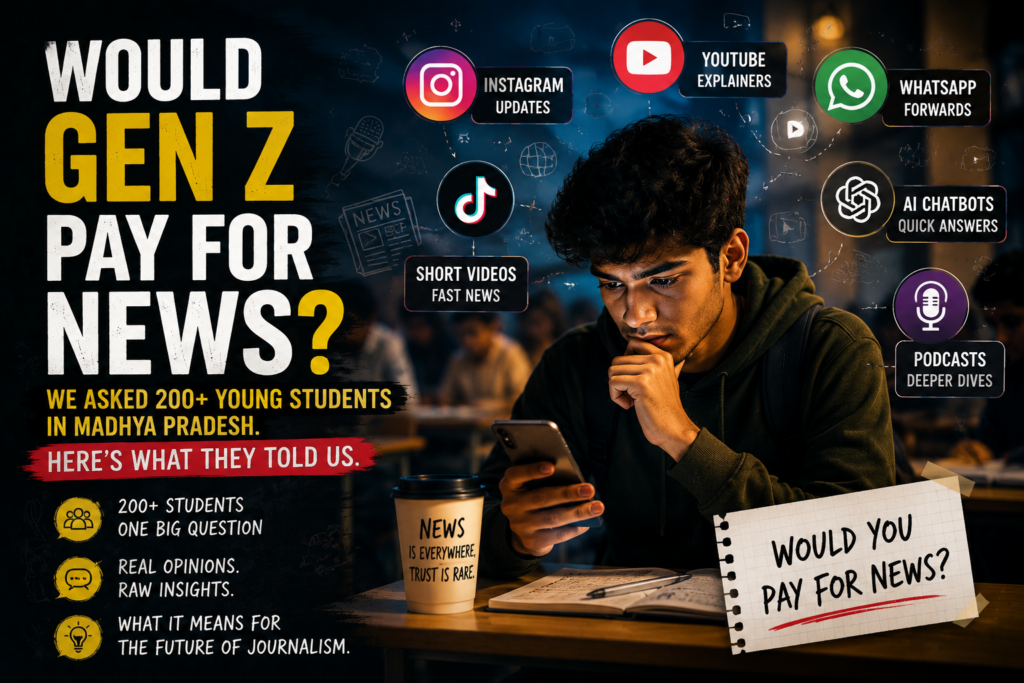
TheYouthTalks spoke to more than 200 young students at a college in Madhya Pradesh to understand how India’s next generation consumes news, whom they trust and, perhaps most importantly, whether they would ever pay for journalism.
Ask a 20-year-old where they get their news, and you are unlikely to hear the answer that traditional news organisations would like.
It may be Instagram.
YouTube.
WhatsApp.
A creator they follow.
A podcast.
A friend who sent them something interesting.
Or, increasingly, an AI chatbot.
But ask a slightly different question — “Would you actually pay for news?” — and the conversation becomes much more interesting.
That is exactly what TheYouthTalks wanted to understand.
Recently, we put the question directly to 200+ young students in a college in Madhya Pradesh, asking them about their news habits, the platforms they use, the people they trust and whether journalism is valuable enough for them to spend their own money on.
The exercise was not designed to tell young Indians what they should think about journalism.
It was designed to understand what they actually think.
And some of the responses offer an important warning — and perhaps an equally important opportunity — for the future of Indian journalism.
The first question isn’t “Will they pay?”
It is:
Where are they getting their news?
For previous generations, this question was relatively easy.
Newspapers.
Television.
News websites.
For today’s young audience, the answer is far more fragmented.
A news story can arrive in the middle of an Instagram feed. It can appear as a YouTube Short. It can be forwarded on WhatsApp. A creator can explain a complicated development in two minutes. An AI chatbot can summarise an entire controversy in seconds.
The result is a generation that can be extremely well connected to information without necessarily having a relationship with a news organisation.
That distinction matters.
Because journalism’s traditional business model depended on something that is becoming increasingly difficult to achieve:
owning the relationship with the reader.
Today, the platform often owns that relationship.
The global shift is already visible
The experience of the students we spoke to is part of a much larger global transformation.
The Reuters Institute’s Digital News Report 2026 found that social media and video networks have become the most widely used routes to online news globally, reaching 54% of respondents, compared with 51% for news organisations’ own websites and apps.
For younger audiences, the shift is even more pronounced.
Among 18–24-year-olds, social platforms, video networks and AI are increasingly becoming the first point of contact with news.
That doesn’t necessarily mean young people don’t care about current affairs.
It means they are encountering current affairs differently.
And that distinction came through clearly in the conversations around our research.
News is important. Paying for it is another matter.
This is perhaps the biggest challenge facing journalism.
Young people may recognise that journalism is important.
They may want credible information.
They may even complain about misinformation.
But none of that automatically translates into:
“I’ll pay ₹200 a month for a news subscription.”
Globally, only a minority of people currently pay for digital news.
Reuters’ 2025 Digital News Report found that across 20 countries where digital subscriptions are well established, only 18% had paid for online news in the previous year.
The majority still prefer free alternatives.
And that raises an uncomfortable question for publishers:
If young people can get the information for free, why would they pay?
The answer may lie in what they believe they are buying.
Because they aren’t necessarily buying news.
They may be buying trust.
Or analysis.
Or original reporting.
Or convenience.
Or access.
Or simply the confidence that somebody has done the hard work of figuring out what is actually true.
The creator has changed the equation
The young audience’s relationship with news is also increasingly shaped by individual personalities.
A traditional news organisation might say:
“Here is our report.”
A creator might say:
“Let me explain what happened.”
That second proposition can feel more personal.
The audience sees the same face repeatedly. They understand the person’s tone. They become familiar with how that individual approaches complicated subjects.
And that relationship can be remarkably powerful.
Reuters’ global research has documented the growing role of individual creators and influencers in news consumption, particularly among younger audiences.
The creator may not necessarily be more accurate.
They may not even be more trustworthy.
But they can be more accessible.
And for Gen Z, accessibility matters.
Then there is the trust problem
This is where journalism still has a potentially enormous advantage.
The internet has created an extraordinary abundance of information.
It has not created an equivalent abundance of verified information.
A young person can see ten different explanations of the same event within minutes.
Which one is correct?
Which source has actually spoken to the people involved?
Who checked the document?
Who verified the photograph?
Who went to the location?
Who asked the difficult question?
Those are precisely the areas where professional journalism can create value.
And this may be the biggest opportunity emerging from the crisis facing traditional news organisations.
Don’t compete with creators on being first. Compete on being right.
But AI has changed the question again
For Gen Z, the news ecosystem is no longer simply newspapers versus social media.
There is now another intermediary:
AI.
A student can ask an AI chatbot:
“Explain this controversy to me.”
Then:
“Give me the timeline.”
Then:
“What are both sides saying?”
Then:
“Explain it like I’m a college student.”
All without visiting a single news website.
That creates a profound economic problem.
A journalist might spend hours researching and reporting a story.
An editor might spend additional hours checking and refining it.
The publisher hosts the finished work.
And then an AI system can potentially summarise the reporting without the user ever visiting the original source.
The question becomes:
Who pays for journalism when the audience consumes the answer but never sees the newsroom that produced it?
Maybe Gen Z doesn’t want a news subscription
This is where our conversation with young Indians becomes particularly important.
The future of journalism may not be about convincing a 20-year-old to buy a traditional digital newspaper subscription.
It may be about understanding what kind of information they consider valuable enough to pay for.
Would they pay for investigative journalism?
Would they pay for career intelligence?
Would they pay for exclusive research?
Would they pay for a fact-checking service?
Would they pay for highly specialised financial, technology or education information?
Would they pay for access to journalists and experts?
Would they pay to become part of a community?
These are very different propositions from:
“Subscribe to our newspaper.”
And perhaps that is where the industry needs to rethink its language.
The Indian opportunity
India is an especially fascinating market because the country isn’t simply reproducing the Western media business model.
Young Indians are consuming news across platforms at enormous scale.
Reuters’ India research has found significant use of YouTube, WhatsApp, Instagram and Facebook for news among its primarily English-speaking online respondents.
But India also has something many markets don’t:
a huge young population entering the information economy simultaneously.
That creates an enormous opportunity for journalism.
The audience exists.
The appetite for information exists.
The challenge is creating a product that young people believe deserves their attention — and eventually, their money.
So, would Gen Z pay?
Our 200+ students may not provide a definitive answer to the future of the journalism industry.
No survey can.
But they can tell us something much more valuable:
what young Indians think right now.
And perhaps that is the question the industry should be asking more often.
Not:
“Why don’t young people read newspapers?”
Not:
“Why don’t they subscribe?”
Not:
“Why do they prefer Instagram?”
But:
“What would make journalism genuinely valuable to them?”
Because the next generation isn’t necessarily rejecting news.
They are rejecting the assumption that news itself is the product.
Information is everywhere.
The scarce commodity is becoming something else:
attention.
context.
credibility.
original reporting.
And above all:
trust.
If journalism can demonstrate that value, young Indians may eventually pay for it.
But perhaps the future will not look like a newspaper subscription at all.
It could be a membership.
A research platform.
A creator-led news channel.
A specialist newsletter.
A fact-checking service.
A community.
An event.
An intelligence product.
Or something we haven’t invented yet.
The question isn’t whether Gen Z will pay for journalism.
The more important question is whether journalism can build something Gen Z believes is worth paying for.
And that is a question the industry can no longer afford to postpone.