
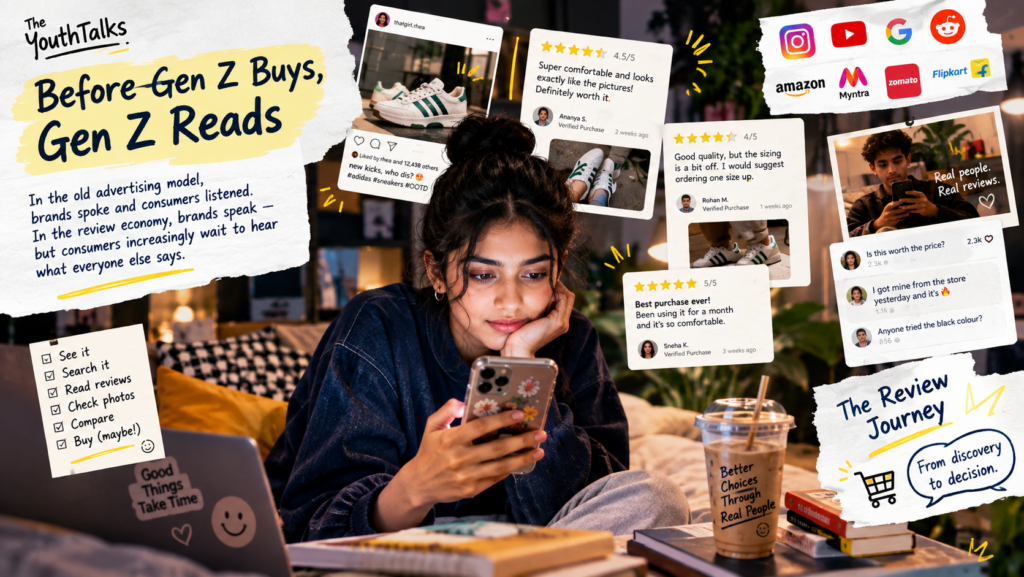
In the old advertising model, brands spoke and consumers listened. In the review economy, brands speak — but consumers increasingly wait to hear what everyone else says.
There was a time when buying something online was relatively simple.
A brand showed you a product. It told you what the product could do. It showed you an attractive photograph, perhaps added a discount, a celebrity endorsement or a carefully constructed promise — and you made a decision.
Today, the journey looks very different.
A young consumer discovers a product on Instagram. Searches for it on Google. Opens the product page. Looks at the rating. Reads a few reviews. Scrolls through customer photographs. Checks the negative reviews. Searches the product again on YouTube. Maybe looks through Reddit conversations. Then sends the link to a friend.
And sometimes, after all that, doesn’t buy it.
Not because the brand failed to create desire.
But because someone else’s experience created doubt.
That is the interesting shift happening in the review economy.
For Gen Z, the product page is increasingly not the end of the persuasion journey. It is where another layer of persuasion begins.
The Brand Can Create Desire. The Consumer Creates Confidence.
India’s consumers have long relied on word-of-mouth. Friends, family and colleagues have always influenced what people eat, wear, watch and buy.
What has changed is the scale and accessibility of that word-of-mouth.
A consumer no longer needs to know someone who owns the product.
They can access hundreds — sometimes thousands — of people who have already bought it.
Research increasingly points towards this importance of consumer feedback. PwC India’s consumer research, for instance, found customer reviews on retailer websites among the leading sources of information Indian consumers use before making purchases.
For Gen Z, this becomes particularly interesting because their shopping journey is deeply intertwined with digital discovery.
They are not necessarily starting with a search box that says, “I want to buy a pair of shoes.”
They may see the shoes on a creator’s Instagram post.
They may notice them in a Reel.
They may encounter them in a friend’s story.
They may see someone wearing them on campus.
Discovery can happen almost accidentally.
But once curiosity has been created, the consumer often begins investigating.
And that investigation increasingly includes other consumers.
The journey is no longer simply:
SEE → WANT → BUY
It is becoming:
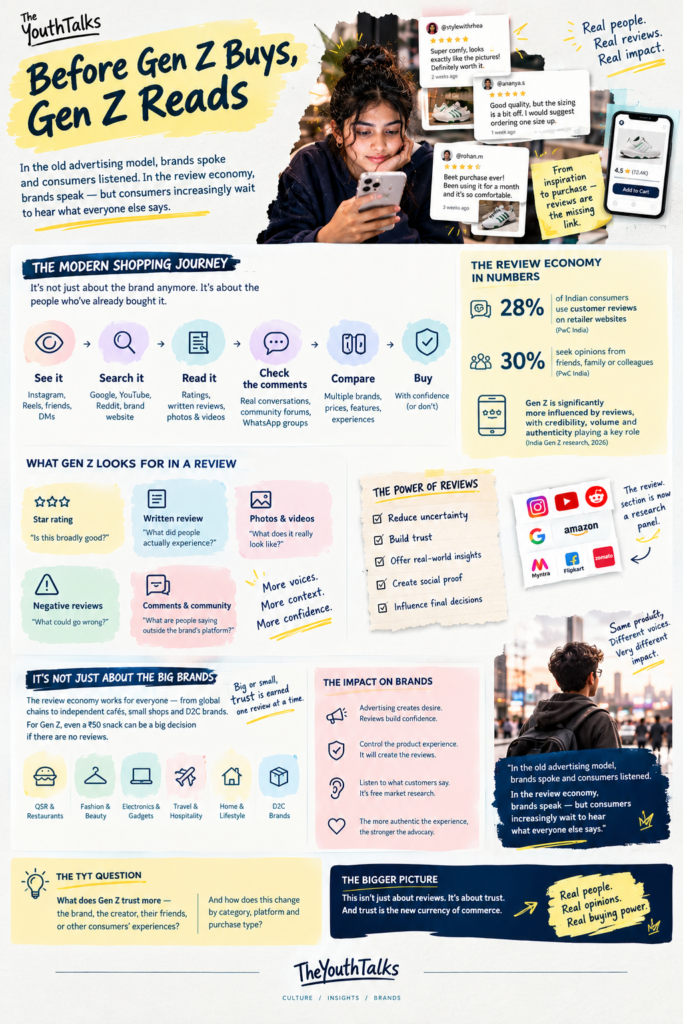
SEE → SEARCH → READ → CHECK → COMPARE → VALIDATE → BUY
That middle section is where reviews have become incredibly powerful.
Before Buying the Product, Gen Z Wants to Buy the Proof
There is a psychological reason reviews matter.
Advertising answers the question:
“Why should you buy this?”
Reviews answer a different question:
“What actually happened when someone like me bought this?”
That distinction is important.
A brand can say that a skincare product works.
A customer can say what happened after using it for three weeks.
A brand can say a pair of jeans has a great fit.
A customer can say, “I am 5’8″, bought a medium and it fits differently than the picture.”
A restaurant can show beautiful food photography.
A diner can tell you whether the portion was enough for two people.
A hotel can show the room.
A guest can tell you whether the room actually looks like the photographs.
The second layer feels different because it is experiential rather than promotional.
A 2026 study focused specifically on Gen Z consumers in Indian e-commerce found that attributes of online reviews — including credibility, authenticity and volume — had a significant positive relationship with buying behaviour.
In other words, Gen Z isn’t simply looking for more reviews.
It is looking for believable evidence.
The Five-Star Rating Is Only the Beginning
The review economy has also evolved beyond the simple five-star rating.
A star tells you something.
A review tells you much more.
A photograph tells you something else.
A video tells you something else again.
And a comment thread can sometimes reveal what the brand’s product page never will.
For a young shopper, the review ecosystem can therefore have multiple layers.
1. The Rating
“Is this product broadly good?”
Four stars or four-and-a-half stars immediately provides a sense of reassurance.
2. The Written Review
“What did people actually experience?”
This is where details around quality, delivery, fit, performance and usability begin to emerge.
3. Customer Photographs and Videos
“What does it really look like?”
This can be particularly powerful in categories such as fashion, beauty, food and home products.
4. Negative Reviews
“What could go wrong?”
Interestingly, negative reviews don’t necessarily kill the purchase.
Sometimes they make the review section more credible.
A product with nothing but five-star reviews can feel suspicious.
A product with a few detailed complaints can feel more real — particularly if the consumer can decide whether those complaints matter to them.
5. Conversations Outside the Brand’s Platform
“What are people saying when the brand isn’t controlling the conversation?”
This is where Reddit threads, YouTube comments, Instagram comments, community groups and even WhatsApp conversations become part of the consideration journey.
The consumer is effectively building their own research panel.
Gen Z Has Turned the Comment Section Into a Research Tool
This is perhaps the more interesting cultural shift.
For Gen Z, comments are no longer simply reactions to content.
They can be information sources.
Someone wants to know whether a product runs small.
Someone wants to know whether a laptop heats up.
Someone wants to know whether a restaurant is actually worth the price.
Someone wants to know whether a beauty product works on Indian skin.
Someone wants to know whether a D2C brand will actually deliver what it promises.
And someone has probably already asked that question.
That changes the relationship between brands and consumers.
The consumer is no longer dependent on the brand’s description.
They can cross-check it.
The result is a generation of shoppers who can be highly curious, but also highly investigative.
And that has major implications for brands.
The D2C Brand Has Perhaps the Most to Gain — and Lose
For established brands, trust can sometimes come from familiarity.
Consumers have seen the logo before.
They may have visited the store.
Their parents may have used the product.
They may already have a mental model of the brand.
For a newer D2C brand, that inherited trust may not exist.
The consumer may discover the brand through an Instagram Reel today and be expected to spend ₹1,500, ₹3,000 or ₹5,000 tomorrow.
That creates a trust gap.
Reviews can help close it.
They become a form of digital trust infrastructure.
The brand says:
We are good.
Hundreds of customers saying:
We bought it. We used it. Here’s what happened.
can make that claim feel considerably more tangible.
But the reverse is equally true.
A brand can spend heavily on performance marketing and influencer campaigns, only for a prospective customer to reach the product page and encounter a series of unresolved complaints.
The money created the click.
The reviews determined what happened next.
The Creator May Create Curiosity. The Customer May Close the Sale.
This is where the review economy becomes particularly interesting for marketers.
The creator economy and the review economy are not necessarily competing systems.
They may be becoming sequential ones.
A creator can introduce the product.
An advertisement can create awareness.
A Reel can create aspiration.
A discount can create urgency.
But a review can provide reassurance.
The journey increasingly looks something like:
BRAND → AWARENESS
CREATOR → CURIOSITY
REVIEW → CONFIDENCE
FRIEND/COMMUNITY → VALIDATION
PURCHASE → ACTION
That doesn’t mean every Gen Z consumer follows this exact sequence.
But it represents an increasingly important way of understanding modern digital commerce.
Research among Gen Z consumers in India has similarly found that review credibility, authenticity and other review characteristics can influence purchase behaviour.
The lesson for brands is not simply “get more reviews.”
It is:
Build products and experiences that people genuinely want to talk about.
Negative Reviews May Actually Be Part of the Trust Equation
This is where brands have to become comfortable with something uncomfortable.
They cannot completely control the conversation anymore.
And perhaps they shouldn’t try to.
Consumers are increasingly suspicious of perfection.
If every review says the product is “amazing”, “excellent”, “perfect” and “must buy”, the section can start to feel manufactured.
A detailed review that says, “The product is good, but the battery could be better” may actually feel more believable.
The review economy therefore rewards something advertising has historically struggled with:
imperfection.
Consumers don’t necessarily need a product to be perfect.
They need to know what they are getting.
That distinction is enormous.
A fashion brand can survive a review saying, “The colour is slightly different from the photograph.”
A restaurant can survive a review saying, “Great food, but weekends are crowded.”
A laptop can survive a review saying, “Excellent performance, but the speakers aren’t great.”
What damages confidence is not necessarily criticism.
It is the feeling that the consumer is being misled.
The New Brand Battle May Be Happening After the Advertisement
For years, marketing teams have invested enormous effort in controlling the first impression.
The campaign.
The film.
The influencer.
The packaging.
The landing page.
The brand story.
But in the review economy, the first impression may no longer be the most important impression.
There is now a second conversation happening after the brand has spoken.
And consumers are listening to it.
This changes what brands need to measure.
Not just:
How many people saw the campaign?
But:
What did people say after seeing it?
Not just:
How many people clicked?
But:
What happened when they reached the review section?
Not just:
What is our average rating?
But:
What are the recurring themes inside our reviews?
The review section can become a free, continuous consumer research panel.
It can tell a brand what people love.
What frustrates them.
What they misunderstood.
What they expected.
What surprised them.
And why they may or may not recommend the product.
For a brand willing to listen, that is extraordinarily valuable data.
The TYT Question: What Does Gen Z Trust More?
This is where the conversation gets particularly interesting for TheYouthTalks.
We often ask young consumers what brands they like.
But perhaps the more revealing question is:
Who do they trust when deciding whether to buy?
The brand?
The creator?
Their friends?
The rating?
The written review?
The customer photograph?
The Reddit thread?
The comments?
The answer may vary dramatically by category.
For beauty, perhaps the demonstration matters.
For fashion, fit and customer photographs may matter more.
For electronics, detailed reviews and long-term performance may become critical.
For restaurants, recent reviews and photographs can influence the decision.
For travel, the gap between the photograph and the actual experience can become the central question.
The opportunity for TYT is therefore not simply to measure whether Gen Z reads reviews.
It is to understand how Gen Z reads reviews.
How many reviews does it take before they feel confident?
Do they read positive or negative reviews first?
How much does a rating matter?
Do photographs matter more than written reviews?
How much trust is lost after one bad experience?
And perhaps the most interesting question of all:
When a brand says one thing and its customers say another, whom does Gen Z believe?
That is a much bigger question than online reviews.
It is a question about trust.
From Brand-Controlled Messaging to Consumer-Validated Commerce
The advertising economy was built around a relatively simple relationship.
Brands had the microphone.
Consumers had the attention.
The internet changed who could speak.
Social media changed how quickly they could speak.
And reviews changed how directly their opinions could influence someone else’s purchase.
For Gen Z, this is becoming normal.
They don’t necessarily expect brands to disappear from the decision.
They simply don’t expect brands to be the only voice in it.
Before Gen Z buys, Gen Z reads.
It reads the rating.
It reads the good reviews.
It reads the bad ones.
It looks at the photographs.
It checks the comments.
It asks friends.
It searches again.
And somewhere in that messy, collective, very human process, a decision gets made.
The implication for brands is profound.
The future of marketing may not belong only to the brands that tell the best stories.
It may increasingly belong to the brands whose customers are willing to tell the best stories about them.
Because in the old advertising model, brands spoke and consumers listened.
In the review economy, brands speak — but consumers increasingly wait to hear what everyone else says.