

For many Indian college students, midnight is no longer the end of the day. It is simply another checkpoint.
Assignments continue. Placement preparation continues. Conversations continue. Screens remain on. And for some students, the bed itself does not become a place to sleep until well after 2 AM.
New research by TheYouthTalks and Happy Heart & Soul suggests that this late-night boundary matters more than the difference between, say, 11:30 PM and 1 AM.
The data points to a sharp 2 AM cliff.
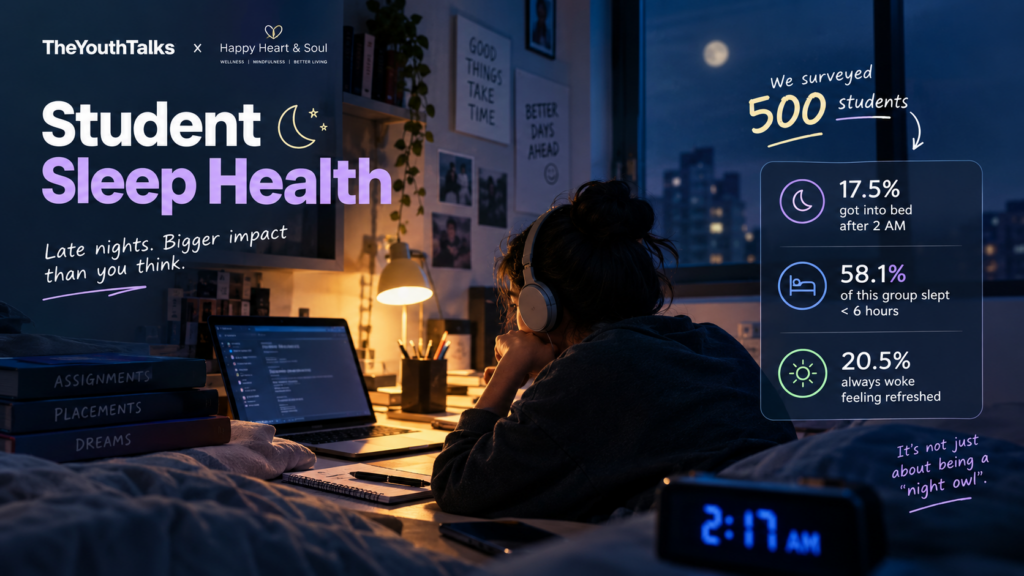
Among the students surveyed, 17.5% reported getting into bed after 2 AM. And within this group, 58.1% were sleeping for fewer than six hours, while only 20.5% said they always woke feeling refreshed.
Compare that with students getting into bed between 10 PM and midnight: only 20.4% slept for fewer than six hours, while 28.6% reported always waking refreshed.
The difference is striking.
The proportion sleeping under six hours nearly triples between the 10 PM–midnight group and those crossing the 2 AM mark. In a sample of roughly 500 students, the report estimates that around 88 students fall into this after-2-AM sleep-deficit group.
It isn’t simply about being a “night owl”
The findings suggest that bedtime is closely connected to how much sleep students ultimately get and how restorative that sleep feels.
The report finds a negative correlation between later bedtime and hours slept (r = -0.21), while later bedtime is also negatively correlated with waking refreshed (r = -0.28). These are associations, not proof that a late bedtime itself causes poor sleep; the survey is cross-sectional and cannot establish the direction of causation.
But the pattern is difficult to ignore.
And it sits inside a much larger pressure cycle.
The research found that 79.6% of students regularly or sometimes allow study or work to cross into their intended sleep time. Only 20.4% reported having a clean boundary between work and bedtime. Students whose work followed them into bed also reported higher average burnout than those who maintained that boundary.
In other words, the clock may be showing 2 AM, but the student’s day has not necessarily ended.
Students are already trying to fix it
Perhaps the most interesting part of the story is that students are not unaware of the problem.
Nearly seven in ten respondents had tried something to improve their sleep. Among substantive open-ended responses, the most common strategies were cutting screen time (30%), fixing a routine (20%), reading or listening to music (12%), exercising or going to the gym (11%), and meditation, breathing exercises or yoga (10%).
Yet many of these attempts remain individual and unstructured.
One second-year student told the survey: “I tried doing exercises and avoiding screen but cannot keep it up consistently.”
That distinction matters.
The research describes the problem not simply as an information deficit, but as a support deficit: students know many of the things they are supposed to do, but changing behaviour while managing academic pressure is harder.
What happens after 2 AM?
The answer from this survey is not that every student must be asleep by a particular hour.
It is that 2 AM appears to be an important warning line.
Before that point, the relationship between bedtime and sleep outcomes is more gradual. After it, the proportion experiencing short sleep rises sharply.
And that makes 2 AM more than a number on the clock. It becomes a useful marker for understanding when the accumulated demands of college life — studying, placements, deadlines, screens, social life and the pressure to keep going — begin showing up in actual hours of sleep.
The students crossing that line are not necessarily careless about sleep. In fact, many are actively trying to improve it.
They may simply be reaching bedtime after the rest of the day has already consumed everything else.
The challenge, therefore, may not be convincing students that sleep matters.
It may be helping them create a day that actually ends before 2 AM.