
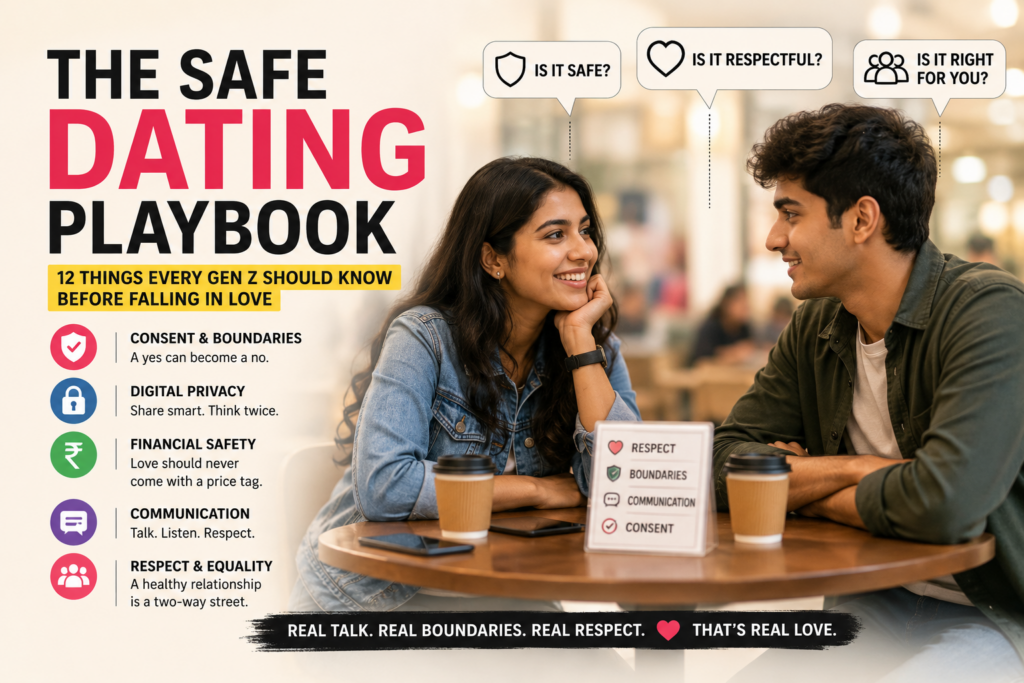
Dating has changed. So has dating safety. From consent and boundaries to UPI scams, intimate images, location sharing and breakups, young Indians need to understand that a safe relationship isn’t just about avoiding physical danger — it is also about emotional, digital and financial safety.
Dating today doesn’t begin when two people meet.
It can begin with a swipe.
Then an Instagram follow.
A DM.
A few late-night WhatsApp conversations.
A video call.
Perhaps a shared playlist.
Maybe a photograph that was never meant to leave the conversation.
By the time two people actually meet, they may already know a surprising amount about each other — or at least believe they do.
This is what makes dating in the digital age fundamentally different.
The opportunities to meet people have increased dramatically. So have the ways in which trust can be manipulated.
For Gen Z, dating safety is therefore no longer simply about being careful when meeting a stranger.
It is about understanding consent, boundaries, emotional manipulation, digital privacy, financial safety, rejection, harassment and how to leave a relationship safely.
And perhaps the most important lesson is this:
Dating should feel exciting. It should never make you feel unsafe.
1. A date is not a promise
One of the most important things young people need to understand is that agreeing to a date means exactly that:
agreeing to a date.
It doesn’t mean agreeing to physical intimacy.
It doesn’t mean agreeing to another date.
It doesn’t mean sharing personal information.
It doesn’t mean staying until the other person is ready to leave.
And it certainly doesn’t mean that either person owes the other anything.
Consent isn’t a one-time transaction.
It applies throughout an interaction.
For men, that means understanding that attraction, flirting, chemistry or even a previous “yes” do not automatically mean consent to something else.
For women, it means knowing that they can change their mind at any point without having to justify the decision.
And the same principle applies to everyone, regardless of gender.
A yes can become a no. A maybe is not a yes. Silence is not consent. Pressure is not consent.
2. Your first date should have a safety plan
There is nothing unromantic about having a safety plan.
In fact, it can make dating more comfortable.
If you’re meeting someone for the first time, consider choosing a public place where other people are around.
Tell a trusted friend where you’re going.
Keep your phone charged.
Have your own way of getting home.
And if something feels wrong, give yourself permission to leave.
You don’t need to wait for a situation to become “bad enough” to walk away.
This advice is often directed at women, but it shouldn’t be.
Men can also be victims of assault, theft, coercion, blackmail, scams or manipulation.
Safety isn’t a gender issue. It is a dating issue.
3. Chemistry isn’t the same as trust
Someone can be charming.
Funny.
Attractive.
Intelligent.
Interesting.
And still not be trustworthy.
This is particularly important in online dating, where people can construct carefully curated versions of themselves.
A great conversation doesn’t tell you everything about someone’s character.
Trust is built through consistent behaviour over time.
One of the simplest rules Gen Z can remember is:
Chemistry can happen in an evening. Trust takes time.
Don’t allow the intensity of a new connection to pressure you into giving someone access to your personal life before you’re comfortable.
4. Your phone is part of your relationship
Dating safety has entered the smartphone.
And young people need to recognise that.
Your location.
Your photographs.
Your conversations.
Your passwords.
Your social-media accounts.
Your contact list.
Your financial information.
All of these can become part of a relationship.
Sharing a live location with someone you trust for safety can be sensible.
Demanding someone’s location 24/7 is something else.
There is a difference between:
“Let me know when you reach home.”
and
“Send me your location. I need to know where you are.”
One can be care.
The other can become control.
The same applies to passwords.
A healthy relationship does not require constant access to someone’s phone, email or social-media accounts.
Privacy isn’t proof that you have something to hide.
5. Think twice before sending an intimate photograph
This may be one of the most important digital-safety lessons for Gen Z.
Before sending an intimate photograph or video, ask yourself:
What happens if I lose control of this file?
You may trust the person today.
But you cannot completely control what happens to a digital file once it leaves your phone.
Phones get hacked.
Accounts get compromised.
Relationships end.
Screenshots happen.
People make mistakes.
And sometimes people deliberately misuse private content.
Never let someone pressure you into sending an intimate image.
Statements like:
“If you trust me, you’ll send it.”
or
“Everyone does it.”
or
“I’ll send one first.”
are not proof of intimacy.
They are pressure.
And pressure is not consent.
6. Learn the difference between a red flag and a preference
Social media has turned the phrase “red flag” into a cultural meme.
But young people need to understand that not everything they dislike is a red flag.
Someone not sharing your music taste isn’t a red flag.
Someone having different food preferences isn’t a red flag.
Someone being introverted isn’t a red flag.
A red flag is about behaviour that threatens your boundaries, safety or autonomy.
For example:
Repeatedly ignoring your “no.”
Trying to isolate you from friends.
Demanding your passwords.
Monitoring your location.
Threatening to expose private conversations.
Pressuring you into physical intimacy.
Borrowing money repeatedly.
Threatening self-harm if you leave.
Trying to control who you meet or what you wear.
These aren’t simply “relationship quirks.”
They can be warning signs.
7. Jealousy isn’t automatically love
One of the most dangerous myths in relationships is that jealousy proves someone cares.
It doesn’t.
There is a difference between:
“I felt insecure when that happened. Can we talk about it?”
and
“You aren’t allowed to talk to him.”
There is a difference between:
“I miss you.”
and
“Why didn’t you reply in five minutes?”
There is a difference between:
“I’d love to meet your friends.”
and
“You don’t need those friends anymore.”
Love doesn’t require surveillance.
A healthy relationship should allow both people to maintain their own friendships, interests, privacy and identity.
8. Watch out for financial manipulation
Dating scams aren’t always complicated.
Sometimes they begin with emotional trust.
A new partner has an emergency.
They need money.
Then they need more.
Perhaps they need help paying a bill, booking travel, making an investment or transferring money.
The emotional connection can make it difficult to say no.
This is why young people should establish financial boundaries early.
Don’t share banking credentials.
Don’t share UPI PINs or passwords.
Don’t transfer money because someone makes you feel guilty.
Don’t allow someone you’ve recently met to use your bank account to receive or transfer money.
And remember:
Love should never require financial proof.
This applies equally to men and women.
9. Learn what emotional coercion sounds like
Not all pressure looks aggressive.
Sometimes it sounds romantic.
“If you really loved me…”
“After everything I’ve done for you…”
“Everyone else is okay with it.”
“You’re making me feel rejected.”
“I’ll be devastated if you don’t.”
These statements can create emotional pressure designed to make someone do something they don’t actually want to do.
A healthy partner can be disappointed by your decision without trying to punish you for it.
You are allowed to say no without managing someone else’s emotions.
10. Rejection is part of dating
This message needs to reach both men and women.
For men:
Someone saying no isn’t an insult to your masculinity.
You are allowed to feel disappointed.
You are not entitled to another chance.
You are not entitled to an explanation.
And rejection does not justify anger, harassment or humiliation.
For women:
You don’t owe someone continued access to your time because they were nice to you.
You can say no.
You can change your mind.
You can end a conversation.
And if you feel unsafe, you don’t have to prioritise being polite over protecting yourself.
The golden rule is simple:
Respect the no.
11. And then comes the part nobody teaches: how to leave
We spend enormous amounts of time teaching young people how to find relationships.
How to flirt.
How to date.
How to impress someone.
How to maintain a relationship.
But we rarely teach them how to leave one.
A healthy breakup isn’t always possible.
Sometimes the other person refuses to accept the relationship is over.
Sometimes there are threats.
Sometimes there is harassment.
Sometimes private information is used as leverage.
This is why leaving an unhealthy relationship may require planning.
Tell someone you trust.
Protect your accounts.
Change passwords.
Review location-sharing settings.
Save evidence of threatening messages.
Avoid meeting someone alone if you feel unsafe.
Seek help when necessary.
And remember:
You are allowed to leave a relationship that no longer feels right.
12. What does a healthy relationship actually look like?
Perhaps the best dating-safety lesson isn’t about identifying bad behaviour.
It is about recognising good behaviour.
A healthy relationship should allow you to say no.
You should be able to disagree.
You should be able to maintain friendships.
You should have privacy.
You should control your own money.
You should be able to make decisions about your body.
You should feel comfortable expressing discomfort.
You should be able to end the relationship.
And you should not have to constantly prove your love.
In other words:
Safety isn’t just the absence of violence.
It is the presence of respect, autonomy, trust and boundaries.
TheYouthTalks Take: Dating doesn’t need to be scary
Gen Z doesn’t need another lecture telling them not to date.
Young people will date.
They will fall in love.
They will have awkward first dates.
They will make mistakes.
They will get their hearts broken.
They will sometimes make decisions they later regret.
That’s part of growing up.
The responsibility of adults, educators, platforms and communities should not be to eliminate those experiences.
It should be to make young people better equipped to navigate them.
Because the dating world Gen Z is entering is fundamentally different from the one their parents grew up in.
A date can begin on an app.
Trust can be built through WhatsApp.
Intimacy can happen through a screen.
A relationship can be monitored through location sharing.
Money can change hands through UPI.
Private moments can become digital files.
And a breakup can continue long after two people stop seeing each other — through messages, photographs, social media and online harassment.
That means dating safety has to evolve too.
For men, it means learning that confidence isn’t pressure, rejection isn’t humiliation, and love isn’t ownership.
For women, it means knowing that boundaries don’t require an apology, politeness should never come at the cost of safety, and leaving is always an option.
And for everyone, the message is the same:
Know your boundaries. Respect someone else’s. Protect your privacy. Don’t confuse control with love. Take your time. Trust behaviour over words. And if something feels wrong, listen to yourself.
Because the best relationship isn’t the one that looks perfect on Instagram.
It’s the one where both people feel safe enough to be themselves.
And perhaps that is the most important dating lesson Gen Z can learn: