

As young Indians reassess the costs, career prospects and lifestyle implications of overseas education, the journey to a foreign university is creating opportunities for brands across technology, finance, travel, fashion and everyday consumer goods.
For generations of Indian families, studying abroad has represented more than a degree. It has been associated with better career prospects, international exposure, independence and the possibility of building a different future.
For today’s Gen Z, however, the decision is becoming more complicated. Global ambitions remain strong, but rising costs, changing immigration policies and uncertainty about employment opportunities are forcing prospective students and their families to scrutinise what an overseas education will actually deliver.
That tension is creating an interesting consumer story.
A student contemplating a university in the United Kingdom, Canada, Germany or Australia is not simply choosing an educational institution. The decision potentially involves years of financial planning, discussions with parents, extensive digital research and a series of purchases spanning technology, travel, accommodation, financial services and lifestyle products.
For marketers, this creates an opportunity to understand a high-involvement consumer journey that begins well before admission and continues long after a student arrives at their destination.
Research by Emeritus, QS and NITI Aayog offers three complementary perspectives on this journey: the changing ambitions of young Indians, the factors influencing their overseas education decisions, and the scale of India’s international student mobility.
Together, they suggest that brands should look beyond the familiar narrative of young Indians aspiring to move abroad and pay closer attention to how they make that decision.
The global ambition remains, but the calculation is changing
Emeritus’ India’s Gen Z Outlook 2026: The No-Cap Generation offers a useful starting point for understanding the changing mindset.
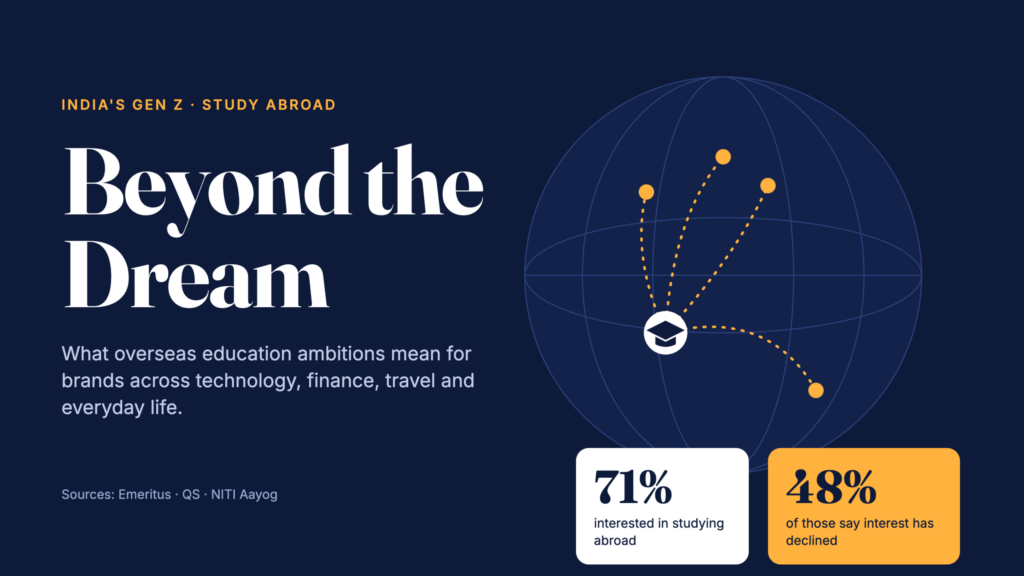
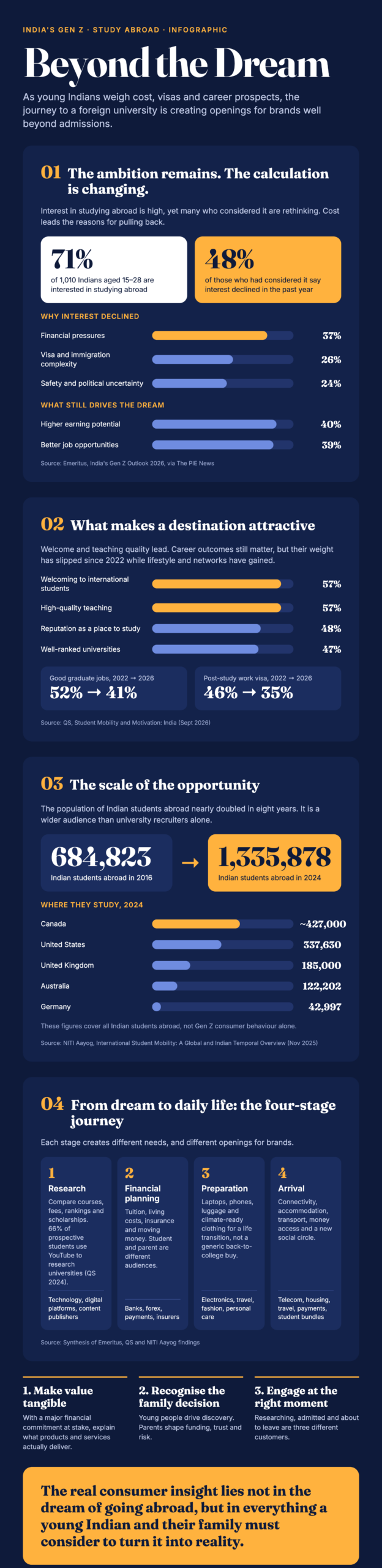
The study surveyed 1,010 Indians aged 15–28 across more than 50 cities, examining attitudes towards careers, education and ambition. According to findings reported by The PIE News in October 2026, 71% of respondents expressed interest in studying abroad.
Yet the same research revealed a more complicated picture. Among respondents who had considered overseas education, 48% said their interest had declined over the preceding year.
Financial pressures were the leading reason for this reassessment, cited by 37% of respondents reporting declining interest. Visa and immigration complexities were cited by 26%, while 24% pointed to safety and political uncertainty.
Career considerations remained important motivations for pursuing an overseas education. Forty per cent cited higher earning potential and 39% cited better job opportunities.
Source: Emeritus, India’s Gen Z Outlook 2026, as reported by The PIE News.
These findings do not suggest that young Indians have abandoned the idea of studying abroad. Instead, they point to a generation weighing its ambitions against the financial and practical realities of achieving them.
For marketers, that distinction matters.
A consumer who is enthusiastic about an overseas education may simultaneously be concerned about affordability, employment prospects and the risk of making an expensive decision that fails to deliver the expected outcome.
This creates room for brands to offer something more valuable than aspiration alone: clarity, reassurance and demonstrable value.
For a financial services company, that might mean helping families understand international payments and budgeting. For a technology brand, it could mean demonstrating the durability and capabilities of a device that will support a student through several years of study. For a university, it means making the relationship between course costs, teaching quality and career opportunities easier to understand.
The broader lesson is that ambition may initiate the journey, but confidence can help determine which products and services consumers ultimately choose.
What makes a destination attractive to India’s Gen Z?
The QS report Student Mobility and Motivation: India, published in September 2026, provides a complementary view of prospective students’ priorities.
According to QS, 57% of prospective Indian students selected a welcoming environment for international students as a factor influencing destination appeal. The same proportion selected high-quality teaching. A destination’s reputation as a place to study was cited by 48%, while 47% identified well-ranked universities.
Career outcomes continued to matter, but QS reported that their relative importance had declined compared with 2022. The share selecting good graduate employment opportunities fell from 52% to 41%, while the share citing access to post-study work visas declined from 46% to 35%.
Meanwhile, the appeal of cultural and lifestyle experiences increased, as did the importance attached to building professional networks.
Source: QS, Student Mobility and Motivation: India.
The findings suggest that destination selection is not exclusively about a university’s academic credentials or the prospect of securing a job after graduation.
Students also consider whether they will feel welcome, build friendships, experience a different culture and develop relationships that could shape their professional lives.
For consumer brands, this broadens the opportunity.
A student preparing to move overseas may be choosing a destination partly for its academic reputation and employment prospects, but their eventual experience will also be shaped by the practicalities of daily life: staying connected with family, finding accommodation, navigating an unfamiliar city and building a social circle.
Brands that understand these needs can position themselves as useful companions in the transition rather than simply advertisers targeting an aspirational audience.
It is important, however, not to interpret QS’s findings as evidence that employability or affordability no longer matter. They remain significant considerations. The findings instead suggest that destination appeal encompasses a broader mix of academic, practical and lifestyle factors.
The scale of the opportunity
NITI Aayog’s November 2025 working paper, International Student Mobility: A Global and Indian Temporal Overview, provides the wider context.
Drawing on data from India’s Ministry of External Affairs and data.gov.in, the paper records 1,335,878 Indian students pursuing education abroad in 2024, compared with 684,823 in 2016.
The data also show how destination preferences have evolved. Canada hosted approximately 427,000 Indian students in 2024, followed by the United States at 337,630, the United Kingdom at 185,000 and Australia at 122,202. Germany hosted 42,997 Indian students.
Source: NITI Aayog, International Student Mobility: A Global and Indian Temporal Overview.
These figures provide evidence of the scale of India’s overseas student population and the range of destinations involved.
They should not, however, be read as a direct measure of Gen Z consumer behaviour. The figures cover Indian students abroad more broadly, while Emeritus and QS examine particular survey populations and their attitudes or intentions.
For marketers, the value of the NITI Aayog data is in establishing that overseas education has implications extending beyond university recruitment. A large population of Indian students living abroad represents a potential audience for services supporting education, mobility, payments, accommodation and everyday consumption.
The commercial opportunity is not uniform across every category, nor does every student have the same purchasing power. But the journey creates multiple occasions on which relevant brands can be considered.
From university research to everyday consumption
The overseas education journey can be viewed as a series of stages, each creating different consumer needs.
1. The research stage: technology and digital discovery
Before applying to a university, students typically investigate courses, fees, rankings, scholarships, destinations and entry requirements.
QS’ 2024 report, From India to the World, based on more than 12,000 prospective Indian students interested in overseas education, found that 66% used YouTube to research universities. The report also highlighted the importance of high-quality teaching and career-related information in student decision-making.
Source: QS International Student Survey 2024 — India report.
For technology brands, this points to an audience with a practical need for devices capable of handling research, applications, video calls, online assessments and eventually university coursework.
For digital platforms and content publishers, the research journey creates opportunities to provide useful information when students are actively comparing options.
Education providers can also benefit from making course details, fees, teaching quality and student experiences accessible through the channels prospective students actually use.
The implication is not simply to advertise more heavily on video platforms. It is to deliver credible, decision-useful information in the formats students prefer.
2. The financial planning stage: banking, payments and insurance
Once a student begins seriously considering overseas education, the financial implications become more immediate.
Families must assess tuition, accommodation, living expenses, travel, insurance and the practicalities of moving money internationally.
Emeritus’ findings on financial pressure suggest that affordability can influence whether students continue pursuing their original plans.
This creates a potential role for banks, foreign-exchange providers, international payment services, insurers and financial planning platforms.
The opportunity lies in reducing complexity and helping families understand the costs involved. Transparent fees, reliable payment processes, accessible guidance and clear explanations of coverage can be more persuasive than generic promises about a global lifestyle.
Financial services brands should also recognise that the student and the parent may be different audiences. The student may be researching destinations and managing everyday expenses, while parents may be more concerned about the total financial commitment, security and reliability.
Communication that addresses both perspectives is likely to be more relevant than treating the family as a single, undifferentiated consumer.
3. The preparation stage: electronics, travel and personal essentials
As departure approaches, aspirations translate into concrete shopping decisions.
Students may need laptops, smartphones, headphones, luggage, travel accessories, clothing suited to the destination’s climate and other essentials for independent living.
This creates a potential opportunity for consumer electronics, fashion, luggage, travel and personal-care brands.
The important consideration is that students are not necessarily buying these products for the same reasons as consumers who remain in India.
A laptop may need to support a particular course, last through several academic years and function reliably across different environments. A smartphone may become the primary link to family and friends in India. Luggage and clothing may need to accommodate international travel and a different climate.
Brands that provide clear comparisons, reliable after-sales support, warranties and products suited to the student’s actual requirements can address these needs directly.
The opportunity should not be reduced to a generic back-to-college campaign. Preparing to move overseas is a distinct life transition with its own purchase decisions.
4. The arrival stage: connectivity, accommodation and everyday services
After reaching a destination, students face another set of decisions.
They need reliable connectivity, suitable accommodation, local transport, access to money and ways to navigate unfamiliar surroundings. Over time, they also establish routines around food, shopping, entertainment and social activities.
Telecommunications companies, accommodation providers, travel platforms, payment services and consumer brands can all potentially serve these needs.
This is also where the importance of a welcoming environment, highlighted by QS, becomes relevant to the broader consumer experience.
Students are not only adapting to a new academic system; they are building a life in a different country. Products and services that make that transition easier may become part of their everyday routines.
For marketers, this creates opportunities for useful onboarding information, student-specific service bundles and partnerships with education providers or student communities.
Such initiatives should be grounded in actual student needs rather than assumptions about what all international students want.
The marketing lesson: understand the journey, not just the aspiration
Taken together, the Emeritus and QS research offers a more nuanced view of Indian Gen Z than the familiar image of a generation uniformly determined to move abroad.
Some young Indians remain strongly interested in international education. Others are reassessing the decision because of cost, visa uncertainty or concerns about safety. Students also differ in their destination preferences, course choices, financial circumstances and career expectations.
For brands, this means there is no single overseas-student consumer profile.
The more useful approach is to understand the different stages of the journey and identify where a product or service can provide genuine value.
A technology company might focus on the preparation stage. A bank might prioritise financial planning and international payments. A travel brand might serve students preparing for departure. A telecommunications provider might concentrate on connectivity after arrival.
Universities and education platforms have an additional responsibility: to communicate clearly about the academic experience, costs, student support and realistic career pathways.
Across categories, three principles stand out.
First, make value tangible. When an overseas education involves a substantial financial commitment, brands should explain what their products and services actually deliver.
Second, recognise the family decision. Young people may drive discovery, but parents and other family members can influence funding, trust and risk assessment.
Third, engage at the right moment. A student exploring universities has different needs from someone who has received an admission offer or is preparing to leave India. Timely, relevant communication is more useful than treating every prospective student as equally ready to purchase.
Beyond the dream
Studying abroad remains a significant aspiration for many young Indians, but the decision is increasingly being evaluated through the realities of affordability, academic quality, employment prospects, personal safety and everyday life.
The Emeritus findings illuminate the tension between interest and hesitation. QS helps explain the factors shaping destination choices. NITI Aayog’s data establishes the wider scale of India’s international student mobility.
For marketers, the combined message is clear: overseas education is not simply a story about where young Indians want to go. It is also a story about the decisions, products and services that shape how they get there and how they live once they arrive.
The brands that recognise this may find opportunities extending well beyond university admissions.
The real consumer insight lies not in the dream of going abroad, but in understanding everything a young Indian and their family must consider to turn that dream into reality.