
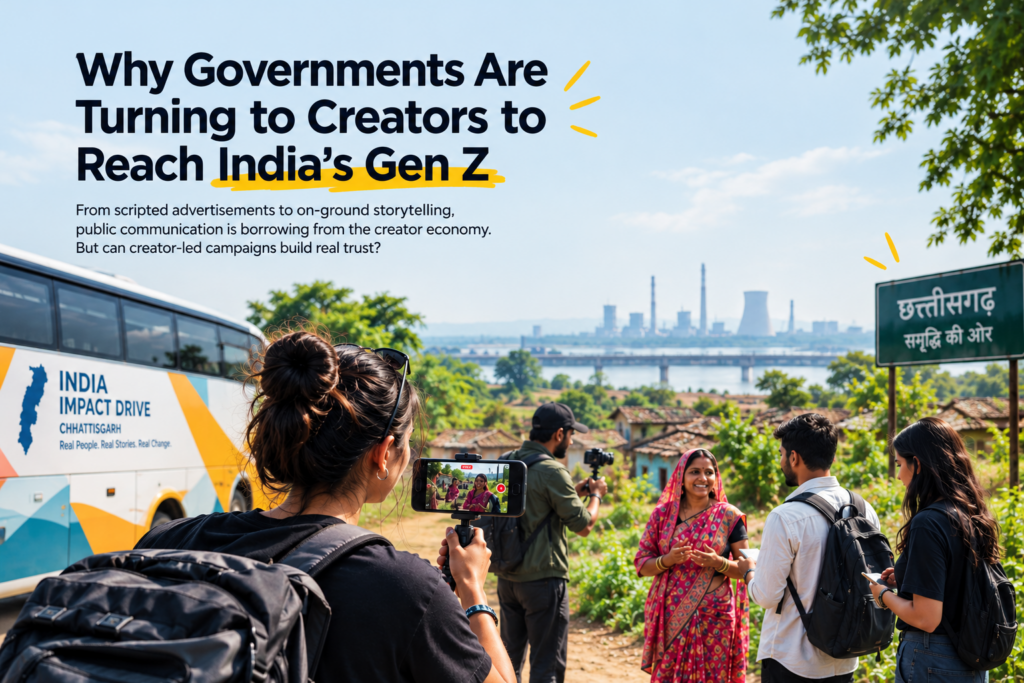
From scripted advertisements to on-ground storytelling, public communication is beginning to borrow from the creator economy. A Chhattisgarh campaign offers a glimpse of this shift, but views alone cannot establish whether young citizens are listening, believing or acting.
A government department has a development story to tell. Traditionally, that story might find its way into a press release, a newspaper advertisement or a carefully produced video featuring officials and project announcements. Today, there is another option: put a group of digital creators on a bus, take them across the state and let them tell the story in their own words.
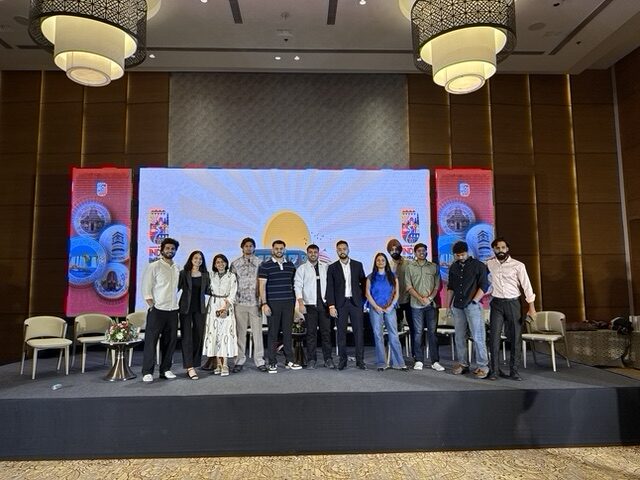
That is the approach adopted by the Government of Chhattisgarh through India Impact Drive, a creator-led storytelling initiative developed by Adosphere. In September 2026, 11 creators travelled more than 1,000 km from Raipur to Raigarh, documenting communities, industries and local initiatives along the way.
According to campaign figures released on October 26, their content generated more than 12 million views between October 4 and 12. The creators had a combined following of 14.6 million, engagement reportedly reached as high as 10%, and more than 80% of comments and reactions were classified as positive sentiment.
The numbers are noteworthy, but the more interesting question is what lies behind the campaign: why are governments increasingly interested in creators, and what can this tell us about the changing ways young Indians encounter public information?
Gen Z’s media habits are changing the communication playbook
For institutions trying to reach younger audiences, the challenge is no longer simply getting information published. It is getting that information noticed in an environment crowded with entertainment, opinions, short videos and personality-led content.
The Reuters Institute’s Digital News Report 2026 offers a useful indication of this shift. Its India findings say around 58% of respondents in its primarily English-speaking sample rely on YouTube for news. The report also describes a media environment in which video-led social platforms, independent creators and traditional news organisations compete for attention.
The findings should not be mistaken for a nationally representative measure of every Indian Gen Z consumer. Nevertheless, they illustrate the importance of digital video and creator-led formats in the country’s news ecosystem.
For governments, the implications extend beyond news consumption. Public information about education, employment, health, transport, welfare schemes and local infrastructure must compete for attention on the same platforms where young people watch creators discuss careers, technology, culture and everyday life.
A formal announcement may communicate what a department has done. A creator visiting a community, speaking to a beneficiary and documenting the experience can potentially make that information more tangible.
The difference is not necessarily the message itself. It is the way the message is encountered.
From influencer endorsements to creator-led storytelling
The Chhattisgarh initiative reflects a distinction that matters to marketers as much as it does to public institutions: the difference between asking creators to distribute a message and allowing them to build a story around an experience.
In conventional influencer campaigns, the organisation often determines the talking points, approves the content and measures the resulting reach. This can work well for straightforward announcements. But excessive scripting risks making content feel like an advertisement, particularly when it appears on a creator’s channel alongside their usual independent work.
India Impact Drive took a different stated approach, providing creators with access to locations and communities rather than a prescribed script.
The itinerary covered planned urban development in Raipur and Nava Raipur, industry in Durg and Bhilai, women-led self-help groups and forest-based enterprise around Jashpur and Kunkuri, and the energy corridor around Raigarh.
Individual stories included a film about Ambikapur’s Garbage Cafe, which reportedly crossed 2.5 million views, and accounts of women building village enterprises. Other creators documented livelihoods, public infrastructure and changes in areas previously affected by Maoist violence.
These examples give audiences specific people and places through which to understand a larger development narrative. They also create opportunities for stories that a standard government advertisement might struggle to tell with the same intimacy.
However, access is not the same as editorial independence. A campaign can give creators freedom over presentation while still influencing which locations, beneficiaries and initiatives they encounter. The extent of that freedom, including whether creators could report setbacks or criticism, is an important question when evaluating the model.
A growing creator economy makes the model more attractive
The government experiment is taking place within a much larger commercial shift.
A May 2025 report by Boston Consulting Group, From Content to Commerce: Mapping India’s Creator Economy, estimated that the country had 2–2.5 million monetised creators influencing more than $350 billion in consumer spending. It projected that creator-influenced consumption could exceed $1 trillion by 2030.
These estimates concern the broader creator economy, not government communication. Yet they demonstrate why creators have become important intermediaries between organisations and audiences.
The commercial appeal is not limited to follower counts. Creators develop distinctive relationships with communities built around language, location, professional interests and cultural identity. A regional creator may be better placed to explain a local employment initiative than a nationally recognised celebrity with a much larger audience.
For public communication, this opens up possibilities across state and district boundaries. Creators can document local infrastructure, explain public services, profile entrepreneurs, highlight tourism destinations or translate complex initiatives into accessible formats.
The model could be particularly relevant when communicating with young people outside major metropolitan centres, provided creators are selected for local credibility and subject knowledge rather than reach alone.
The same logic that makes a specialist technology creator useful to a software brand may make a regional storyteller useful to a public institution. Relevance, familiarity and the ability to explain a subject can matter as much as scale.
The numbers look promising. But what do they prove?
The Chhattisgarh campaign’s reported 12 million views provide an indication of distribution. They do not, by themselves, establish how many distinct people watched the content, how much of each video they consumed or whether viewers understood the issues being presented.
Similarly, an engagement rate reaching 10% is not necessarily the average rate across all content. The result depends on the calculation method, platform and mix of posts. The reported positive sentiment figure also needs context: how many comments were analysed, how was sentiment classified, and was the analysis independently verified?
These are not reasons to dismiss the campaign. They are reasons to distinguish between reach, response and impact.
For governments, a more meaningful measurement framework would examine whether audiences remembered a scheme, understood eligibility requirements, visited an official information page, completed an application or took another relevant action. For campaigns intended to build public awareness, pre- and post-campaign research could help determine whether knowledge changed.
Independent assessment would also help establish whether creator-led communication performs better than conventional government content when the audience, subject and distribution conditions are comparable.
Without that evidence, the safest conclusion is that the campaign achieved reported digital reach—not that it has conclusively demonstrated greater public trust.
Trust is the opportunity, but also the responsibility
Creator-led communication works partly because audiences choose to follow individual personalities rather than institutions alone. That relationship can make unfamiliar information more accessible. It can also create risks when a paid partnership is presented as spontaneous personal endorsement.
For public-sector campaigns, transparency matters. Audiences should be able to understand who commissioned the content, what role the government played and whether a creator received compensation or other benefits. Clear disclosures and access to verifiable information are essential to maintaining credibility.
There is also a difference between showing a successful project and providing a complete picture of public services. A series of compelling individual stories can illustrate progress, but it cannot establish the effectiveness of an entire policy or programme.
The strongest creator-led initiatives will therefore need more than cinematic videos and high engagement. They will need credible storytellers, transparent partnerships, evidence that supports their claims and room for audiences to ask questions.
What marketers can learn from the experiment
The implications extend beyond government communication. Brands trying to connect with Gen Z face a similar challenge: how to communicate a message without making every interaction feel like a sales pitch.
Three lessons stand out.
First, build experiences worth documenting. Rather than treating creators as distribution channels, organisations can give them meaningful access to products, people, places and processes.
Second, match creators to the story. The most suitable creator may be the person with relevant expertise or a strong regional connection, not necessarily the largest following.
Third, measure outcomes beyond views. Reach matters, but audience understanding, meaningful engagement and subsequent action provide a more complete picture of effectiveness.
Chhattisgarh’s India Impact Drive is an early example of how these principles might be applied to public communication at scale. Whether the model becomes a durable alternative to conventional government campaigns will depend on the quality of future chapters and the evidence they produce.
For now, the larger shift is worth watching. As public institutions compete for attention in a creator-driven media environment, the question is no longer simply how to broadcast a message. It is how to make information relevant enough for people to engage with it—and credible enough for them to take it seriously.