
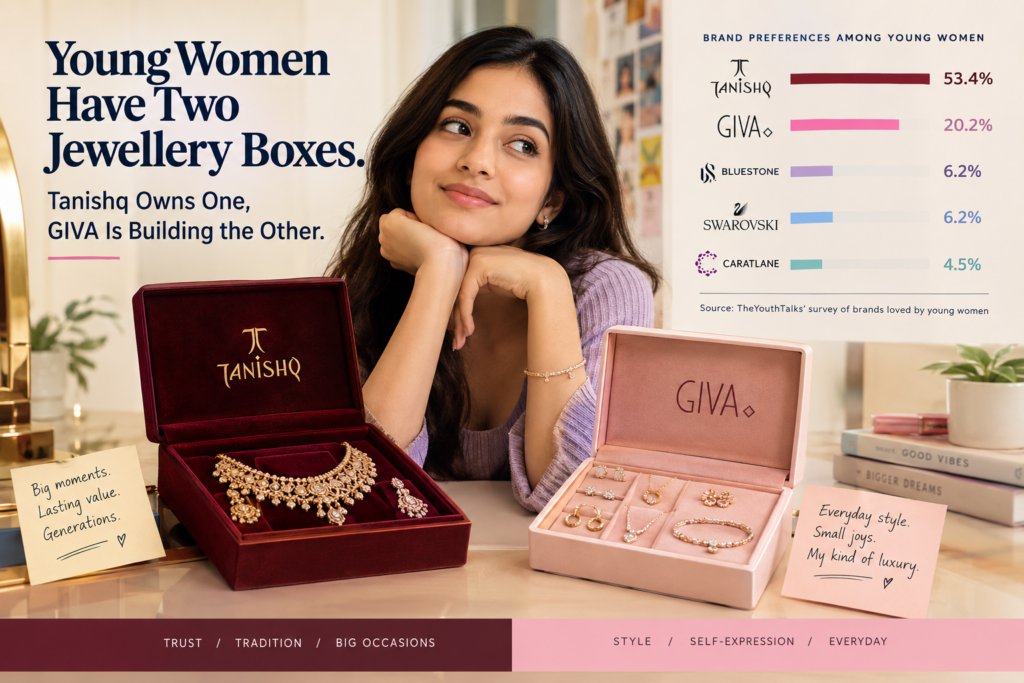
Tanishq commands more than half of jewellery preferences among young women. But GIVA’s strong second-place finish reveals something more interesting: jewellery is becoming less about occasions and more about everyday self-expression.
There is a particular kind of purchase that makes people pause before they spend.
Jewellery is one of them.
A dress can be bought on impulse. A pair of sneakers can be justified as a necessity. But when it comes to jewellery, especially something expensive, the decision often carries more weight. There is money involved, certainly, but there is also trust, family influence, perceived quality and, sometimes, the expectation that what you buy today could still be around decades from now.
That is what makes the latest jewellery preferences among young women particularly revealing.
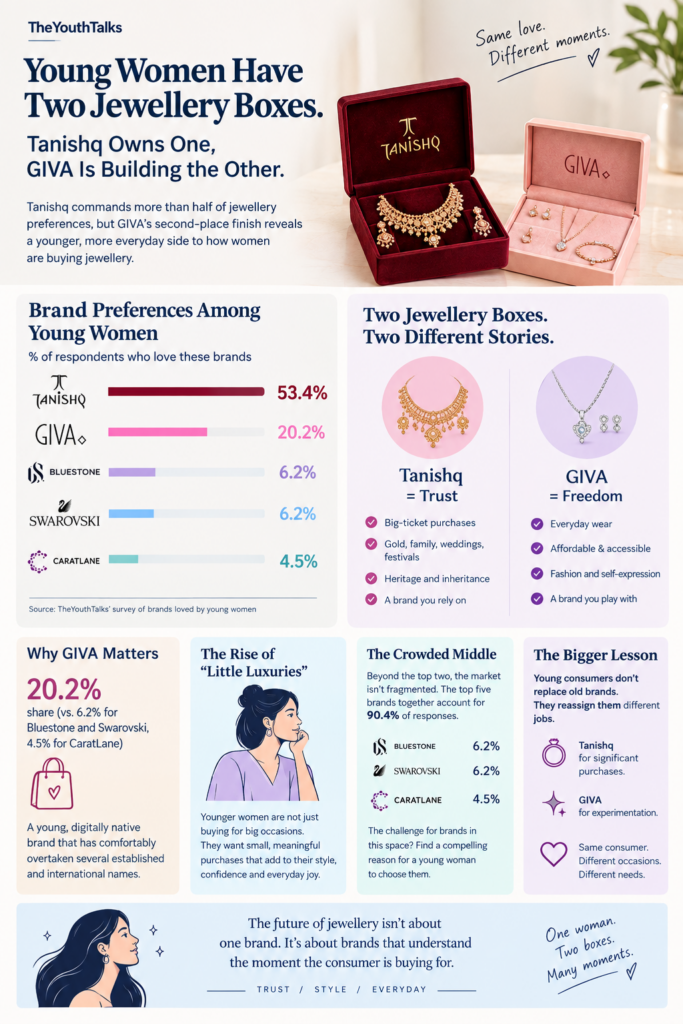
According to TheYouthTalks’ survey of brands loved by young women, Tanishq is the clear leader, named by 53.4% of respondents. Its nearest competitor, GIVA, is at 20.2%.
Bluestone and Swarovski follow at 6.2% each, while CaratLane records 4.5%.
The gap between Tanishq and GIVA is therefore a striking 33.1 percentage points.
There is no real contest at the top.
But perhaps that isn’t the most interesting part of the story.
The more intriguing question is: why has GIVA managed to occupy such a strong No. 2 position among a younger audience?
The answer may lie in the fact that young women are not necessarily choosing between Tanishq and GIVA.
They may be buying both—for very different reasons.
Tanishq Owns the Jewellery of Trust
For decades, jewellery in India has been about much more than adornment.
It has been part of weddings, festivals, family traditions, milestones and inheritance. Gold, in particular, has carried financial and emotional significance. Jewellery can be gifted by parents, purchased for a wedding, passed between generations or kept as an asset.
In that environment, trust becomes an extraordinarily powerful brand asset.
Tanishq’s 53.4% preference share reflects precisely that kind of accumulated equity.
When someone is spending a substantial amount of money on jewellery, familiarity matters. Consumers want to know where the product comes from, whether the quality will hold up and whether the brand will stand behind the purchase.
There is also an emotional dimension.
Imagine a young woman buying her first significant piece of jewellery with money she has saved herself. The decision is unlikely to be based purely on what looks good on Instagram. She may ask her mother. She may speak to a friend. She may visit a store before making the final decision.
The purchase becomes a moment.
And when a purchase feels consequential, established trust has enormous value.
This is where Tanishq’s position is difficult to challenge.
It isn’t simply selling jewellery. It has spent years becoming synonymous with the idea that jewellery is something worth trusting.
Then Comes GIVA—and a Different Jewellery Habit
Now consider the woman who buys a pair of earrings because she likes them.
There is no wedding.
No festival.
No anniversary.
No elaborate family discussion.
She simply sees something that fits her style and thinks: I want that.
This is where the GIVA story becomes fascinating.
At 20.2%, GIVA isn’t merely appearing somewhere in the rankings. It is comfortably ahead of several internationally recognised and established jewellery names in the survey.
That suggests a shift in what jewellery can mean to a younger consumer.
For this generation, jewellery does not always have to be a once-in-a-while purchase. It can be part of everyday dressing, personal style and self-expression.
A necklace can accompany a dinner with friends.
A bracelet can become part of a college outfit.
A pair of earrings can be bought simply because they work with a particular look.
The purchase can be small, spontaneous and personal.
In other words, jewellery is increasingly becoming an accessory rather than only an occasion.
And that is a very different market opportunity.
The Other Jewellery Box
Perhaps the simplest way to understand the data is to imagine that young women have two jewellery boxes.
The first contains the pieces that matter.
The wedding jewellery. The expensive purchase. The gold. The piece that parents might help choose. The necklace that could eventually become a family heirloom.
Tanishq has a formidable claim on this box.
The second box is more playful.
It contains the earrings purchased for a particular outfit, the bracelet that caught someone’s attention online, the necklace bought before a holiday or the small piece that simply felt like a good idea on a Friday evening.
GIVA appears to be building this box.
The two boxes can coexist.
In fact, they may be complementary.
That is an important distinction because consumer markets are often described through a binary lens: old versus new, traditional versus modern, premium versus affordable.
Young consumers do not always behave that way.
They can hold multiple preferences at once.
They can trust one brand for a major purchase and discover another for everyday experimentation.
Jewellery Is Becoming a “Little Luxury”
There is a broader consumer behaviour hiding underneath this shift.
Young Indians may be increasingly conscious about spending, but that doesn’t mean they have abandoned aspiration.
Instead, aspiration is often being broken into smaller, more attainable moments.
A relatively affordable piece of jewellery can deliver a sense of occasion without requiring the kind of financial commitment associated with traditional jewellery buying.
That makes jewellery particularly interesting as a category.
A woman may not be ready to spend a large amount on a luxury handbag. She may not want to buy expensive jewellery every few months. But a smaller piece can still provide that feeling of owning something beautiful, personal and slightly indulgent.
It becomes a little luxury.
And little luxuries can be surprisingly powerful.
They allow consumers to reward themselves without waiting for someone else to give them a reason to celebrate.
This is particularly relevant to younger consumers, for whom purchasing decisions are increasingly intertwined with identity.
The question is no longer simply, “Is this valuable?”
It is also:
“Does this feel like me?”
The Crowded Middle Has a Problem
The numbers become even more interesting when we move beyond the top two.
Bluestone and Swarovski each record 6.2%, while CaratLane stands at 4.5%.
Together, the top five brands account for 90.4% of responses.
That tells us something important.
This isn’t an endlessly fragmented jewellery market in the minds of these young consumers. A small number of brands dominate consideration.
But there is a pronounced gap between the first two and everyone else.
Tanishq has built a huge moat around trust and established jewellery credentials.
GIVA, meanwhile, appears to have found a powerful contemporary proposition around accessibility, design and everyday wear.
The brands sitting between these two positions face a difficult question:
Why should a young woman choose you?
Being established may not be enough.
Being fashionable may not be enough either.
The opportunity lies in owning a distinct consumer moment.
Young Consumers Don’t Always Replace Brands. They Reassign Them.
This may ultimately be the biggest lesson from the data.
When a new generation enters a category, we often expect disruption to mean replacement.
The assumption is that younger consumers will abandon established brands and move entirely towards newer ones.
But that’s not necessarily what is happening here.
Instead, young consumers may be reassigning jobs to brands.
Tanishq can be the brand for a significant purchase.
GIVA can be the brand for experimentation.
One can represent permanence.
The other can represent spontaneity.
One is about an investment.
The other is about expression.
And neither necessarily needs to eliminate the other.
Think about a young woman getting ready for a friend’s wedding. She may wear a significant piece of jewellery purchased from Tanishq. A few weeks later, she may order a pair of GIVA earrings to wear with a completely different outfit.
There is no contradiction.
She isn’t necessarily changing her mind about jewellery.
She is changing the occasion for which she is buying it.
The Real Battle May Be Over Occasions
This is why the future of jewellery may not be determined simply by who has the biggest brand or the largest catalogue.
It may be determined by who understands the moment of purchase.
Jewellery for weddings is one market.
Jewellery for work is another.
Jewellery for college, dates, holidays, birthdays, festivals, nights out or simply “because I liked it” represents a collection of increasingly important micro-occasions.
And younger consumers are creating more of those occasions.
That gives brands an opportunity to move jewellery from the jewellery store into the everyday wardrobe.
It also changes how brands need to communicate.
The traditional jewellery advertisement often speaks about relationships, heritage and milestones.
The newer jewellery conversation can be about personality, mood, fashion and self-expression.
Neither is inherently better.
They simply answer different questions.
Two Boxes, One Consumer
The most revealing takeaway from TheYouthTalks’ data may therefore have little to do with which brand is winning.
Tanishq’s 53.4% share is an extraordinary demonstration of the power of trust and brand equity.
GIVA’s 20.2% is a different kind of achievement. It suggests that a younger, digitally native jewellery proposition can establish meaningful emotional relevance without necessarily inheriting the traditional associations of the category.
And perhaps that is exactly where the jewellery market is heading.
Not from traditional to modern.
Not from Tanishq to GIVA.
But from one jewellery occasion to many.
Young women may not be looking for one brand to fulfil every jewellery need. They may be building wardrobes—and jewellery boxes—that serve different versions of themselves.
There is the piece they will keep forever.
And there is the piece they want to wear tonight.
Tanishq has built an extraordinary position in the first box. GIVA appears to be making a serious claim on the second.
The brands that understand that distinction may be the ones that define the next chapter of India’s jewellery market.
Because the future consumer may not ask, “Which jewellery brand do I love?”
She may ask a much more interesting question:
“Which brand do I need for this moment?”