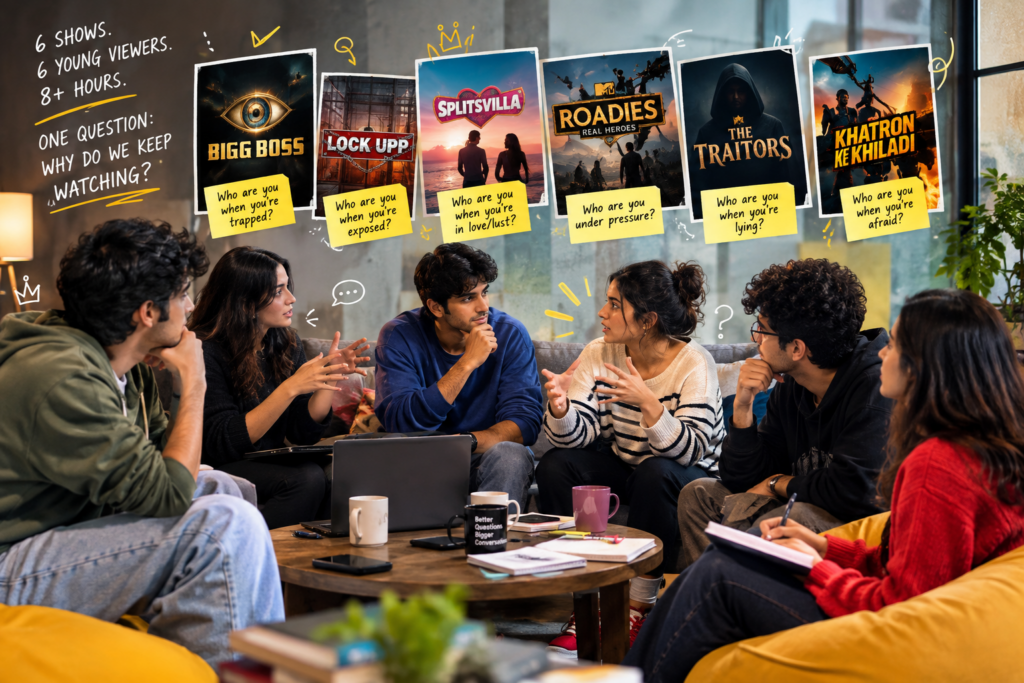
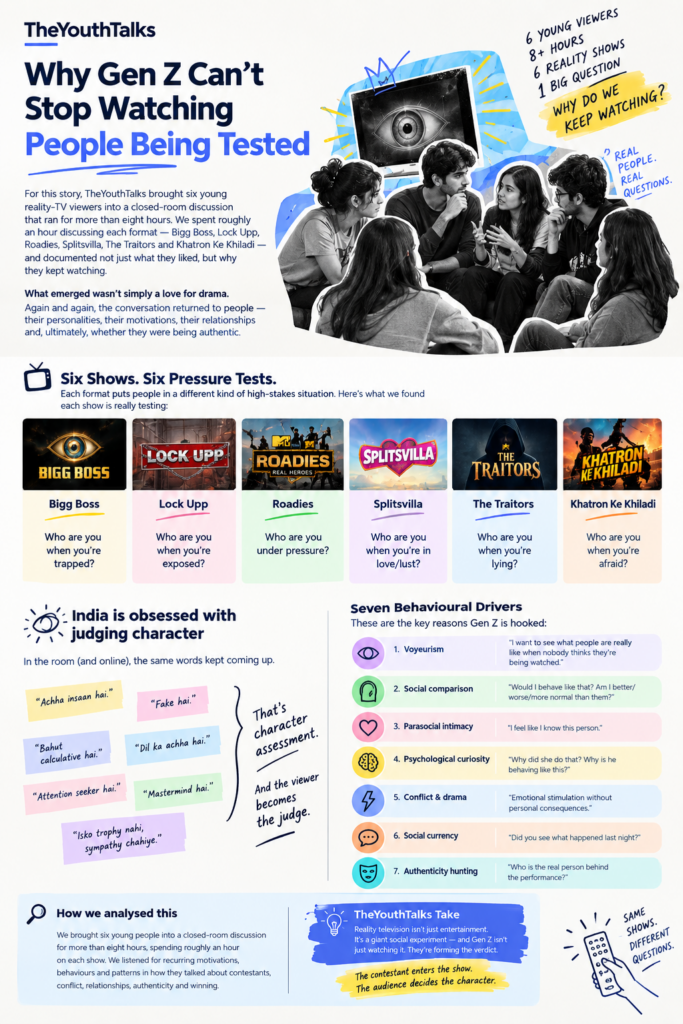
6 young people. 8+ hour Discussion. 6 reality shows. One question: Why do we keep watching?
There is a moment in almost every reality show when something changes.
The shouting stops. The challenge is over. The contestants go back to the house, the room or the group. And suddenly, the audience stops asking what happened.
Instead, a more interesting question takes over:
What does this tell me about the person?
Is he genuine?
Is she fake?
Is that confidence or arrogance?
Is this friendship real?
Is he playing the game?
Does she deserve to win?
Is this who they really are, or simply who they want the cameras to see?
For this edition of TheYouthTalks Cultural Lab, we wanted to understand what sits beneath India’s enduring fascination with reality television.
So we put six young people through a simple experiment: more than eight hours of viewing across six popular formats — Bigg Boss, Lock Upp, Roadies, Splitsvilla, The Traitors and Khatron Ke Khiladi.
Different shows. Different rules. Different contestants.
But beneath all of them was a surprisingly similar proposition:
Put people under pressure and let’s see who they really are.
Perhaps that is the real product being consumed.
Not the task.
Not the fight.
Not even the contestant.
The character.
Reality TV Is Less About Reality Than Revelation
Reality television is easy to dismiss as mindless entertainment. There is drama, romance, jealousy, competition, conflict and, inevitably, a fair amount of chaos.
But research into reality-TV audiences suggests the attraction is more complicated.
Studies have linked reality-TV consumption with voyeuristic viewing, while other research has examined the role of social comparison and the emotional reactions viewers experience when comparing themselves with reality-TV participants.
And Big Brother research offers perhaps the most revealing insight of all: audiences are drawn to the social and performative nature of the format and actively look for moments when contestants appear to be genuinely themselves inside an obviously artificial environment.
That is the paradox.
The more manufactured the environment, the more interested we become in discovering something that feels real.
Six Shows. Six Pressure Tests.
Look at the six formats through a slightly different lens.
Bigg Boss – Who are you when you’re trapped?
Lock Upp – Who are you when you’re exposed?
Roadies – Who are you under pressure?
Splitsvilla – Who are you when attraction, jealousy and competition enter the room?
The Traitors – Who are you when you have to lie?
Khatron Ke Khiladi – Who are you when you’re afraid?
The circumstances change, but the underlying experiment remains remarkably consistent.
Pressure creates behaviour. Behaviour creates clues. And the audience interprets the clues.
This is why the viewer becomes more than a spectator.
They become a judge.
India Doesn’t Just Watch. India Judges Character.
Listen to the language surrounding any popular reality show.
“Achha insaan hai.”
“Fake hai.”
“Bahut calculative hai.”
“Dil ka achha hai.”
“Attention seeker hai.”
“Mastermind hai.”
These aren’t merely comments about gameplay. They are judgments about character.
Every argument becomes evidence. Every friendship becomes evidence. Every apology becomes evidence. Even silence becomes evidence.
The audience is constructing a psychological profile of someone it has never met.
And that is culturally fascinating.
Indian social life has long involved evaluating whether someone is trustworthy, genuine, selfish, arrogant, kind or “good.” Reality television takes that familiar instinct and turns it into a mass entertainment format.
The contestant enters. The audience observes. A decision is made. A verdict begins to form.
Then comes another episode — and the verdict changes.
The Audience Is Doing More Than Watching
One of the reasons reality television remains so powerful is that the show rarely ends when the episode ends.
A controversial statement becomes a Reel.
A fight becomes a meme.
An elimination becomes a WhatsApp debate.
A contestant’s behaviour becomes an argument between friends.
The audience is no longer simply consuming content.
It is collecting conversation currency.
Research into interactive Big Brother audiences has similarly found that younger, more digitally engaged viewers could become more involved with the programme beyond passive television viewing.
That matters enormously in the social-media era.
Entertainment is increasingly not just:
“What did you watch?”
It is:
“What can you talk about because you watched it?”
The show provides the material.
The audience builds the culture around it.
So Why Do We Keep Watching?
Our Cultural Lab identified seven overlapping behavioural forces.
1. Voyeurism
We are naturally curious about situations we would normally never witness.
A friendship breaking down. Someone falling in love. Someone lying. Someone being rejected. Someone losing control.
Reality television gives viewers access to other people’s emotional lives without requiring them to experience the consequences themselves. Research has found a positive relationship between voyeuristic tendencies and reality-program consumption.
2. Social Comparison
Reality television quietly asks:
Would I behave like that?
Would I lose my temper?
Would I lie?
Would I apologise?
Could I remain calm?
Research has shown that comparisons with reality-TV participants can influence viewers’ emotional responses, making the genre a peculiar kind of social mirror.
3. Parasocial Intimacy
Watch someone for weeks and the stranger starts to feel familiar.
You know their personality, their relationships, their insecurities and their habits.
Eventually:
“I don’t like him.”
“She deserves to win.”
“I feel bad for her.”
The relationship isn’t real in the conventional sense, but the emotion can be.
Research has found links between reality-TV viewing, social-media interaction with media personalities and the development of parasocial relationships.
4. Psychological Curiosity
Why did he lie?
Why did she react that way?
Was that apology genuine?
Was the fight strategic?
The audience becomes an amateur psychologist, constantly updating its theory of the contestants.
5. Conflict and Drama
Let’s not over-intellectualise it.
Drama is fun.
A fight creates suspense. A betrayal creates emotion. A romance creates anticipation.
Reality television adds another ingredient: uncertainty.
You don’t know exactly what the person will do next.
6. Social Currency
Reality shows give people something to discuss, debate and share.
Watching becomes a form of participation.
The contestant provides the story.
The audience provides the verdict.
7. Authenticity Hunting
Perhaps this is the most fascinating motivation.
Audiences know reality television is edited. They know contestants understand the cameras are there. They know performance and strategy are part of the game.
And yet they keep looking for the moment when the performance breaks.
Research on reality-TV audiences has found authenticity to be an important component of how viewers construct and evaluate what they perceive as “real,” often collecting pieces of information to determine whether a person appears trustworthy or genuine.
The paradox is simple:
The more someone performs, the more we want to know who they are underneath the performance.
Why Gen Z Makes This Even More Interesting
This is where reality television intersects with a much bigger cultural shift.
Gen Z has grown up surrounded by curated identities.
Instagram profiles are curated.
Dating profiles are curated.
Online personas are curated.
LinkedIn is curated.
Even ordinary young people understand personal branding.
There is an increasing distinction between:
Who I am
and
Who I present myself as.
Reality television reverses that relationship.
Instead of asking:
“How do I control how people see me?”
the viewer gets to ask:
“What happens when someone can’t completely control how they are perceived?”
Put someone under pressure.
Remove privacy.
Add competition.
Add attraction.
Add fear.
Add uncertainty.
Then watch.
Eventually, something might slip.
Or, at least, the audience hopes it will.
The Reality-TV Paradox
Social media says:
“Here is the person I want you to see.”
Reality television says:
“Let’s see who you actually are.”
And Gen Z consumes both.
Perhaps that isn’t a contradiction at all.
In a world where identity is increasingly curated, the possibility of unfiltered behaviour becomes more fascinating.
Reality television doesn’t necessarily offer reality.
It offers the possibility of revelation.
That distinction matters.
The environment may be manufactured. The challenges may be designed. The footage may be edited.
But the behaviour produced by pressure can still feel revealing.
And audiences know they are watching a constructed world. They simply enjoy trying to work out what, within that construction, feels genuine.
TheYouthTalks Cultural Lab Take
Maybe we’ve been asking the wrong question.
Why do people watch Bigg Boss?
Why Roadies?
Why Splitsvilla?
Why Lock Upp?
Why The Traitors?
Why watch people fight, cry, lie, flirt, fail and compete?
Maybe it isn’t simply because people love drama.
Maybe they love figuring people out.
Reality television turns personality into content.
It turns behaviour into evidence.
It turns audiences into judges.
And it turns judgement into conversation.
Ultimately, each of these shows asks a variation of the same question:
Who are you when you can’t completely control the situation?
Perhaps that is why we keep watching.
Not necessarily to find out who wins.
But to decide:
who we believe the contestants really are.
Because in the end, the contestant enters the show.
The pressure creates the behaviour.
The audience creates the character.