Zomato leads Swiggy comfortably. But the real surprise is what comes next.
Ask a young Indian woman which food-delivery brand she loves, and you might expect the answer to be Zomato or Swiggy.
After all, these are the apps that have transformed how urban India eats. They sit on our phones, remember our favourite restaurants, recommend what we might like tonight and, increasingly, compete to get dinner to our doors in minutes rather than hours.
But TheYouthTalks’ latest survey throws up a more interesting answer.
Sometimes, the brand young women love isn’t the app at all.
It is McDonald’s.
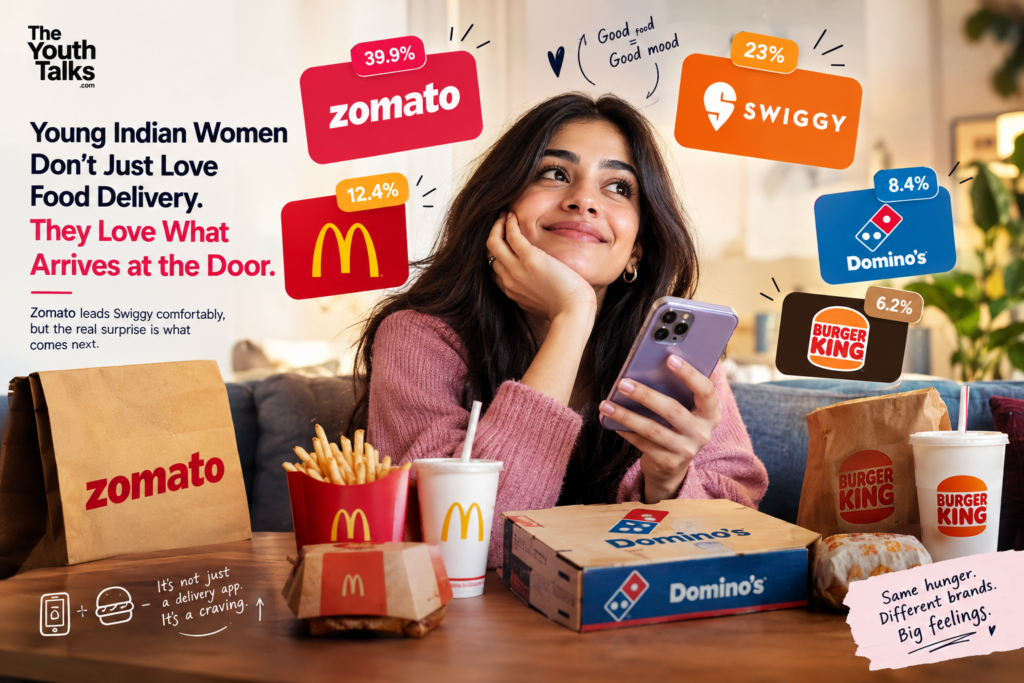
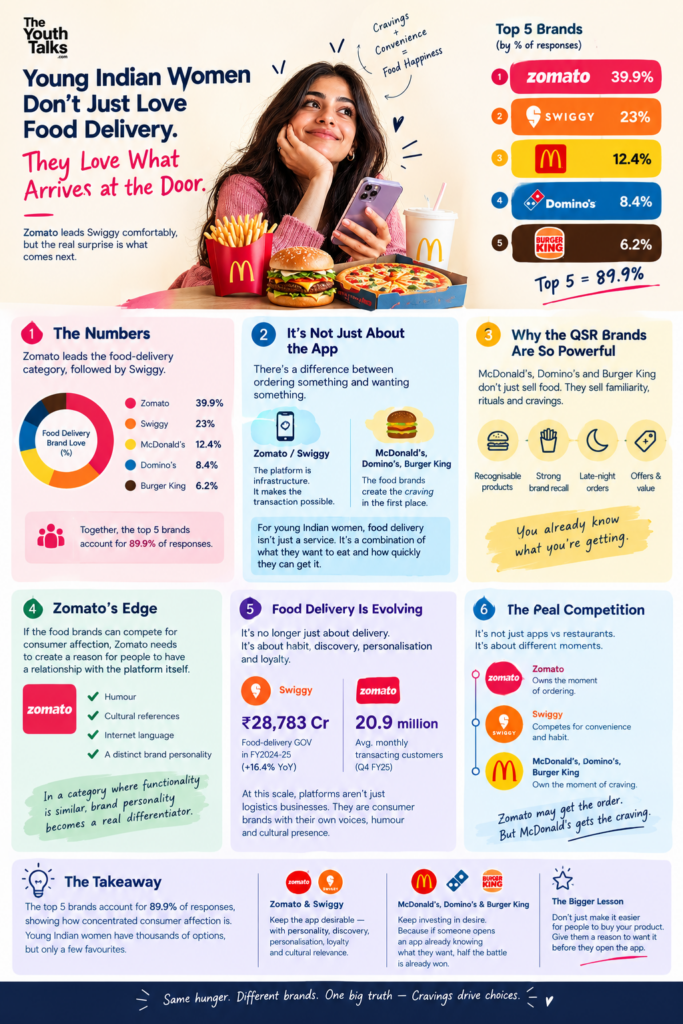
In TheYouthTalks’ survey of brands loved by young Indian women, Zomato leads the food-delivery category with 39.9% of responses, comfortably ahead of Swiggy at 23%. Together, the two platforms account for 62.9% of responses.
Then the ranking takes an unexpected turn.
McDonald’s comes third with 12.4%, followed by Domino’s at 8.4% and Burger King at 6.2%.
Put those five brands together and they account for 89.9% of all responses.
On the surface, this looks like a food-delivery ranking.
Look a little closer, though, and it may actually be telling us something much more interesting about how young Indian consumers think about food.
Because perhaps they aren’t really choosing a delivery platform.
They are choosing a craving.
The app gets the order. The food gets the love.
There is an important difference between ordering something and wanting something.
You may open Zomato because you are hungry.
But hunger doesn’t necessarily create a relationship with the app.
You might instead be thinking:
I want a burger.
I want pizza.
I want McDonald’s.
I need those fries.
The distinction sounds small, but it is strategically significant.
A delivery platform is, at its most basic level, infrastructure. It connects a consumer to a restaurant, processes the order and gets the food from one place to another.
The restaurant brand creates the desire.
That is why McDonald’s appearing in the top three is more than an interesting statistical anomaly.
It suggests that young consumers may not think about food delivery as a category defined purely by technology or logistics. Their mental model may be much simpler:
What do I want to eat, and how quickly can I get it?
That is a very different question.
When the craving comes before the app
Think about the last time you ordered a familiar meal.
There is a good chance you didn’t begin with an app.
You began with an idea.
Maybe you had spent the day studying or working and suddenly wanted a pizza. Maybe it was late at night and a McDonald’s burger felt like exactly the right answer. Perhaps you were watching a movie and wanted something familiar rather than experimenting with an unfamiliar restaurant.
The app came later.
This is where brands such as McDonald’s, Domino’s and Burger King have an advantage that is difficult to replicate.
They have spent years creating recognisable products and building rituals around them.
The red-and-yellow McDonald’s packaging. The Domino’s pizza box. The familiar Burger King burger. The fries. The offers. The late-night order.
These aren’t simply food products anymore. They are mental shortcuts.
You don’t always need to be persuaded to try them.
You already know what you are getting.
And sometimes, that familiarity is precisely the appeal.
McDonald’s doesn’t have to win the delivery battle
This creates an interesting strategic situation for restaurant brands.
McDonald’s doesn’t necessarily need to convince consumers that its delivery experience is better than Zomato’s.
It needs to make consumers want McDonald’s strongly enough that they will find a way to get it.
Once that craving exists, the delivery platform becomes the facilitator.
The same logic applies to Domino’s.
The consumer doesn’t necessarily wake up thinking, Which food-delivery platform should I use tonight?
They might simply think, I want Domino’s.
That distinction gives restaurant brands an unusual kind of power.
The platform controls the transaction.
The restaurant can control the desire.
And that is where Zomato becomes particularly interesting
If this is the case, Zomato’s 39.9% share becomes even more significant.
The platform isn’t merely competing with Swiggy.
It is competing, in a sense, with the brands that create the reason for people to order in the first place.
That makes the strength of the platform’s own brand identity incredibly important.
Zomato has historically understood that a delivery app doesn’t have to communicate like a logistics company. Its advertising and social-media presence have often leaned into humour, cultural references, internet language and observations about everyday Indian behaviour.
That personality matters.
Two platforms can offer broadly similar functionality. Both can display restaurants. Both can process payments. Both can provide delivery tracking.
But consumers can still develop a preference for one.
In a category where the functional differences can become difficult for consumers to notice, brand personality becomes a competitive asset.
Zomato’s position in TheYouthTalks’ survey suggests that this relationship with the consumer is not merely theoretical.
Food delivery is no longer just about delivery
The category itself is changing.
Swiggy’s FY2024-25 annual report describes food delivery as its core business while highlighting discovery, personalisation and loyalty as important elements of its consumer proposition. The company reported food-delivery Gross Order Value of ₹28,783 crore in FY2024-25, up 16.4% year-on-year.
Zomato, meanwhile, reported 20.9 million average monthly transacting customers for food delivery in Q4 FY25, alongside food-delivery GOV of ₹9,778 crore.
Those numbers tell us something important.
These businesses are operating at enormous scale.
At that scale, simply being a functional delivery service isn’t enough. The platforms increasingly have to become consumer brands in their own right.
And that means competing for something much more valuable than a single order.
They are competing for habit.
Who do I instinctively open when I’m hungry?
Who do I trust to find something good?
Which app understands what I usually eat?
Which brand feels like it understands me?
Which one do I remember without thinking?
Those questions sit beyond logistics.
The battle is moving from convenience to cultural relevance
For years, food delivery could largely be sold on convenience.
Don’t cook.
Don’t drive.
Don’t wait.
Just order.
But convenience has gradually become table stakes.
The next layer is emotional.
Food is deeply connected to mood, memory, celebration, boredom, comfort and even identity. A late-night burger isn’t always just a late-night burger. A pizza ordered with friends isn’t merely a transaction. A favourite meal after an exhausting day can become a small ritual.
That gives food brands an emotional territory that delivery platforms cannot completely own.
The platform can make the experience faster.
The food brand can make the experience meaningful.
The strongest businesses will probably be those that understand both.
There is another lesson hiding in the data
TheYouthTalks’ numbers also reveal how concentrated consumer affection is.
The top five brands account for 89.9% of responses.
That is remarkable.
It suggests that despite the enormous number of restaurants, cloud kitchens, cafés and food-delivery options available to young Indian consumers, a relatively small group of brands dominates their mental shortlist.
This is an important reminder in an age of seemingly unlimited choice.
Consumers may have thousands of options.
But they don’t necessarily have thousands of favourites.
Choice can expand almost infinitely while preference remains surprisingly narrow.
And brands that become part of that shortlist acquire an enormous advantage.
What should food brands take away from this?
For Zomato and Swiggy, the challenge is to ensure that the app itself remains desirable rather than becoming an invisible piece of infrastructure.
That means continuing to invest in personality, discovery, personalisation, loyalty and cultural relevance.
For McDonald’s, Domino’s and Burger King, the lesson is different.
They should continue investing in the thing that made them powerful in the first place: desire.
Because if someone opens an app already knowing what they want, half the marketing battle has already been won.
And for newer restaurant brands, there may be an even bigger opportunity.
Don’t try to become another option in an endless restaurant catalogue.
Become the restaurant someone remembers.
Become the burger someone craves.
Become the pizza someone talks about before they even reach for their phone.
The real competition isn’t between apps and restaurants
Perhaps the most useful way to interpret the data is to stop thinking of Zomato, Swiggy, McDonald’s, Domino’s and Burger King as competing for exactly the same thing.
They aren’t.
At least, not entirely.
Zomato owns a significant part of the ordering moment.
Swiggy competes for the same moment of convenience and habit.
McDonald’s, Domino’s and Burger King compete for the moment before that — the moment when a consumer decides what she wants.
And that distinction matters.
Because the most valuable moment in food may not be the click on “Order Now.”
It may be the thought that comes five minutes earlier:
I really want that.
That is where a brand becomes a craving.
And once a brand reaches that point, the delivery app is no longer creating demand.
It is simply helping fulfil it.
The food-delivery lesson for every consumer brand
There is a broader lesson here that extends well beyond food.
Technology can make buying easier.
It can make discovery faster. It can reduce friction. It can make transactions almost invisible.
But none of those things necessarily creates desire.
The brands that matter most are often the ones that make people want something before they start looking for it.
For young Indian women, TheYouthTalks’ data suggests that food delivery is increasingly a combination of both worlds: the convenience of the platform and the emotional pull of the product.
Zomato may get the order. But McDonald’s gets the craving.
And in a market where everyone is racing to make delivery faster, perhaps the more enduring competitive advantage is much simpler:
Don’t just make it easier for people to buy your product. Give them a reason to want it before they open the app.