
For years, the conversation around student sleep has had an obvious culprit: the smartphone.
Put the phone away. Reduce screen time. Stop scrolling before bed.
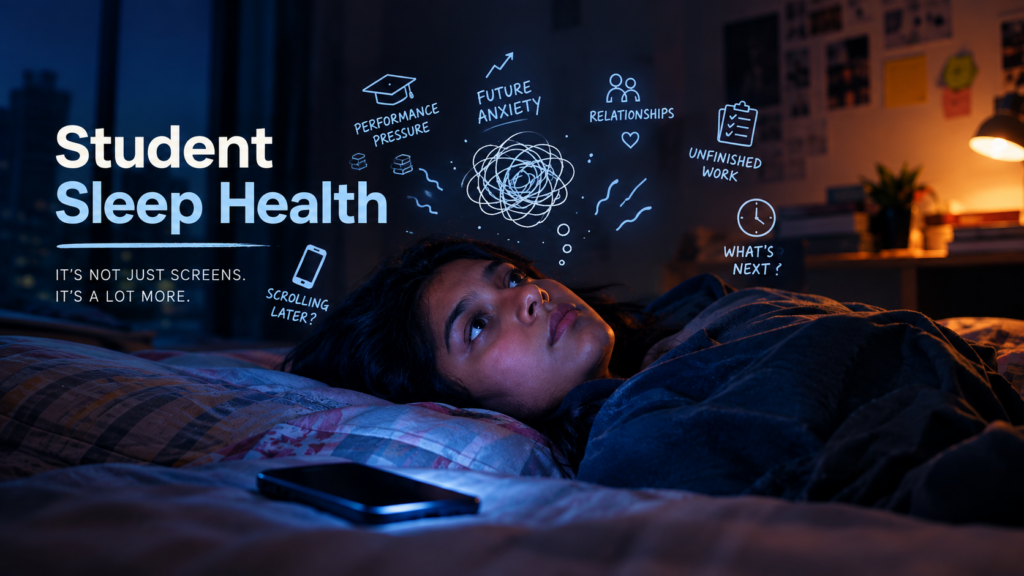
But new research among 500 college students across Delhi-NCR, Indore, Udaipur and other Indian towns suggests that the student sleep crisis may be more complicated. The biggest obstacle to sleep in this sample is not waking up during the night or simply spending too much time on a screen. It is a mind that refuses to switch off.
According to Student Sleep Health in India 2026, a research initiative by TheYouthTalks with Happy Heart & Soul, 64.9% of students said racing thoughts or feeling “wired but tired” was their main sleep struggle. By comparison, 30.6% reported waking during the night.
The problem, therefore, often begins before sleep even starts.
The thoughts keeping students awake
Among students who described what occupies their minds at bedtime, 52% identified performance pressure and 39.8% pointed to future anxiety. Perfectionism accounted for 17.9%, while relationships were cited by 15.4%.
Only 12.2% described their problem primarily as a physical state in which the body felt tense while the mind was otherwise blank.
In other words, the concerns keeping students awake are closely connected to the pressures surrounding college life: performance, unfinished work, and uncertainty about what comes next.
The report describes the problem as a “pressure loop.” Poor sleep can affect retention, potentially making study take longer; longer study hours can push bedtime later; pressure and guilt can then make it harder to quiet the mind.
Importantly, the researchers caution that the survey is cross-sectional and cannot establish causation. The relationships observed are patterns worth investigating, rather than proof that one factor directly causes another.
So, what about the phone?
The research does not suggest that screens are harmless.
In fact, the relationship with sleep quality is striking.
Among students who spent less than 15 minutes on screens before sleep, 52.3% said they always woke refreshed. Among those spending more than an hour, that figure fell to 16.9%.
Yet the amount of sleep itself did not change dramatically across these screen-time groups. The proportion sleeping under six hours was 38.6% among the lowest-screen group and 33.8% among those using screens for more than an hour.
The distinction matters.
The data suggests that screens may be affecting how restorative sleep feels, rather than simply determining how many hours students sleep.
That changes the message from “put your phone away and you’ll sleep longer” to something more nuanced: reducing late-night screen exposure may help students get more out of the sleep they already manage to get.
The bigger problem may begin before the phone comes out
The report also finds that 51% of students say they feel guilty when resting, while another 36.9% say workload puts pressure on them. Together, that means only 12% reject the idea that rest is something they need to think about in these terms.
And 79.6% say study or work regularly or occasionally crosses into the time they had intended to be asleep.
This creates an important distinction between a sleep-hygiene problem and a pressure problem.
A student who lies awake thinking about tomorrow’s placement preparation, unfinished coursework or future career prospects may not necessarily be helped by another reminder about blue light.
The report’s recommendations therefore focus partly on managing the mind rather than simply managing the clock: writing down unfinished tasks before bed, protecting the final 30 minutes from screens, maintaining a consistent wake time, and seeking professional support when persistent sleep difficulties go beyond self-help.
Young India may already know it needs help
Perhaps the most encouraging finding is that students are not necessarily resistant to intervention.
57.7% said they would join a structured sleep-reset programme, while 73.6% said they would allow their sleep to be tracked for research. Nearly seven in ten had already tried something to improve their sleep.
The challenge, then, may not simply be convincing students that sleep matters.
It may be understanding why a tired student still cannot stop thinking.
The smartphone is visible. The pressure is not.
And for India’s students, the latter may be the conversation that needs to happen before the lights go out.