How India’s youngest legal-drinking-age consumers are reshaping alcohol through moderation, bold flavours, premium experiences, convenience and the growing importance of social occasions.
For decades, the conversation around alcohol consumption was relatively straightforward.
Beer was beer.
Whisky was whisky.
A cocktail was something you ordered at a bar.
And drinking was largely associated with a familiar set of occasions — celebrations, parties, dinners, weekends or social gatherings.
But India’s young consumers are entering the category with a different mindset.
For Gen Z, the question isn’t simply:
“What do I want to drink?”
It is increasingly:
“What kind of experience do I want tonight?”
That distinction may sound subtle, but it has significant implications for the beverage alcohol industry.
Recent global research points to an alcohol category that remains resilient while consumer behaviour continues to evolve. Moderation, flavour, convenience, value, premium experiences and brand trust are becoming increasingly important. At the same time, social connection remains one of the strongest motivations behind drinking.
For India, these trends become even more interesting.
India’s Gen Z isn’t simply importing global drinking culture. It is adapting it to an environment shaped by local flavours, strong social networks, diverse regional cultures, state-level regulations and a rapidly expanding experience economy.
The result could be a distinctly Indian version of the next generation of drinking culture.
Gen Z Isn’t Necessarily Drinking More. They’re Drinking Differently.
One of the easiest conclusions to draw from rising Gen Z engagement with alcohol is that young people are simply drinking more.
That would miss the bigger story.
The more interesting shift is behavioural.
Young legal-drinking-age consumers are becoming more deliberate about what they consume, how much they consume and the occasions in which alcohol fits into their lives.
Globally, research cited in recent industry analysis shows that 76% of legal-drinking-age adults consume alcohol, while Gen Z participation has been increasing.
At the same time, global per-capita consumption has declined in recent years.
That apparent contradiction tells us something important.
More people can participate in a category without necessarily consuming more of it.
And that is where moderation becomes critical.
For Gen Z, moderation does not necessarily mean abstinence.
It can simply mean control.
It can mean drinking less frequently. Choosing a lighter option. Paying attention to alcohol content. Choosing quality over quantity. Or deciding that tonight is about socialising rather than getting drunk.
The emerging consumer is not necessarily anti-alcohol.
They may simply be anti-excess.
The Occasion Is Becoming as Important as the Drink
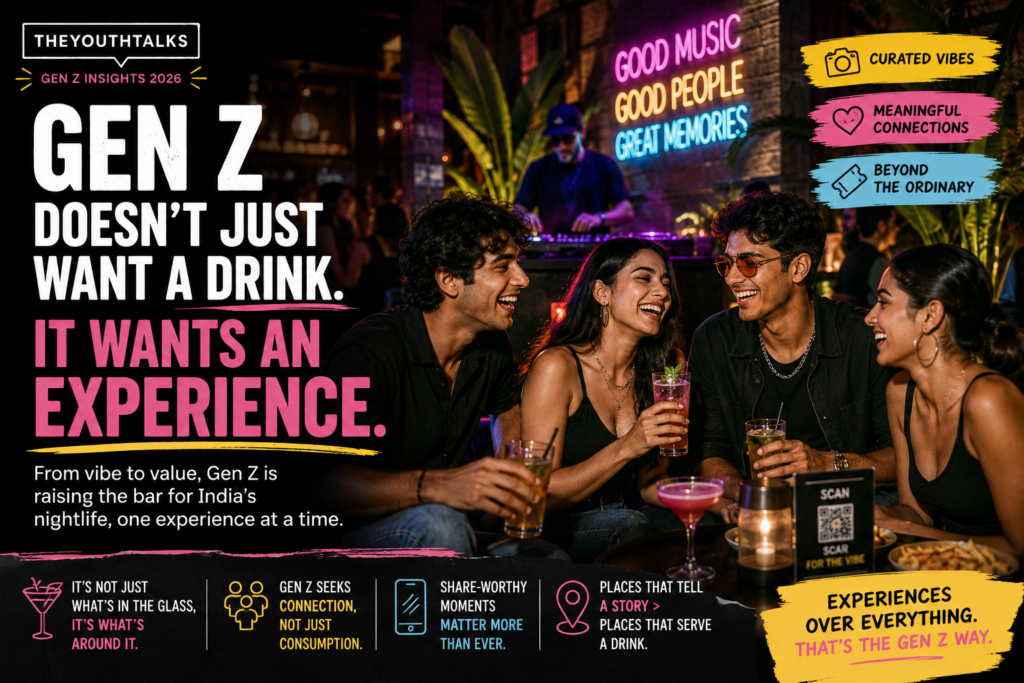
Perhaps the most powerful trend for India is the growing importance of social occasions.
Research cited in the global report suggests that 35% of consumers identify social occasions as their primary motivation for drinking.
That makes intuitive sense in India.
Alcohol is rarely consumed in isolation.
It is part of a larger moment.
A birthday dinner.
A friend’s house party.
A concert.
A weekend getaway.
A date.
A cricket screening.
A wedding.
A night out with colleagues.
A rooftop gathering.
The beverage becomes part of the occasion.
This changes how brands need to think.
Instead of asking:
“Who drinks our product?”
the more interesting question becomes:
“When does our product belong?”
A beer may belong to a cricket evening.
A cocktail may belong to a date.
A premium spirit may belong to a celebration.
An RTD may belong to a music festival.
The occasion determines the choice.
And Gen Z is increasingly building its social identity around experiences rather than simply products.
The Experience Economy Is Entering the Glass
This is where alcohol begins to intersect with a much larger Gen Z trend.
Young consumers increasingly value experiences that allow them to participate, discover and connect.
Music.
Food.
Travel.
Comedy.
Sport.
Art.
Fashion.
Gaming.
Communities.
Alcohol can sit inside each of these worlds.
But the drink doesn’t necessarily have to be the hero.
The experience can be.
Think about a music event.
People aren’t attending because they want to buy a particular beverage. They’re attending for the artist, the atmosphere, the people and the memories.
The beverage becomes one element of the experience.
That is a powerful shift.
The best beverage brands may increasingly be those that understand the culture surrounding consumption rather than simply promoting the liquid inside the bottle.
Premiumisation Doesn’t Always Mean Expensive
Another important trend is premiumisation.
Global industry data cited in the report indicates that premium-plus beverage alcohol volumes grew at approximately 5% CAGR between 2014 and 2024.
But what does premiumisation mean to an Indian Gen Z consumer?
It doesn’t necessarily mean buying the most expensive bottle available.
Premium can mean better ingredients.
It can mean an interesting flavour.
It can mean better packaging.
It can mean provenance.
It can mean a drink that feels distinctive.
Or it can simply mean being served something in an environment that feels special.
This is important because Gen Z has already normalised premiumisation across other categories.
Consider coffee.
Food delivery.
Skincare.
Sneakers.
Travel.
Restaurants.
Young consumers are often willing to pay more when they believe the additional spend delivers a better experience.
Alcohol is no different.
The opportunity therefore isn’t simply to sell a more expensive drink.
It is to make the consumer feel that the drink is worth the experience.
Flavour Is Becoming a Discovery Engine
Perhaps nowhere is this more obvious than in the rise of flavour-led beverages.
The global research cited in the report found that 52% of consumers identify flavour as the leading reason for choosing ready-to-drink beverages.
This is particularly interesting in India.
Indian consumers already live in an extraordinarily flavour-rich culture.
Mango.
Masala.
Chilli.
Citrus.
Tamarind.
Lychee.
Passion fruit.
Spices.
Herbs.
Regional ingredients.
The Indian palate is accustomed to experimentation.
That creates an interesting opportunity for beverage brands.
The next generation of alcohol products may not simply compete on the traditional distinctions between beer, wine and spirits.
They may compete on taste experiences.
The question becomes:
“What does this taste like?”
rather than simply:
“What category does this belong to?”
That is a much more expansive territory.
Why RTDs Could Be a Major Gen Z Opportunity
Ready-to-drink beverages are particularly well aligned with the way younger consumers live.
They are convenient.
They are portable.
They are easy to understand.
They don’t require mixing.
And they allow brands to build strong flavour identities.
But convenience alone isn’t enough.
The successful RTD may be the one that combines three things:
Flavour + Convenience + Occasion.
A drink for a beach trip.
A drink for a house party.
A drink for a concert.
A drink for a casual evening.
A drink for a celebration.
That is much more compelling than simply saying the product is “ready to drink.”
It gives the product a cultural role.
India could become an especially interesting market for this kind of innovation, provided brands navigate the country’s complex state-level regulatory environment responsibly.
Gen Z Wants New Experiences — But It Still Wants Trust
There is an interesting contradiction in the emerging consumer.
Gen Z wants discovery.
But it also wants reassurance.
The global research found that 77% of consumers are more likely to trust a new product when it comes from a brand they already know.
That creates an important strategic opportunity.
Consumers may be curious about new flavours, new formats and new occasions.
But they don’t necessarily want to take every risk themselves.
A familiar brand can act as a bridge.
A known name introduces a new flavour.
A trusted company launches a new format.
An established brand creates an unfamiliar experience.
The consumer gets novelty without completely abandoning familiarity.
In other words:
Gen Z wants to experiment, but it doesn’t necessarily want to experiment blindly.
Trust can therefore become the foundation on which innovation is built.
Social Media Is Changing How Drinking Culture Is Discovered
The modern drinking experience often begins before the first sip.
It starts on a screen.
A cocktail appears in a Reel.
A new bar becomes popular on Instagram.
A creator talks about a new drink.
Friends share photos from an event.
A music festival announces its beverage partners.
A restaurant introduces a new menu.
Discovery is digital.
Consumption is physical.
That creates an important bridge for brands.
The beverage may be consumed offline, but the desire for it can be created online.
This makes content an increasingly important part of beverage marketing.
But there is a catch.
Gen Z is highly sensitive to advertising that feels forced.
The brands that win may be those that participate in culture rather than simply interrupt it.
Instead of saying:
“Buy this.”
They can create:
“Come experience this.”
India’s Gen Z Is Not One Consumer
There is another factor global beverage research cannot fully capture when applied to India.
There isn’t one Indian Gen Z.
There are many.
Mumbai is different from Bengaluru.
Bengaluru is different from Delhi.
Delhi is different from Goa.
And metropolitan nightlife culture can look completely different from the consumption environment in smaller cities.
Even more importantly, alcohol regulation varies considerably across Indian states, including differences in availability and legal drinking ages.
So the Indian opportunity cannot simply be described as:
“Target Gen Z.”
Brands need to understand which Gen Z they are speaking to.
Where do they live?
What are their social occasions?
What kind of venues exist around them?
What flavours resonate locally?
What does premium mean in their context?
What role does alcohol play within their peer group?
The future of India’s beverage market may therefore be highly segmented.
The New Indian Drinking Funnel
Put these trends together and a new consumer journey begins to emerge.
Discover
A consumer sees a new drink, flavour, event or experience online.
↓
Explore
They become curious about the product.
↓
Validate
They look for reviews, recommendations and brand familiarity.
↓
Choose
Flavour, occasion, convenience, price and experience influence the decision.
↓
Socialise
The drink becomes part of a shared moment.
↓
Moderate
The consumer decides how much, how often and whether the occasion warrants drinking.
This is very different from the old model of:
Advertising → Purchase → Consumption
The new model is closer to:
Culture → Discovery → Experience → Social Identity → Consumption
That is a much richer opportunity for brands.
What Does This Mean for Alcohol Brands?
The beverage alcohol industry may need to rethink what it is actually selling.
It is not simply selling alcohol.
It is selling:
occasions.
flavours.
memories.
social connection.
identity.
experiences.
That doesn’t mean the product becomes irrelevant.
Quite the opposite.
Product quality remains fundamental.
But the product now needs a context.
A reason to exist.
A moment where it belongs.
This is where brands can move beyond traditional advertising and begin creating communities, events, experiences and cultural associations.
The most interesting brand question may no longer be:
“How do we increase consumption?”
It may be:
“How do we become part of the moments Gen Z actually cares about?”
That is a much more sustainable question.
The Bigger Gen Z Insight: Control Over Consumption
Perhaps the most important finding isn’t about flavour, RTDs or premiumisation.
It is about agency.
Gen Z wants to make its own decisions.
How much to drink.
What to drink.
Where to drink.
When to drink.
Whether to drink.
That is consistent with a broader pattern we see across Gen Z consumer behaviour.
They want choice.
They want personalisation.
They want authenticity.
They want products to fit their lives rather than being told how their lives should fit the product.
Alcohol is simply another category where that mindset is becoming visible.
The category isn’t disappearing.
The consumer is becoming more selective.
So, How Will Gen Z Drink in India?
The answer may be:
Less predictably.
A young consumer might enjoy a premium cocktail one weekend, an RTD at a concert the next, a beer while watching a match and no alcohol at all the weekend after that.
There doesn’t have to be a contradiction.
That is the point.
The future isn’t necessarily about drinking more.
It is about choosing better.
Better suited to the occasion.
Better suited to the individual.
Better suited to the moment.
And perhaps that is the most important lesson for India’s beverage industry.
Gen Z isn’t asking brands to simply give them another drink.
They are asking brands to understand why the moment matters.
The Future of Drinking May Be About the Moment, Not the Drink
India’s beverage alcohol market is entering an interesting phase.
Young consumers are discovering new flavours.
Experimenting with new formats.
Exploring premium experiences.
Paying attention to moderation.
Looking for convenience.
And, perhaps most importantly, placing greater value on the social experience surrounding consumption.
The glass is only one part of the story.
The people around it matter.
The music matters.
The place matters.
The occasion matters.
The memory matters.
And for Gen Z, the ability to choose how they participate matters most of all.
So the biggest question for beverage brands in 2026 may not be:
“How do we get Gen Z to drink?”
It may be:
“What experience can we create that Gen Z wants to be part of?”
Because the next generation of beverage brands may not win simply by making a better drink.
They will win by becoming part of a better moment.