





From YouTube explainers and WhatsApp groups to creators and AI, young Indians are not becoming less interested in what is happening around them. They are simply choosing a very different route to find out.
There is a moment that has become increasingly familiar in conversations about young people and news.
Someone says, “Gen Z doesn’t read the news anymore.”
Another person nods.
Then comes the inevitable list: newspapers are dying, television is losing relevance, young people don’t visit news websites, everyone gets their information from Instagram, and nobody has the attention span to read a 1,200-word article.
It makes for a convenient narrative.
It is also only partly true.
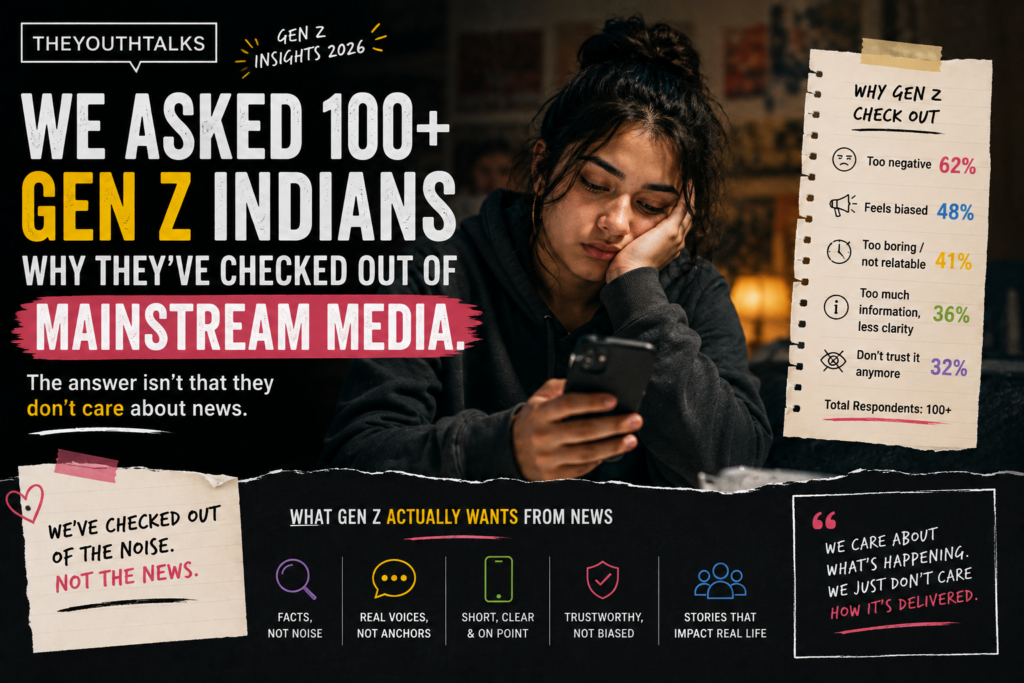
We wanted to understand what is actually happening inside Indian Gen Z’s news habits, so we asked more than 100 young Indians a simple question:
Do you still engage with mainstream news — television channels, newspapers, established news websites and their apps — and if you don’t, why did you stop?
The answers were revealing.
Most didn’t say they had stopped caring about the world.
They said they had stopped going looking for the news.
Instead, the news comes to them.
A YouTube video appears in their recommendations. Someone shares a clip in a WhatsApp group. A creator explains a complicated policy change in six minutes. A friend sends a screenshot. Increasingly, an AI chatbot is asked to explain what happened and why it matters.
The habit has changed.
The appetite hasn’t disappeared.
And the latest global data suggests this isn’t an Indian quirk. It is becoming one of the defining transformations in modern news consumption.
The Global News Habit Has Already Changed
The Reuters Institute’s Digital News Report 2026, based on almost 100,000 interviews across 48 markets, found that social media and video networks have, for the first time, become the most widely used way of accessing online news globally.
54% of people now use social media and video networks for news, ahead of news organisations’ own websites and apps at 51%.
Among 18–24-year-olds, the shift is even more pronounced.
52% say social media, video networks and AI chatbots are their main way of getting news.
That is not a small behavioural adjustment.
It represents a fundamental change in the relationship between audiences and news organisations.
For decades, the basic model was straightforward.
You bought a newspaper.
You switched on the television at a particular hour.
You visited a news website.
You deliberately went to the news.
Today, the news increasingly finds you while you are doing something else.
And that distinction is enormous.
In India, YouTube and WhatsApp Are Doing the Heavy Lifting
If there is one thing that makes India’s Gen Z news behaviour particularly interesting, it is that the global conversation often focuses on Instagram, TikTok or X.
India tells a somewhat different story.
According to the Reuters Institute’s 2026 India report, around 58% of respondents use YouTube for news. Television remains significant too, but social and video platforms have become central to how Indians discover and consume information.
And then there is WhatsApp.
For millions of Indians, WhatsApp isn’t merely a messaging service.
It is a family bulletin.
A neighbourhood noticeboard.
A college information channel.
A place where a cousin shares a breaking-news video before anyone has opened a news app.
A parent forwards something with the message, “Is this true?”
And sometimes, ironically, that becomes the reason someone starts researching the story.
The Reuters Institute has previously documented just how deeply embedded WhatsApp is in India’s news ecosystem, with more than half of respondents in its India research reporting that they get news through the platform.
Our conversations with young Indians reflected this reality.
The news isn’t necessarily being read.
It is being encountered.
“I Don’t Follow the News” Doesn’t Mean “I Don’t Know What’s Happening”
This was perhaps the most interesting distinction in our conversations.
Some respondents said they don’t follow news.
But when asked whether they knew about major events, political developments, technological changes, celebrity controversies or major international stories, many did.
So where did the information come from?
Usually, somewhere else.
A YouTube creator.
A short video.
A podcast.
A WhatsApp message.
A friend’s Instagram story.
A conversation in college.
A Reddit thread.
An AI chatbot.
The implication is important.
News consumption is becoming ambient.
Young people don’t necessarily sit down and consume “the news” as a discrete activity.
They encounter fragments of it throughout the day.
A headline while scrolling.
A 90-second explanation during lunch.
A podcast while commuting.
A forwarded video at 11 p.m.
A five-minute conversation with ChatGPT before an exam or interview.
The old news habit was intentional.
The new one is often incidental.
Why Did Gen Z Drift Away From Mainstream Media?
The answers from our respondents broadly fell into four categories.
1. News Feels Exhausting
Several respondents described mainstream news as overwhelming, repetitive or emotionally draining.
The problem wasn’t that they didn’t care.
It was that there was simply too much of it.
Every day brings another breaking-news alert.
Another controversy.
Another debate.
Another argument between television anchors.
Another notification.
Another crisis.
The Reuters Institute found that 52% of Indian respondents say they sometimes or often avoid the news.
That number should worry news organisations.
But perhaps not for the reason they think.
News avoidance does not necessarily mean news rejection.
Sometimes it means news fatigue.
Young people may be saying:
“I want to know what matters. I just don’t want to spend my entire day watching everything that happens.”
That is a very different consumer demand.
2. Young Indians Want Someone to Explain, Not Just Report
Another recurring theme was explanation.
A traditional news report might tell you what happened.
A creator might spend ten minutes explaining why it happened, what caused it, who benefits, who loses and what happens next.
For Gen Z, that second format can feel much more useful.
It is one reason personality-led news has become so powerful.
A young viewer often knows the person delivering the information.
They know their voice.
They understand their style.
They may disagree with their politics, but they know where the creator is coming from.
That transparency can paradoxically feel more authentic than a television anchor attempting to maintain an impersonal tone.
The Reuters Institute’s global research captures this tension: audiences often find creators and influencers more entertaining and easier to understand, even while they tend to regard them as less trustworthy or impartial than established news organisations.
In other words, young audiences are making a trade-off.
They may sacrifice some institutional credibility for accessibility and clarity.
That should concern journalism.
But it should also teach journalism something.
Trust Hasn’t Disappeared. It Has Become More Complicated.
One of the easiest conclusions to draw from this trend is that Gen Z doesn’t trust the media.
That is too simplistic.
The better conclusion is that Gen Z doesn’t automatically trust institutions simply because they are institutions.
That is a major difference.
Young audiences are increasingly asking:
Who is telling me this?
What is their incentive?
What are they leaving out?
Can I verify it somewhere else?
Are they trying to inform me or provoke me?
And, perhaps most importantly:
Why should I care?
The Reuters Institute’s 2026 data puts India’s overall trust in news at 39%, down four percentage points year-on-year, although some established print publishers and public broadcasters continue to retain relatively high brand-level trust.
So this isn’t a complete collapse of trust.
It is a fragmentation of trust.
People trust different sources for different reasons.
A newspaper may be trusted for an investigation.
A YouTube creator may be preferred for an explanation.
A WhatsApp group may be where the story is first encountered.
And an AI chatbot may be where someone goes to make sense of it.
The old hierarchy has been replaced by a network.
AI Could Make This Even More Complicated
There is another player entering this already crowded ecosystem.
AI.
The Reuters Institute found that 10% of people globally now use AI chatbots for news each week, up from 7% the previous year. Among under-35s, usage is 16%.
For now, AI is not replacing news organisations.
But it is changing the way people consume information.
Imagine a young person seeing a headline about a complicated government policy.
The old behaviour:
Open Google.
Search for the story.
Click three or four articles.
Read.
Compare.
The emerging behaviour:
Open an AI chatbot.
Ask:
“Explain this policy to me like I’m 20. Who does it affect? What are the arguments for and against it?”
That is a fundamentally different relationship with information.
The chatbot becomes the interpreter.
And this creates an enormous opportunity for journalism — but also an enormous threat.
Because if audiences increasingly consume the explanation without visiting the original source, the journalist may do the reporting while somebody else owns the relationship with the reader.
The Creator Is Becoming the New News Front Door
This is particularly important in India.
A generation of independent journalists, explainers, podcasters and creators has emerged outside traditional television and newspaper structures.
Some have built enormous audiences.
Others have created niche communities around business, technology, politics, culture, careers or international affairs.
The Reuters Institute’s India report specifically highlights the growing importance of individual news creators and notes how platforms such as YouTube have become important spaces for both traditional journalists and independent voices.
This doesn’t mean creators are inherently better journalists.
They aren’t.
They have their own incentives, biases and blind spots.
But they have understood something that many traditional organisations are still struggling to accept:
People follow people.
A logo doesn’t have a personality.
A journalist does.
A newsroom doesn’t necessarily have a voice.
A creator does.
And Gen Z has grown up in an internet where personalities are often the primary interface through which information, entertainment, education and even commerce are delivered.
News was always going to be affected by that.
But There Is a Dangerous Side to the New News Diet
There is a reason mainstream journalism still matters.
Algorithms don’t necessarily reward accuracy.
They reward engagement.
A nuanced explanation may receive less attention than an outrageous claim.
A correction rarely travels as far as the original misinformation.
A WhatsApp forward doesn’t come with an editor.
A creator doesn’t necessarily have a fact-checking desk.
And an AI chatbot can produce a confident answer that still needs verification.
The Reuters Institute reports that 62% of people globally are concerned about distinguishing real information from fake information online, up four percentage points from the previous year.
That creates a strange paradox.
The more young people move away from traditional media because they don’t trust it, the more they may find themselves surrounded by information that is even harder to verify.
And this is where established journalism still has an enormous role.
Not necessarily as the first place Gen Z goes.
But as the place they go when they want to know:
Is this actually true?
The Future May Not Be Mainstream Versus Social Media
The media industry often frames the debate as a war.
Traditional media versus creators.
Newspapers versus YouTube.
Television versus Instagram.
Journalists versus influencers.
That framing may already be obsolete.
The future is probably hybrid.
A traditional newsroom might produce the original investigation.
A journalist might explain it on YouTube.
A creator might discuss it on a podcast.
A WhatsApp user might forward the clip.
A young viewer might ask an AI chatbot to explain the background.
And eventually, that viewer might click through to the original reporting.
The boundaries are disappearing.
The question isn’t who wins.
The question is who gets to own the relationship with the audience.
So, Has Gen Z Checked Out of News?
Not really.
They have checked out of the old way of consuming news.
That distinction may be the single most important takeaway from our conversations with more than 100 young Indians.
They don’t necessarily want fewer stories.
They want fewer stories that feel irrelevant.
They don’t necessarily want less information.
They want information that helps them understand.
They don’t necessarily reject journalists.
They reject formats that make journalism feel like an obligation.
And they don’t necessarily trust creators blindly.
They simply appear more willing to give them a chance.
That should be a wake-up call for mainstream media.
Because the competition isn’t another newspaper.
It isn’t another television channel.
It isn’t even another news website.
The competition is the rest of Gen Z’s attention.
A YouTube video.
A Netflix episode.
A podcast.
A WhatsApp conversation.
A gaming session.
A creator.
An AI chatbot.
A hundred different things can win the next ten minutes.
The News Industry Has a Gen Z Problem. But It May Also Have a Gen Z Opportunity.
The answer isn’t for news organisations to become louder.
Or more sensational.
Or to copy every creator trend.
It may be something much simpler.
Make journalism easier to understand without making it less rigorous.
Explain.
Contextualise.
Show your work.
Let journalists have personalities.
Use video properly.
Build communities.
Ask young audiences what they actually want to know.
And, most importantly, stop assuming that a generation that doesn’t open a newspaper at 8 a.m. is a generation that doesn’t care about the world.
Our small survey suggests the opposite.
They care.
They are curious.
They have opinions.
They want context.
They want to understand.
They have simply changed the route.
The Reuters Institute’s global data shows that the migration towards social, video and AI is no longer a fringe behaviour. It is becoming the mainstream itself.
And India’s numbers make the message even clearer.
YouTube is already a major news gateway. WhatsApp remains deeply embedded in how information travels. News avoidance is widespread. Trust is under pressure. And independent creators are increasingly competing with established institutions for attention.
The question for Indian journalism, therefore, isn’t:
“How do we get Gen Z to come back to the newsroom?”
It may be:
“How do we build journalism that Gen Z actually wants to invite into its life?”
Because the young Indian audience hasn’t stopped listening.
It has simply stopped waiting for the news to arrive at 9 p.m.
The news is already in their pocket. The battle now is for who gets to explain it.