Netflix is named by nearly two-thirds of young women in TheYouthTalks’ OTT survey — a striking lead over platforms with stronger mass-market and accessibility advantages.
In the streaming business, the obvious things should matter.
Price matters. Reach matters. A large content library matters. Sports rights matter. And in India, where entertainment consumption is increasingly spread across television, smartphones and connected devices, accessibility should matter too.
But when young Indian women are asked a slightly different question — not which OTT platform do you use?, but which OTT brand do you love? — the hierarchy changes dramatically.
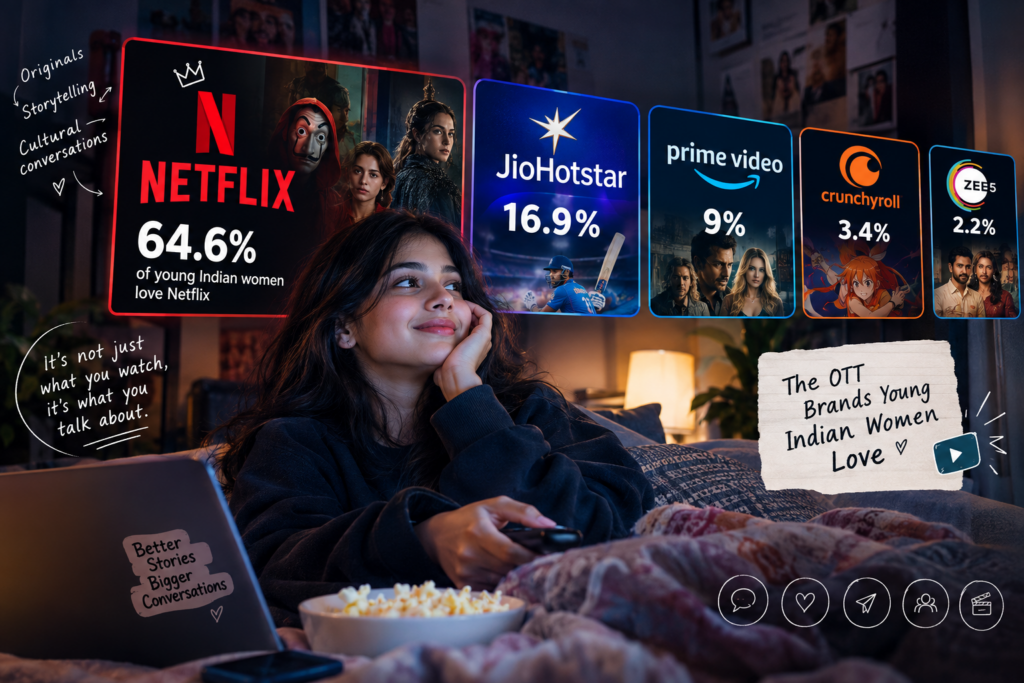
According to data from TheYouthTalks’ survey of young Indian women, Netflix was named by 64.6% of respondentsas the OTT brand they love.
JioHotstar followed at 16.9%, Prime Video at 9%, Crunchyroll at 3.4% and ZEE5 at 2.2%.
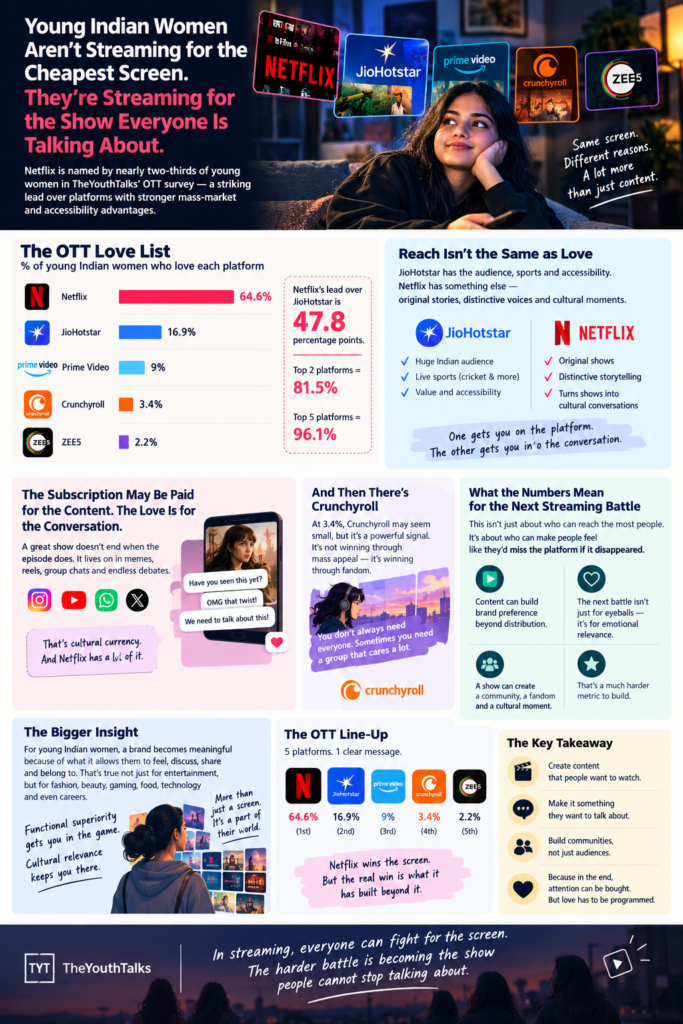
The gap between Netflix and JioHotstar is 47.7 percentage points. Together, the top two platforms account for 81.5% of responses, while the top five account for 96.1%.
Those numbers are striking on their own.
But the more interesting question is not why Netflix is ahead.
It is what young viewers appear to be rewarding when they say they love an entertainment brand.
Reach Isn’t the Same as Love
JioHotstar enters the streaming battle with some formidable advantages.
It has enormous reach in India, a broad entertainment proposition and major sports properties, including cricket. For a country where price sensitivity and mass accessibility remain important considerations, that is a powerful combination.
Netflix plays a different game.
Its proposition has historically revolved around premium original programming, distinctive storytelling and the ability to create shows that become cultural events.
That difference matters.
A streaming platform can be useful without becoming beloved. A consumer might subscribe because the service is affordable, because a particular sport is available, because the family already uses it, or because its catalogue happens to contain enough titles to justify the monthly payment.
Love is a different equation.
It emerges when a platform repeatedly gives people something they care about.
A series becomes a conversation with friends. A character becomes a meme. A plot twist dominates social media for a weekend. Someone sends you a clip on WhatsApp and asks, “Have you watched this yet?”
Suddenly, watching isn’t an isolated activity anymore.
It has become social currency.
The Subscription May Be Paid for the Content. The Affection Is for the Conversation.
This distinction may be one of the most important insights hiding inside the data.
Consumers can subscribe to a platform because of its functional benefits. But they can develop an emotional relationship with a brand because of the experiences associated with it.
Netflix has spent years building an entertainment identity around original programming and global cultural moments.
Think about the anatomy of a breakout series.
First, people watch it.
Then they discuss it.
Then social platforms amplify the discussion.
Memes appear. Reactions follow. Spoilers become a hazard. Friends recommend the show to friends. Creators make videos about it. Publications write about it. Suddenly, a programme that began as a piece of entertainment becomes part of the cultural environment.
The content itself becomes marketing.
That is particularly relevant for younger audiences, for whom the boundary between entertainment and social interaction is increasingly blurred.
A show does not necessarily end when the credits roll.
The conversation continues on Instagram, YouTube, WhatsApp and other digital spaces.
And that gives entertainment brands an unusual advantage: their product can advertise the brand without looking like advertising.
Young Viewers Are Not Just Watching. They Are Participating.
There is another layer to this.
Younger audiences increasingly experience entertainment through communities and fandoms.
The most successful franchises don’t simply generate viewers. They create people who identify with the franchise, discuss its characters, follow its creators and actively seek out related content.
This is where Netflix’s position becomes particularly interesting.
The platform has demonstrated an ability to turn individual titles into global cultural phenomena. But the broader lesson is not necessarily that every streaming service needs to imitate Netflix.
It is that content with cultural relevance can create a fundamentally different kind of consumer relationship.
A catalogue gives consumers choice.
A cultural phenomenon gives them a reason to participate.
Those are not the same thing.
And Then There Is Crunchyroll
At 3.4%, Crunchyroll is nowhere near Netflix’s 64.6% in this survey.
Yet its presence is arguably one of the more revealing numbers in the dataset.
Why?
Because Crunchyroll is not built around universal appeal.
Its strength lies in a highly specific entertainment culture: anime.
For an anime enthusiast, Crunchyroll can represent more than a streaming destination. It can be part of an identity, a fandom and a community.
That distinction offers an important lesson for entertainment companies.
You don’t always need everyone to care. You need some people to care deeply.
A smaller audience with intense affinity can sometimes be more valuable from a brand-building perspective than a much larger audience with weak emotional attachment.
This is the same principle visible across contemporary consumer culture: fandom can be a powerful economic and marketing force.
The Rise of Fandom Over Functionality
The OTT results should not be interpreted as evidence that price, distribution or catalogue breadth no longer matter.
They clearly do.
A consumer still needs access to a service. A subscription still has a cost. Content availability still determines what people can actually watch.
But the survey offers a different perspective on brand preference.
When consumers are asked which service they love, functional advantages may not be enough.
The platform associated with a favourite show occupies a different psychological space from the platform that simply has the largest catalogue.
That may be one reason Netflix’s number is so pronounced.
It is competing not merely as a utility, but as an entertainment identity.
And that distinction could become increasingly important as India’s OTT market matures.
The Question Streaming Platforms Should Be Asking
For years, the streaming conversation has focused heavily on acquisition.
How many subscribers?
How many viewers?
How much time spent?
How many downloads?
How much reach?
Those metrics remain important. But there is another question that is harder to answer:
How many people would genuinely miss your platform if it disappeared tomorrow?
That is not a conventional reach metric.
It is a measure of emotional relevance.
And it is considerably harder to manufacture.
A platform can spend money acquiring subscribers. It can negotiate distribution. It can bundle itself into telecommunications plans. It can offer discounts.
But none of those automatically creates affection.
That has to come from the experience.
What Netflix’s Lead Could Mean for the Next Streaming Battle
TheYouthTalks data does not suggest that one business model has definitively defeated another. Nor does it measure every dimension of OTT success.
What it does provide is a sharp snapshot of brand affinity among the young Indian women surveyed.
And that snapshot raises an important possibility.
The next phase of India’s streaming competition may not be decided solely by who can distribute content to the most people.
It may increasingly depend on who can create content that people feel compelled to discuss.
That is a very different competitive battlefield.
A platform with cricket can create appointment viewing. A platform with an enormous catalogue can create convenience. A platform with a lower price can reduce the barrier to subscription.
But a platform with shows that become part of everyday conversation can create something else altogether: cultural relevance.
And cultural relevance has a multiplier effect.
The viewer watches the show. The viewer talks about the show. Someone else hears about it and watches. Creators respond to it. Social media amplifies it. Newsrooms cover it. More people become aware of the platform.
The content begins pulling the brand along with it.
The Bigger Gen Z and Young Women Insight
Perhaps the most interesting takeaway from the survey isn’t actually about Netflix.
It is about how young consumers increasingly define brands.
For this generation, a brand can become meaningful because of what it allows them to feel, discuss, share and belong to.
That applies far beyond entertainment.
The same dynamic can influence fashion, beauty, gaming, food, technology and even careers. Functional superiority may get a product into consideration. But cultural relevance can determine whether people develop an attachment to it.
Netflix’s 64.6% figure, therefore, should be read as more than an OTT ranking.
It is a signal about the difference between consumption and connection.
Young Indian women may have many ways to watch something.
But the platform that consistently gives them something worth talking about occupies a different position in their lives.
And Crunchyroll’s smaller but meaningful presence reinforces the other side of the equation: intensity of fandom can matter just as much as breadth of audience.
The streaming industry has spent years fighting for eyeballs.
The next battle may be for something considerably harder to win.
Not attention. Not subscriptions. Not even watch time.
Affection.
Because attention can be bought, subscriptions can be discounted, and distribution can be engineered.
But when a show becomes part of someone’s conversation, identity and culture, the brand behind it earns something that a price cut cannot easily replicate.
In streaming, everyone can fight for the screen. The harder battle is becoming the show people cannot stop talking about.