

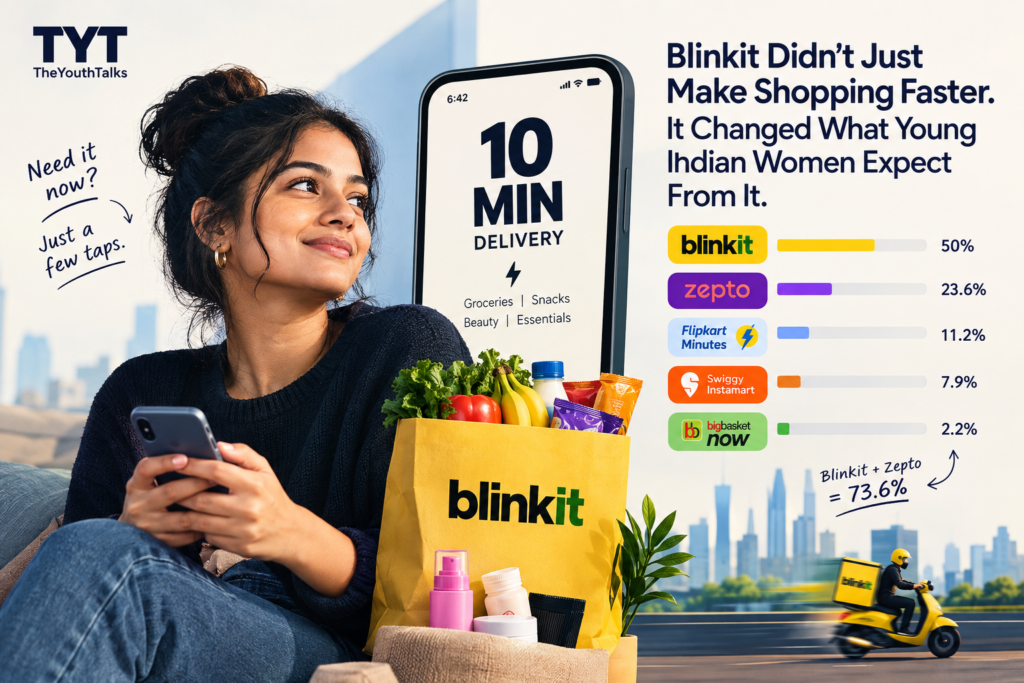
Blinkit commands half of all quick-commerce preferences in TheYouthTalks’ survey, revealing how quickly a category built around “ten minutes” has become part of everyday consumption.
A few years ago, waiting ten minutes for your groceries would have sounded like an advertisement.
Today, it can sound like a delay.
That may be one of the most revealing consumer shifts hidden inside TheYouthTalks’ latest survey of brands loved by young Indian women.
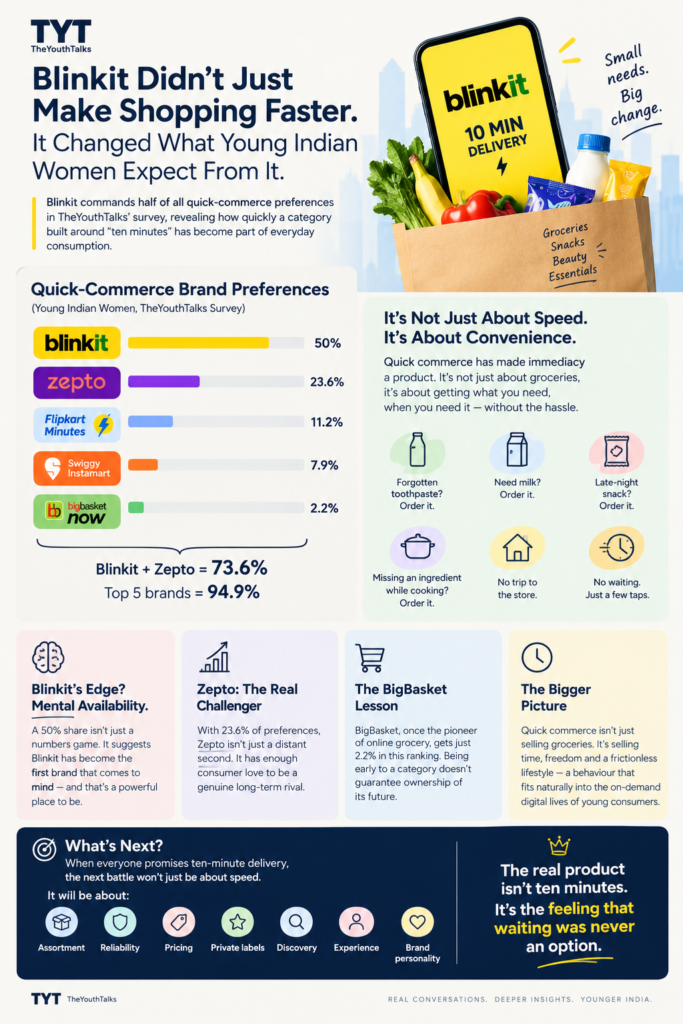
Blinkit accounts for 50% of responses in the quick-commerce category—exactly half of all brand mentions. Zepto follows at 23.6%, while Flipkart Minutes, Swiggy Instamart and BigBasket Now register 11.2%, 7.9% and 2.2% respectively.
Put another way, Blinkit and Zepto together account for 73.6% of the category.
The concentration is striking. But perhaps the more interesting story isn’t which company is winning.
It is what these numbers say about the consumer.
Because quick commerce may have started by promising speed. It is increasingly selling something much harder to displace: a new definition of convenience.
Ten Minutes Has Become a Consumer Expectation
There was a time when grocery shopping involved planning.
You remembered that you were running out of milk. You made a mental note to buy toothpaste. Perhaps you added a few things to a shopping list before heading to the neighbourhood store or placing an online order.
Quick commerce has disrupted that sequence.
Forgotten toothpaste? Order it.
Need milk? Order it.
Want something to snack on while watching a movie? Order it.
Realised halfway through cooking that an ingredient is missing? There is an app for that.
The interesting part is not that these things can now arrive quickly. It is that consumers increasingly structure their behaviour around the knowledge that they can arrive quickly.
That distinction matters.
Redseer has previously found that monthly ordering frequency on quick-commerce platforms rose to nearly six orders per month in FY24, from 4.4 in FY21. The same research described the evolution of the category from occasional top-ups towards weekly and even monthly stock-ups.
That is what habit formation looks like.
The consumer doesn’t wake up every morning thinking about quick commerce. Instead, the service quietly becomes embedded into everyday life.
And once that happens, the question changes.
It is no longer:
“Why should I get this in ten minutes?”
It becomes:
“Why should I have to wait longer?”
That is a much more powerful proposition.
Blinkit’s Biggest Advantage May Not Be Speed
It would be easy to look at Blinkit’s 50% share in TheYouthTalks’ survey and conclude that the company has simply built the best quick-commerce proposition.
The reality may be more nuanced.
Blinkit’s biggest advantage could be mental availability.
When a consumer thinks, “I need this right now,” which brand comes to mind first?
That first mental association is enormously valuable.
Consumers don’t necessarily compare five apps before ordering a packet of chips, a phone charger, skincare, breakfast cereal or a last-minute household essential. For many small, frequent purchases, the decision may happen in seconds.
The brand that comes to mind first has already won part of the battle.
This is why a 50% preference figure is significant. It suggests that Blinkit isn’t merely competing for individual orders. It may be occupying a disproportionate share of consumers’ mental shortcuts.
And mental shortcuts become habits.
Habits, in turn, are notoriously difficult for competitors to break.
The Category Has Become Far Bigger Than Grocery
There is another reason the Blinkit number deserves attention.
Quick commerce is no longer simply an alternative grocery-delivery mechanism.
The category itself is expanding.
Redseer estimates that Indian quick commerce reached approximately $13–14 billion in FY26, representing around 17% of total online retail GMV. It also estimates that quick commerce now commands roughly 70% of online grocery, even though online grocery itself represents only about 2% of India’s overall grocery retail market.
That last number is particularly revealing.
There is still enormous room for the format to grow.
And growth is increasingly moving beyond the obvious grocery basket.
Beauty and personal care is a good example. Redseer estimates that beauty and personal-care GMV within quick commerce expanded roughly 22.5 times between CY22 and CY25, with the category’s share of quick-commerce GMV rising from around 2.8% to 8.5%.
That means the consumer is gradually learning something new:
Quick commerce isn’t just where you go when you’ve forgotten something. It can be where you shop.
That is a much larger opportunity.
Zepto Is the Challenger That Matters
Blinkit’s dominance should not obscure the second number in the TYT survey.
Zepto records 23.6% of preferences.
That is not a distant second.
It gives Zepto enough consumer preference to look like a genuine challenger, rather than simply another participant in a crowded category.
Together, Blinkit and Zepto command 73.6% of the responses.
The hierarchy then drops considerably:
Blinkit — 50%
Zepto — 23.6%
Flipkart Minutes — 11.2%
Swiggy Instamart — 7.9%
BigBasket Now — 2.2%
The top five brands account for 94.9% of responses.
That tells us something important about the maturity of the consumer conversation.
Consumers may have many apps available to them, but availability does not automatically translate into preference.
The market is consolidating in people’s minds even while competition remains intense in the real world.
The BigBasket Number Is Perhaps the Most Interesting
If Blinkit’s 50% is the headline, BigBasket’s 2.2% may be the number marketers should spend more time thinking about.
BigBasket was an early and important name in India’s online grocery story.
It helped establish the idea that consumers could move grocery shopping from the physical store to the internet.
But the consumer expectation changed.
The original promise of online grocery was largely about not having to visit the store.
The new promise is about not having to wait.
That is a subtle but fundamental shift.
Being early to a category does not guarantee ownership of its future.
Consumer expectations can evolve faster than brand equity.
A company can have years of recognition, a large customer base and considerable category history—and still find itself challenged when a new generation begins defining the category differently.
For established consumer businesses, that should be an uncomfortable thought.
Young Consumers Are Buying Back Time
There is a deeper psychological dimension to quick commerce.
Consumers aren’t only buying groceries.
They are buying time.
They are avoiding a trip to the store.
They are eliminating the need to plan ahead.
They are turning an errand into a few taps.
For younger consumers who have grown up with smartphones, digital payments, food delivery, streaming and app-based services, this behaviour feels increasingly natural.
The expectation is consistent across categories:
If entertainment can be on-demand, why shouldn’t shopping be?
If a cab can arrive at your location, why should you travel to the product?
If a meal can reach you, why should a missing ingredient require a separate trip?
Quick commerce fits neatly into this broader digital worldview.
Redseer describes the typical quick-commerce consumer as skewing towards Gen Z and millennials in affluent urban households, with a strong preference for convenience and speed and an openness to indulgence and impulse purchases.
This is where the category becomes more interesting than its delivery promise.
It isn’t really selling ten minutes.
It is selling the removal of friction.
When Everyone Promises Ten Minutes, What Happens Next?
There is, however, a problem waiting on the horizon.
If every major platform can deliver quickly, speed eventually becomes less distinctive.
Ten minutes can be a competitive advantage when everyone else takes an hour.
It becomes much less powerful when everyone promises something similar.
The next battle could therefore move towards assortment, reliability, pricing, private labels, product discovery, personalised recommendations, customer experience and brand personality.
The question will no longer be:
“Who can deliver fastest?”
It may become:
“Who understands what I need before I even start searching?”
That is a much harder problem to solve.
And it could determine the next generation of quick-commerce winners.
The Real Product Is Convenience
The most important takeaway from TheYouthTalks’ survey may therefore have little to do with groceries.
Blinkit’s 50% share is a signal of something broader.
Young consumers are becoming increasingly comfortable with immediacy as a default setting.
The category has moved from novelty to habit.
From habit, it is moving towards expectation.
And once an expectation becomes embedded in everyday behaviour, changing it again becomes extremely difficult.
This is why quick commerce deserves to be studied not merely as a retail phenomenon, but as a consumer-behaviour story.
The companies are competing to deliver products.
But they are also competing to shape what consumers consider normal.
And perhaps that is Blinkit’s most significant achievement.
It didn’t simply make shopping faster.
It helped convince a generation that waiting was optional.
The next question for every quick-commerce company—and every brand watching this transformation from the sidelines—is simple:
What happens when ten minutes itself starts feeling too slow?