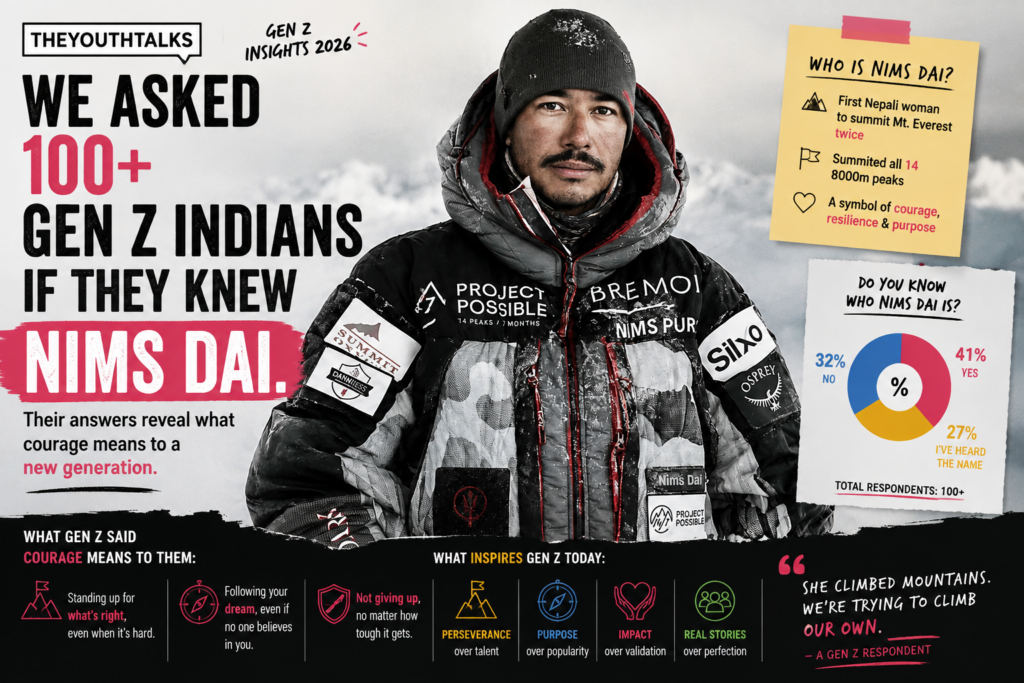
After the record-breaking mountaineer died in a Broad Peak avalanche, we asked 100+ young Indians if they knew his story. What they remembered wasn’t just the 14 peaks. It was his philosophy of making the impossible possible — a message that resonates with a generation fighting a different kind of mountain every day.
There are some people whose achievements are so extreme that they seem almost fictional.
Nirmal Purja, better known as Nims Dai, was one of them.
In 2019, the former Gurkha and British special forces soldier set out to climb all 14 of the world’s mountains above 8,000 metres. These are the peaks mountaineers often refer to as the “death zone”, where thin air, extreme cold, avalanches and rapidly changing weather can turn a few minutes into a fight for survival.
Purja didn’t merely complete the challenge.
He did it in six months and six days.
The previous record had stood for years. Suddenly, a man most Indians had never heard of was being discussed around the world.
Then came Netflix.
14 Peaks: Nothing Is Impossible turned an extraordinary mountaineering achievement into an accessible human story for millions of people who had never cared about climbing before.
For many young viewers, he wasn’t introduced as a mountaineer.
He was introduced as someone who appeared to believe that “impossible” was simply another word for “not attempted yet.”
Then, on July 31, 2026, Purja died in an avalanche on Broad Peak in Pakistan during a climbing expedition.
The news brought his story back into public consciousness.
And it prompted us to ask a different question.
Not How many peaks did Nims Dai climb?
But:
Did India’s Gen Z actually know who he was — and what did they take away from his story?
We asked more than 100 young Indians.
The answers told us something surprisingly interesting about how this generation understands courage.
Nims Dai Wasn’t Famous Because Gen Z Loved Mountaineering
The first thing that became clear was that most young respondents did not come to Nims Dai through mountaineering.
They came through Netflix.
For many, 14 Peaks had appeared as a recommendation. Some watched it because a friend suggested it. Others clicked because the title sounded intriguing.
Very few described themselves as mountaineering enthusiasts before watching the documentary.
That distinction matters.
Nims Dai became an introduction to the sport rather than a celebrity who emerged from it.
A 20-year-old who had never heard of Annapurna could suddenly tell you about all 14 eight-thousanders.
A college student who had never considered climbing could suddenly spend an evening watching videos of Everest, K2 and Nanga Parbat.
The documentary made the mountain accessible.
But more importantly, it made the mindset behind the climb accessible.
And that is what seemed to stick.
Project Possible: The Idea That May Matter More Than the Mountains
Perhaps the most powerful part of the Nims Dai story for a Gen Z audience isn’t actually the 14 peaks.
It is Project Possible.
The name itself captures the philosophy.
The project was born from an audacious proposition: that all 14 of the world’s 8,000-metre peaks could be climbed within seven months.
At the time, the previous benchmark stood at around seven years.
It sounded unreasonable.
It sounded excessively ambitious.
It sounded, in the language of conventional thinking, impossible.
Nims Dai chose to call it Project Possible.
That is more than clever branding.
For young people, it becomes a mindset.
Because the mountains that Gen Z is fighting every day don’t necessarily have snow on them.
They can be much more ordinary — and much more personal.
The fear of failing an examination.
The anxiety of not getting an internship.
The pressure to land the right job before everyone else.
The feeling that your friends are moving ahead while you’re standing still.
The uncertainty of entering a job market being reshaped by artificial intelligence.
The pressure of social media, where someone else’s achievement appears on your screen every few seconds.
The fear of disappointing your parents.
The loneliness of not knowing what you are actually good at.
For some young Indians, there is a different demon every morning.
And that is where Project Possible becomes more than a mountaineering story.
It becomes a mental framework.
You don’t have to conquer the whole mountain today.
You have to believe that the mountain can be climbed.
Gen Z Doesn’t Need Another “Work Hard” Speech
This distinction is important.
Young people have heard “work hard” thousands of times.
They have heard “dream big”.
They have heard “never give up”.
They have seen motivational reels telling them to wake up at 5 a.m., delete Instagram and become a completely different person in 30 days.
Most of it disappears within minutes.
Nims Dai’s story feels different because the evidence is physical.
The mountain doesn’t care about motivational quotes.
The weather doesn’t care about your followers.
Altitude doesn’t care about your college degree.
At 8,000 metres, there is nowhere to hide behind appearances.
You either prepared or you didn’t.
You either have the resilience to continue or you don’t.
And that makes the philosophy behind Project Possible unusually tangible.
It isn’t:
“Believe you can do anything.”
It is closer to:
“Take the impossible thing. Break it down. Prepare relentlessly. Build a team. Then attempt it.”
That is a far more useful message for a generation navigating real-world uncertainty.
The Number 14 Wasn’t the Most Important Number
If you ask someone who knows Nims Dai’s story about his achievement, the first fact they will probably mention is 14.
Fourteen peaks.
Above 8,000 metres.
In six months and six days.
It is an extraordinary statistic.
But when we asked young Indians what they actually remembered about him, the conversation often moved somewhere else.
They talked about the decision to attempt the challenge.
The scale of the ambition.
The refusal to accept conventional timelines.
The physical and psychological endurance.
And the willingness to keep going when the rational response might have been to stop.
That is perhaps why the story resonates with Gen Z.
This is a generation growing up in an environment where everything feels measurable.
Grades.
College admissions.
Internships.
LinkedIn profiles.
Followers.
Views.
Salary packages.
Productivity.
Against that backdrop, Nims Dai’s story offered a strangely simple idea:
Pick something extraordinarily difficult and commit to it.
Your Mountain Doesn’t Have to Be Everest
The most useful way to understand Project Possible is not as a lesson in mountaineering.
It is a lesson in reframing.
For Nims Dai, the mountain was literal.
For a young Indian today, it could be something entirely different.
It could be getting the first job after hundreds of applications.
Building a startup when nobody believes in the idea.
Learning a skill from scratch.
Recovering from an academic failure.
Convincing your family to let you pursue an unconventional career.
Leaving a toxic workplace.
Starting again after rejection.
Or simply waking up every morning and trying to become a slightly better version of yourself when the previous day didn’t go according to plan.
The mountain changes.
The philosophy doesn’t.
Project Possible is powerful because it allows people to define their own mountain.
And perhaps that is why the story resonates beyond adventure sports.
The Leadership Lesson Was Bigger Than the Record
One of the most interesting themes to emerge from our conversations was that respondents didn’t talk only about Nims Dai’s individual achievement.
They talked about other people.
That matters because the conventional image of an extreme athlete is often intensely individualistic.
One person.
One record.
One flag at the summit.
Purja’s public story complicated that image.
His expeditions repeatedly involved teams, fellow climbers and Sherpas.
His first winter ascent of K2 in January 2021 was achieved alongside fellow Nepali climbers, becoming a landmark moment for Nepal’s mountaineering community.
The significance wasn’t simply that Purja reached the summit.
It was that a group reached it together.
That distinction resonated with young respondents.
In a generation increasingly sceptical of the lone-genius narrative, team-first ambition has a different appeal.
You can be extraordinarily ambitious without pretending you achieved everything alone.
Courage Is Not the Absence of Fear
Perhaps this is the biggest lesson young people can take from his story.
Courage is often portrayed as fearlessness.
But that isn’t particularly realistic.
You can be terrified and still move forward.
You can doubt yourself and still prepare.
You can know that failure is possible and still attempt something difficult.
That may be a better definition of courage for Gen Z.
Because this generation is not necessarily afraid of ambition.
It is afraid of falling behind.
The distinction matters.
A young person can simultaneously be ambitious and anxious.
They can want a great career while being terrified that they aren’t good enough.
They can dream of starting a company while worrying about financial security.
They can want to pursue their passion while hearing ten people tell them it isn’t practical.
In that context, Nims Dai’s story doesn’t say, “Don’t be afraid.”
It says something more useful:
Don’t let the existence of fear decide the size of your ambition.
The Harder Truth: Possible Doesn’t Mean Easy
There is, however, a danger in turning Project Possible into another feel-good slogan.
Making something possible does not make it easy.
Nims Dai’s achievements required extraordinary physical preparation, technical expertise, logistics, resources, teamwork and risk management.
The same principle applies to everyday ambition.
Wanting something isn’t enough.
A goal needs a plan.
A plan needs discipline.
Discipline needs consistency.
And sometimes, the plan needs to change.
That is another reason his story is useful.
Project Possible wasn’t about blindly charging toward a mountain.
It was about turning an enormous objective into something that could actually be attempted.
For Gen Z, that may be the most practical lesson of all.
Don’t ask:
“How do I achieve everything?”
Ask:
“What is the next climb?”
His Passing Makes the Message More Complicated
There is no way around the fact that Nims Dai’s death changes how we read his achievements.
Before July 31, his story could comfortably be consumed as an inspirational documentary.
A remarkable man.
A remarkable record.
An impossible goal.
Now there is a harder reality attached to it.
Purja died in the same environment that had made him famous — during an expedition on Broad Peak in Pakistan, where an avalanche claimed the lives of multiple climbers.
That doesn’t diminish what he achieved.
But it reminds us that courage and risk are not the same thing.
Extreme ambition has consequences.
And perhaps young audiences need that nuance too.
Courage is not about chasing danger.
It is about understanding what you are willing to risk for something you believe matters.
The Mountain Most Gen Z Indians Will Climb Isn’t a Mountain
The overwhelming majority of the young Indians we spoke to will never stand on an 8,000-metre summit.
They don’t need to.
The value of Nims Dai’s story was never that everyone should become a mountaineer.
It was that he gave an unusually vivid example of what happens when someone takes an audacious goal seriously.
And for a generation that battles a different demon almost every day, that can be enormously powerful.
The demon may be self-doubt.
Comparison.
Failure.
Financial pressure.
Career uncertainty.
Loneliness.
The fear of being ordinary.
Or simply the exhausting feeling that everyone else seems to know what they are doing.
Project Possible offers a different way of looking at that struggle.
You don’t have to defeat every demon at once.
You don’t have to reach the summit today.
You don’t even have to know exactly what the summit looks like.
You need to decide that the mountain is possible.
Then take the next step.
What Nims Dai Leaves Behind
It would be easy to remember Nirmal Purja as a collection of records.
Fourteen peaks.
Six months and six days.
K2 in winter.
Another fourteen without supplemental oxygen.
World records.
But records eventually get broken.
What appears to have stayed with the young Indians we spoke to is something less measurable.
The audacity to set a goal.
The discipline to pursue it.
The humility to recognise a team.
The willingness to keep evolving.
And the courage to enter places where the outcome was never guaranteed.
Perhaps that is why someone from Nepal, whom many Indian Gen Z respondents had never heard of before Netflix introduced them to his story, could become a reference point for ambition thousands of kilometres away.
They weren’t necessarily inspired to climb mountains.
They were inspired to think differently about their own.
And perhaps that is the real legacy of Project Possible.
Not that everything is possible.
That would be too simplistic.
Rather, that some of the things we call impossible have never been tested by someone willing to prepare, persist and try.
For a young person fighting a different demon every morning, that distinction can matter.
Your mountain may not be Everest.
It may be an exam.
A job.
A business.
A broken relationship.
A difficult family conversation.
A dream nobody else understands.
Whatever it is, the question remains the same:
What if the thing you have already decided is impossible is simply the thing you haven’t climbed yet?
That may be the most enduring lesson Nims Dai leaves behind.