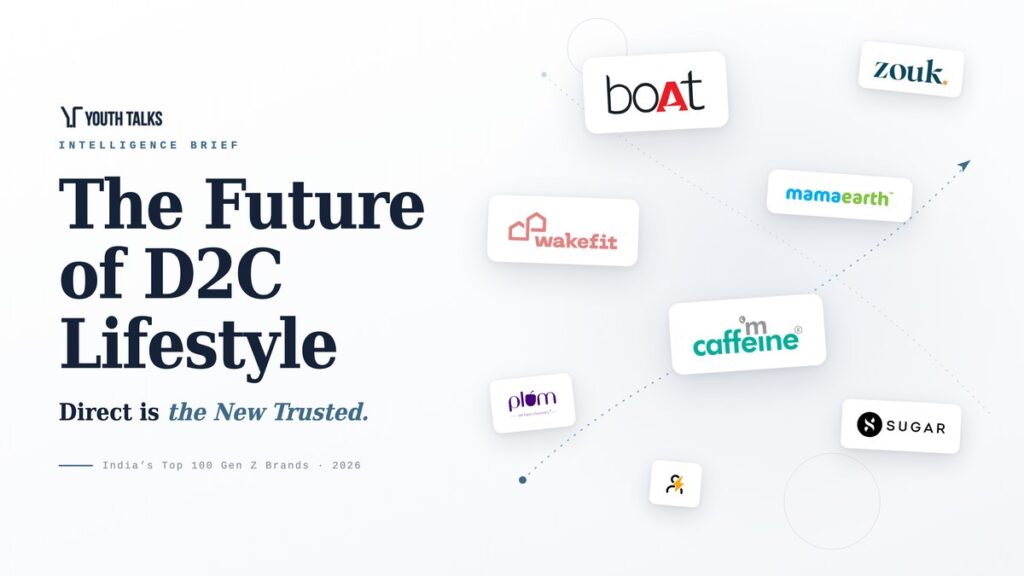
A TheYouthTalks Intelligence Brief | India’s Top 100 Gen Z Brands 2026
India’s direct-to-consumer revolution has fundamentally changed how brands are built.
For years, success in D2C was measured by customer acquisition, digital reach and marketplace growth. Scale became the ultimate benchmark. If a brand could dominate online conversations and expand rapidly across platforms, success appeared inevitable.
Gen Z is quietly redefining those rules.
Our survey of more than 5,000 Indian college students suggests that the next generation of successful D2C brands will not be those that simply sell products online. They will be the brands that become part of youth culture.
The findings reveal a widening gap between brands that are frequently purchased and brands that young consumers genuinely admire. That distinction may determine which D2C businesses become enduring brands—and which remain successful retailers.
For founders, investors and marketers, the message is clear.
The future of D2C is no longer about transactions.
It is about emotional relevance.
The Big Finding: Growth Doesn’t Always Create Love
The strongest D2C brands among Gen Z are not necessarily the ones with the largest customer base.
Beardo emerged as one of the most widely used brands in our study, reaching nearly one-third of respondents.
Yet when students were asked to name their favourite D2C lifestyle brand without any prompts, very few mentioned it.
Boat painted a very different picture.
Although its usage was comparable, it generated significantly higher spontaneous preference, emerging as the category’s most emotionally resonant brand.
This distinction highlights one of the most important strategic questions facing India’s D2C ecosystem.
Are brands building customers…
or building communities?
Because those are no longer the same thing.
The Culture Advantage
One of the defining characteristics of successful D2C brands has always been their ability to move faster than traditional companies.
But speed alone is becoming less valuable.
Culture is becoming more valuable.
TheYouthTalks’ Love Score measures exactly this shift by comparing brand usage with unprompted emotional preference.
Brands that score highly are doing something fundamentally different.
They are converting purchases into belonging.
Consumers don’t simply buy them.
They identify with them.
Boat illustrates this particularly well.
Its emotional affinity exceeds what its usage alone would predict, suggesting that the brand has successfully evolved beyond consumer electronics into a cultural symbol for many young Indians.
For D2C founders, that transition—from product to identity—is perhaps the most valuable growth strategy available.
Gen Z Doesn’t Buy Products. It Buys Stories.
The data also challenges one of the biggest misconceptions about younger consumers.
Price remains important, emerging as the single strongest purchase driver.
But affordability alone does not explain long-term preference.
Quality, durability and distinctive design together account for the majority of purchase decisions.
This suggests that Gen Z is remarkably pragmatic.
Young consumers are willing to experiment with emerging brands, but only if those brands consistently justify their promise.
Price may encourage the first purchase.
Design creates differentiation.
Quality creates repeat behaviour.
Identity creates advocacy.
The brands that combine all four build something much harder to replicate than market share.
They build loyalty.
Community Is the New Distribution
Perhaps the most powerful insight from this year’s study is the growing importance of peer recommendation.
More than four out of five respondents reported influencing the purchase decisions of friends and family.
In an age where every consumer has an audience, recommendations travel faster than advertising.
But recommendations are earned.
Students recommend brands that reflect their own personalities.
Brands such as Boat, Plum Goodness and Zouk appear to benefit from exactly this dynamic.
Their customers are not simply buyers.
They become ambassadors.
This changes the economics of D2C growth.
Marketing no longer ends when a customer completes a purchase.
It begins there.
The Next Phase of India’s D2C Revolution
India’s first generation of D2C companies disrupted traditional retail through digital distribution.
The next generation will differentiate themselves through emotional differentiation.
That requires a different operating philosophy.
Less focus on customer acquisition alone.
More focus on customer advocacy.
Less obsession with impressions.
More obsession with identity.
The brands that survive the next decade are unlikely to be those spending the most on performance marketing.
They will be those creating the strongest emotional communities around their products.
Three Strategic Lessons for D2C Founders
1. Distribution Gets You Customers. Culture Keeps Them.
Digital reach creates awareness.
Cultural relevance creates loyalty.
2. Great Products Win Transactions. Great Brands Win Identity.
Consumers increasingly choose brands that reflect who they are—not simply what they need.
3. Community Is Becoming the Strongest Competitive Moat.
Customer acquisition can be copied.
Communities cannot.
Brands that inspire recommendation will grow more efficiently than those relying solely on paid media.
Monday Morning Memo for D2C Leaders
If you’re leading a D2C business today, ask yourself three questions.
- If we stopped advertising tomorrow, would customers still talk about us?
- Are we optimising for conversion—or connection?
- Does our product solve a problem, or does our brand become part of someone’s identity?
The answers may reveal whether you’re building a successful business—or an enduring brand.
TheYouthTalks Verdict
India’s D2C movement is entering a new chapter.
The first wave of brands proved that products could be built, marketed and sold without traditional retail.
The next wave will prove something even more important.
That the strongest D2C brands are not built through algorithms alone.
They are built through culture.
For Gen Z, products are increasingly becoming expressions of personality, identity and belonging.
The brands that successfully transform customers into communities will define the next decade of India’s consumer economy.
Download the Complete Gen Z Adored Brands Report
This article highlights just one chapter of a much larger story. The full TheYouthTalks Gen Z Adored Brands Report analyses how more than 5,000 young Indians perceive and emotionally connect with brands across multiple industries—from automobiles and smartphones to fashion, food, finance, entertainment and beyond. If you’re a marketer, founder, researcher or business leader looking to understand what truly drives the next generation of consumers, download the complete report and explore the insights shaping the future of brand building in India.
Access your complimentary copy at TheYouthTalks Gen Z Adored Brands: https://theyouthtalks.com/genz-adored-brands/