





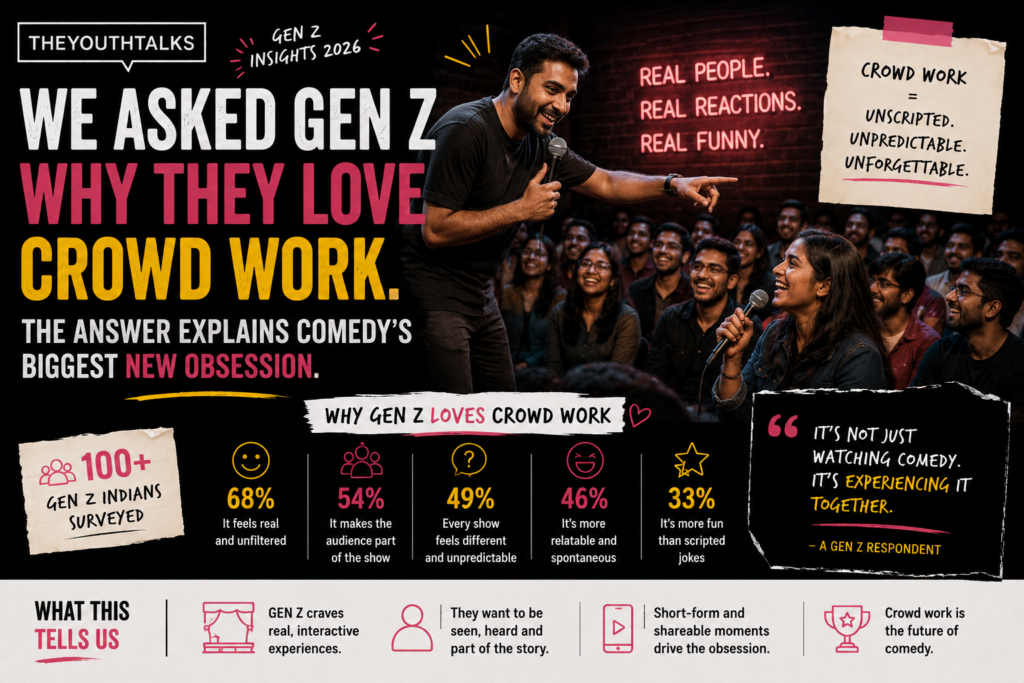
From Harsh Gujral and Gaurav Kapoor to Matt Rife and Russell Peters, unscripted audience interaction has become one of comedy’s most powerful social-media formats. But is crowd work actually easier than writing jokes?
There is a particular kind of comedy video that seems almost impossible to escape on Instagram Reels and YouTube Shorts.
A comedian walks towards the edge of the stage.
They point at someone in the audience.
“What do you do?”
The stranger answers.
“I’m a software engineer.”
A pause.
The comedian notices something else, asks another question and, within seconds, an ordinary conversation has turned into a joke.
There is no elaborate set-up. No elaborate production. Sometimes, barely even a traditional punchline.
Just two people talking.
And yet these are among the most widely circulated comedy clips on social media today.
Welcome to the age of crowd work.
For years, crowd interaction was often treated as a small component of stand-up — something a comedian might use to warm up an audience, fill a gap between prepared jokes or recover when a set wasn’t going according to plan.
That has changed.
Crowd work is now a content category of its own.
For some comedians, it has become a defining part of their digital identity. For others, it is an ingenious marketing tool: post the spontaneous interaction online, attract millions of views, and leave the carefully written material for the people who actually buy tickets.
The format is particularly well suited to Gen Z.
And perhaps that isn’t surprising.
In an internet filled with polished influencers, edited podcasts, carefully constructed brand content, AI-generated media and increasingly sophisticated production, there is something strangely compelling about watching somebody think in real time.
You don’t know what the audience member will say.
The comedian doesn’t know either.
And that uncertainty is the entertainment.
So, Why Did Crowd Work Suddenly Take Over?
The simplest answer is social media.
The more interesting answer is that crowd work solved a very specific problem created by social media.
A comedian’s most valuable asset is their material.
A joke that has taken weeks or months to write, test, rewrite and perfect can eventually become the centrepiece of a paid live show or comedy special.
Posting that joke online creates a problem.
Once millions of people have seen it, the surprise is gone.
A recent Indian Express report on the rise of crowd-work clips noted precisely this tension: comedians spend enormous amounts of time developing longer shows, while the social-media ecosystem demands a constant supply of fresh content. Crowd work offers a way to create clips without necessarily giving away the carefully written material audiences are paying to see live.
That is a remarkably efficient content model.
The comedian gets content.
The audience gets entertainment.
The scripted show remains protected.
And the platform gets another highly watchable video.
Everybody wins.
The Internet Turned “You Had to Be There” Into a Content Format
Crowd work is not new.
What changed was the camera — and, more importantly, the distribution system surrounding it.
Historically, the magic of crowd work was precisely that you had to be there.
A comedian might ask a stranger about their job, relationship, hometown or first date. Something funny happens. Everyone in the room laughs.
Then the moment disappears.
Social media changed that.
Suddenly, the most spontaneous part of a comedy show could be filmed, edited into a 30-second vertical video and distributed to people who were nowhere near the venue.
Instagram Reels and YouTube Shorts are particularly well suited to this format because the clip can stand completely on its own.
You don’t need to know the comedian’s entire body of work.
You don’t need to understand what happened during the previous 45 minutes.
You don’t even necessarily need to know the name of the show.
You simply watch.
There is a question.
There is an unexpected answer.
Then there is the reaction.
The structure is almost perfect for short-form video.
Why Gen Z Loves Watching Someone Think on Their Feet
There is a larger cultural reason crowd work works so well with young audiences.
Gen Z has grown up in an extraordinarily edited internet.
Influencers choose their best photographs.
Creators record multiple takes.
Podcasters remove awkward pauses.
Brands manufacture “authenticity.”
AI can now generate increasingly sophisticated images, voices and videos.
The result is a strange paradox.
The internet has become more polished while audiences have become more suspicious of polish.
That makes genuine spontaneity valuable.
A crowd-work clip contains something that is difficult to completely manufacture: uncertainty.
The comedian genuinely doesn’t know what the stranger is going to say.
The audience member doesn’t know what the comedian will do with the answer.
The joke might work.
It might completely fail.
And that possibility of failure is part of what makes success exciting.
For a generation accustomed to highly edited digital experiences, watching somebody improvise in real time can feel surprisingly intimate.
It feels less like consuming content and more like witnessing something happen.
That distinction matters.
It Is Interactive Without Requiring You to Participate
There is another clever psychological trick hidden inside crowd work.
The viewer is technically outside the interaction.
But they feel involved.
When a comedian asks:
“How long have you two been dating?”
the viewer immediately starts guessing.
What will they say?
Are they actually together?
Is there going to be an awkward reveal?
Will the comedian find something funny?
The audience becomes an invisible third participant.
That makes crowd work particularly powerful on short-form platforms, where attention is won through anticipation.
The viewer isn’t merely waiting for the punchline.
They’re waiting to discover what happens next.
Russell Peters Understood the Power of Audience Interaction Early
Crowd work has existed for decades, and some comedians mastered it long before Instagram became central to comedy discovery.
Russell Peters is one of the most interesting examples.
His career predates today’s short-form ecosystem by years, yet audience interaction became an important part of his online popularity.
His early internet circulation demonstrated something that today’s comedians understand instinctively: a comedian speaking directly to an audience member can create an instantly understandable piece of content.
You don’t need extensive context.
You need a funny interaction.
Peters also demonstrated another important principle: crowd work doesn’t necessarily have to be disposable.
It can become part of a comedian’s identity.
That is precisely what has happened to the format in the social-media era.
Matt Rife Turned Crowd Work Into a Discovery Engine
If Russell Peters was an early example, Matt Rife is perhaps one of the clearest modern examples of what happens when audience interaction meets Instagram and YouTube’s short-form ecosystem.
Rife’s audience grew enormously through clips of him interacting with people in the crowd.
The formula is deceptively simple.
Question.
Unexpected answer.
Quick observation.
Punchline.
Reaction.
Next.
The important point isn’t that every interaction is extraordinary.
It is that the format is repeatable without being repetitive.
Every audience is different.
Every stranger gives a different answer.
Every night generates a new story.
That is exactly what an internet platform hungry for fresh content wants.
Paul Smith and the Rise of the Crowd-Work Comedian
British comedian Paul Smith offers another strong example.
His online presence has been heavily associated with videos of conversations with audience members.
The format became so central to his digital identity that viewers began arriving at shows specifically expecting that interaction.
That represents an important transition.
The content is no longer merely advertising the comedy show.
The content has become part of the product.
The audience watches the clips.
The clips create curiosity.
Curiosity sells tickets.
The ticket gets them into a room where they hope they might become part of the next clip.
And the cycle begins again.
India Has Its Own Crowd-Work Stars
The same phenomenon is unfolding rapidly in India.
Harsh Gujral
Harsh Gujral is perhaps the clearest example of a comedian whose public identity has become closely associated with audience interaction.
His conversational style and ability to turn ordinary audience responses into jokes have made crowd work a major part of his digital appeal.
There is something particularly Indian about the material.
The conversations often begin with mundane details — where someone works, what they studied, whether they are married, where they are from — and then suddenly spiral into comedy.
The audience isn’t simply watching a comedian tell jokes.
They are watching him read people.
And that is a different skill.
A person says something.
The comedian has seconds to decide what is interesting about it.
Then they have to find the comedic angle.
Then they have to deliver it.
There is no editing room.
No second take.
No writer sitting beside them.
That is difficult.
Gaurav Kapoor
Gaurav Kapoor represents another side of the Indian scene.
His comedy demonstrates that crowd interaction can work when it is integrated into a broader comedic voice rather than treated simply as an endless stream of audience insults.
That distinction matters.
The strongest crowd work doesn’t merely embarrass someone.
It creates a shared joke.
The audience member becomes part of the comedy rather than merely its target.
Vikas Kush Sharma: When the Crowd Becomes the Show
Vikas Kush Sharma is perhaps an even more interesting Indian example of how crowd work has evolved from a supporting device into a recognisable comedy format.
Known for his crowd work, storytelling and roast-style humour, Sharma has built a substantial digital following around interactions that feel less like traditional stand-up and more like an unpredictable conversation between the comedian and someone who happened to buy a ticket that night. His YouTube catalogue is filled with crowd-work videos, including interactions around relationships, break-ups, proposals and awkward audience situations.
What makes Sharma particularly relevant to this conversation is the content loop he has created.
Something happens in the room. The interaction becomes a joke. The joke becomes a video. The video travels online. Someone discovers the comedian through that clip, follows him, watches another clip and eventually decides to attend a live show.
The live audience, in other words, is not merely consuming the comedy. It is helping generate the next piece of content.
That is a significant shift in how stand-up can work in the social-media era.
Sharma has also spoken about his preference for crowd work and “raw comedy”, while recent profiles have highlighted his ability to read a room and adapt to audiences in real time. His appeal therefore fits neatly into the larger phenomenon this story is examining: audiences are increasingly interested not only in the joke, but in watching a comedian figure out the joke in front of them.
And there is an important business advantage here too. Every audience is different, so the content supply is effectively renewable. A comedian doesn’t have to publish the same carefully written joke that forms part of a paid show. Instead, the room itself becomes the source material.
For a digital audience, it feels spontaneous.
For the comedian, it can be remarkably strategic.
More Indian Names Are Entering the Crowdwork Conversation
The phenomenon should not be reduced to a handful of comedians.
India’s stand-up ecosystem now includes performers such as Aakash Gupta, Abhishek Upmanyu, Anubhav Singh Bassi, Rahul Subramanian, Kenny Sebastian, Kanan Gill, Pranit More, Inder Sahani and Rajat Chauhan, among many others.
Their dependence on crowd work varies considerably.
Some are primarily known for written material.
Some regularly interact with audiences.
Some have found that spontaneous moments make particularly effective social-media clips.
That distinction is important.
The story is not that every Indian comedian has suddenly become a crowd-work comedian.
It is that crowd work has become an increasingly important part of how comedy is discovered online.
And It Is Bigger Than India
The same pattern can be seen internationally.
Alongside Matt Rife, Paul Smith and Russell Peters, comedians such as Mark Normand, Stavros Halkias, Luke Kidgell, Max Amini and Liam Withnail have all participated in an increasingly visible ecosystem of audience-interaction comedy.
Their styles are very different.
So are their audiences.
But the underlying content mechanic is remarkably similar.
A real person.
An unpredictable answer.
A comedian reacting in real time.
A clip that requires almost no context.
That is a powerful combination.
But Is Crowd Work Actually Easier Than Writing Comedy?
This is where the debate gets interesting.
Ask comedians and you’ll get very different answers.
One argument is that crowd work is actually harder.
And there is a strong case for it.
A scripted joke can be tested.
You can rewrite the wording.
Change the pause.
Move the punchline.
Try it in a smaller room.
Try it again.
Remove what doesn’t work.
Eventually, you have something polished.
Crowd work offers none of that.
The person sitting in front of you may be hilarious.
They may be painfully boring.
They may misunderstand the question.
They may become uncomfortable.
They may say something that takes the comedian somewhere completely unexpected.
The performer has seconds to react.
That is improvisation.
And improvisation is a genuine comedic skill.
But There Is Another Side to the Debate
Once a comedian becomes famous, audiences arrive already wanting them to succeed.
That changes the equation.
A mediocre observation from a famous comedian can receive a huge laugh.
The same line from an unknown performer might die completely.
There is also a growing criticism that some comedians use crowd work as a substitute for writing.
That criticism isn’t entirely unfair.
If a comedian repeatedly asks predictable questions and then relies on insults, stereotypes or sexual remarks, the interaction can become formulaic.
At its worst, crowd work becomes:
“Tell me something about yourself so I can make fun of you.”
That isn’t necessarily clever.
And audiences are beginning to notice.
Recent criticism around viral crowd-work incidents in India has raised questions about misogyny, humiliation, consent and the pursuit of clicks.
That matters.
The stranger on stage is not simply content.
They are a person.
The Best Crowd Work Is More Than Insulting Someone
This may ultimately be the dividing line between good crowd work and lazy crowd work.
Good crowd work observes.
It listens.
It connects unrelated details.
It finds the absurdity in an ordinary answer.
And, ideally, it makes the audience member look funny too.
The comedian isn’t simply waiting for an opportunity to attack.
They are collaborating with the room.
That is why the best crowd-work comedians can make an audience member who said something completely ordinary suddenly seem like the funniest person in the building.
The skill isn’t merely being quick.
It is being observant while being quick.
Why This Format Feels So Human in the Age of AI
There may be an even bigger reason crowd work is resonating now.
The internet is entering an era in which content can increasingly be generated, edited and optimised by machines.
Images can be fabricated.
Voices can be cloned.
Videos can be manipulated.
Entire pieces of content can be produced without anyone physically being present.
Against that backdrop, watching a comedian deal with a completely unpredictable human being has a particular appeal.
The stranger cannot be scripted.
The response cannot be predicted.
The comedian cannot outsource the decision.
For a few seconds, the audience gets to watch human intelligence operating without a safety net.
That is compelling.
Perhaps the most interesting thing about crowd work isn’t the joke itself.
It is the human unpredictability behind the joke.
The Future of Stand-Up May Be a Two-Speed Business
There is a larger business lesson hidden in all of this.
The modern comedian may increasingly need two different products.
The first is the polished show.
The carefully written jokes.
The hour-long narrative.
The material audiences pay to experience live.
The second is the unpredictable content engine.
Crowd work.
Backstage moments.
Audience reactions.
Unexpected interactions.
Clips that can travel across Instagram and YouTube.
The two products feed each other.
The clips create discovery.
Discovery creates followers.
Followers create ticket demand.
The live show creates new crowd-work moments.
Those moments become more clips.
And the cycle repeats.
That isn’t merely a change in comedy.
It is a new creator-economy business model.
Crowd Work Also Protects What Comedians Are Selling
There is another, more strategic reason comedians are leaning into crowd work: it allows them to feed the internet without giving away their best material.
A stand-up comedian can spend months writing, testing and refining a 60-minute set. Those jokes are ultimately what audiences are paying to experience in a theatre or comedy club. If the strongest five minutes of that set are uploaded online repeatedly, the comedian risks turning the paid experience into something the audience has already consumed for free.
Crowd work neatly solves that problem.
The scripted set can remain largely protected for the people who buy tickets, while spontaneous interactions with the audience become the digital content engine. A comedian can perform the same carefully constructed material night after night for paying audiences, while every evening can still generate a completely different set of short-form clips.
It is a remarkably efficient arrangement.
Live audiences get exclusivity. Digital audiences get spontaneity. And comedians get both ticket sales and a constant stream of content.
There is also an important psychological advantage. When someone watches a crowd-work clip online, they are not necessarily consuming the comedian’s “product” in full. They are getting a glimpse of the experience. In many cases, that glimpse creates curiosity: What is this comedian’s full show actually like?
In that sense, crowd work functions almost like a trailer — except one that can be generated organically every night.
For comedians navigating an economy where social-media visibility is increasingly important but their core business remains live performance, that distinction is invaluable. They don’t have to sacrifice their best jokes to stay relevant online.
They can give the internet the moments that happen around the jokes, while keeping the jokes themselves for the room.
And perhaps that is one of the smartest things about the crowd-work boom: what looks like spontaneous chaos from the audience’s perspective can actually be a very deliberate content strategy from the comedian’s side.
Crowd Work Didn’t Kill Stand-Up. It Changed the Front Door.
The mistake would be to assume that the popularity of crowd work means Gen Z doesn’t appreciate written comedy.
It does.
But young audiences increasingly discover comedians differently.
They may encounter a 40-second crowd-work clip before they ever watch a full special.
They may follow the comedian because of one interaction.
They may then discover the scripted material.
And eventually, they may buy a ticket.
So perhaps the real story isn’t:
Crowd work is replacing stand-up.
It is:
Crowd work has become the trailer for stand-up.
And that is a significant distinction.
The comedian’s carefully written hour remains the main event.
Crowd work is increasingly the doorway.
In a world where attention is scarce, unpredictability travels faster than polish.
The comedians who understand that aren’t choosing between the audience and the algorithm.
They are putting the audience at the centre of the algorithm.
And perhaps that is why a simple question from a comedian —
“So, what do you do?”
— has become one of the most powerful opening lines in comedy today.