
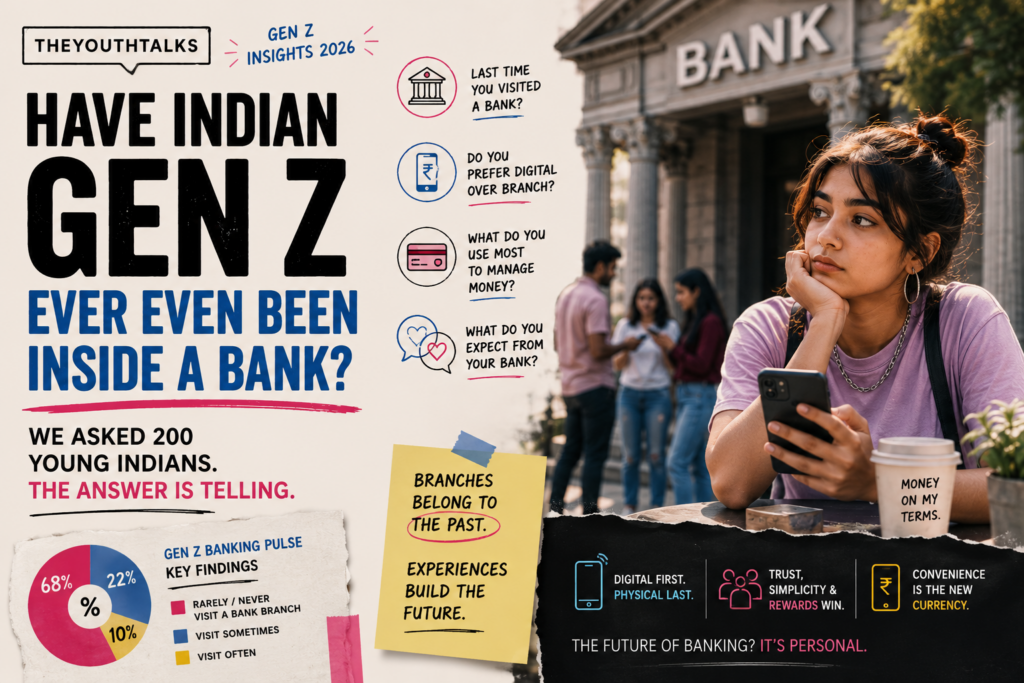
For a generation that grew up with UPI, mobile banking and instant payments, the bank branch may no longer be a place they know — or feel they need.
There was a time when opening a bank account was almost a rite of passage.
You went to the branch with your parents. You carried photographs. You filled out forms with a blue or black pen. Someone behind a counter checked your documents, stamped a few pages and told you to come back later. If you were old enough, you probably left with your first passbook and the vague feeling that you had officially entered adulthood.
For many young Indians today, that entire experience sounds almost historical.
So we asked a deceptively simple question to 200 young Indians from Gen Z: Have you ever actually been inside a bank?
The responses offered a fascinating glimpse into how dramatically the relationship between young Indians and financial institutions may be changing.
This is not a nationally representative survey, nor is 200 respondents enough to make a definitive claim about India’s 200-million-plus Gen Z population. But it is a useful snapshot — particularly because the question was not about whether young people use banks.
Of course they do.
The question was whether they actually go to one.
And that distinction matters.
Banking Is Everywhere. Banks Aren’t.
India’s young consumers are arguably among the most digitally integrated banking users anywhere in the world.
They receive money on their phones. They split restaurant bills through UPI. They pay rent digitally. They buy concert tickets, order food and recharge their phones without ever thinking about which bank sits behind the transaction.
The infrastructure is almost invisible.
The scale of that transformation is enormous. According to the National Payments Corporation of India (NPCI), UPI processed more than 23.2 billion transactions in May 2026, worth nearly ₹29.9 lakh crore.
For a 19-year-old, “banking” can therefore mean opening an app, scanning a QR code and entering a PIN.
The bank itself is somewhere in the background.
That is a profound change from the relationship many older Indians had with their banks. For previous generations, the branch was the bank. It was where you opened accounts, deposited money, spoke to a manager, updated your passbook, applied for loans and occasionally spent an unreasonable amount of time waiting for your token number to be called.
Gen Z has inherited a different financial ecosystem.
And perhaps more importantly, it has inherited it at exactly the moment when digital payments became almost frictionless.
We Asked 200 Gen Zs: “Have You Ever Been Inside a Bank?”
Our small study focused on young Indians, primarily students and early adults, across campuses and cities.
The question was intentionally simple.
Have you ever physically entered a bank branch?
What emerged from the conversations was more interesting than a simple yes-or-no response.
For many respondents, the answer was effectively: Yes, but I don’t remember why.
A substantial group recalled visiting a branch only once or twice — usually because someone else required them to.
Opening a student account.
Completing KYC.
Getting documents signed.
Sorting out a scholarship-related requirement.
Accompanying a parent.
In other words, the branch visit wasn’t necessarily part of their banking routine. It was an administrative interruption to it.
That distinction came up repeatedly.
The “My Parents Took Me” Generation
One of the most striking patterns was how many young respondents associated their first bank visit with their parents.
The parent knew what to do.
The young person simply followed instructions.
There was little sense of discovery or ownership.
For previous generations, visiting a bank could be the beginning of a financial relationship. For many Gen Z consumers, the first meaningful interaction with their bank may happen through a mobile application.
That’s a subtle but important shift.
The institution is no longer introduced through a person behind a counter. It is introduced through a screen.
And the first impression isn’t a branch manager.
It’s the interface.
The Branch Has Become a “Problem-Solving Place”
Another interesting pattern emerged from respondents who had visited branches more than once.
They weren’t necessarily going there because they preferred physical banking.
They were going because something had gone wrong.
A transaction needed resolving. A document needed verification. An account required an update. There was an issue that couldn’t be solved quickly through an app.
This changes the psychological role of the branch.
Instead of being the default destination for banking, it becomes the fallback destination when digital banking fails.
That is a very different proposition.
The branch is no longer necessarily where the relationship begins. It is where the customer goes when the relationship with the app breaks down.
That doesn’t mean physical branches are irrelevant. Far from it.
In fact, recent research in India suggests that younger, digitally savvy consumers are among those least dependent on branch visits, while entrepreneurs, affluent customers and rural users continue to account for a larger share of physical footfall. An EY report cited in May 2026 also found that 55% of customers wanted improvements to digital banking services, including apps, websites and chatbots.
The direction of travel is clear: convenience is moving increasingly toward digital channels.
UPI Changed More Than Payments
It is tempting to describe India’s digital banking revolution as an app story.
It isn’t.
It is a behavioural story.
UPI has changed what Indians expect from financial services.
The expectation today is not simply that money should be safe. It should be available instantly, transferable instantly and visible instantly.
NPCI describes UPI as an instant payment system that enables transfers between bank accounts through mobile applications.
That sounds technical.
For Gen Z, it is simply normal life.
A friend sends you ₹350. You receive it immediately.
You pay a shopkeeper by scanning a QR code.
You don’t need to know their bank.
You don’t need their account number.
You don’t need to visit a branch.
You may not even think of the transaction as “banking”.
That’s the fascinating part.
Digital banking has become so embedded in everyday life that it has stopped feeling like banking.
The Bank Is Becoming Invisible
For older Indians, trust in a bank could be physical.
You knew the branch.
You knew the manager.
You recognised the guard.
You had a passbook.
You might have visited the same branch for twenty years.
For Gen Z, trust can be much more abstract.
It might be a successful transaction notification.
It might be an app that works every time.
It might be a familiar UPI interface.
It might even be a recommendation from a friend.
And increasingly, financial trust is being mediated through digital experiences.
This creates an interesting challenge for traditional banks.
They have spent decades building physical infrastructure designed to create proximity.
But what happens when proximity no longer means walking distance?
What if the most important “branch” is the banking application sitting on a customer’s phone?
But Don’t Write Off the Branch Yet
There is an important caveat here.
The disappearance of branch visits among young consumers should not be mistaken for the disappearance of physical banking.
Globally, banks continue to discover that branches can play a role in establishing credibility, particularly when customers are making high-value or complicated financial decisions.
Recent research reported by the Financial Times found that even digitally savvy US consumers continue to value having a branch nearby, with 63% of Millennials and Gen Z respondents saying they liked having branches in their neighbourhoods.
That tells us something important.
People can want a bank branch without wanting to visit it.
The branch can be a symbol of security rather than a destination.
That distinction may become increasingly relevant in India too.
A young person may never visit their bank, but they may still feel more comfortable knowing that a physical institution exists somewhere nearby.
Digital convenience and physical reassurance don’t necessarily have to compete.
They can coexist.
So What Does Gen Z Actually Want From a Bank?
If the branch isn’t the primary relationship, what is?
The answer, based on our conversations, is surprisingly straightforward.
Young consumers want banking to be:
Fast.
Simple.
Transparent.
Available 24/7.
And when something goes wrong, they want a human being who can actually solve the problem.
That last point may be the most important.
Gen Z may be comfortable doing almost everything digitally, but that doesn’t mean they want to be abandoned inside a chatbot when their money is stuck.
The future of banking may therefore not be entirely digital.
It may be digital by default, human when necessary.
That is a very different model from traditional banking.
A Small Survey, But a Big Cultural Signal
Two hundred respondents cannot tell us exactly how every young Indian thinks about banks.
It would be irresponsible to pretend otherwise.
But small surveys can sometimes reveal something that large datasets struggle to capture: the language people use when describing their everyday lives.
And when a generation talks about a bank branch as something their parents took them to, somewhere they visited for paperwork, or simply somewhere they have never needed to go, it tells us something significant.
The physical bank may still exist.
But it is no longer necessarily part of the mental map of young consumers.
That may ultimately be the bigger story.
Because the question isn’t really whether Gen Z visits bank branches.
The more interesting question is:
If an entire generation can manage money without ever needing to enter a bank, what exactly should a bank branch mean to them?
India’s banking industry has spent decades making banking accessible by building branches everywhere.
Gen Z may be the first generation to experience the opposite transformation — banking becoming accessible precisely because they don’t have to go anywhere.
And perhaps that is the real revolution.
The bank didn’t disappear.
It simply moved into their pocket.