
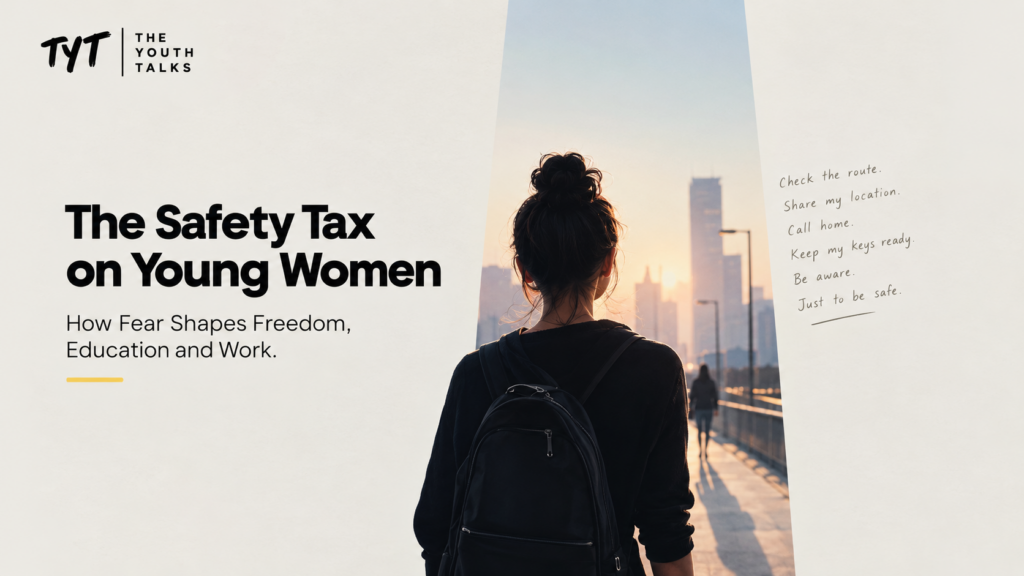
From late-night commutes and campus life to internships and first jobs, the invisible calculations young women make every day reveal a larger question: who gets to move freely through India, and who must plan their lives around the possibility of danger?
At 8:42 pm, a young woman leaves her office. Her cab is three minutes away. She checks the registration number, shares her live location with a friend and calls home before getting into the car.
The journey hasn’t started, but the safety checklist has.
A college student returning from a group project chooses a longer route because the shorter one is poorly lit. Another declines an evening event because the last convenient bus leaves before it ends. Someone considering an internship in another part of the city calculates not just the stipend and learning opportunities, but also the cost of a safe commute.
These are illustrative situations, not isolated stories about individual women. They describe a broader question about everyday life: how much additional planning does a person have to do simply to feel safe moving through the world?
For many women, safety is not a consideration that appears only when something goes wrong. It is a continuous background calculation.
Which road? Which transport? What time? Who knows where I am? What if my phone battery dies?
Researchers sometimes describe these repeated precautions as safety work: the mental and practical effort people expend to anticipate, avoid and respond to potential threats.
The individual actions may seem small. The cumulative burden is not.
And for young Indian women entering adulthood, that burden raises a question that extends well beyond personal security: what happens when the freedom to pursue an opportunity depends on how safely you can get there and return?
The journey is not always equal
Consider two students invited to attend the same industry networking event. Both want to go. Both believe it could help them find internships, meet mentors or understand an industry better.
One checks the event’s location and calendar.
The other checks those things, too, but also calculates the return journey, whether public transport will still be available, whether a friend can accompany her and whether the expense of a cab is justified.
The opportunity is technically available to both. The cost of accessing it is not necessarily the same.
This is where conversations about women’s safety need to move beyond the familiar list of precautions.
Safety influences not only whether a woman can avoid a dangerous situation, but also whether she can participate fully in ordinary life. An evening class, a college festival, a networking dinner, a first job with late shifts or a spontaneous meeting with friends can each involve additional decisions.
None of these decisions automatically means that a woman will miss out. Nor does every woman experience public spaces in the same way. But the possibility of having to make these calculations deserves serious attention.
The consequences can extend into education and work. If an internship requires travel at inconvenient hours, if a workplace expects employees to stay late, or if a professional event ends after public transport becomes difficult to access, safety becomes part of the opportunity’s real cost.
The question is no longer simply whether a young woman has access to a classroom or a job.
It is whether she can use that access with the same practical freedom as everyone else.
The numbers tell a difficult story
The global scale of violence against women makes this discussion impossible to dismiss as a matter of individual perception.
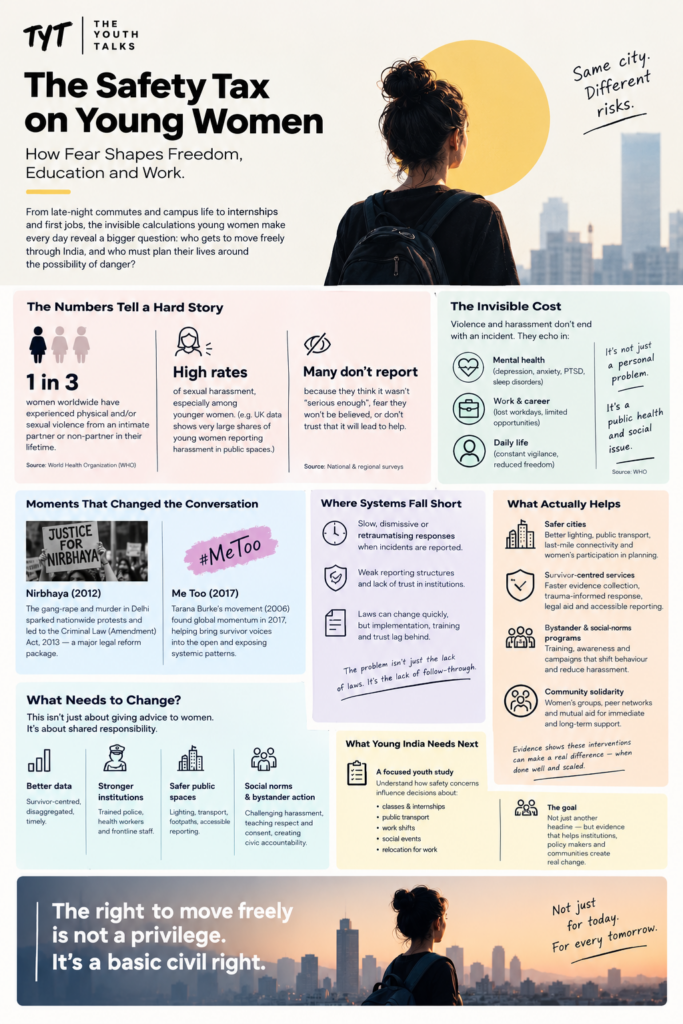
The World Health Organization estimates that nearly one in three women worldwide have experienced physical and/or sexual violence during their lifetime, primarily intimate partner violence or non-partner sexual violence.
This figure should be understood carefully. It measures specified forms of violence; it is not a direct estimate of how many women experience street harassment, unwanted attention or everyday fear. Those experiences require their own evidence and measurement.
That distinction matters because women’s safety is often discussed through statistics that describe different problems as though they were interchangeable.
Violence, sexual harassment, fear of harassment and the precautions taken to avoid potential danger are related, but they are not identical.
A woman does not need to have experienced a violent incident herself to change her behaviour because she perceives a risk. Equally, the fact that someone takes precautions does not establish that an incident occurred or that every precaution was necessary.
Good policy needs to understand all these dimensions without confusing them.
It also needs to recognise the limitations of recorded crime. Official complaints and police records capture reported incidents, not necessarily the full extent of what happens. Some survivors do not report violence because of fear, stigma, concerns about being believed or uncertainty about whether reporting will lead to meaningful assistance.
The absence of a complaint should therefore not automatically be interpreted as proof that a place, institution or system is safe.
For India, this calls for better evidence on how young women experience mobility, harassment, campus safety, workplace transport and reporting mechanisms. National statistics are essential, but they cannot answer every local question about how a student travels home from college or how an early-career professional navigates an unfamiliar city.
That is where careful, transparent youth research can add value.
The invisible cost of being alert
Safety planning consumes more than time.
It can involve attention, mental effort and the emotional strain of constantly assessing unfamiliar situations. The effects vary from person to person, and it would be wrong to assume that every precaution produces the same psychological outcome. But persistent concerns about personal safety can affect how people experience public spaces and plan their activities.
Imagine reaching home after an ordinary workday. The journey was uneventful. Nothing happened.
Yet the trip involved checking the vehicle, monitoring the route, keeping the phone accessible and informing someone when you arrived.
From the outside, it was an ordinary commute. From the inside, it involved a series of decisions that other passengers may not have had to make.
This is one reason the absence of an incident cannot, by itself, establish that the experience was free of burden.
The same issue can arise on campus. A student may choose not to stay back for a club meeting, take part in a late rehearsal or attend a social gathering. She might make the decision because of transport availability, family expectations, personal preference, safety concerns or several factors together.
It is difficult to determine how often safety is the decisive factor without asking young people directly.
But it is worth asking whether institutions understand these trade-offs at all.
Universities measure attendance, placements, academic performance and participation in extracurricular activities. Employers measure productivity, retention and employee engagement. How often do they examine whether the practical arrangements surrounding those activities make participation equally accessible?
A campus can advertise an inclusive culture while leaving students to work out their own arrangements for getting home safely. An employer can offer career advancement while overlooking how late working hours and unreliable transport affect employees’ ability to accept those opportunities.
In both cases, a supposedly individual problem may have an institutional dimension.
When public outrage becomes policy
India has witnessed moments when violence against women has forced questions of safety and accountability into the national conversation.
The December 2012 gang rape and murder in Delhi, widely known as the Nirbhaya case, triggered mass protests and renewed demands for legal reform. The Criminal Law (Amendment) Act, 2013 introduced significant changes to the legal framework addressing sexual offences.
The case remains an important reminder of the power of public attention to demand institutional action.
But legal reform and everyday safety are not the same measure of progress.
Laws define offences, establish duties and provide mechanisms for justice. Their practical value also depends on implementation, investigation, access to support, institutional conduct and public trust.
A person deciding whether to report harassment is not responding only to the wording of a law. They may also be thinking about whether they will be heard, whether the process will be accessible, whether their privacy will be respected and whether they can pursue the complaint without disproportionate personal costs.
The global Me Too movement offers another perspective on the relationship between individual experiences and institutional responsibility. Tarana Burke began the movement in 2006 to support survivors, while the hashtag gained worldwide prominence in 2017. It helped bring widespread attention to sexual harassment and abuse, particularly in workplaces and positions of unequal power.
Neither public mobilisation nor legal change solves a problem automatically. Both can, however, create pressure to examine practices that were previously normalised or ignored.
The challenge is sustaining that scrutiny after public attention moves elsewhere.
Stop making women responsible for solving the problem alone
Much of the everyday conversation about women’s safety is framed as advice to women.
Stay alert. Avoid isolated places. Share your location. Do not travel alone at night. Keep emergency numbers handy.
Some precautions may be useful in particular circumstances. Practical safety information has its place.
The problem arises when these precautions become the principal response to violence and harassment.
A woman can follow every recommendation and still experience harassment. A person cannot reliably predict or control another person’s decision to cause harm. Nor should the freedom to attend an event, accept a job or return home depend entirely on an individual’s ability to anticipate every possible risk.
The responsibility must extend to the people and institutions that shape the environment.
Cities need safer, more accessible public spaces. Lighting, functioning public transport, dependable last-mile connections, maintained footpaths and accessible reporting mechanisms can all contribute to safer mobility. Their effectiveness should be evaluated rather than assumed.
Educational institutions need clear systems and practical support. Campuses should communicate complaint procedures, protect confidentiality appropriately, respond to reports seriously and examine transport arrangements for activities that run late. Safety policies should be understood by students, not merely displayed on institutional websites.
Employers need to examine how work is organised. Late shifts, off-site events and travel requirements should come with appropriate arrangements and clear processes for raising concerns. Workplace harassment policies need meaningful implementation, not just formal compliance.
Public authorities need evidence that measures are working. Complaint numbers alone are insufficient. An increase in reports may reflect an increase in incidents, improved awareness or greater confidence in reporting. A decrease may indicate improvement, but it may also reflect declining trust. Data needs context, alongside evidence on response times, outcomes, accessibility and people’s experiences.
And bystanders have a role, too. Friends, colleagues, transport staff and members of the public can contribute to safer environments by challenging harassment where it is safe to do so, supporting affected people and refusing to treat abusive behaviour as harmless entertainment.
None of these measures guarantees that violence will disappear. Together, however, they distribute responsibility more appropriately than a system that asks potential victims to manage every risk themselves.
What young India needs to measure next
There is another opportunity here: understanding the problem through the experiences of young people themselves.
A carefully designed study of college students and early-career professionals could examine whether safety concerns influence decisions about evening classes, internships, public transport, workplace shifts, social events and relocation for work.
It could ask not only whether respondents have experienced harassment, but also whether they have changed their behaviour because of safety concerns, what support they can access and how confident they feel about reporting incidents.
The questions would need to be specific, voluntary and sensitive to participants’ privacy. Researchers should avoid collecting unnecessary identifying details, and any findings should clearly disclose the sample, methodology and limitations.
A small student survey would not establish national prevalence. It could, however, identify patterns worth investigating through larger and more representative studies.
For a youth-focused platform, this is an important distinction. Young people should not appear in research only as a demographic affected by a problem. Their experiences can help identify where systems fail and which changes deserve attention.
The goal should not be to produce another alarming headline. It should be to generate evidence that institutions can use.
The right to move freely
Return to the young woman waiting for her cab.
She checks the registration number. She shares her location. She calls home. Eventually, she reaches her destination.
Nothing happens.
The journey ends, and the next day she will probably do many of the same things again.
There is no reason to suggest that every safety precaution is inherently unfair or that all women should experience travel in precisely the same way. People will always make personal decisions about comfort, risk and convenience.
The larger question is whether these decisions are being made freely or under constraints that society has accepted as inevitable.
Can a student attend an evening lecture without having to sacrifice another opportunity because the journey home is impractical? Can a young professional accept a demanding role without being left alone to solve transport and safety problems created by the way work is organised? Can a woman spend time in a public space without being treated as responsible for preventing someone else’s misconduct?
These are not simply questions about crime prevention. They are questions about access, independence and participation.
A society cannot claim that its educational and professional opportunities are equally available merely because the same doors are technically open to everyone. It must also examine the conditions under which people can walk through them.
The measure of progress is not whether women have become better at anticipating danger. It is whether institutions have become better at preventing harm, responding to it and ensuring that people can participate in public life without unnecessary barriers.
The goal is not to make women less careful. It is to make constant vigilance less necessary.
Because the freedom to study, work, travel, meet friends and return home should not depend on how successfully someone can calculate risk.
The challenge is not to teach young women how to navigate an unsafe world indefinitely. It is to build public spaces, institutions and systems that give them greater freedom to live in it.