

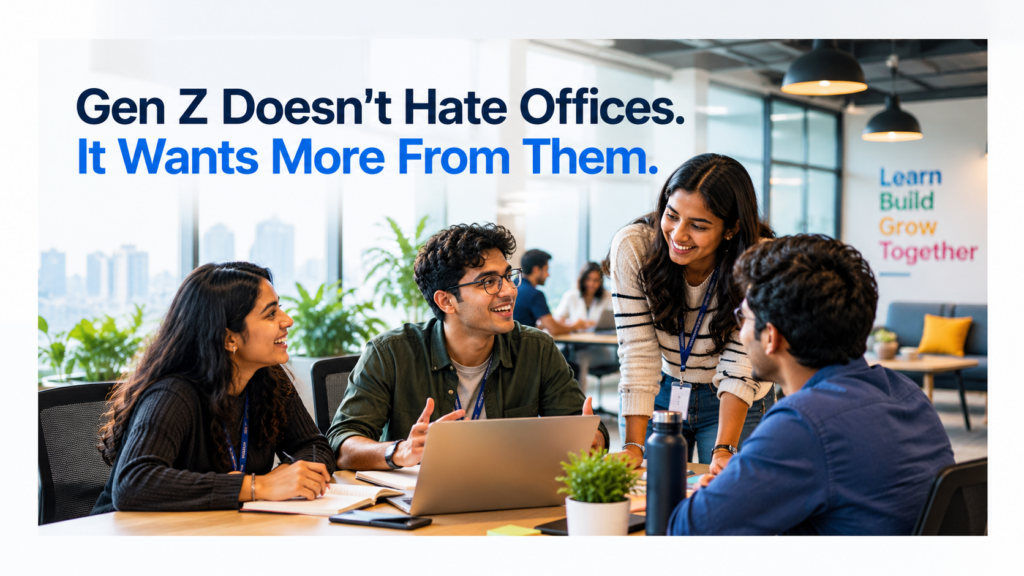
As companies rethink return-to-office policies and the future of hybrid work, research suggests that young Indians may not be as opposed to physical workplaces as popular narratives suggest. What they increasingly want is an office that offers learning, collaboration, professional relationships and a reason to show up.
For much of the past few years, the debate around Gen Z and the workplace has revolved around one assumption: young professionals want to work from home. Having entered the workforce during or shortly after the pandemic, Gen Z has often been associated with remote work, flexible schedules and a preference for greater control over where and when work happens.
But the picture emerging from research in India is more nuanced.
A significant proportion of young professionals are open to working from offices, provided the experience offers something beyond sitting at a desk, attending meetings and completing tasks that could just as easily be done from home. For many, the workplace can be an important environment for learning, building professional relationships, understanding organisational culture and discovering how careers develop.
The question, therefore, may not be whether Gen Z wants to return to the office. It is whether employers are giving the generation enough reasons to come back.
The numbers challenge the work-from-home narrative
A December 2022 report by NASSCOM, developed in partnership with Indeed, titled Gen Z and Millennials: Reshaping the Future of Workforce, offers an interesting perspective on how young Indians view different working arrangements.
Based on an online survey of more than 1,100 Millennials and Gen Z respondents, alongside interviews with over 25 CHROs and HR leaders, the research found that 60% of Gen Z respondents preferred a hybrid working model. However, 25% preferred working completely from the office, compared with just 15% who preferred completely remote work.
The comparison with Millennials is equally interesting. While 60% of Millennials also preferred hybrid working, only 14% wanted to work entirely from the office, while 26% preferred a completely remote arrangement.
The findings suggest that Gen Z respondents were more open to office-based work than their Millennial counterparts.
This challenges the idea that younger employees universally favour remote working. Instead, the preference appears to be for a combination of flexibility and physical interaction.
The NASSCOM report also highlighted that 21% of Gen Z respondents wanted the flexibility to choose their office days. The finding points towards an important distinction: young professionals may not necessarily be rejecting the workplace; they may be questioning the extent to which employers should dictate how frequently they use it.
For employers, this creates an opportunity to rethink hybrid work beyond simply deciding how many days employees must be present.
An office can offer what a laptop cannot
One of the most important aspects of beginning a professional career is learning things that rarely appear in a formal job description.
A young employee may understand a technical assignment but still need guidance on communicating with clients, presenting ideas, navigating team dynamics or handling disagreements. These experiences often develop through observation, informal conversations and working alongside colleagues.
For someone entering their first job, being physically present can make it easier to approach a senior colleague, seek feedback, observe how experienced professionals solve problems and understand how decisions are made within an organisation.
These interactions may not always happen naturally through scheduled video calls.
This is particularly relevant for fresh graduates and early-career professionals who are still developing their professional confidence and understanding of workplace expectations.
A young AI Engineer working with a large tech company on the condition of anonymity reasoned :-
“I think working from home is convenient, but when you are starting your career, there are many things you learn simply by being around people who have more experience. Sometimes, a five-minute conversation with a senior can teach you something that might otherwise take several days to figure out.”
For young employees, the office can also become a space to build friendships and professional networks. These relationships can influence future collaborations, mentorship opportunities and even career decisions.
In this context, the workplace is not merely a location where employees complete their assigned responsibilities. It can also be an environment in which they develop as professionals.
Research points to the value of in-person connections
The changing relationship between Gen Z and physical workplaces is also visible in Deloitte’s 2024 Gen Z and Millennial Survey, which included a separate India country profile.
The global survey covered 22,841 respondents across 44 countries, including 500 Gen Z respondents and 300 Millennials in India.
The research found that return-to-office policies were producing mixed outcomes. Some respondents reported feeling more engaged and connected with their organisations and colleagues, while others experienced financial pressures, increased stress and challenges associated with commuting and additional responsibilities.
Importantly, the report identified both the positive and negative consequences of bringing employees back to physical workplaces.
For Indian Gen Z respondents, the positive experiences included greater engagement and connection with colleagues, improved routine and structure, and increased collaboration and social interaction.
At the same time, commuting costs, additional accommodation expenses and the impact on personal time emerged as concerns.
This is an important distinction. The physical workplace can offer professional and social benefits, but the experience of getting there also carries a cost.
A return-to-office policy that overlooks these considerations risks creating resentment rather than stronger engagement.
The challenge for employers is to ensure that the benefits of physical presence are meaningful enough to justify the time and effort involved.
Gen Z wants flexibility, but also wants to belong
The discussion around workplace flexibility is often presented as a choice between employee convenience and organisational productivity. However, the expectations of younger professionals may be more layered.
They want the freedom to manage their time, but they also want to feel included in their teams. They want independence, but they need access to guidance. They value flexibility, but they do not necessarily want to miss out on opportunities because they are not physically present.
For a young employee, being left out of an informal discussion, an impromptu brainstorming session or a conversation about an upcoming project can sometimes mean missing an opportunity to contribute.
This makes the quality of workplace interaction particularly important.
A full stack Developer working with Deloitte India said :-
“I would prefer a workplace where I have some flexibility, but I would not want to feel disconnected from my team. Being around colleagues helps you understand how things work, participate in conversations and become more confident about sharing your own ideas.”
For employers, this means hybrid working needs to be designed thoughtfully. Simply allowing employees to work from home on selected days is not enough.
Teams need to create opportunities for meaningful collaboration, ensure that remote employees are not disadvantaged and make office days useful for activities that benefit from in-person interaction.
The emphasis should shift from counting attendance to improving the quality of collaboration.
The first few years of a career are different
There is another dimension to this debate: the career stage of the employee.
An experienced professional who has spent a decade building industry relationships, developing specialised skills and managing teams may have very different workplace requirements from someone entering their first job.
For the latter, the workplace can provide an important learning environment.
Understanding how an organisation functions, observing leadership behaviour, receiving immediate feedback and developing relationships with colleagues can all contribute to professional development.
The NASSCOM research also identified learning and growth as important considerations for Gen Z when selecting employers. The report found that young respondents placed importance on company culture, ethics, learning and career development, alongside the organisation’s brand.
It also highlighted that learning and development was an important non-financial benefit for Gen Z.
This suggests that the physical office experience and professional development should not be treated as entirely separate conversations.
If companies want young employees to attend offices, they could make those days more valuable through mentoring sessions, peer-learning activities, collaborative projects, leadership interactions and opportunities to work across departments.
An office that provides access to people, knowledge and experiences can offer something that a remote working arrangement may find difficult to replicate consistently.
The problem with mandatory attendance without meaningful engagement
However, the willingness to work from an office should not be mistaken for unconditional acceptance of rigid attendance policies.
Deloitte’s 2024 research highlights why the distinction matters.
While some employees appreciated the engagement and collaboration associated with returning to offices, others reported financial and personal costs, including commuting expenses and additional stress.
For young professionals, particularly those living in large Indian cities, the daily commute can consume considerable time and money.
If employees spend several hours travelling only to attend virtual meetings from their office desks, the value of physical attendance becomes difficult to justify.
Similarly, asking employees to come to the office without providing opportunities for interaction, learning or collaboration can make the exercise feel administrative rather than productive.
I don’t mind travelling to the office when there is a reason to be there. But if I am going to spend hours commuting and then spend the entire day attending online meetings, it becomes difficult to understand the purpose of coming in, said a young female intern.
For organisations, this raises a practical question: what should employees be able to do in the office that they cannot do as effectively elsewhere?
The answer could include team collaboration, mentoring, training, creative problem-solving, client interactions and informal knowledge-sharing.
Companies may also need to reconsider how they measure productivity. Physical attendance does not automatically translate into better performance, just as working remotely does not necessarily mean reduced commitment.
What employers need to rethink
The emerging evidence suggests that the future of work may not be a contest between offices and remote working.
Instead, organisations need to think about how different working arrangements support different employee needs.
For Gen Z, the office could become a place where professional relationships are built, knowledge is shared and career opportunities become more visible.
That requires a more deliberate approach to workplace design and management.
Companies could consider making office days more purposeful, introducing structured mentorship programmes, creating opportunities for employees to interact with senior leadership and encouraging collaborative assignments that bring teams together.
They could also give employees greater autonomy in deciding when physical presence is most useful, rather than applying uniform attendance requirements across every role and team.
Managers will have an equally important responsibility. Young professionals need constructive feedback, access to guidance and opportunities to participate in meaningful work. These experiences should not depend entirely on whether an employee happens to be sitting near a senior colleague.
Ultimately, the office needs to become more than an infrastructure investment. It needs to become an investment in people.
The future may be hybrid, but the experience needs to improve
The debate around Gen Z and office culture is unlikely to disappear anytime soon. As organisations continue to experiment with hybrid arrangements, return-to-office mandates and flexible working policies, the expectations of younger employees will remain an important part of the conversation.
The research from NASSCOM and Deloitte offers a useful reminder that the generation cannot be described through a single preference. Some young professionals value remote working, others appreciate the structure and interaction of an office, while many want the freedom to combine both.
What connects these preferences is the desire for a workplace that supports professional growth without unnecessarily compromising personal time and flexibility.
For employers, the challenge is not simply to persuade Gen Z to return to offices. It is to build workplaces where young professionals can learn, collaborate, feel included and see a future for themselves.
Perhaps the more relevant question for companies is no longer how many days Gen Z employees should spend in the office.
It is whether the experience they receive on those days is worth showing up for.