

For generations of young Indians, customer-support and BPO jobs have offered a relatively accessible route to earning, independence and a lifestyle upgrade. As AI agents take over routine work, the bigger question may not be how many people lose their jobs today, but how many young Indians will struggle to get their first one tomorrow.
For a young Indian graduate who has spent years studying without knowing exactly what career to pursue, a call-centre job can offer something refreshingly concrete: a salary at the end of the month.
The work may involve answering customer queries, resolving complaints, processing requests or following a script through a headset. It may mean night shifts, demanding performance targets and conversations with customers thousands of kilometres away. But for someone entering the workforce, it can also mean earning independently, contributing to household expenses, paying personal bills and enjoying the first taste of financial freedom.
For many young people, that first salary is not simply income. It is a change in how they live.
Now, artificial intelligence is beginning to challenge the economics of the very jobs that have helped make India a global hub for customer service and business-process outsourcing (BPO).
In April 2024, K. Krithivasan, chief executive of Tata Consultancy Services (TCS), warned that advances in generative AI could dramatically reduce the need for traditional call centres. More recently, TCS Chairman N. Chandrasekaran predicted that AI agents could eventually match the company’s human employee count.
These are not predictions that every call-centre worker will lose their job. But they offer a glimpse of how one of India’s largest technology companies sees the future of work.
For the young Indian looking for a first salary, the question is becoming harder to ignore: if machines can handle an increasing share of routine customer interactions, where will the next generation find its first job?
Why the call-centre job matters
India’s customer-service industry has benefited from a large workforce, English-language capabilities, cost competitiveness and the ability to serve international customers across time zones.
For young people, the appeal has often been practical rather than aspirational. A customer-support role can offer an entry point into formal employment without requiring the years of specialised training demanded by some other careers. Depending on the employer, role and location, graduates may be able to enter the workforce relatively quickly, develop communication skills and gain experience in a corporate environment.
The income can support a lifestyle upgrade that feels significant early in one’s career. A young employee may be able to buy a better phone, pay for personal expenses without asking family for money, move away from home or start saving.
Some workers use these jobs as stepping stones into team management, training, quality assurance, operations or other functions. Others value the job as a source of immediate income while they figure out their longer-term plans.
These jobs are not universally accessible, nor are they easy. Recruitment requirements, language proficiency, working conditions and pay vary widely. But customer-support and BPO work has represented an important employment pathway for a section of India’s young workforce.
That is what makes the AI transition particularly significant. The issue is not simply whether an existing employee can be replaced. It is whether a familiar entry point into working life could become harder to access.
When TCS began warning about call centres
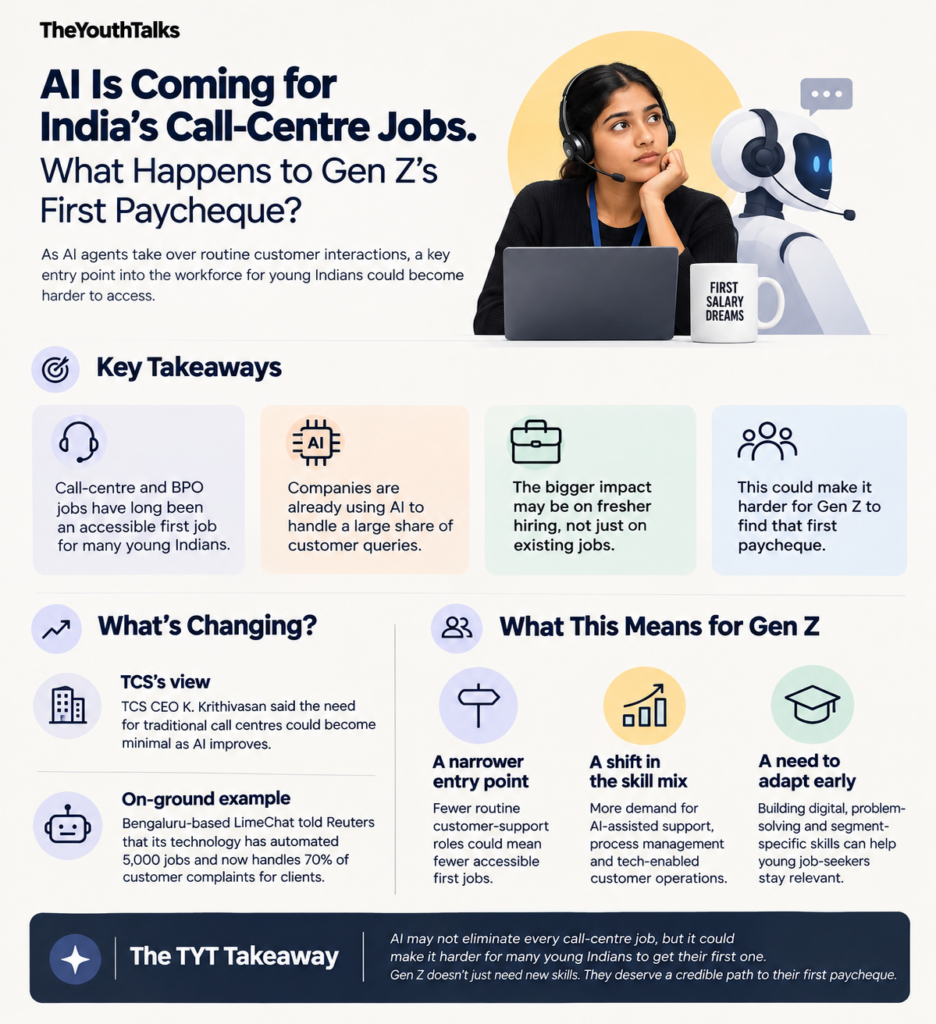
In an April 2024 interview with the Financial Times, TCS CEO K. Krithivasan said that the requirement for traditional call centres could become minimal as AI improved.
He described a future in which technology could anticipate customer problems and address them proactively, reducing the need for customers to make calls in the first place. AI systems could analyse transaction histories, identify issues and handle tasks that had traditionally required human agents.
The warning was striking because call centres have long been an important source of employment in countries such as India and the Philippines.
Krithivasan did not argue that employment overall would necessarily decline. He also pointed to the potential for growing demand for technology talent. Nevertheless, his comments highlighted how generative AI could change a business model built around handling large volumes of customer interactions.
Read the Financial Times interview.
The shift is not limited to predictions from technology executives. In October 2025, Reuters reported on Indian companies deploying AI systems to automate customer-service work.
One example was Bengaluru-based LimeChat. The company told Reuters that its technology had automated 5,000 jobs and was handling 70% of customer complaints for its clients. These were company-reported figures, not an independently verified estimate of net job losses across India. They nevertheless illustrate the extent to which some businesses are already using AI to handle routine customer interactions.
For companies handling thousands of similar queries every day, the commercial attraction is understandable. AI can potentially manage more interactions without requiring a proportional increase in staff. It can help businesses provide round-the-clock service and deal with fluctuations in demand.
But the same calculation looks very different from the perspective of a young job-seeker.
AI agents and the changing economics of work
In June 2026, TCS Chairman N. Chandrasekaran made an even broader prediction about AI’s role in the company’s operations.
Speaking at TCS’s annual general meeting, he said: “I predict that over the next three years, TCS will have as many AI agents as human employees.”
The statement was about AI agents across TCS, not specifically call-centre workers. Chandrasekaran also indicated that the adoption of AI would slow hiring, while arguing that new opportunities would emerge and that the company would continue investing in talent and reskilling.
Read the coverage in The Indian Express.
The distinction matters. An AI agent is not necessarily equivalent to a human employee: one agent may perform a narrow task, while another may coordinate a sequence of activities. The comparison does not mean that TCS plans to replace half its human workforce or that every agent eliminates a job.
But the statement signals a change in how large technology services companies are thinking about productivity and labour.
If businesses can automate more tasks, they may be able to handle greater volumes of work without expanding their human workforce at the same pace.
For young Indians, that could make the first rung of the employment ladder more competitive.
The jobs that never get created
Much of the public discussion about AI and employment focuses on workers being replaced. But for a young person trying to enter the workforce, a more immediate risk may be a reduction in new hiring.
Imagine a customer-service operation that previously needed a large team to manage incoming queries. If AI begins handling a substantial share of those interactions, the company might retain experienced employees for complex cases while recruiting fewer people for routine work.
No mass layoff is necessary for the entry-level opportunity to shrink.
This is one reason the employment impact of AI can be difficult to measure. A company may automate a process gradually, allow attrition to reduce its headcount or hire fewer freshers in subsequent recruitment cycles. The effect becomes visible in the number of jobs available rather than in a single dramatic announcement.
The international picture provides a reason for concern, although it should not be confused with direct evidence of the Indian experience. An October 2026 analysis by the Financial Times, drawing on Revelio Labs data, reported a decline in global call-centre employment since late 2023. The report suggested that reduced hiring, rather than only large-scale layoffs, was an important part of the shift.
Read the Financial Times analysis.
This is global evidence, not proof that AI alone has caused Indian call-centre employment to fall. Economic conditions, client spending, outsourcing decisions and other forms of automation also influence recruitment. But it raises a critical question for India: what happens if the industry creates fewer entry-level positions just as more young people are looking for work?
A first job is also a place to learn. Employees develop professional communication, learn how organisations operate, handle difficult customers and become familiar with business processes.
If routine roles become less available, the question is not only where displaced workers go. It is also where the next generation gains its initial experience.
Will AI create a new kind of first job?
There is another side to the transition.
Businesses adopting AI need people to implement systems, monitor performance, manage exceptions, review outputs and improve customer experiences. Companies may create opportunities in AI operations, workflow design, data management and technical support.
India could benefit from these emerging areas. But there is an important qualification: a new job is not automatically a replacement for an old one.
A young person who could previously qualify for an entry-level customer-support role may not immediately qualify for a position involving AI deployment or technical operations. These roles can require different skills, additional training and, in some cases, prior experience.
The transition therefore depends on more than whether new jobs appear in aggregate. It depends on whether young workers can realistically move into them.
Employers have a role to play by providing training and creating pathways from routine customer support into more complex responsibilities. Training institutions need to prepare students for AI-assisted workplaces rather than treating AI as a distant specialisation. Policymakers and industry bodies need better information about which roles are shrinking, which are growing and where workers can transition.
Without these bridges, the benefits of automation could accrue disproportionately to businesses and highly skilled workers, while those seeking their first foothold in the labour market face a narrower set of options.
The first paycheque deserves a place in the AI debate
The debate around AI employment often becomes a contest between two predictions: that machines will eliminate vast numbers of jobs, or that technology will create new opportunities that ultimately outweigh the losses.
For young Indians, the immediate reality may be more complicated.
Some customer-support roles will change rather than disappear. Some businesses will continue hiring. Others may automate tasks and slow recruitment. New occupations will emerge, but the timing, location and accessibility of those opportunities will vary.
It would be premature to declare the end of India’s call-centre industry. It would be equally unwise to assume that every young worker affected by automation can simply retrain and move into a better-paying technology role.
The more useful question is whether India’s next generation will have enough accessible entry points into the workforce as the nature of work changes.
For many young people, a first salary represents much more than a number credited to a bank account. It is a step towards independence, a contribution to family life and an opportunity to discover what they can do next.
AI may transform how customer service is delivered. The responsibility now is to ensure that the transition does not make the first step into working life harder to find.
Because when the conversation turns to the future of work, India’s young people deserve more than assurances that new jobs will eventually emerge.
They deserve a credible path to their first one.