


When sports predictions, creator promotions and game-like experiences bring wagering closer to everyday digital entertainment, the biggest risk may be how easily financial risk becomes difficult to recognise.
A cricket match is underway. Someone checks the score on their phone, watches a few highlights and joins a conversation about which player will perform better. Another person shares a prediction in a group chat. A creator discusses the likely outcome of a match. Somewhere in this mix of sports, statistics and entertainment, money may enter the picture.
For a young person, the transition from following a game to predicting its outcome may appear natural. The sport is familiar. The players are known. The statistics are available. The decision can feel less like a gamble and more like an informed judgment.
But there is a crucial difference between predicting an outcome and putting money at risk on it.
That difference becomes harder to examine when wagering is encountered through the same digital environments used for entertainment, social interaction and gaming. A familiar interface, a sports-related promotion or a creator discussing a winning prediction can make an activity appear less financially consequential than it really is.
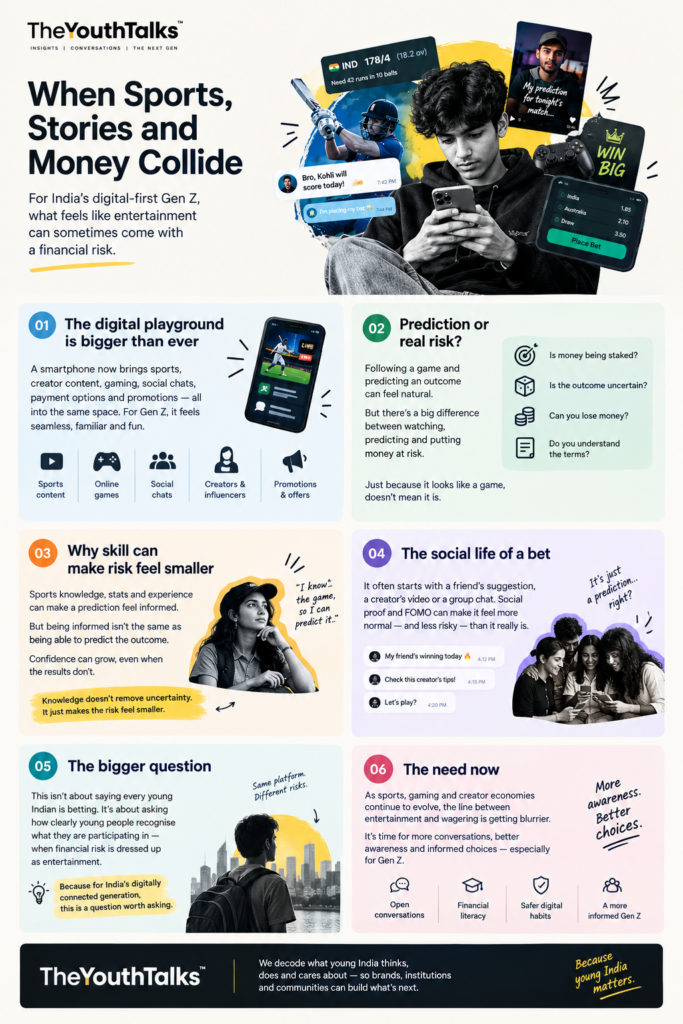
This is not a claim that every young Indian is betting, or that every person who enjoys sports or gaming is at risk of developing a gambling problem. It is a more specific question: when financial risk is presented through the language of entertainment, how clearly do young people recognise what they are participating in?
For India’s digitally connected generation, it is a question worth asking.
When entertainment and wagering begin to overlap
For years, gambling was often associated with recognisable settings: casinos, betting shops, card games or informal wagers between people. Online platforms have changed how easily people can encounter activities involving money and uncertain outcomes.
A smartphone can bring sports content, online games, payment facilities, creator recommendations and promotional messages into the same everyday environment. This proximity does not make all these activities equivalent. Playing a video game, entering a fantasy sports contest, predicting a match without money and placing a monetary wager can involve very different risks and rules.
Yet the digital experience can make the distinctions less obvious to a casual observer.
Interfaces built around scores, selections, rankings, rewards and rapid updates can resemble features found elsewhere in online entertainment. Users may focus on the competition, the prediction or the immediate result, while giving less attention to the money being risked.
The important distinction is not whether an activity looks like a game. It is what happens when a person participates.
Is money being staked? Is the outcome uncertain? Can the participant lose money? What conditions govern the activity? Does the user understand those conditions before participating?
These questions matter because presentation and substance are not the same thing. An activity does not become financially harmless simply because it is colourful, interactive or connected to a sport someone loves.
Why the promise of skill can make risk feel smaller
One of the most persuasive ideas in sports-related wagering is that knowledge can improve outcomes.
A cricket enthusiast may follow player statistics, pitch conditions and team combinations. A football fan may study formations, injuries and previous performances. Someone who follows esports may understand the competitive landscape of a particular game.
That knowledge can make a prediction feel informed rather than random.
But being informed is not the same as being able to predict an uncertain outcome consistently. A knowledgeable fan can still be wrong. Conditions can change, unexpected events can intervene, and even a well-reasoned prediction can fail.
This creates an important psychological distinction: confidence in a decision does not eliminate uncertainty from the outcome.
The danger is not that knowledge has no value. It is that knowledge in one area can create a sense of control that exceeds what the evidence supports.
A person who correctly predicts an outcome may conclude that they have discovered a reliable method. A subsequent loss may be interpreted as bad luck rather than a reason to reconsider the method. A series of successful predictions can strengthen confidence, even if the results do not establish that the activity is consistently profitable.
The same problem can arise outside sports. Familiarity with a subject can make people more confident in their judgments without making those judgments infallible.
For young users who are still developing financial habits, understanding this distinction is particularly important. Knowledge of the game does not change the fact that money is being placed at risk.
The social life of a bet
Digital behaviour rarely develops in isolation.
Young people discover interests through friends, online communities, creators and the content recommended to them. Sports conversations often move between group chats, short videos, livestreams and discussions around major tournaments.
Within these spaces, predictions can become social activities. People compare opinions, discuss players, debate outcomes and celebrate when their forecasts prove correct.
None of this is inherently problematic. Sports discussion and friendly predictions can be part of the enjoyment of following a competition.
The situation changes when money becomes involved and participation starts carrying social expectations.
A young person may feel curious because friends are participating. Someone may want to demonstrate that their knowledge of a sport is better than everyone else’s. Another person may encounter repeated references to winning and begin to wonder whether they are missing an opportunity.
These are possibilities to investigate, not assumptions about every young person’s experience. Their significance lies in how social settings can shape perceptions of what is normal, acceptable or worth trying.
A financial decision that might seem questionable when considered privately can feel less consequential when a group treats it as entertainment.
This is why conversations about online wagering should extend beyond individual self-control. They should also examine the environments in which behaviour is encouraged, repeated and discussed.
When the creator becomes part of the pitch
Influencers and digital creators play an important role in how audiences discover products, services and ideas. Their content can feel more personal than conventional advertising because it is delivered through a familiar voice, an established community or a format audiences already enjoy.
That familiarity can also complicate the way commercial messages are interpreted.
A viewer may see a creator discussing a betting-related product, showing a result or directing followers towards a platform. Depending on how the content is presented, the viewer may not immediately distinguish an advertisement from an independent recommendation.
A visible winning outcome can also provide an incomplete picture. It may show what happened on one occasion without explaining the money risked, any losses, the likelihood of repeating the result or the commercial relationship behind the content.
This does not mean that every creator promoting a product is being deceptive. It means that audiences need enough information to understand what they are watching.
Is the content sponsored? Is there a referral arrangement? Is the creator being paid to encourage participation? What risks are disclosed alongside the potential rewards?
These questions are relevant to any financial promotion, but particularly to content involving uncertain outcomes and the possibility of losing money.
For platforms, advertisers and creators, disclosure should not be treated as a minor formality. Audiences need to understand the nature of a recommendation before using it to make financial decisions.
For young viewers, the corresponding lesson is equally straightforward: a familiar face is not a substitute for independent judgment.
The financial reality behind the screen
Money can feel different when it is handled digitally.
A purchase made with cash creates an immediate physical exchange. A digital transaction can be reduced to a few taps, a balance displayed on a screen or a number deducted from an account.
This convenience has benefits across everyday life. But when money is repeatedly committed to uncertain outcomes, the ease of the transaction can make it important to pay closer attention to the cumulative amount involved.
A single small payment may not seem significant. Repeated payments, however, can add up. And when a person loses money, the desire to recover it can introduce another layer of risk.
One particularly concerning pattern is chasing losses: continuing to wager in an attempt to win back money that has already been lost.
The reasoning can sound persuasive in the moment. Another attempt might recover the previous loss. Stopping now could mean accepting the loss permanently. A different prediction might produce a better result.
But the money already lost cannot be recovered simply by continuing to participate. Each new wager introduces additional uncertainty and the possibility of further loss.
This is where a recreational activity can become financially and emotionally difficult to manage.
Warning signs can include repeatedly spending more than intended, hiding participation from family or friends, borrowing money to continue, feeling unable to stop, or allowing the activity to interfere with studies, work, sleep and relationships.
No single behaviour automatically establishes a gambling disorder. But persistent loss of control, financial harm or distress deserves to be taken seriously rather than dismissed as an ordinary consequence of entertainment.
Why young Indians need a clearer conversation about online wagering
Young adulthood is a period when many people begin managing money independently. Students may be learning to budget for the first time. Early-career professionals may be receiving a regular salary. Others may be preparing for examinations, looking for work or depending on family support while they study.
Their financial circumstances vary considerably. There is no single Gen Z experience, and it would be misleading to assume that all young people have the same disposable income, motivations or exposure to wagering.
But financial habits formed during these years can influence how people approach risk later.
Learning to distinguish an investment from a wager, a prediction from a reliable forecast, or a promotional claim from an independently verified fact is part of becoming financially informed.
That education should not begin only after someone experiences a loss.
Schools, colleges, families and youth-facing organisations can create opportunities for open discussions about digital money habits. Such conversations should explain how uncertain outcomes work, why past wins do not guarantee future success, and how repeated small transactions can affect a budget.
They should also avoid reducing the subject to moral judgment. Telling young people that betting is irresponsible, without explaining how financial and psychological risks develop, may do little to help someone who is already struggling.
A more useful approach is to give people the language and practical knowledge to recognise risk early, seek support and make decisions without pressure or shame.
The responsibility does not end with the user
Individuals must understand the decisions they make, but they are not the only participants in the digital environment.
Platforms determine how products are presented and accessed. Advertisers decide which claims and incentives appear in promotional material. Creators influence how their audiences interpret recommendations. Regulators establish the rules under which activities can operate.
Each has a different responsibility.
Platforms and operators should provide clear information about the nature of the activity, the money involved, the possibility of loss and the conditions governing participation. Where relevant, age restrictions and other safeguards should be implemented effectively rather than treated as boxes to tick.
Creators and advertisers should make commercial relationships clear and avoid presenting uncertain financial outcomes as dependable ways to earn money.
Regulators must address unlawful activities, misleading promotions and applicable consumer-protection concerns within the relevant legal framework.
India’s treatment of online money gaming and related activities has also been subject to significant legal and regulatory change. The law may distinguish between activities in ways that are not obvious from their marketing. Anyone examining a specific platform or format should consult the current official legal position rather than assume that every online activity involving money is governed identically.
The wider principle is that the presentation of an activity should not obscure its actual financial consequences.
A better question than whether betting is entertaining
For a young person encountering online wagering, the most useful questions are not limited to whether the experience looks exciting or whether other people are participating.
They begin with a more basic assessment.
Am I putting money at risk? Do I understand the rules and the possibility of losing that money? Am I participating because I genuinely want to, or because a friend, creator or promotion has made it feel normal? Can I stop without feeling compelled to recover a loss? Would I make the same decision if I had not seen someone else’s apparent success?
These questions are not a guarantee against harm. But they shift attention away from the presentation of the activity and towards the decision itself.
Anyone who finds that wagering is becoming difficult to control should consider stepping away from the activity, avoiding further attempts to recover losses and seeking support from a trusted person or a qualified professional. Financial distress and loss of control should not have to reach a crisis point before they are discussed.
Most importantly, young people should not have to pretend that a problem does not exist because an activity was initially presented as entertainment.
When the game involves money, the distinction matters
Digital entertainment will continue to evolve. Sports content will become more interactive, games will introduce new forms of participation, and creators will remain influential in how young audiences discover products and experiences.
Not every new format represents a threat. Not every prediction is a bet, and not every person who encounters wagering will experience harm.
But those distinctions make it more important to examine what is actually happening rather than relying on labels.
When a financial wager is presented through familiar game mechanics, sports knowledge or social content, the appearance of entertainment can draw attention away from the possibility of loss. Recognising that gap is an essential part of digital and financial literacy.
For young Indians, the goal should not be to approach every digital experience with suspicion. It should be to understand when the nature of an experience changes—and what that change means for their money, choices and well-being.
Because when betting begins to look like gaming, the most important question is not how engaging the experience feels. It is whether the person participating fully understands the risk.