







From midnight sale alerts and wish lists to limited-period offers and easy digital payments, India’s online sale season promises young shoppers more for less. But when everything appears to be a deal, is Gen Z really saving money — or finding more reasons to spend?
The notification arrives on the phone. A favourite pair of sneakers is discounted. A smartphone that seemed too expensive last month suddenly looks affordable. A skincare product saved to a wish list is now available at a lower price. And somewhere on the shopping app, a countdown suggests that the offer will not last forever.
For India’s young online shoppers, the great e-commerce sale is no longer just a shopping event. It is an opportunity to plan purchases, discover brands, upgrade products and perhaps buy something that was never part of the original plan.

Amazon’s Great Indian Festival and Flipkart’s Big Billion Days have become prominent fixtures of India’s festive shopping calendar. Their appeal goes beyond lower prices: they bring together product launches, bank offers, exchange deals, cashback and the excitement of finding something desirable at what appears to be the right price.
But there is a question worth asking as another sale season unfolds: when Gen Z shops during India’s biggest online sales, is it spending less on things it already wanted, or spending more because the discounts make buying feel irresistible?

The answer is unlikely to be the same for every young consumer. And that is precisely what makes the generation worth understanding.
The deal hunter is not necessarily an impulse buyer
There is a tendency to portray Gen Z as a generation that shops through social media, follows trends and makes spontaneous purchases. Published research presents a more nuanced picture.

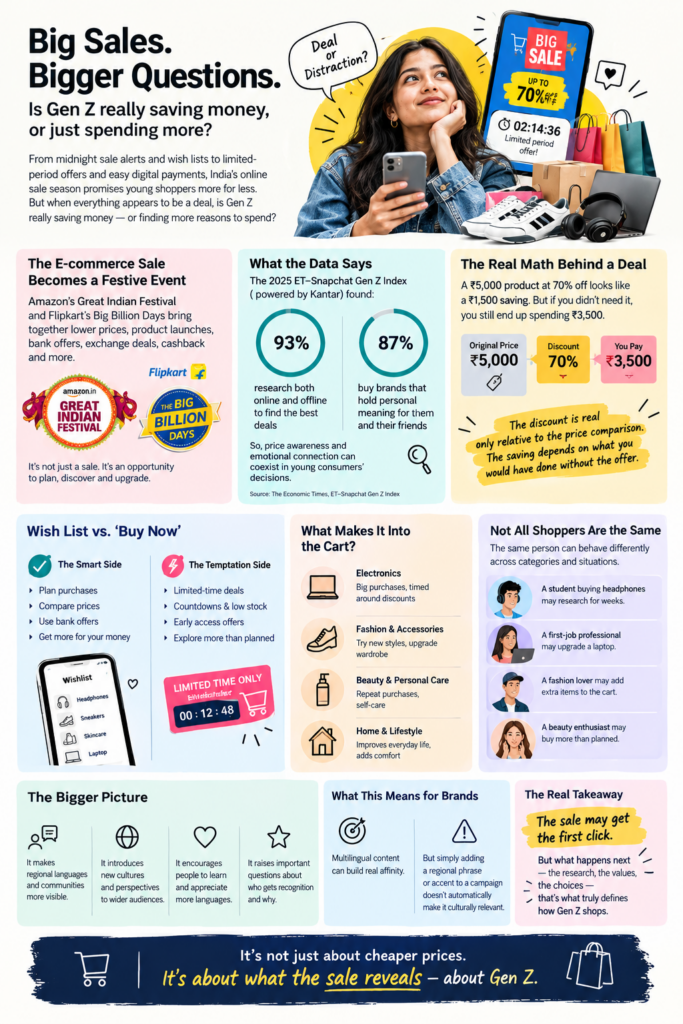
The 2025 ET–Snapchat Gen Z Index, powered by market research agency Kantar, found that 93% of surveyed Gen Z respondents researched both online and offline to find the best deals. The study also reported that 87% bought brands that held personal meaning for them and their friends. These findings suggest that price awareness and emotional connection can coexist in young consumers’ decisions. Source: The Economic Times, ET–Snapchat Gen Z Index
For a student purchasing headphones, a first-job professional upgrading a laptop or a young shopper looking for everyday fashion, a major sale can offer a genuine financial advantage. Comparing prices, waiting for a planned purchase and using a bank discount are sensible ways to manage a limited budget.
But deal hunting has another side. Once shoppers start measuring a purchase by the discount offered rather than the amount they must pay, the calculation can change.
A product originally priced at ₹5,000 and offered at ₹3,500 may look like a saving of ₹1,500. Yet if the shopper did not need the product and would not otherwise have bought it, the purchase still means spending ₹3,500.
The discount is real only relative to the price comparison. The saving, in a personal-budget sense, depends on what the consumer would have done without the offer.
That distinction sits at the heart of the online-sale economy.
The wish list meets the temptation to buy now
For some young shoppers, the sale begins well before the first offer goes live. Products are saved, prices are compared and purchases are postponed until a more attractive deal appears.
This is the sensible side of sale shopping. A planned purchase becomes cheaper, and the consumer retains more money for other priorities.
However, sales platforms also create reasons to bring a purchase forward. Limited-time deals, countdowns, low-stock messages and early-access windows can make waiting feel risky. A shopper who had intended to buy one item may start exploring related products because the prices look unusually attractive.
The result is a tension between two behaviours: shopping strategically and shopping because the moment feels too good to miss.
Neither behaviour defines all Gen Z consumers. A student with a carefully managed budget may research a purchase for weeks. Another shopper may add inexpensive accessories to a cart simply because the offers appear temporary. The same individual may behave differently when buying a necessary electronic device and when shopping for fashion or beauty products.
The more useful question for brands is therefore not whether Gen Z is impulsive. It is which products, offers and situations turn consideration into an unplanned purchase.
What makes it into the cart?
Online sales bring several competing priorities into one place. Electronics can represent a substantial purchase that shoppers prefer to time around a discount. Fashion and accessories offer opportunities to experiment with personal style. Beauty products may encourage repeat purchases, while home and lifestyle items can become attractive when a shopper sees a product that promises to improve everyday life.
The categories also carry different financial implications.
A discounted laptop bought for college or work may replace a purchase that was already necessary. A lower-priced pair of shoes may be a planned upgrade. Several small purchases, meanwhile, can collectively exceed the amount a consumer intended to spend.
The 2025 ET–Snapchat Gen Z Index identified shopping, brand discovery and financial priorities as interconnected aspects of young Indians’ lives. Its findings on research-led deal hunting also caution against treating every purchase as a reaction to advertising or social-media trends. Source: The Economic Times
For e-commerce platforms, this creates a balancing act. They want shoppers to discover more products and complete more transactions. Consumers, meanwhile, want to feel that the money they spend delivers genuine value.
A successful sale does not necessarily mean buying the most products. It can mean finding the right product at the right price — and knowing when not to buy.
The influence of creators, friends and online discovery
The shopping journey often begins outside the marketplace itself.
A creator demonstrates a product. A friend shares a link. A fashion or beauty recommendation circulates on social media. A shopper sees a product repeatedly and adds it to a wish list before a sale finally provides the trigger to purchase.
In this journey, discounts can become the final nudge rather than the original motivation.
The ET–Snapchat Gen Z Index reported that 84% of surveyed respondents followed influencers who shared authentic experiences, while 79% were open to buying less familiar or niche brands. Those results point to the importance of discovery and trust alongside price. <Cite refs={[“turn776705search0”]}/>
For young consumers, a sale can reduce the perceived risk of trying an unfamiliar brand. If the product is less expensive than expected and a trusted creator has recommended it, the decision may feel easier.
But discovery does not guarantee satisfaction. A product can be popular online and still disappoint once it arrives. A discount can also make a purchase seem more urgent than it deserves to be.
This is why product reviews, return policies, quality and the credibility of recommendations remain important. A low price is attractive; a product that genuinely meets expectations is what makes the purchase worthwhile.
The payment is easier. The budget still has limits.
Digital payments have reduced friction in online shopping. A consumer can move from product discovery to checkout without handling cash or visiting a store. Bank offers, reward points and cashback can make the final amount look even more attractive.
Convenience is useful, but it can also make spending less visible in the moment.
A shopper may focus on the discounted price of each item without adding up the total cart value. Several purchases spread across different apps can make the overall expense harder to track. And when a sale overlaps with festive gifts, travel, social plans or routine expenses, each individual transaction competes for the same finite budget.
It would be misleading to suggest that Gen Z is financially careless. Research from the ET–Snapchat index has highlighted an interest in saving and long-term wealth creation among surveyed young consumers. The challenge is that a person can have sensible financial goals and still be tempted by a particularly attractive offer.
For students and early-career professionals managing their own money, the practical test is simple: does the purchase fit the budget after essential expenses and savings, or does the discount become a reason to postpone those priorities?
The price on the screen cannot answer that question. The consumer has to.
Are the sales themselves changing?
The wider e-commerce environment is changing too. A September 2026 YouGov report on India’s festive shopping found that 26% of surveyed consumers planned to stick to their usual budget and shop more strategically. It also reported that 49% prioritised quality and 42% price when choosing products. These figures refer to the report’s surveyed population, not Gen Z alone, but they illustrate the broader importance of value beyond headline discounts. Source: YouGov, India Festive Shopping Report 2026
Meanwhile, reporting by Financial Express on the 2026 festive season points to a market where rising product costs and less room for deep discounts are influencing sale strategies. Source: Financial Express
If discounts become less generous, platforms and brands may need to compete through a combination of product selection, convenience, financing or exchange offers, service and trust.
For young consumers, this could make comparison shopping even more important. The biggest percentage discount may not produce the lowest final price, and an attractive offer may not represent the best value if the product is unsuitable or its quality is poor.
The smartest shopper is not necessarily the one who finds the largest discount. It may be the one who understands the total cost and buys only what is worth paying for.
The real question is what happens after the sale
The success of a sale season is often measured through orders, revenue and the number of products sold. Those figures tell retailers how the event performed commercially. They do not, on their own, tell us whether consumers saved money or overspent.
To understand Gen Z’s relationship with online sales, it is worth looking beyond the checkout. Did shoppers buy products they had planned to purchase anyway? Did they switch to better-value alternatives? Did the offers introduce them to brands they continued buying? And how many purchases felt worthwhile a few weeks later?
These are important questions for platforms and marketers because a transaction is not the same as lasting customer value.
A shopper who discovers a genuinely useful product at a fair price may return to the brand. A shopper who feels pressured into buying something unnecessary may be less enthusiastic once the excitement fades.
The distinction matters for consumers as well. Sale shopping can be a powerful way to stretch a budget, provided the budget exists before the countdown begins.
Saving money is a decision, not a discount badge
India’s great online sales will continue to offer young consumers opportunities to compare products, discover brands and make planned purchases at more attractive prices. Gen Z’s digital fluency and deal research make it an important audience for e-commerce platforms, but the generation should not be reduced to either impulsive shoppers or perfectly rational bargain hunters.
Young consumers can be careful with money, interested in new products and attracted to a good offer — all at the same time.
The real difference lies in what happens between seeing a deal and deciding to buy.
A discount can make a necessary purchase more affordable. It can also make an unnecessary purchase feel justified. The same sale can help one shopper stay within budget and encourage another to exceed it.
For brands, the challenge is to offer genuine value rather than rely entirely on urgency. For consumers, the challenge is to separate the products they want from the products a sale makes them want.
The best online sale is not the one that leaves Gen Z with the fullest cart. It is the one that leaves young shoppers feeling they made the right decisions — even after the offers disappear.