
From sneakers and streetwear to accessories and trend-led outfits, young Indian consumers are balancing the desire to look distinctive with the need to spend carefully. For fashion brands, the opportunity lies in making self-expression accessible without making the product feel ordinary.
A pair of sneakers. An oversized T-shirt. A carefully chosen accessory that transforms an otherwise ordinary outfit.
Sometimes, a small purchase can make a significant difference to how someone feels about their appearance. It can help them experiment with a new aesthetic, participate in a trend or present a version of themselves they want the world to see.
For young Indian consumers, fashion increasingly offers this possibility without necessarily requiring a premium price tag.
A shopper may admire an expensive pair of shoes but choose a more affordable alternative. They may experiment with streetwear, try a new silhouette or purchase accessories that refresh clothes they already own. The objective is not always to buy the most expensive product. It is to find something that looks right, feels relevant and fits the budget.
This creates an interesting opportunity for India’s fashion industry.
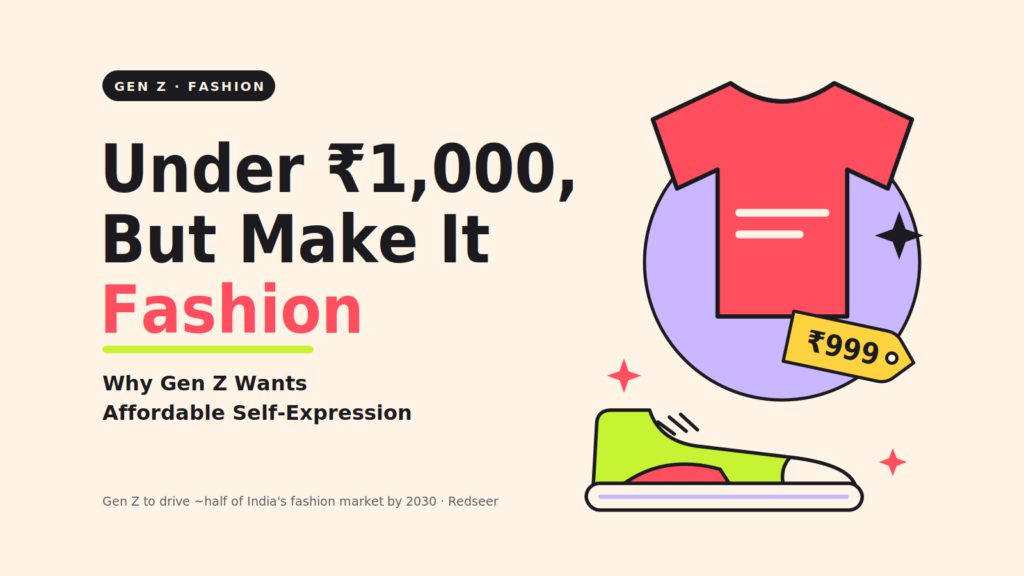
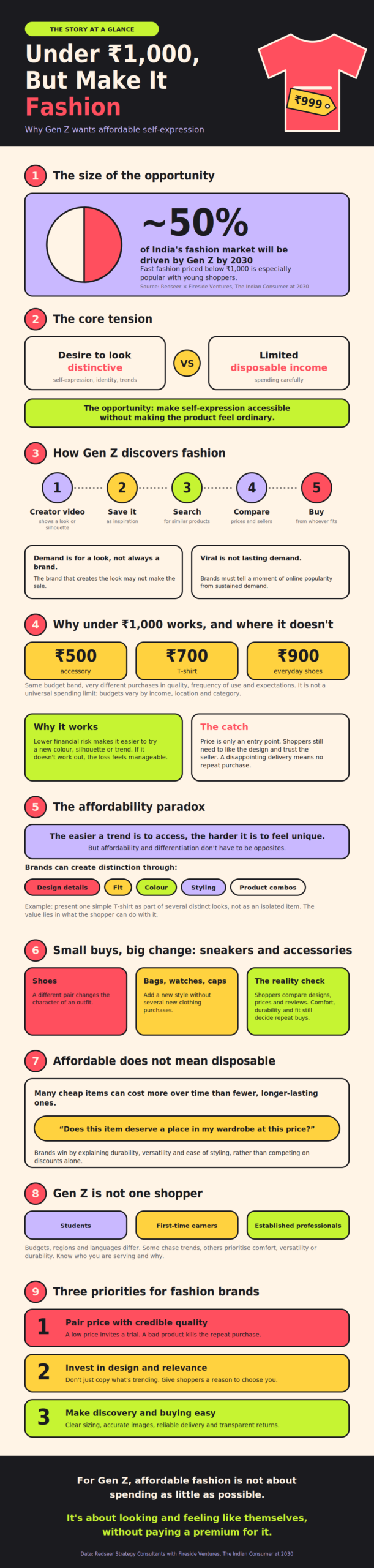
According to Redseer Strategy Consultants’ report, The Indian Consumer at 2030: Redefining Aspirations, Choices, and Markets, developed with Fireside Ventures, Gen Z is projected to drive approximately half of India’s fashion market by 2030. The report also highlights the popularity of fast-fashion products priced below ₹1,000.
The findings point towards a consumer opportunity that extends beyond affordability. For many young shoppers, the challenge is to reconcile the desire for self-expression with the realities of limited disposable income.
For fashion brands, understanding that balance could be central to winning the next generation of consumers.
Fashion is more than something to wear
Clothing has always served practical purposes. It protects the body, meets social expectations and reflects the requirements of different occasions.
But fashion also communicates identity.
The choice of a T-shirt, a pair of sneakers or a particular accessory can signal interests, affiliations, aspirations or simply a preference for a particular aesthetic. These choices may be subtle, but they can matter to consumers who are still exploring how they want to present themselves.
For Gen Z, this process unfolds in a highly connected environment. Social platforms expose young consumers to an enormous variety of styles, creators and cultural influences. Looks that once circulated within a particular city or social group can now reach audiences across India and beyond.
A consumer can discover an outfit through a creator’s video, save it for inspiration and look for similar products on a shopping platform.
The resulting demand is not necessarily for a specific brand. It may be for a particular look, silhouette, colour combination or way of styling an outfit.
That creates an opening for brands capable of translating emerging trends into products that young consumers can realistically afford.
The commercial challenge is to offer access to a desirable aesthetic without relying entirely on the prestige associated with a luxury label.
The appeal of the sub-₹1,000 purchase
Redseer’s analysis identifies products priced below ₹1,000 as an important part of Gen Z’s fashion preferences.
The figure is useful because it highlights a segment of the market where accessible pricing and trend participation can intersect. But it should not be interpreted as a universal spending limit: consumers’ budgets vary considerably by income, location, product category and personal priorities.
A ₹700 T-shirt, a ₹900 pair of everyday shoes and a ₹500 accessory are also very different purchases in terms of quality, frequency of use and expectations.
Nevertheless, accessible price points can make experimentation easier.
A young shopper may be more willing to try a new colour, silhouette or trend when the financial risk is relatively low. If the purchase does not work out, the loss may feel more manageable than spending several thousand rupees on an unfamiliar style.
This can create opportunities for brands that offer a steady supply of affordable, relevant products.
However, the price alone does not guarantee demand. Consumers still have to like the design, trust the seller and believe that the product will meet their expectations.
An inexpensive item that looks appealing online but disappoints when it arrives may not generate a repeat purchase.
For brands, affordability is an entry point. It is not a substitute for product quality, thoughtful design or a credible shopping experience.
Social media has changed the fashion discovery journey
Fashion discovery once depended heavily on physical stores, magazines, films, celebrities and recommendations from friends.
Those influences remain relevant, but digital platforms have expanded the number of ways consumers encounter new styles.
A creator’s outfit video can introduce a silhouette. A streetwear community can popularise a particular aesthetic. A short styling tutorial can demonstrate how one item works with several others.
The consumer can then search for similar products, compare prices and decide whether to purchase.
This creates a more fluid relationship between inspiration and shopping. The brand that creates the original look may not be the brand that eventually makes the sale.
For young consumers, the process can be an opportunity to adapt trends to their own preferences and budgets. They may take inspiration from an expensive outfit without purchasing every item in it.
For businesses, it creates a different competitive landscape. Brands must understand the visual language and cultural context that make a product desirable, rather than relying exclusively on established brand recognition.
A distinctive design, useful styling content or a clear product proposition can help a business enter the consideration set.
But social visibility can also be temporary. A product may attract attention because it appears in a popular video, only to be replaced by the next trend.
Brands need to distinguish between a moment of online popularity and sustained consumer demand.
The affordability paradox: looking distinctive in a mass market
There is an interesting tension at the heart of affordable fashion.
The more widely available a product becomes, the easier it is for consumers to access a trend. Yet fashion often derives part of its appeal from the desire to look distinctive.
Young shoppers may want the accessibility of a mass-market product without feeling that their appearance is entirely interchangeable with everyone else’s.
This does not mean every consumer wants unusual clothing or exclusive designs. Some prefer familiar basics, while others enjoy experimenting with emerging styles. Many move between these preferences depending on the occasion.
The implication for brands is that affordability and differentiation need not be opposites.
A company can create distinction through design details, fit, colour, styling, product combinations or a recognisable point of view. It can also help consumers use accessible products in different ways.
For example, a simple T-shirt can be presented as part of several distinct looks rather than marketed as an isolated item. Accessories can help refresh existing wardrobes. A collection can offer coordinated pieces that make styling easier without requiring a large purchase.
The value lies not only in what the product costs, but in what the consumer can do with it.
Sneakers, accessories and the details that matter
Fashion consumption does not begin and end with clothing.
Footwear and accessories can play a significant role in shaping an outfit, and Redseer’s analysis highlights the importance of sneakers and accessories among young consumers.
These categories are particularly interesting because they can allow consumers to experiment without replacing an entire wardrobe.
A different pair of shoes can change the character of an outfit. A bag, watch, cap or other accessory can introduce a new style without requiring several new clothing purchases.
For budget-conscious shoppers, such products can provide relatively accessible ways to participate in trends.
But the market is also competitive. Consumers can compare designs, prices and reviews across multiple sellers, making it difficult for brands to rely on appearance alone.
Comfort, durability, fit and perceived quality remain important considerations, particularly for products used frequently.
Brands that understand these practical requirements may be better positioned to turn a first purchase into a repeat relationship.
Affordable fashion does not mean disposable fashion
The appeal of low prices also raises an important question: what happens when trend participation becomes dependent on frequent replacement?
A consumer who purchases several inexpensive items may spend more over time than someone who buys fewer, longer-lasting products. Poor quality can also turn an apparently affordable purchase into a disappointing one.
This does not mean young consumers uniformly prefer disposable fashion, nor does it establish that lower prices necessarily lead to wasteful behaviour.
It does, however, create an opportunity for brands to think more carefully about value.
Durability, versatility and ease of styling can make an affordable product more useful. Brands can explain how an item works across occasions, how it can be combined with existing clothes and what consumers should reasonably expect from it.
For shoppers, the most useful question is not simply whether an item costs less than ₹1,000. It is whether the item deserves a place in their wardrobe at that price.
For businesses, communicating that value may be a stronger long-term proposition than competing through discounts alone.
What fashion brands need to understand about Gen Z
The opportunity is not to assume that all young consumers want the same styles or have identical budgets.
Gen Z includes students, first-time earners and established professionals, as well as consumers from different regions, languages and economic backgrounds. Their purchasing power and fashion priorities can vary substantially.
Some may be motivated by trend discovery. Others may prioritise comfort, versatility, durability or the practical requirements of everyday life.
Brands therefore need to understand which consumers they are serving and why particular products appeal to them.
Three priorities stand out.
First, accessible pricing should be paired with credible quality. A low price may encourage trial, but an unsatisfactory product can damage the prospect of repeat purchases.
Second, brands should invest in design and relevance rather than simply copying whatever is trending online. Consumers need a reason to choose one product over comparable alternatives.
Third, businesses should make discovery and purchase straightforward. Clear sizing information, accurate product images, reliable delivery and transparent return policies can be particularly important when shoppers cannot physically examine an item before buying.
These considerations can help fashion businesses turn momentary interest into a more dependable relationship with customers.
The real value of fashion under ₹1,000
The rise of affordable, trend-led fashion reflects a broader consumer question: how can young Indians participate in the experiences and aesthetics they value without stretching their budgets?
Fashion provides one answer. It allows consumers to experiment with identity through individual purchases, combinations and changing preferences.
Redseer’s projections suggest that Gen Z will play a substantial role in India’s fashion market by 2030. But the opportunity for brands is not simply to sell more low-priced products.
It is to understand why those products matter.
A young shopper may be looking for confidence, a sense of belonging, creative expression or simply something new to wear. The purchase price is part of the decision, but the meaning attached to the product can be just as important.
The brands that understand this relationship may be better equipped to compete in a market where trends move quickly and consumers have plenty of alternatives.
Because for Gen Z, affordable fashion is not necessarily about spending as little as possible.
It is about finding a way to look and feel like themselves — without having to pay a premium for it.