
Microsoft’s latest Work Trend Index puts India ahead of every other market studied in the adoption of AI agents at work. But as artificial intelligence takes on more workplace tasks, the next generation faces a bigger question: will knowing how to use AI be enough, or will critical thinking, human judgement and adaptability determine who gets ahead?
India’s artificial intelligence story is increasingly moving beyond technology companies, coding assistants and experimental applications. AI is beginning to influence how people work, how businesses organise their teams, how managers evaluate performance and, perhaps most importantly, what employers expect from the next generation of professionals.
For young Indians preparing to enter the workforce, this transition could be particularly consequential.
A student graduating today may enter an organisation where AI tools are already drafting reports, analysing information, preparing presentations, managing workflows and assisting with decisions. Tasks that once gave fresh graduates an opportunity to learn the basics of a profession could increasingly be handled, at least partly, by AI systems.
That does not necessarily mean fewer opportunities. But it could mean that the definition of an entry-level employee is changing.
A new graduate may no longer be judged only on how quickly they can complete an assigned task. Employers could increasingly expect them to understand what needs to be done, use AI to execute parts of the work, recognise when the output is inaccurate and take responsibility for the final result.
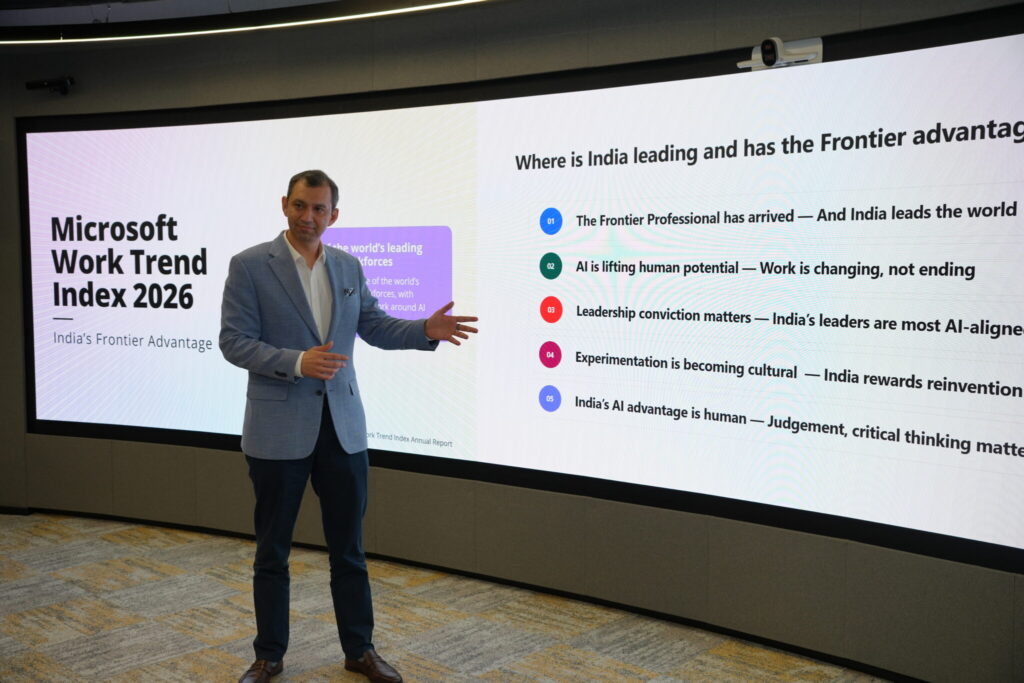
This changing relationship between humans and technology is at the centre of Microsoft’s 2026 Work Trend Index.
The research presents an interesting picture of India’s emerging workplace. Among the AI users surveyed across ten markets, India has the highest share of what Microsoft describes as Frontier Professionals: employees who are not merely experimenting with AI but are using AI agents to complete complex tasks, redesign workflows and establish repeatable ways of working.
According to Microsoft’s India findings, 32% of Indian AI users qualify as Frontier Professionals, twice the global average of 16%.
The finding is significant. But for Gen Z, the more important question is what happens next.
If India is moving towards a workplace where humans and AI agents increasingly work together, are its colleges, universities, employers and young professionals preparing for that transition at the same pace?
India is emerging as a leading AI-powered workforce
Published in September 2026, the India findings of Microsoft’s Work Trend Index provide a snapshot of how artificial intelligence is moving from individual experimentation towards more structured workplace adoption.
The global research draws on 20,000 AI users across ten markets, alongside trillions of anonymised Microsoft 365 productivity signals.
The study identifies a category of workers called Frontier Professionals. These are people who use AI agents for complex, multi-step work, regularly redesign their workflows around what AI can do and participate in structured practices that can be repeated and scaled across teams.
India recorded a 32% share of Frontier Professionals among its AI users, compared with 16% globally.
The finding suggests that India’s workplace AI adoption is not limited to employees using generative AI to write emails, summarise documents or generate basic content. A growing group is beginning to rethink how entire assignments and business processes are completed.
Microsoft also found that 78% of Indian AI users said AI was enabling them to undertake work that was not possible a year earlier. The corresponding global figure was 58%. Among India’s Frontier Professionals, the proportion rose to 85%.
This distinction is important.
AI adoption is often measured through the number of employees who have access to a tool or the frequency with which they use it. But the more meaningful question is whether technology is enabling people to do something different.
For example, a marketing professional who previously spent several hours gathering information, organising research and preparing a presentation may now use AI agents to complete portions of that workflow. The employee’s contribution could shift towards defining the problem, deciding which information is relevant, interpreting findings and presenting recommendations.
Similarly, an engineer may use AI to assist with debugging, documentation and code generation, while spending more time evaluating architecture, understanding business requirements and checking the reliability of the solution.
The nature of the work changes even if the job title remains the same.
Microsoft’s broader Work Trend Index describes this as a new agency equation: as AI agents take on more execution, humans gain greater responsibility for directing work, making decisions and owning outcomes.
For young professionals, this could become one of the defining characteristics of their careers.
The rise of the Frontier Professional: Why using AI is no longer enough
One of the more interesting aspects of Microsoft’s research is that it does not define an advanced AI user simply by the number of prompts they write or the number of AI tools they have tried.
The Frontier Professional represents a more sophisticated relationship with technology.
These employees are using AI agents to handle multi-step assignments rather than isolated tasks. They are rethinking existing workflows and developing repeatable processes through which AI can contribute to team-level work.
In other words, they are moving from asking AI to help them complete a task towards deciding how a task should be completed in the first place.
This distinction matters for Gen Z.
A young professional who knows how to use ChatGPT, Microsoft Copilot or another generative AI application has an important starting advantage. But familiarity with AI does not automatically translate into the ability to use it effectively in a professional environment.
Consider two fresh graduates joining the same organisation.
The first uses AI to write an email, prepare a presentation or summarise a document. The second understands the objective of an assignment, breaks it into smaller components, identifies which parts can be delegated to AI, evaluates the results and combines the findings into a meaningful recommendation.
Both are using AI. But their ability to create value is different.
The second graduate is closer to the kind of professional that the Frontier Workforce concept describes.
This is also why AI literacy should not be reduced to learning a collection of tools. Tools will change. Platforms will become more capable, and the way people interact with AI will continue to evolve.
The more durable skill may be understanding how to work with intelligent systems: knowing what to delegate, what to question, what to verify and where human intervention is necessary.
For India’s colleges and universities, this creates a significant opportunity to rethink how students are prepared for professional life.
The surprising finding: Human judgement is becoming more valuable
Perhaps the most important part of Microsoft’s India research is not the number of people using AI agents. It is what Indian respondents believe will matter as AI takes on more work.
Microsoft found that 63% of Indian AI users identified quality control of AI-generated output as an important skill in an AI-powered workplace, compared with 50% globally.
Critical thinking came next, with 59% of Indian respondents identifying it as an important skill, against 46% globally.
Both figures were the highest among the ten markets studied.
Another 87% of Indian respondents said they remained responsible for the thinking and treated AI output as a starting point rather than a final answer.
These findings offer a useful counterpoint to the popular perception that the future belongs simply to people who know the most AI tools.
As AI becomes more capable of generating information, the ability to evaluate that information becomes increasingly important.
A student can ask an AI application to explain a financial concept, prepare a business plan or analyse a consumer market. But how does that student know whether the information is accurate? Can they recognise an unsupported assumption? Can they identify missing context? Can they distinguish between a convincing answer and a correct one?
These questions are not limited to technology professionals.
A marketing graduate using AI to develop a brand strategy still needs to understand consumers. A finance graduate using AI to analyse financial information needs to understand the underlying numbers. A journalist using AI to organise research must still verify facts and assess sources.
In each case, AI may reduce the time spent on execution, but it does not remove the responsibility to get the work right.
This is where critical thinking, communication, contextual understanding and professional judgement become particularly important.
For Gen Z, the challenge may therefore be less about competing with AI at tasks it can perform and more about developing the capabilities required to direct and evaluate it.
Is the first job changing before young Indians even enter the workplace?
One of the biggest concerns surrounding workplace AI is its potential impact on entry-level employment.
Traditionally, organisations have relied on fresh graduates to perform a range of foundational tasks. These could include research, documentation, preparing presentations, basic coding, data entry, reporting, customer support and administrative work.
Such assignments may not always be particularly exciting, but they serve an important purpose. They allow new employees to understand how organisations operate, learn professional standards and gradually develop the experience required for more complex responsibilities.
AI is beginning to change this arrangement.
If an AI agent can prepare a first draft of a report, analyse a spreadsheet, generate basic code or organise information, an employer may have less reason to assign those activities to a junior employee in their traditional form.
This raises a difficult question: if AI takes over some of the work through which fresh graduates traditionally gained experience, where will the next generation acquire those foundational professional skills?
The concern is not necessarily that every entry-level job will disappear. Rather, the composition of entry-level work could change.
Young employees may be expected to handle more complex responsibilities earlier in their careers, while organisations may become more selective about the skills they expect from new recruits.
There are already indications that employers are changing their expectations.
Deloitte India’s Campus Workforce Trends 2026 report, released in August, found that 35% of surveyed organisations said AI adoption was creating new entry-level roles or skill requirements, up from 21% in FY25.
The same research found that 86% of organisations reported AI or agentic AI was transforming their recruitment processes.
AI and data capabilities were attracting salary premiums of 20–25% in certain campus-hiring categories, while analytical thinking and problem-solving attracted premiums of 10–15%.
These findings suggest that AI is influencing both sides of the employment equation: how companies identify talent and what they expect that talent to contribute.
For students, this creates a more complicated employment landscape.
Learning a technical skill may still be valuable, but simply possessing a degree or being familiar with a popular AI application may not be enough to differentiate a candidate.
Employers may increasingly look for people who can demonstrate what they can accomplish with technology.
The distinction between knowing a tool and delivering an outcome could become central to early-career hiring.
The employability gap: Are colleges keeping pace?
India has a large higher-education ecosystem, with students graduating every year across engineering, management, commerce, science, humanities and other disciplines.
However, the transition from academic education to professional employment has never been straightforward.
Students frequently encounter a gap between what they learn in classrooms and what employers expect them to demonstrate in the workplace.
AI could make this gap more visible.
A student may have completed a course on programming but have limited experience applying those concepts to real-world problems. A management graduate may understand marketing frameworks but have never been required to analyse actual consumer behaviour. A commerce student may know accounting principles but lack experience interpreting financial information in a business context.
AI can potentially help bridge some of these gaps by making learning more interactive, providing assistance and allowing students to experiment with tasks that previously required access to specialist resources.
But there is another possibility.
Students could become increasingly dependent on AI to complete assignments without developing a sufficiently strong understanding of the underlying concepts.
A presentation generated in minutes does not necessarily mean the student understands the subject. A functioning piece of code does not automatically mean its author understands why it works. An AI-generated research report does not demonstrate the ability to conduct independent research.
Educational institutions will therefore need to think beyond introducing AI courses or making AI applications available to students.
They will need to reconsider how learning is assessed.
If a student can generate an assignment using AI, perhaps the more useful assessment is to ask them to defend their conclusions, explain their assumptions, demonstrate their process and solve a related problem independently.
Project-based learning, collaborative assignments, live problem-solving exercises, internships and practical industry challenges could become increasingly important.
The objective should not be to prevent students from using AI. It should be to ensure that using AI does not replace the process of learning.
India’s AI advantage may depend on its managers, not just its young workforce
There is another dimension to Microsoft’s research that deserves attention.
The report suggests that the impact of AI is influenced not only by individual employees but also by the organisations in which they work.
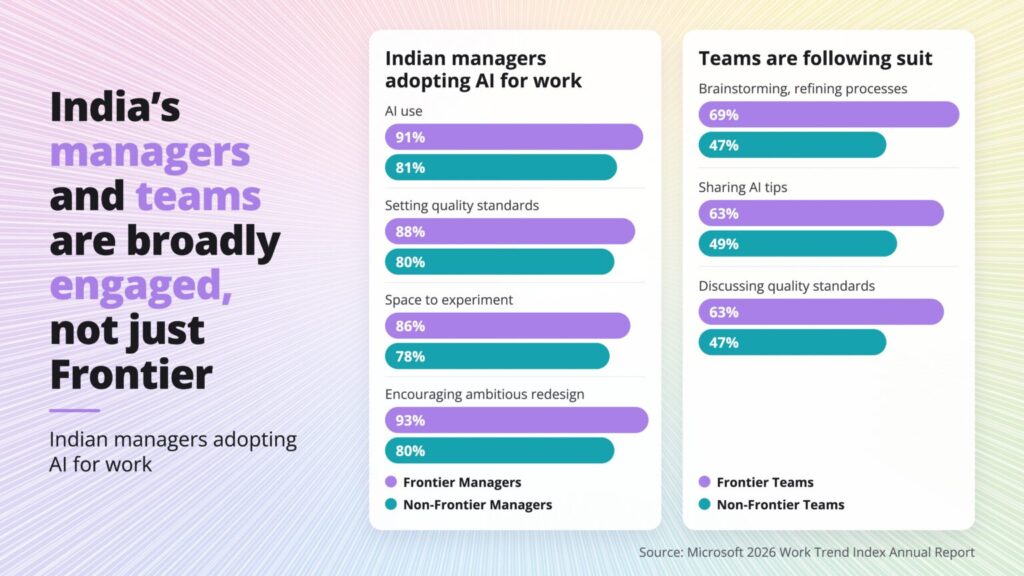
In its global analysis, Microsoft found that organisational factors such as workplace culture, manager support and talent practices accounted for more than twice the reported AI impact of individual factors such as personal mindset and behaviour.
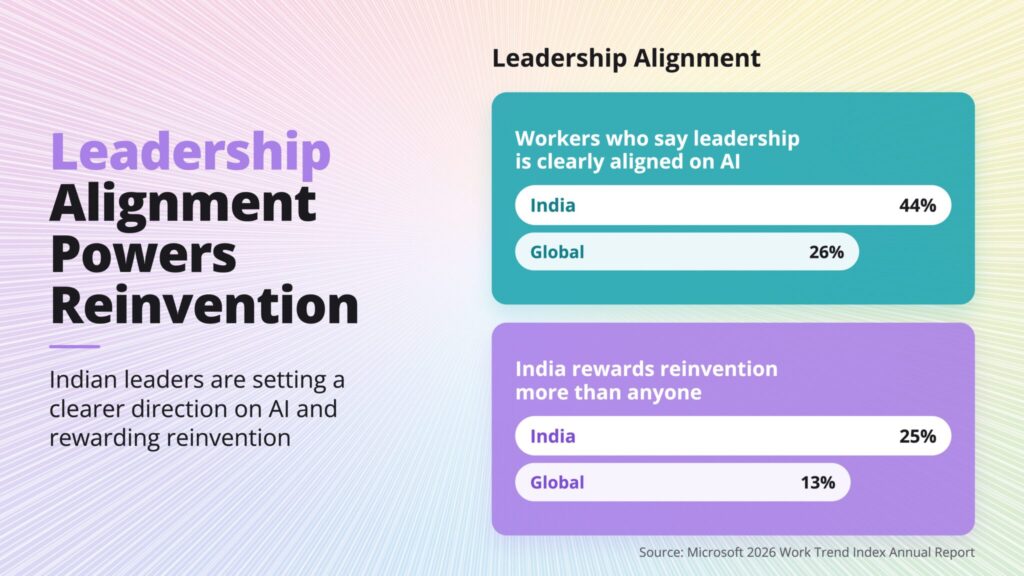
The report also found that leadership alignment on AI stood at 44% in India, compared with 26% globally.
At an organisational level, 34% of Indian organisations reported agent workflows operating at the function level, against 26% globally.
These findings suggest that India’s progress is being supported by workplace environments in which AI adoption is increasingly encouraged and integrated into business processes.
This is relevant because young professionals cannot be expected to independently transform their working environments.
A graduate may arrive at an organisation with considerable AI knowledge but find that the company has no clear policies, limited access to approved tools or managers who discourage experimentation.
Another graduate may join a workplace where managers actively encourage employees to experiment, establish standards for AI-generated work and allow teams to redesign existing processes.
The same individual capabilities could produce very different outcomes in these two environments.
This is why the responsibility for preparing young people for an AI-powered workplace cannot rest entirely with students.
Employers need to create opportunities for employees to learn, experiment and apply technology to real business problems.
Managers also need to recognise that productivity gains should not automatically translate into simply assigning more work to employees. The larger opportunity is to improve the quality of work, encourage innovation and create opportunities for people to develop capabilities that were previously difficult to acquire.
For organisations hiring Gen Z, the question should not simply be whether a candidate knows AI. It should be whether the organisation is prepared to help that candidate become better at working with it.
The workplace is changing across India’s largest companies
The shift described in Microsoft’s research is not limited to survey responses.
The company also highlighted enterprise-level AI adoption across some of India’s largest technology organisations.
Infosys, TCS, Wipro and LTM collectively signed up for more than 400,000 Microsoft 365 Copilot seats in under six months, according to Microsoft’s India announcement.
At Infosys, the company’s programme to introduce Copilot to more than 100,000 employees had recorded over 91% monthly active usage.
At TCS, 86% of Copilot-licensed associates were actively using AI in their daily work. Microsoft reported that some teams had recorded productivity improvements of 20–25% in research and content production, alongside faster insight generation and reductions in work-cycle time for selected processes.
Wipro reported monthly active usage above 95%, with associates generating 7.5 million prompts every month. The company also reported more than 29,000 employee-developed agents and over 60 enterprise-grade agentic solutions in use.
These examples offer an indication of how AI adoption is moving into everyday organisational activity.
For a young engineer, analyst, consultant or business professional joining a large organisation, this could mean entering a workplace where AI is already part of the standard operating environment.
The expectation may increasingly be that employees know how to work alongside these systems rather than treat them as optional productivity tools.
However, enterprise adoption figures should not be confused with universal workforce readiness. These are examples from large organisations, and they do not establish that every Indian company, particularly smaller businesses and startups, has reached a similar level of adoption.
The experience of a graduate joining a major IT services company may be very different from that of someone joining a small manufacturing business, a regional enterprise or a young startup.
India’s AI transition is unlikely to happen uniformly.
The danger of becoming too dependent on AI
There is a paradox in the growing use of artificial intelligence.
The more capable these systems become, the easier it can be for users to delegate tasks without fully understanding what they are delegating.
A student who uses AI to write every assignment may become efficient at producing submissions but may not develop the ability to structure an argument independently.
An employee who relies on AI for every analysis may struggle to recognise when the output is based on incorrect information.
A junior developer who accepts generated code without understanding its logic may find it difficult to troubleshoot when something goes wrong.
The danger is not simply that AI might make mistakes. It is that excessive dependence could gradually weaken the user’s ability to recognise those mistakes.
Interestingly, Microsoft’s global research provides another useful perspective here.
The report found that Frontier Professionals were more likely than other professionals to deliberately perform some work without AI to keep their skills sharp: 43% compared with 30%.
They were also more likely to pause before starting an assignment and decide which parts should be handled by AI and which should remain human responsibilities: 53% compared with 33%.
These findings suggest that advanced AI users do not necessarily delegate everything to technology.
Instead, they appear more deliberate about when to use it and when to rely on their own capabilities.
This is an important lesson for students.
Learning to work with AI should also involve learning when not to use AI.
Young professionals need opportunities to develop independent problem-solving skills, understand their disciplines and build the confidence to make decisions without depending entirely on generated answers.
The objective should be to use technology to expand human capability, not gradually surrender it.
What will make a Gen Z professional valuable in 2030?
If AI adoption continues to accelerate, the skills that differentiate young professionals may look different from those that traditionally determined career progression.
Technical knowledge will remain important, particularly in areas such as software development, cybersecurity, data science, engineering and digital product development.
But technical knowledge alone may not be sufficient.
The ability to understand problems, communicate effectively, work across disciplines and make sound decisions could become equally important.
A young marketing professional, for example, may be able to use AI to analyse customer feedback, develop campaign concepts and prepare creative briefs. But understanding why consumers behave in a particular way, identifying cultural shifts and making a brand relevant to a specific audience still require contextual judgement.
An engineer may use AI to generate code more quickly, but understanding the architecture of a system, identifying vulnerabilities and evaluating whether a solution is appropriate remain essential.
A finance professional may use AI to process large amounts of information, but interpreting risk and understanding the implications of a decision require professional judgement.
This points towards a broader definition of employability.
The next generation may need a combination of five capabilities:
1. AI fluency: Understanding how to use AI tools and agents effectively across different professional tasks.
2. Critical thinking: Being able to question information, recognise assumptions, evaluate evidence and identify inaccurate outputs.
3. Communication: Explaining ideas, presenting findings, collaborating with people and translating complex information into meaningful decisions.
4. Adaptability: Being willing to learn new tools, move across responsibilities and respond to changing workplace expectations.
5. Domain knowledge: Developing a deep understanding of a particular field rather than relying on AI-generated information without context.
These capabilities are interconnected.
AI fluency without domain knowledge can produce convincing but shallow work. Domain knowledge without adaptability can become outdated. Technical skills without communication can limit an individual’s ability to influence decisions.
The strongest professionals may be those who combine these capabilities rather than excel at just one.
The opportunity for young Indians goes beyond technology jobs
Another important implication is that the AI opportunity should not be restricted to engineering students or those pursuing careers in technology.
AI is increasingly relevant to marketing, advertising, media, finance, consulting, education, healthcare, retail, manufacturing, design and customer experience.
A student studying commerce could use AI to analyse business performance. A communications graduate could work with AI-assisted research and content workflows. A design student could use generative tools while developing a stronger understanding of visual communication and user experience.
A young entrepreneur could use AI to conduct market research, test business ideas, build prototypes and automate parts of business operations.
This could lower some of the barriers to experimentation and allow people with different educational backgrounds to undertake work that previously required larger teams or specialist resources.
Microsoft’s finding that 78% of Indian AI users are doing work that they could not do a year earlier is relevant in this context.
It points towards the possibility that AI could expand the range of work individuals can attempt.
For young Indians, particularly those outside traditional technology hubs, this could be significant.
However, access to technology does not automatically translate into equal opportunity.
Students at well-resourced institutions may have better access to mentors, industry projects, internships and professional networks. Others may have access to the same AI applications but fewer opportunities to apply them in meaningful settings.
The challenge for India’s education and employment ecosystem will be to make practical AI learning more widely accessible, rather than allowing the benefits to concentrate among students who already have institutional advantages.
The bigger question for employers: Are they preparing Gen Z or simply expecting more from them?
As organisations adopt AI, there is a risk that the conversation around employability becomes overly focused on what young people need to learn.
Students are told to acquire new skills, become AI proficient, develop critical thinking and remain adaptable.
But employers also need to examine how their expectations are changing.
If an organisation expects fresh graduates to be AI proficient, does it provide them with access to appropriate tools?
If it expects them to demonstrate critical thinking, does the recruitment process test their ability to reason through problems rather than simply evaluate academic credentials?
If it expects them to take ownership of outcomes, does it provide opportunities to make decisions and learn from mistakes?
And if AI reduces the time required to complete routine assignments, will organisations use that time to develop junior employees or simply increase their workload?
These questions matter because the first few years of employment are often when young professionals develop the foundations of their careers.
AI could create opportunities for graduates to contribute to more complex assignments earlier. But this will require organisations to rethink mentoring, training and the way junior roles are structured.
There is also a recruitment dimension.
Deloitte India’s 2026 campus research found that behavioural competencies and learning agility were among the strongest reported predictors of pre-placement offer conversions, ranking ahead of technical competencies in its findings.
This reinforces the idea that employers are looking beyond qualifications and isolated technical capabilities.
The ability to learn, collaborate, adapt and deliver in changing circumstances is becoming an important part of the employability equation.
For Gen Z, this could mean that building a portfolio of practical work, demonstrating problem-solving ability and gaining real-world experience will matter alongside formal qualifications.
India’s AI advantage will ultimately be tested by its young workforce
Microsoft’s 2026 Work Trend Index offers an encouraging picture of India’s progress in workplace AI adoption.
The country has recorded the highest share of Frontier Professionals among the ten markets studied. Its AI users report greater opportunities to undertake new kinds of work, while placing considerable importance on human judgement and critical thinking.
But there is an important distinction between leading in AI adoption and ensuring that the benefits of that adoption reach the next generation.
The research primarily captures people already using AI at work. It does not establish how prepared India’s entire student population is, nor does it tell us what proportion of fresh graduates can independently work with AI agents in professional settings.
That is a question that requires further investigation.
For India’s Gen Z, the coming years could bring both opportunity and uncertainty.
AI may allow young professionals to work faster, experiment more freely and contribute to projects that previously required years of experience. At the same time, it could change the nature of entry-level assignments, raise hiring expectations and make certain traditional skills less valuable.
The winners may not necessarily be those who use the greatest number of AI applications.
They may be those who understand their professions, ask better questions, evaluate information carefully and know how to combine human judgement with technological capability.
For colleges and universities, the challenge will be to prepare students for a workplace that is changing faster than traditional curricula.
For employers, it will be to redesign entry-level roles and create meaningful opportunities for young talent to learn and grow.
And for young professionals, the challenge will be to move beyond using AI as a shortcut and learn how to use it as an extension of their own capabilities.
India may have a head start in building an AI-powered workforce. But the more consequential question is whether its young people will be ready to lead it.
Because the future of work may not belong to those who can do everything themselves, or those who allow AI to do everything for them. It may belong to those who know what to ask, what to delegate, what to question and, ultimately, what they alone must take responsibility for.