

For millions of young Indians, choosing an undergraduate course is among the first major decisions they make about their future. It is also one of the first decisions where personal ambition meets financial reality. A student may want to study psychology, design, economics or literature, while parents may be more inclined towards engineering, medicine, commerce or management because they appear to offer clearer career opportunities.
Between these expectations lies a generation trying to answer a difficult question: should the choice of a college course be driven by passion, the possibility of getting a job, or the ability to afford the education in the first place?
The decision has become more complicated as higher education expands, employers demand a wider combination of skills, and artificial intelligence begins changing the nature of work. For Gen Z, choosing a degree is no longer simply about selecting a subject to study for three or four years. It is about understanding what that investment could mean for their professional and financial future.
The Employability Question: Does Every Degree Lead to a Job?
India’s higher education system offers students an increasingly wide range of choices, but the relationship between a qualification and employment remains an important concern.
According to the Ministry of Education’s All India Survey on Higher Education (AISHE) 2021–22, India had nearly 4.33 crore students enrolled in higher education. Undergraduate programmes accounted for 78.9% of total enrolment. Arts remained the largest undergraduate discipline, with 34.2% of students, followed by science at 14.8%, commerce at 13.3% and engineering and technology at 11.8%.
The numbers illustrate the diversity of educational choices being made across the country. They also raise a larger question: are students choosing courses based on the opportunities they offer, or are they often following familiar educational pathways without fully understanding the employment possibilities?
NITI Aayog’s 2026 report, Reimagining Skilling for Viksit Bharat@2047, highlights the gap between educational qualifications and workplace requirements. Citing the Economic Survey 2024–25, the report notes that only 8.25% of graduates are employed in roles aligned with their qualifications.
This does not mean that the remaining graduates are necessarily unemployed or unsuccessful. Many develop careers outside their original disciplines. However, it underlines why students need to look beyond the degree certificate and understand the skills and opportunities that a course can realistically provide.
What Do Different Undergraduate Pathways Offer?
One way to make a more informed decision is to compare educational pathways rather than treating individual degrees as guaranteed routes to employment.
The India Skills Report 2026, whose graduate employability estimates are also referenced in NITI Aayog’s report, provides an interesting comparison across qualifications.
| Undergraduate pathway | 2026 employability indicator | Potential career directions |
|---|---|---|
| B.E./B.Tech | 70.2% | Software, engineering, analytics, technology and product roles |
| B.Com | 62.8% | Accounting, banking, finance, taxation and business analytics |
| B.Sc | 61.0% | Research, laboratory work, analytics and specialised sciences |
| B.A. | 55.6% | Media, public policy, education, research, communications and related fields |
Source: NITI Aayog, Reimagining Skilling for Viksit Bharat@2047 (2026), Table 75, drawing on the Global Employability Reports 2025 and 2026. These are employability indicators, not actual placement percentages, guaranteed employment rates or salary outcomes.
Engineering continues to show a relatively strong employability indicator, reflecting the demand for technical capabilities across several industries. However, the figures also challenge the assumption that non-engineering degrees automatically lead to weaker employment prospects.
Commerce graduates, for instance, are finding opportunities across financial services, fintech, taxation, accounting and business operations. A B.Com graduate who develops practical capabilities in financial analysis, Excel, data visualisation and taxation can build a professional profile that extends well beyond traditional accounting roles.
Similarly, science graduates can explore opportunities in research, healthcare-related industries, biotechnology, data analytics and specialised technical fields, depending on their subjects and additional qualifications.
Arts graduates have opportunities in communications, media, public policy, education, research, design-related work and several other sectors. However, many of these pathways require students to combine their academic knowledge with practical experience and demonstrable skills.
The lesson is not that one degree is universally better than another. It is that the quality of the institution, the student’s capabilities and the opportunities to gain relevant experience can significantly influence what a qualification eventually delivers.
The College Can Matter as Much as the Course
Two students pursuing the same undergraduate degree can have very different experiences depending on where they study.
A computer science student at an established engineering institution may benefit from experienced faculty, well-equipped laboratories, industry interaction, internship opportunities and an active placement network. Another student studying the same subject at a college with limited infrastructure and industry exposure may need to work considerably harder to build an equivalent professional profile.
The same distinction applies to commerce, management, science and humanities.
This makes institutional research an essential part of choosing a course. Students should examine more than rankings or advertised placement packages. They should look at the median salary offered, the percentage of eligible students placed, the number of companies recruiting, the relevance of jobs offered and the availability of internships.
The National Institutional Ranking Framework (NIRF) can provide a useful starting point for comparing institutions, but students should also examine individual college placement reports and speak to recent graduates.
For those considering private universities, the question should not simply be whether the institution has an impressive campus. It should be whether its academic environment, faculty, industry connections and career support justify the additional investment.
The Financial Reality: What Is the Actual Cost of a Degree?
The financial implications of higher education are often underestimated because families initially focus on tuition fees.
The actual cost can include accommodation, food, transport, books, equipment, examination fees and other expenses. Students moving from smaller towns to metropolitan cities may face a substantial additional financial commitment.
The difference between a government institution and a private university can also be significant. A relatively affordable undergraduate programme at a public university may allow a student to graduate with limited financial pressure. An expensive private programme may offer additional infrastructure and industry exposure, but those benefits need to be evaluated against its total cost.
Students and parents should calculate the full expenditure over the entire duration of the course, rather than comparing only the first year’s tuition fee.
They should also consider whether the chosen pathway requires further education. A student planning to pursue an MBA after a BBA, for example, should account for the potential cost of both qualifications. Similarly, someone considering law, research or specialised scientific careers should understand whether postgraduate education or professional qualifications are likely to be necessary.
An important consideration is the time required to recover the investment. A course with a high fee is not necessarily a poor financial decision, just as an inexpensive degree does not automatically represent good value. The outcome depends on the institution, the quality of education, the student’s career direction and the opportunities available after graduation.
Passion Versus Practicality: Does Gen Z Have to Choose One?
The debate around passion and employability is often presented as a choice between following one’s interests and pursuing a financially secure career. But this can be a misleading way of looking at the decision.
A student interested in history, political science or literature need not abandon those interests simply because they are not conventional professional degrees. These subjects can develop research, writing, analytical and communication capabilities that are useful in several industries.
Likewise, someone interested in mathematics does not necessarily have to pursue engineering. Economics, statistics, actuarial science and quantitative finance can offer alternative pathways, depending on aptitude and academic preparation.
The more useful question is whether students can identify ways to connect their interests with opportunities in the wider economy.
This requires them to explore potential career directions before enrolling. Speaking to professionals, attending industry events, taking introductory online courses and undertaking short projects can help students understand what working in a particular field actually involves.
Parents also have an important role to play. Instead of treating conventional degrees as the only secure choices, families can encourage students to research different pathways and evaluate them on their merits.
The AI Factor: Why a Degree Alone May Not Be Enough
The growing adoption of artificial intelligence adds another dimension to the education decision.
Technology is changing how organisations approach software development, marketing, finance, customer service, research and several other functions. Tasks that once required substantial manual effort can increasingly be assisted by AI tools.
However, this does not mean that students should simply choose computer science or AI-related courses to secure their futures. AI is becoming relevant across disciplines, and the ability to work alongside these technologies will increasingly matter to graduates from different academic backgrounds.
A commerce student may need to understand data analytics and AI-assisted financial tools. A media student may benefit from learning digital production, audience analytics and AI-supported research. A science graduate may need computational and data-handling capabilities alongside subject knowledge.
The emphasis should be on combining domain expertise with technological adaptability, critical thinking, communication and problem-solving.
The challenge for colleges is equally important: curricula must evolve alongside the industries they are preparing students to enter.
Making the Decision: Five Questions Students Should Ask
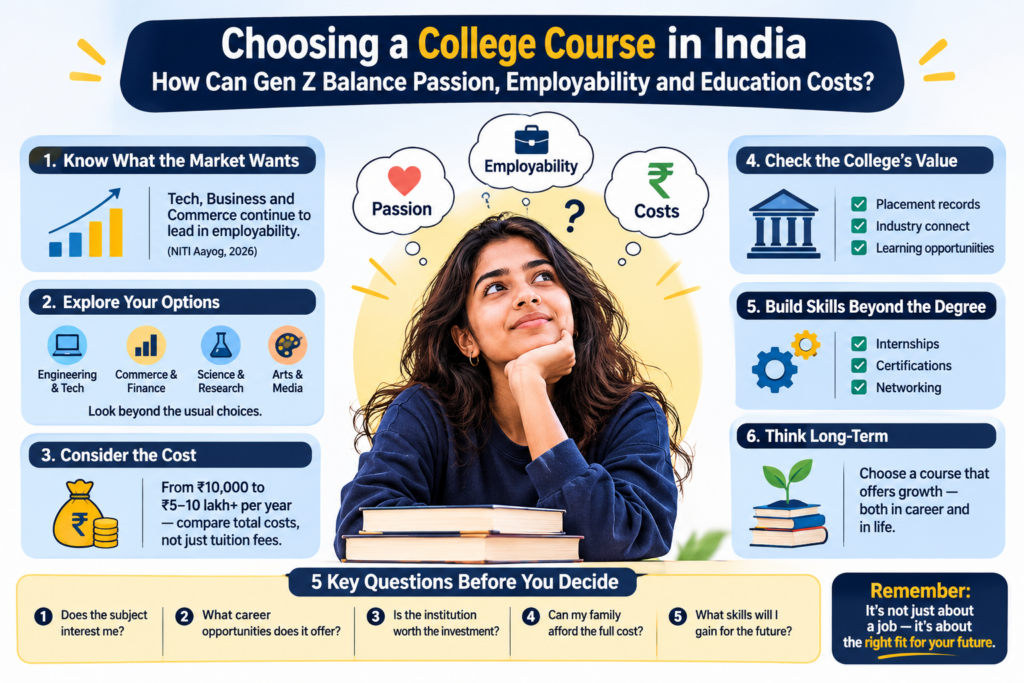
Before committing to a college course, students can make their decisions more informed by asking five questions:
- Does the subject interest me? Can I imagine studying it seriously for three or four years?
- What opportunities does it offer? Which industries and roles could I realistically explore after graduation?
- Is the institution worth the investment? What do its academic quality, internships and placement outcomes tell me?
- Can my family afford the complete cost? Have I considered accommodation, additional qualifications and potential education loans?
- What skills will I graduate with? Will I have practical experience, relevant technical capabilities and the ability to adapt to changing workplace requirements?
These questions cannot eliminate uncertainty, but they can help students avoid making decisions based solely on social expectations, popular career trends or advertised salary packages.
The Degree Is a Starting Point, Not the Destination
Choosing an undergraduate course is an important decision, but it should not become a source of lifelong anxiety. Careers are increasingly non-linear, and graduates often move across industries, acquire new skills and discover professional interests that they did not anticipate at 18.
The responsibility, therefore, is not to identify a supposedly perfect degree that guarantees financial success. It is to choose an educational pathway that offers a reasonable balance of personal interest, academic quality, affordability and future opportunities.
For Gen Z, the smarter investment may not always be the most expensive university or the most fashionable course. It may be an affordable degree from a credible institution, combined with internships, practical skills, industry exposure and a willingness to keep learning.
Passion matters. Employability matters. And the cost of education matters too.
The challenge is to bring all three into the same conversation before making a decision that could shape the next several years of a young person’s life.