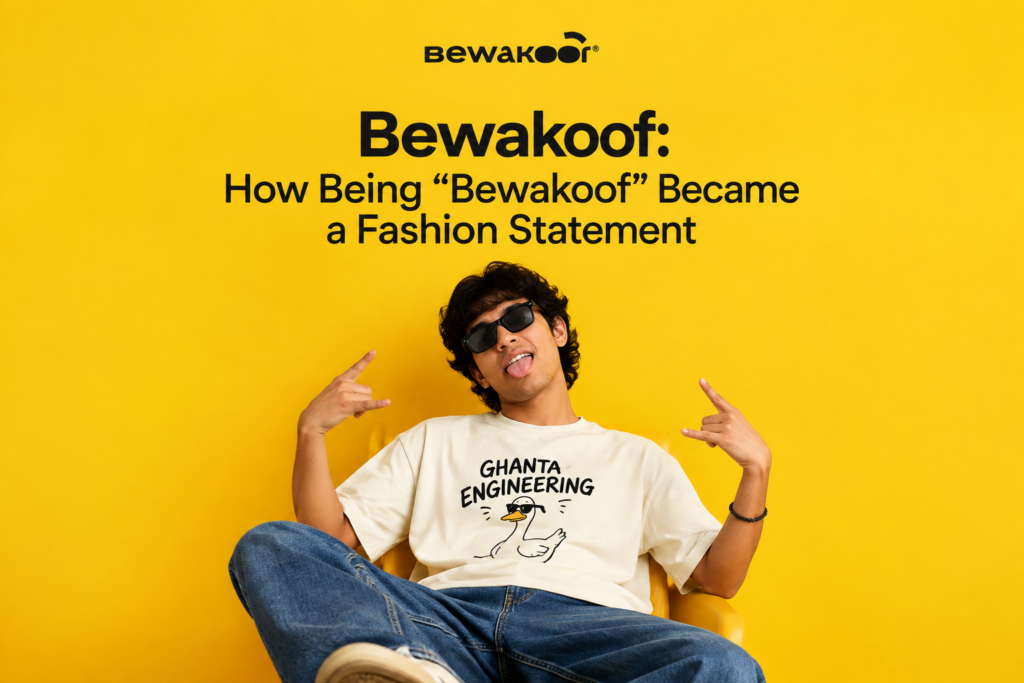
In a fashion market obsessed with looking cool, Bewakoof built a brand around being unapologetically different — turning Indian humour, internet culture and self-expression into something young consumers could wear.
Fashion has always been a way of saying something without saying it.
A suit can say you mean business. A luxury watch can signal status. A football jersey can reveal allegiance. A vintage jacket can suggest taste.
But what if the T-shirt itself could make the joke?
What if your clothes could say Ghanta Engineering, reference a meme, carry an absurd illustration, celebrate a piece of Indian pop culture or simply communicate an attitude that was distinctly your own?
That is where Bewakoof found its space.
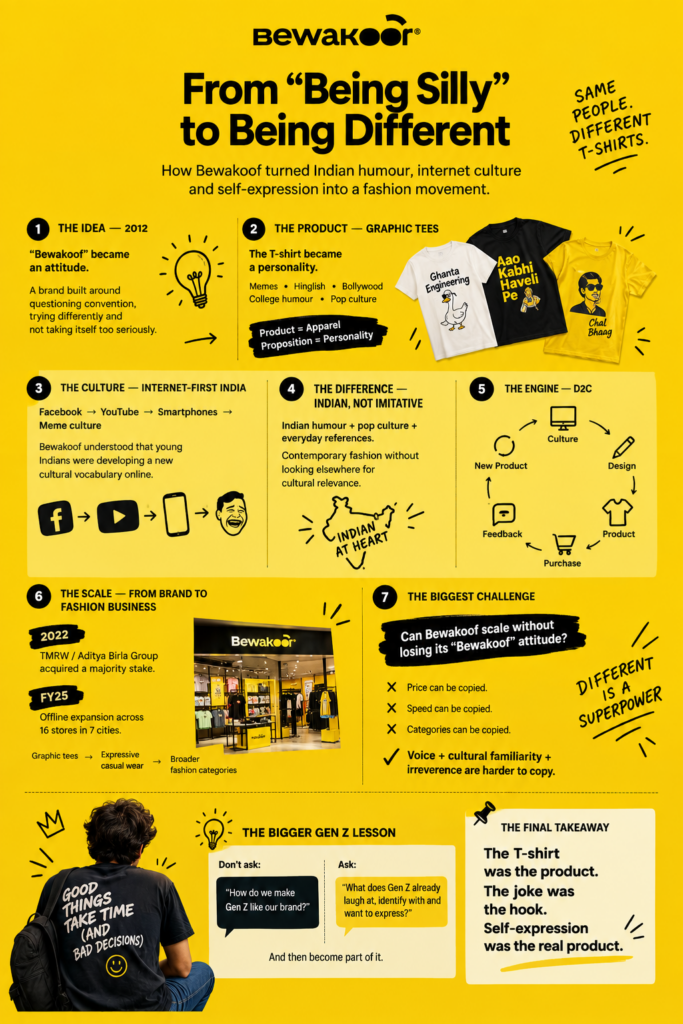
Founded in 2012, the Indian fashion brand built its identity around a provocative idea: perhaps being called “bewakoof” — foolish, unconventional or different — was not necessarily an insult. On its own “Our Story” page, the company describes Bewakoof as a spirit of looking at things differently, trying new things even when success is not guaranteed and questioning what society expects.
It was an unusual philosophy for a fashion company.
And perhaps that was precisely the point.
The T-shirt became a personality
For decades, graphic T-shirts have existed at the intersection of fashion and self-expression.
But Bewakoof understood something particularly important about India’s emerging digital youth culture: young consumers did not necessarily want fashion to make them look like everyone else. They wanted fashion to make them recognisable.
The distinction is subtle but important.
A plain black T-shirt is clothing.
A T-shirt carrying a joke that only your generation understands is a conversation starter.
A reference to engineering college life is an inside joke.
A Bollywood reference can become nostalgia.
A meme can become a cultural timestamp.
A quirky graphic can simply say: this is my kind of humour.
Bewakoof’s own account of its early journey points to designs such as “Ghanta Engineering” and “Aao Kabhi Haveli Pe” as examples of the irreverent language that helped define the brand.
The product may have been apparel.
The proposition was personality.
It understood the Indian internet before “internet culture” became a marketing phrase
One of the most interesting things about Bewakoof is the cultural environment in which it emerged.
The early 2010s were transforming Indian youth culture.
Facebook was becoming a daily habit. Smartphones were becoming affordable. YouTube was changing entertainment. Meme pages were exploding. Bollywood references travelled faster. College humour became digital content. Young Indians increasingly had a shared vocabulary that was not being dictated entirely by television, newspapers or traditional fashion magazines.
The internet was creating its own culture.
Bewakoof was built inside that transition.
Instead of treating Indian humour as something separate from fashion, it made humour part of the product.
That gave the brand a distinctive advantage: it could participate in conversations that were already happening.
This is an important difference between creating culture and responding to it.
A traditional fashion campaign might tell consumers what is fashionable.
A culturally fluent brand can notice what people are already laughing about, talking about and identifying with — and turn that behaviour into a product.
Bewakoof repeatedly operated in that space.
Being Indian was not something to hide
There is another reason the brand’s positioning matters.
For a long time, fashion aspiration in India often meant looking outward.
Western silhouettes. International brands. Global celebrities. Imported cultural references.
Bewakoof helped demonstrate that there was another route to desirability.
It could be contemporary without pretending to be somewhere else.
It could be fashionable and distinctly Indian.
It could use Hinglish, Indian pop culture, college humour, Bollywood references and everyday observations without treating them as inferior to global culture.
That made the brand feel culturally close to its audience.
And closeness matters.
Especially with younger consumers.
Gen Z does not live in a world where culture arrives in neat categories. A consumer can watch an international streaming series in the morning, send an Indian meme to friends five minutes later, listen to Punjabi music in the afternoon and wear a T-shirt referencing an old Bollywood film at night.
Identity has become layered.
Brands that understand that complexity have an opportunity to become more than retailers.
They can become cultural participants.
From graphic T-shirts to expressive fashion
The challenge for any distinctive fashion brand is what happens after the original idea works.
A graphic T-shirt can establish a brand.
But it cannot necessarily build an entire fashion business.
Bewakoof gradually expanded beyond the graphic-tee proposition into broader casual and expressive wear. Today, its positioning under TMRW describes it as a D2C fashion brand for Gen Z and Millennials, with products spanning licensed merchandise, graphic tees, oversized fits and distinctive bottomwear.
This evolution is important.
Because once a consumer understands what a brand means, the brand can start selling more things without necessarily losing its identity.
The underlying proposition becomes bigger than any individual product.
That is the difference between a product brand and a brand world.
Bewakoof was no longer simply asking:
“Would you wear this T-shirt?”
It was increasingly asking:
“Does this feel like you?”
The D2C model helped make the attitude scalable
Bewakoof was also a product of India’s direct-to-consumer revolution.
The company describes its model as direct-to-consumer, with in-house capabilities spanning design, manufacturing, technology, data science and marketing. Its stated proposition has been to create distinctive fashion for contemporary Indians while combining accessibility with value.
That operating model matters because expressive fashion needs experimentation.
A brand built around cultural references needs to understand what people are responding to.
Which designs work?
Which categories move?
Which audiences are engaging?
Which references have relevance?
Which products are becoming stale?
Digital commerce can provide a continuous feedback loop.
And that makes the relationship between culture and commerce much tighter.
The internet tells the brand what people are talking about.
The brand turns some of those cultural signals into products.
Consumers buy, wear and share them.
The cycle begins again.
In that sense, Bewakoof was not just another D2C fashion company.
It was an early example of how digital culture could influence product creation itself.
Then came the bigger fashion machine
In 2022, Aditya Birla Group’s TMRW acquired a majority stake in Bewakoof in a transaction reported at ₹200 crore. At the time, Bewakoof had reported revenue of about ₹162 crore, up from ₹129 crore in the previous fiscal year.
The deal represented a significant transition.
Bewakoof had been built as a digitally native, founder-led fashion company.
Now it had access to the resources and operating capabilities of one of India’s largest fashion groups.
That creates a fascinating tension.
Scaling a brand requires systems.
But personality cannot always be systematised.
You can optimise supply chains.
You can improve inventory cycles.
You can expand categories.
You can build physical stores.
You can improve marketing efficiency.
But can you institutionalise the irreverence that made people love the brand in the first place?
That is one of the central questions in Bewakoof’s next chapter.
From screen to store
The digital-first fashion story is also changing.
For years, D2C brands were often described as the alternative to physical retail.
Today, many of them are discovering that digital and physical are not necessarily competing models.
TMRW’s FY25 reporting noted the expansion of offline presence across brands including Bewakoof, The Indian Garage Co. and Nobero, with the portfolio reaching 16 stores across seven cities at the end of FY25. The company described category expansion, premiumisation, collaborations and offline expansion as important growth drivers.
That shift is particularly interesting for Bewakoof.
A website can deliver convenience.
A physical store can deliver discovery.
It can turn a digital brand into a visible part of a city.
It can allow friends to walk in together, browse together and discover products that they might previously have encountered only through a screen.
For a brand whose proposition is fundamentally expressive, that physical experience could become increasingly important.
But the biggest challenge may be staying “Bewakoof”
This is where the Bewakoof story becomes more interesting than a simple growth narrative.
Fashion is full of brands that began with a distinctive personality and gradually became more conventional as they scaled.
The danger for Bewakoof is not necessarily competition.
It is dilution.
If every fashion brand becomes increasingly fast, affordable, trend-led and digitally marketed, then speed and price alone are not enough to distinguish one brand from another.
Bewakoof’s real asset is harder to copy.
Its voice.
Its cultural familiarity.
Its ability to make something ordinary feel slightly mischievous.
Its willingness to not take fashion — or itself — too seriously.
That is difficult to manufacture.
And perhaps even more difficult to maintain at scale.
As TMRW continues to build Bewakoof as part of its larger portfolio of youth-oriented fashion brands, the company is positioning Bewakoof as India’s largest D2C fashion brand in expressive casual wear, led by pop-culture and fandom trends.
The opportunity is therefore not simply to sell more clothes.
It is to preserve the reason people wanted those clothes in the first place.
The bigger lesson for Gen Z brands
There is a tendency in marketing to ask:
How do we make Gen Z like our brand?
Bewakoof suggests a different question.
What does Gen Z already like, laugh at, identify with or want to express — and can the brand become part of that behaviour?
That is a fundamentally different approach.
Bewakoof did not invent Indian humour.
It did not invent graphic T-shirts.
It did not invent pop culture.
It did something more commercially interesting.
It brought those things together in a brand that gave young Indians a way to wear their personality.
And that is why its name remains such an important part of the story.
“Bewakoof” is not just a label.
It is the brand’s permission slip.
Permission to be different.
Permission to be funny.
Permission to not take fashion too seriously.
Permission to wear something because you like it.
In a category increasingly crowded with brands chasing trends, that kind of attitude can be more durable than any individual trend.
Because trends change.
Humour changes.
Memes disappear.
Fashion cycles accelerate.
But the desire to express who you are does not.
And perhaps that is the real reason Bewakoof has endured.
The brand did not convince young Indians that being different was fashionable.
It made being different the fashion.
The T-shirt was the product.
The joke was the hook.
But the real product was always self-expression.
Bewakoof didn’t just sell clothes to a generation finding its voice. It gave that voice something to wear.