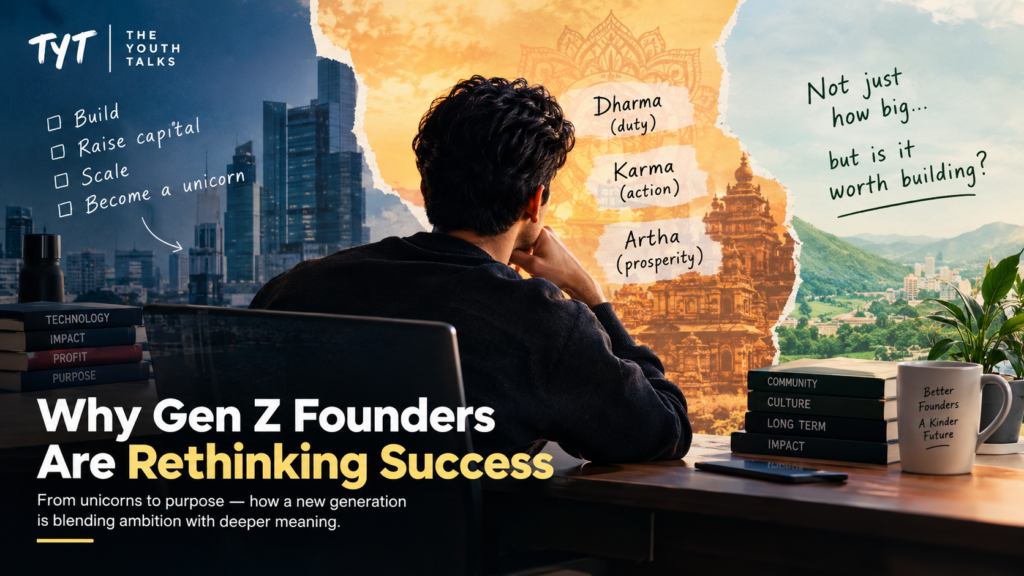
For more than a decade, the Indian startup dream was remarkably easy to understand.
Build fast.
Raise capital.
Scale.
Grow users.
Become a unicorn.
And then, perhaps, become something even bigger.
The numbers were the language of aspiration. Valuation became a shorthand for success. Funding rounds became milestones. A billion-dollar valuation became the ultimate badge that a young company had made it.
But something interesting is happening underneath that familiar startup story.
For some young founders, the question is beginning to change.
Not “How big can this become?”
But:
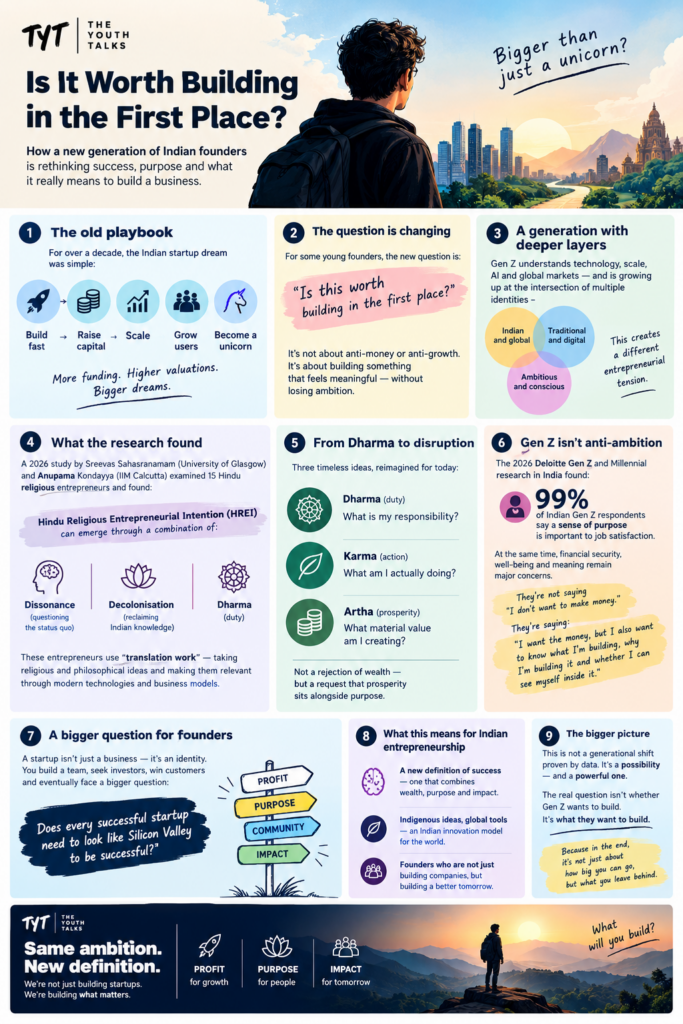
“Is this worth building in the first place?”
That does not mean Gen Z has suddenly become anti-money, anti-growth or anti-business.
Quite the opposite.
This is a generation that understands technology, scale, creator economics, AI and global markets almost instinctively. It is also a generation growing up at the intersection of multiple identities — Indian and global, traditional and digital, ambitious and increasingly conscious of meaning.
And that creates a different entrepreneurial tension.
Can you build something commercially successful without disconnecting it from who you are?
Can technology be modern without becoming culturally rootless?
Can a company create wealth and still have a reason beyond wealth?
And perhaps most importantly:
Does every successful startup need to look like Silicon Valley to be successful?
A fascinating new academic study suggests that these questions may be more relevant to Indian entrepreneurship than they first appear.
A 15-founder study raises a much bigger question
A 2026 study by Sreevas Sahasranamam of the Adam Smith Business School at the University of Glasgow and Anupama Kondayya of IIM Calcutta examined something that mainstream entrepreneurship research has rarely explored: what happens when Hindu philosophical ideas become part of entrepreneurial intention.
The study, Understanding Hindu Religious Entrepreneurship: A Translation Perspective, is based on a qualitative study of 15 Hindu religious entrepreneurs.
Its argument is not that Hinduism provides a ready-made startup manual.
It is much more interesting than that.
The researchers identify what they call Hindu Religious Entrepreneurial Intention, or HREI, and find that it can emerge through a combination of dissonance, decolonisation and Dharma — duty.
The entrepreneurs studied were engaging in what the researchers describe as “translation work”: taking religious knowledge and philosophical ideas and making them relevant to the contemporary world through entrepreneurial expression.
That can mean using contemporary technologies and business models to reinterpret ideas that might otherwise remain locked in historical or religious contexts.
And this is where the study becomes relevant to a much larger conversation about young Indian entrepreneurship.
Because perhaps the question isn’t whether Indian founders are becoming more religious.
Perhaps the question is whether some young founders are becoming more interested in where their ideas come from.
From Dharma to disruption
Three concepts are particularly interesting here.
Dharma — duty.
Karma — action.
Artha — prosperity or material well-being.
These ideas do not necessarily sit comfortably inside the conventional startup vocabulary.
Startup culture tends to speak about product-market fit, TAM, CAC, growth, defensibility, exits and valuation.
The language of Dharma asks a different question:
What is my responsibility?
Karma asks:
What am I actually doing?
Artha asks:
What material value am I creating?
Put together, they create a rather different definition of entrepreneurship.
Not one that rejects prosperity.
One that asks prosperity to sit alongside purpose.
The Glasgow-IIM Calcutta research specifically highlights how the entrepreneurs it studied use these ideas to construct alternative interpretations of entrepreneurial success, including community-centred and values-led approaches.
That distinction matters.
Because the emerging founder archetype is not necessarily:
“Money is bad.”
It may be:
“Money is not the only measurement.”
Gen Z isn’t rejecting ambition
This is where the conversation around Gen Z can easily become cliché.
Young people are often described as wanting purpose over profit, flexibility over hierarchy and meaning over money.
But that binary doesn’t really capture what is happening.
The 2026 Deloitte Gen Z and Millennial research in India, for example, found that 99% of Indian Gen Z respondents said having a sense of purpose was important to job satisfaction. At the same time, financial security remains a major concern. The data suggests that money, meaning and well-being are not substitutes for one another; young Indians increasingly want some combination of all three.
That is a far more interesting picture of Gen Z.
They are not necessarily saying:
“I don’t want to make money.”
They are saying:
“I want the money, but I also want to know what I’m building, why I’m building it and whether I can see myself inside it.”
For founders, that question becomes even more complicated.
A job can be left.
A startup becomes an identity.
You spend years of your life inside it.
You recruit people into it.
You ask investors to believe in it.
You ask customers to believe in it.
You eventually have to decide what happens when the opportunity becomes much larger than the original idea.
The question of purpose therefore becomes an operating question, not simply a branding question.
The rise of the translator founder
Perhaps the most fascinating idea in the Glasgow-IIM Calcutta research is the concept of the entrepreneur as a translator.
Not translator in the conventional sense.
A translator between worlds.
Ancient and contemporary.
Traditional and technological.
Local and global.
Philosophical and commercial.
The research describes entrepreneurs who attempt to contemporise religious knowledge and make it relevant through modern entrepreneurial expression. The examples discussed around this research include ventures using technologies such as AI and VR to engage with Vedic knowledge, heritage and religious experiences.
That is a very different founder archetype from the stereotypical “disrupt everything” entrepreneur.
The translator founder isn’t necessarily trying to destroy the old world.
They are asking:
What from the old world still matters — and how can it survive in the new one?
That question could become particularly powerful in India.
Because India is not a culture where modernity simply replaced tradition.
The two have collided, mixed and coexisted.
A 20-year-old can use generative AI to build an app, consume American entertainment, speak in internet slang, invest through a mobile platform — and still be deeply influenced by family traditions, regional culture, language, mythology or philosophy.
These are not necessarily contradictory identities.
They are the same person’s identities.
And Gen Z may be unusually comfortable living inside that contradiction.
The “two lives” problem
For earlier generations, professional and personal identities could be kept relatively separate.
You could have your work life.
And then you could have your beliefs, family, community and cultural life outside work.
The internet has made that separation harder.
For Gen Z, identity travels.
Your values are visible.
Your interests are visible.
Your opinions are visible.
Your communities are visible.
Your side projects are visible.
Your personal brand and professional identity can overlap.
That creates a new founder question:
What happens when the company you build becomes an extension of the person you are?
This is where the idea of decolonisation in the Glasgow-IIM study becomes particularly provocative.
The researchers argue that some entrepreneurs use Hindu philosophical frameworks to challenge the assumption that entrepreneurship must be understood through frameworks developed primarily in Western contexts.
That does not mean rejecting Western business thinking.
There is nothing inherently wrong with venture capital, shareholder value, global markets or Silicon Valley.
The more interesting possibility is that Indian founders may increasingly add their own frameworks to the conversation.
Not replace one imported playbook with another.
Build a bigger one.
What if the next Indian startup isn’t a copy of anything?
India’s first major wave of technology entrepreneurship often involved localisation.
Take a successful global model.
Adapt it for India.
Solve Indian problems.
Scale it.
The next generation may have a different opportunity.
It can build from India without necessarily building Indian versions of somebody else’s ideas.
That distinction is already visible in parts of India’s technology ecosystem.
Young founders are increasingly building for globally relevant problems in areas such as AI, aerospace, climate technology, deep tech and advanced manufacturing — rather than simply recreating familiar consumer internet models. Recent reporting on India’s Gen Z founders has similarly pointed to a generation looking beyond quick exits and towards globally relevant technology.
But the cultural opportunity could be even larger.
India has thousands of years of philosophical, linguistic, artistic and social knowledge.
Much of it remains either inaccessible to younger generations or trapped inside formats that do not fit contemporary behaviour.
What happens if a Gen Z founder sees that not as heritage to preserve in a museum, but as raw material for innovation?
A language-learning platform built around endangered Indian languages.
An AI interface for accessing classical knowledge.
A new form of wellness rooted in Indian traditions but designed for digital-native consumers.
Technology that makes regional culture more accessible rather than less relevant.
These aren’t necessarily religious startups.
They are examples of a larger idea:
What happens when cultural identity becomes an innovation input?
The startup question after the unicorn
The unicorn will not disappear.
Nor should it.
Building a billion-dollar company is an extraordinary achievement.
Capital matters.
Scale matters.
Profits matter.
Employment matters.
Innovation matters.
There is nothing inherently shallow about wanting to build something enormous.
The more interesting shift is that valuation may no longer be enough to explain why a young founder chose to build something.
A company can be worth a billion dollars and still leave its founder asking whether it should exist.
And another company can be much smaller and still be deeply meaningful to the people who built it.
That does not make one morally superior to the other.
It simply changes the question.
Success can have more than one scoreboard.
Revenue can be one.
Users can be another.
Impact can be another.
Cultural preservation can be another.
Community can be another.
Knowledge can be another.
And, increasingly, personal alignment may be one too.
Gen Z’s entrepreneurial contradiction
Perhaps the most interesting thing about Gen Z founders is that they don’t fit neatly into the categories previous generations created for them.
They aren’t necessarily anti-capitalist.
They aren’t necessarily anti-corporate.
They aren’t necessarily anti-growth.
They aren’t necessarily spiritual entrepreneurs.
They aren’t necessarily trying to “change the world” with every startup.
They are simply growing up in a moment where the old definitions of success are being questioned from multiple directions.
AI is changing what work means.
Creators are becoming businesses.
Employees are becoming founders.
Global markets are accessible from Indian cities.
Technology is making small communities commercially viable.
And cultural identity is becoming increasingly visible rather than something entrepreneurs feel they need to hide.
That creates room for a different kind of founder.
One who can be intensely ambitious and deeply rooted.
One who can understand venture capital and still care about community.
One who can build with AI and still be interested in ancient knowledge.
One who wants wealth without necessarily making wealth the entire point.
That may be the real significance of the Dharma conversation.
Not that every Gen Z founder is suddenly looking to Hindu philosophy for answers.
There is no evidence for that.
The more interesting point is that some founders are beginning to ask whether the questions they inherited about entrepreneurship are the only questions worth asking.
Beyond the unicorn
For years, the startup world asked founders:
How big can you build?
The next generation may increasingly ask:
How meaningful can you build?
Those questions do not have to compete.
A company can be profitable and purposeful.
Global and Indian.
Technological and cultural.
Ambitious and responsible.
Modern and rooted.
The Glasgow-IIM Calcutta study offers only one small — and very specific — window into this possibility. Its sample is just 15 Hindu religious entrepreneurs, so it cannot be used to declare a sweeping transformation of Indian entrepreneurship. But that is precisely why the research is interesting: it opens a door rather than closing the argument.
And perhaps that is where the next chapter of Indian entrepreneurship becomes genuinely exciting.
Not when Gen Z rejects the unicorn.
But when it asks what the unicorn is for.
Because the next generation may not be less ambitious than the one before it.
It may simply want its ambition to mean something.
The next big Indian startup story may not be about how much a company is worth.
It may begin with a more difficult question: what is worth building?