
India’s youngest consumers are reshaping beauty, fashion, fitness, travel and digital entertainment. But their growing spending power comes with a challenge for brands: winning attention is one thing; earning repeat purchases is quite another.
A young Indian consumer walks into a beauty store looking for a skincare product. Later that week, the same person browses sneakers online, saves a travel destination discovered on Instagram and watches a creator explain why one product is better than another.
These decisions may appear unrelated. Yet they reveal something important about the consumer economy taking shape in India. Young people are navigating a marketplace where products, trends and recommendations are constantly within reach, while their spending decisions reflect a mix of aspiration, affordability, convenience and personal identity.
For brands, this presents an opportunity that is difficult to ignore — and a challenge that is easy to underestimate.
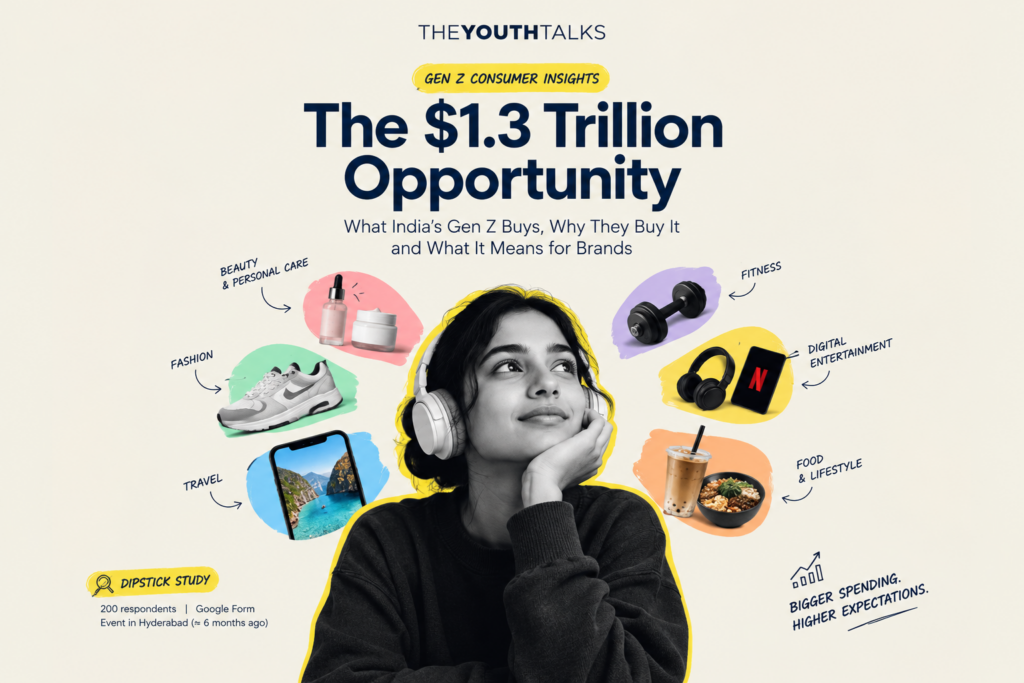
By financial year 2030, India’s Gen Z consumers are projected to account for approximately $1.34 trillion in consumption, according to Redseer Strategy Consultants’ report, The Indian Consumer at 2030: Redefining Aspirations, Choices, and Markets, developed with Fireside Ventures.
The projection makes Gen Z one of the most consequential consumer groups for businesses planning their next phase of growth. But the more interesting question is not how much this generation will spend. It is what will persuade young Indians to spend their money on one product, brand or experience rather than another.
The $1.3 trillion opportunity
Gen Z is commonly defined as those born between 1997 and 2012, although definitions vary across research organisations. In 2030, this group will span teenagers and young adults entering or progressing through their working lives.
That distinction matters. A school student making a purchase with parental assistance has a different spending capacity from a 28- or 30-year-old professional earning a salary. Yet both may influence consumer trends, household decisions and the products that businesses choose to develop.
Redseer’s projections suggest that Gen Z’s consumption could grow from approximately $520 billion in FY2024 to $1.34 trillion by FY2030.
This is not a prediction of how much money every young Indian will personally have available to spend. Rather, it represents the projected consumption associated with this demographic.
The opportunity spans multiple industries. Redseer estimates that Gen Z could account for nearly $19 billion in beauty and personal care spending, $40 billion in fitness and sports consumption, and more than $100 billion in travel and tourism expenditure by 2030.
Fashion, digital entertainment, food and emerging lifestyle categories add further dimensions to this opportunity.
The message for businesses is clear: Gen Z should not be treated as a niche youth segment that can be addressed through occasional campaigns. It is a consumer cohort whose preferences will increasingly influence product development, distribution, pricing and brand strategy.
But size alone does not guarantee success.
The value equation is changing
One of the most revealing aspects of Gen Z consumption is the tension between aspiration and affordability.
Young consumers may want the latest sneakers, an effective skincare routine, a memorable holiday or access to fitness products. At the same time, many are navigating limited disposable incomes, educational expenses, early-career salaries and competing financial priorities.
Redseer’s research highlights the popularity of fashion products priced below ₹1,000, alongside growing interest in beauty, fitness and experiences.
This suggests that affordability is important, but it does not necessarily mean young consumers want the cheapest product available.
A low-priced item that fails to deliver its promised benefit may not represent good value. A slightly more expensive product that lasts longer, solves a specific problem or offers a meaningful experience may justify the additional cost.
For brands, this creates a more demanding definition of value. Price remains important, but it must be considered alongside quality, usefulness, convenience, design and emotional appeal.
The implications extend beyond discounting. Businesses may need to offer accessible entry-level products, transparent product information and clearer reasons for consumers to choose them.
The challenge is to make aspiration attainable without making the product feel disposable.
Beauty: more experimentation, harder-earned loyalty
Beauty and personal care offer a particularly interesting illustration of this changing behaviour.
Redseer estimates that Gen Z will account for nearly $19 billion of India’s beauty and personal care market by 2030. Its analysis describes increasingly elaborate routines, greater attention to specific skin and hair concerns, and growing participation by young men in personal care.
The significance extends beyond a larger market for cosmetics and skincare.
As consumers become more familiar with different products and routines, their expectations may become more specific. A cleanser, moisturiser or serum is increasingly evaluated according to the problem it claims to address.
That can make consumers more willing to experiment.
For brands, the resulting challenge is not simply getting a product into a consumer’s shopping basket. It is demonstrating why that product deserves to remain there.
A consumer might repeatedly purchase skincare products while switching between brands. The category remains important, but loyalty to an individual company is less certain.
This distinction has consequences for marketing investment. Attractive packaging and a successful launch can generate trial, but repeat purchases depend on product performance, price, availability and the consumer’s experience.
The same principle can apply to hair care, nutrition, fitness products and other categories in which consumers compare results and experiment with alternatives.
Fashion: self-expression without the premium price tag
Fashion offers another window into the Gen Z consumer.
Redseer identifies affordable fashion as an important part of the market, noting the popularity of items priced below ₹1,000. Its findings also point to the growing role of sneakers and accessories in young consumers’ wardrobes.
The broader interpretation is that fashion purchases can serve two purposes at once: meeting a practical need and expressing an identity.
Social media accelerates the circulation of styles, aesthetics and product recommendations. A look that gains visibility online can influence what consumers want to try, even when they cannot or do not want to spend heavily on premium labels.
This creates opportunities for brands that combine accessible pricing with recognisable design and cultural relevance.
However, the speed at which trends circulate can also make demand difficult to sustain. Products that feel current today may lose their appeal quickly, and brands must balance trend responsiveness with quality, inventory management and responsible production.
The commercial opportunity lies in understanding not just what young consumers buy, but why a particular look becomes desirable in the first place.
Fitness and travel: consumption beyond products
Gen Z’s consumer priorities are not confined to what it wears or applies to its skin.
Redseer projects $40 billion in Gen Z fitness and sports consumption by FY2030. Its analysis covers sportswear, footwear, nutrition, fitness applications and related activities.
Fitness can therefore create spending across several interconnected categories. A young person who starts exercising may eventually purchase sports shoes, comfortable clothing, gym access, nutrition products or a subscription to a fitness application.
The initial behaviour creates opportunities across a wider ecosystem.
Travel presents a similar pattern. Redseer estimates that Gen Z travel and tourism spending could exceed $100 billion by 2030, with younger travellers showing interest in experiences such as hostels, independent travel and offbeat stays.
For travel businesses, the product is not simply a hotel room or a ticket. It can also be the experience, the freedom to explore and the memories that travellers want to create.
Both categories illustrate why brands should look beyond individual transactions. Understanding the wider activity surrounding a purchase can reveal opportunities to serve consumers at several points in their journey.
Discovery is not the same as trust
Digital platforms have made it easier for young consumers to discover products, compare alternatives and encounter new brands.
But visibility does not automatically translate into credibility.
A product may appear in a creator’s video, a friend’s recommendation or a social-media advertisement. The consumer still needs a reason to believe that it is worth purchasing.
That reason could be a credible review, a demonstrated benefit, a recommendation from someone they trust or an experience that meets expectations.
For brands, this means that influencer reach and engagement metrics cannot tell the entire story. A campaign may generate considerable attention without establishing lasting preference.
The stronger opportunity is to build a consistent relationship between what a brand promises and what the consumer experiences.
This is particularly important in categories where consumers can easily switch products or where the consequences of a disappointing purchase are immediately apparent.
Young consumers may discover brands through social media, but companies must give them reasons to return after the campaign ends.
The household influence that spending figures may miss
Gen Z’s economic significance also extends beyond purchases made with its members’ own money.
Redseer describes this generation as the “Reverse Generation”, highlighting its ability to influence the decisions of older family members.
Young consumers may introduce parents to unfamiliar technology, influence entertainment subscriptions, recommend travel destinations or shape preferences around products and services.
This creates a distinction between the person who pays for a purchase and the person who influences it.
For businesses, understanding this relationship can be important when developing products and campaigns. Young consumers may influence a decision even when another family member ultimately makes the payment.
However, that influence will vary by category, household and individual circumstances. It should be treated as a strategic opportunity rather than an assumption that every Gen Z consumer controls family spending.
What brands need to get right
The $1.3 trillion projection offers a compelling reason for businesses to pay attention to Gen Z. But the figure alone does not tell brands how to win.
Three priorities stand out.
First, companies need to make value tangible. Accessible prices matter, but so do product performance, convenience and a credible reason to buy.
Second, brands must recognise that discovery and loyalty are different challenges. Social-media visibility may introduce a product to consumers, but sustained preference requires a consistently good experience.
Third, businesses need to understand the context in which consumption happens. Beauty is connected to personal care routines, fitness to lifestyle choices, travel to experiences, and fashion to self-expression. Products compete not just against alternatives in their own category, but against other demands on consumers’ money and attention.
None of this means Gen Z behaves as one uniform group. Income, geography, language, life stage and personal priorities can produce very different consumption patterns. Brands that treat all young Indians as a single audience risk missing precisely the differences that matter.
The task is to identify meaningful segments without reducing a diverse generation to stereotypes.
The generation is growing. The challenge is earning its choice.
India’s Gen Z consumers represent an enormous projected market, but the real opportunity lies in understanding the decisions behind that spending.
A generation that experiments with products, balances aspiration with affordability and discovers brands through an increasingly crowded digital environment may be difficult to win over through advertising alone.
For businesses, the question is no longer simply whether Gen Z represents a growth opportunity. It is whether their products, prices and promises fit the way young consumers make decisions.
The companies that answer that question well may be better placed to build lasting relationships with this generation.
The $1.3 trillion projection tells us why Gen Z matters. Understanding why its members buy, switch, recommend and return will determine which brands benefit from it.