





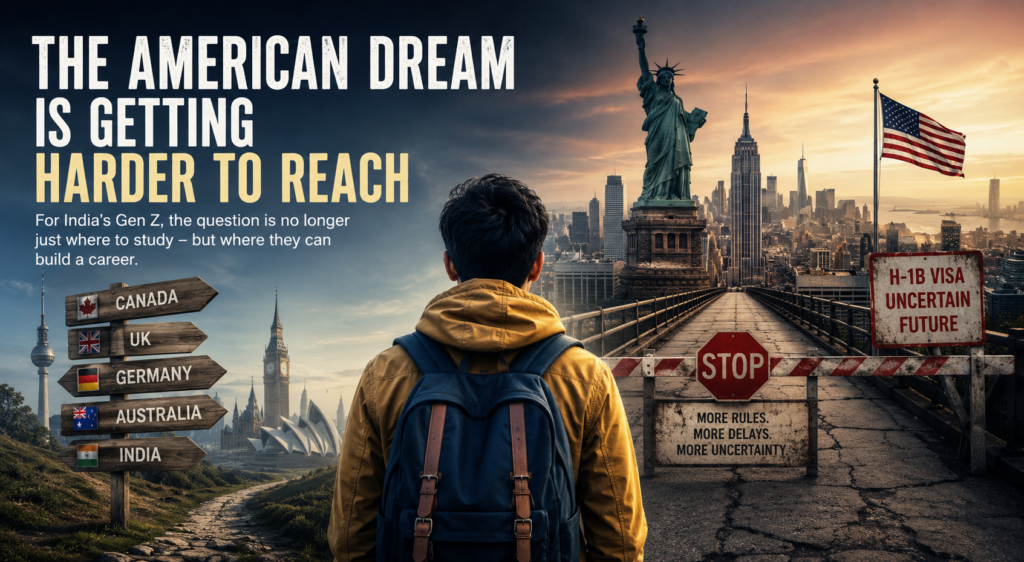
For India’s young generation, studying in America was once a pathway to a global career. As immigration rules tighten, Gen Z may have to rethink not just where it studies — but where it wants to build its future.
For generations of Indian families, the American dream followed a familiar script.
Get into a good American university.
Take the education loan.

Fly across the world.
Earn a master’s degree.

Find a job.
Use the post-study work period to get a foothold in the American economy.

And then, hopefully, make it through the H-1B system and stay.
It was never guaranteed. The H-1B lottery has always been uncertain, and the journey from temporary employment to permanent residency has been particularly difficult for Indian nationals.
But there was something powerful about the proposition.
The path was understandable.
A student could at least imagine how an Indian classroom could eventually lead to an American workplace.
In 2026, that pathway is becoming harder to predict.
The United States is tightening immigration rules across several fronts — from student admissions and visa vetting to the H-1B selection system and the cost of sponsoring foreign workers.
None of these changes, individually, means that Indian students should stop considering America.
But together, they are changing the calculation.
And that raises a bigger question:
If an American degree no longer comes with a reasonably predictable pathway to an American career, will America remain the default dream destination for India’s young talent?
The American Dream was never just about education
The attraction of an American university has never been limited to the classroom.
For an Indian student, the proposition has traditionally been much larger:
Study at a globally recognised university.
↓
Graduate with an American qualification.
↓
Use post-study work opportunities to enter the labour market.
↓
Find an employer willing to sponsor you.
↓
Enter the H-1B system.
↓
Build a career in America.
This education-to-employment pathway has been one of the biggest reasons the United States became such a powerful destination for Indian students.
The degree mattered.
But so did what came after the degree.
And that is where today’s uncertainty becomes important.
A student deciding whether to spend tens of lakhs of rupees on an American master’s degree isn’t only asking whether the university is good.
They are also asking:
Will I be able to work there?
For how long?
Will an employer sponsor me?
Will I have a realistic chance of getting an H-1B?
What happens if I don’t?
The American education decision is therefore increasingly becoming an immigration decision as well as an education decision.
H-1B is no longer just a lottery question
The H-1B programme allows U.S. employers to hire foreign professionals in specialty occupations. It has long been particularly important to the technology sector and to Indian professionals.
Traditionally, the programme has had a numerical cap of 65,000 visas, with an additional 20,000 places for workers holding qualifying U.S. advanced degrees.
Demand has routinely exceeded supply.
But the system is now changing in ways that could matter to the next generation of Indian graduates.
In February 2026, the U.S. introduced a weighted H-1B selection system that favours registrations associated with higher wage levels while retaining opportunities for workers at lower wage levels. The new system applies to the FY2027 cap season.
The policy effectively changes the traditional idea of the H-1B lottery.
It is no longer simply:
“Get lucky.”
It increasingly becomes:
“How valuable is the position you are being hired for?”
According to DHS estimates accompanying the rule, a Level I wage registration would have a substantially lower selection probability than a Level IV registration under the weighted system.
For a highly paid, specialised professional, this may not fundamentally change the attractiveness of the United States.
For a recent graduate trying to enter the labour market, however, it adds another variable to an already uncertain journey.
Then came the $103,265 question
The latest development is even more striking.
On August 25, 2026, the Department of Homeland Security published a proposal to establish a $103,265 fee on H-1B cap-subject petitions, including petitions eligible for the advanced-degree exemption. The proposed fee would be payable when the employer files the petition and would be in addition to other applicable fees.
There is an important caveat.
This is a proposal, not a final fee currently applicable to every new H-1B petition.
The development comes after a separate $100,000 payment introduced by the Trump administration in 2025 was struck down by a federal judge in June 2026, with litigation continuing.
But from a student’s perspective, the legal distinction doesn’t completely eliminate the strategic question.
H-1B sponsorship is ultimately an employer decision.
If employing a foreign graduate becomes significantly more expensive or administratively difficult, an employer may think differently about sponsorship.
That doesn’t mean employers will stop sponsoring international graduates.
It does mean that the equation becomes more complicated.
And the student is left asking:
“Will my future employer be willing to make that investment in me?”
The student visa system is changing too
The H-1B is only one part of the journey.
In July 2026, DHS finalised a rule replacing the traditional “duration of status” framework for F-1 students with a defined period of admission and a process for requesting an extension when necessary.
The rule is scheduled to take effect on September 15, 2026.
For most students, the admission period will generally be limited to the time needed to complete the programme, subject to a maximum of four years, with students needing to seek an extension in circumstances where additional time is required.
The change has already triggered legal challenges from organisations representing students, universities and journalists.
Again, this isn’t the same as saying:
“Indian students can only study in America for four years.”
The actual system contains exceptions and extension mechanisms.
But it does represent a change in philosophy.
The government is moving away from an open-ended duration linked to the student’s programme and toward a more defined immigration status that requires closer tracking and, in some cases, additional action.
For a student already navigating a complicated international education system, another layer of administrative uncertainty is hardly irrelevant.
And the scrutiny isn’t only paperwork
In March 2026, the State Department expanded online-presence review to additional visa categories. F-1, M and J applicants were already subject to this type of review, and H-1B and H-4 applicants are also included.
Applicants in these categories have been instructed to make their social-media profiles public or open to facilitate vetting.
The stated rationale is national-security and eligibility screening.
But for international students, the message is clear:
The student visa is being treated with greater scrutiny than it once was.
That matters particularly to a generation that has grown up with a digital identity.
For Gen Z, Instagram, LinkedIn, X, TikTok and other platforms aren’t separate from everyday life.
They are part of it.
The idea that social-media activity can become part of a visa-screening process adds a new dimension to the decision to study abroad.
The pathway from classroom to workplace is also under scrutiny
Another development arrived just days before the end of August.
On August 24, the administration issued guidance aimed at universities around Curricular Practical Training (CPT), which allows eligible international students to undertake practical training that is integral to their curriculum.
The administration said it had observed increased use of CPT that it believed did not comply with regulatory requirements and warned institutions that failure to comply could affect their certification to enrol international students.
Several universities subsequently paused certain CPT applications while they reviewed the guidance.
This is important because practical experience is a significant part of how international students transition from university into the labour market.
The message emerging from the U.S. system is therefore broader than simply:
“The H-1B is harder.”
It is increasingly:
“Every stage of the international-student-to-worker pathway is receiving greater scrutiny.”
And that is what makes the current moment different.
India has the most at stake
India isn’t a peripheral player in this story.
It is at the centre of it.
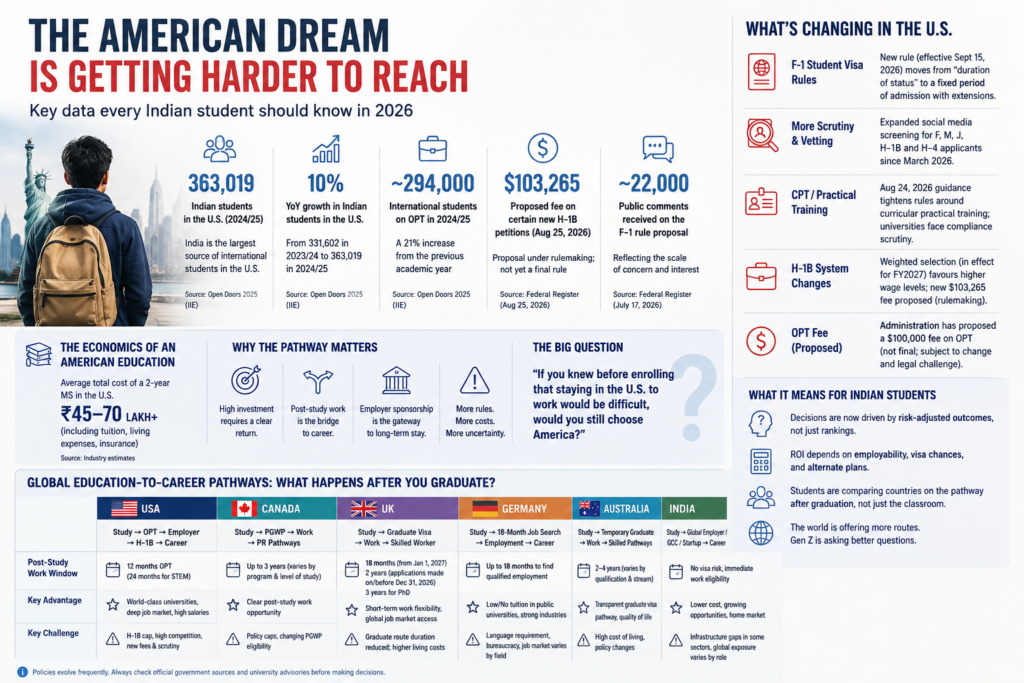
According to the Institute of International Education’s Open Doors 2025 report, 363,019 Indian students studied in the United States during the 2024/25 academic year, making India the largest source of international students in the country. The number was up 10% from the previous year.
That number tells us something important.
Despite years of immigration uncertainty, America has remained extraordinarily attractive to Indian students.
But there are also early signs that the broader international-student market is becoming more difficult.
Open Doors reported that the number of new international students enrolling in U.S. institutions fell 7% in fall 2024, while new graduate enrolments fell 15%.
These numbers should not be interpreted as proof that Indian students are abandoning America.
They aren’t.
But they do provide context for the question now facing U.S. universities:
How much uncertainty can an international student absorb before the economics of an American education stop making sense?
Because the American degree is an expensive bet
For many Indian families, studying in the United States is not a casual decision.
Tuition.
Accommodation.
Living expenses.
Travel.
Insurance.
Currency fluctuations.
And often, an education loan.
A student may be committing several years of their life and a substantial amount of family wealth to the decision.
That means the post-graduation pathway matters.
Imagine two universities offering similarly strong programmes.
One is in a country where the student has a clearly defined period to look for work after graduation.
The other offers extraordinary career opportunities, but the student’s ability to remain employed depends on a more competitive immigration process and employer sponsorship.
The university rankings may favour one.
The risk-adjusted career calculation may favour the other.
This is the change Gen Z may increasingly bring to the international education market.
The world is offering different pathways
This is where the conversation gets interesting.
The question for an Indian student is no longer simply:
“USA or not USA?”
There are multiple models.
🇺🇸 United States
Study → post-study work → employer → H-1B → career
The U.S. still offers arguably the world’s deepest technology, research and high-paying professional ecosystem.
But the path from education to long-term employment is increasingly selective and uncertain.
🇨🇦 Canada
Study → PGWP → work → potential longer-term immigration pathways
Canada offers eligible graduates access to a Post-Graduation Work Permit. Eligibility depends on factors including the institution and programme, and applicants generally have up to 180 days after completing their studies to apply.
Canada has also tightened its international-student system, including restrictions on study permits and changes to post-graduation work eligibility.
So Canada isn’t a simple “easy alternative.”
Its proposition is different:
The transition from education to work is more explicitly built into the international-student pathway.
🇬🇧 United Kingdom
Study → Graduate visa → work → longer-term work route
The UK offers a Graduate visa after successful completion of an eligible course.
But that pathway is also changing.
Students applying on or before December 31, 2026 can receive a two-year Graduate visa. For applications made from January 1, 2027, the standard period becomes 18 months, while doctoral graduates retain a three-year period.
Again, the message isn’t that Britain is easy.
It is that students can understand the bridge between education and employment.
🇩🇪 Germany
Study → up to 18 months to find qualified employment → career
Germany offers international graduates from German universities the possibility of obtaining a residence permit for up to 18 months to look for qualified employment. During that period, graduates can take up employment while searching for the right qualified role.
For Indian students who are increasingly conscious of cost and employability, that can be an attractive proposition.
Germany may not have the cultural pull of Silicon Valley.
But it offers something else:
a defined pathway from education into the labour market.
🇦🇺 Australia
Study → Temporary Graduate visa → work → skilled pathways
Australia’s Temporary Graduate visa allows eligible international graduates to live, work and study in Australia after completing their qualifications. The current Post-Higher Education Work stream is specifically designed for graduates with Australian higher-education qualifications.
Australia, like Canada and the UK, has also tightened aspects of its international education system.
And that is an important point.
The alternatives aren’t standing still either.
The new global competition isn’t about universities alone
For decades, international education was marketed largely around rankings.
Harvard.
Stanford.
MIT.
Oxford.
Cambridge.
Toronto.
Melbourne.
Technical universities in Germany.
The conversation was:
“Where can I get the best education?”
The next generation may increasingly ask:
“What happens after I graduate?”
That changes the competitive landscape.
A student may compare:
Tuition
- Cost of living
- University quality
- Post-study work rights
- Probability of employment
- Immigration pathway
- Salary
- Cost of returning home
- Career mobility
That is a much more sophisticated calculation.
And Gen Z is likely to make it.
India is becoming part of the equation too
There is another destination that often gets ignored in conversations about global education:
India.
For decades, the implicit assumption was that the ambitious Indian student needed to leave India to access global career opportunities.
That assumption is weakening.
India’s technology ecosystem has expanded.
Global Capability Centres have grown.
Multinational companies employ large technology teams in Indian cities.
Startups have created new career pathways.
Global companies increasingly build products, engineering teams and research capabilities in India.
Remote work has also made geography somewhat less decisive for certain professions.
None of this means India can replicate the academic and professional ecosystem of America’s very best universities.
It cannot.
But the economic opportunity cost of leaving India is different from what it was 15 or 20 years ago.
A student now has to compare:
₹50–70 lakh overseas education + immigration uncertainty
against
a lower-cost Indian education + a growing domestic technology ecosystem + the possibility of working for a global company from India.
For some students, that calculation may become compelling.
America still has an enormous advantage
It would be wrong to write this story as though the United States is suddenly losing its appeal.
It isn’t.
America still possesses an extraordinary concentration of world-class universities, research institutions, technology companies, venture capital, healthcare companies and high-paying professional opportunities.
Indian students aren’t choosing America only because of immigration.
They choose it because America remains America.
And the latest data demonstrates the strength of that attraction: more than 363,000 Indian students were in the U.S. during 2024/25.
There is another argument worth considering too.
If the U.S. immigration system increasingly rewards highly skilled and highly paid workers, the world’s strongest students and professionals may still see America as the place where exceptional talent can generate exceptional economic returns.
The policy direction is not necessarily:
“We don’t want international talent.”
It can also be interpreted as:
“We want to be more selective about the international talent we admit and retain.”
The difference matters.
America may become harder to enter without becoming less attractive to the people it most wants.
But the dream is becoming more calculated
That may ultimately be the biggest change.
For years, an Indian student’s American education decision could be driven heavily by ambition:
“I want to work in America.”
Today, ambition is increasingly accompanied by a spreadsheet.
How much will this cost?
What salary can I expect?
How long can I work after graduation?
What if I don’t get H-1B?
What if my employer doesn’t sponsor me?
What is my backup country?
Can I repay my education loan if I have to return to India?
The American Dream isn’t necessarily disappearing.
It is becoming risk-adjusted.
And that may change the kind of students who choose America.
Those with strong financial cushions may be more willing to take the risk.
Those in high-demand fields may feel more confident.
Those targeting elite universities may decide the upside is worth it.
But students making a purely financial decision may increasingly look elsewhere.
The question Gen Z needs to ask
The most important shift may therefore be conceptual.
Don’t ask only:
Which country has the best university?
Ask:
Which country gives me the strongest pathway from education to opportunity?
That means evaluating a foreign degree as a career pathway, not just a qualification.
The pathway might look like:
USA:
Study → OPT → employer → H-1B → career
Canada:
Study → PGWP → employment → longer-term pathways
UK:
Study → Graduate visa → employment → Skilled Worker route
Germany:
Study → job-search period → qualified employment
Australia:
Study → Temporary Graduate visa → employment → skilled pathways
India:
Study → global employer / GCC / startup → career
None of these pathways is guaranteed.
All are evolving.
But they offer different combinations of cost, opportunity, flexibility and immigration certainty.
And that is exactly what the next generation of Indian students will have to compare.
The American Dream isn’t dead. But the default may be changing.
For decades, America occupied a unique place in the imagination of India’s aspiring middle class.
The American university was the destination.
The American job was the reward.
And the possibility of staying was the dream.
That equation is being rewritten.
Not because America has suddenly stopped attracting Indian students.
Not because other countries have suddenly become better.
And not because the American education system has lost its appeal.
Rather, because the pathway after graduation is becoming harder to predict.
And when a young person is making a multi-year, multi-lakh investment, predictability matters.
The next generation of Indian students may therefore become less interested in choosing countries purely by university rankings.
They may compare futures.
How much will my education cost?
How long can I legally work?
How difficult is it to stay?
What happens if I don’t get sponsorship?
What happens if my plan fails?
And perhaps the most important question of all:
Where can I build a global career without having to gamble my entire future on an immigration lottery?
We don’t yet know how Indian students will answer that question.
The numbers still show an enormous appetite for America.
But the global education market is changing, and the competition is no longer simply for students.
It is for young talent with choices.
America still has one of the strongest propositions in the world.
But it may no longer be the only obvious one.
For India’s Gen Z, the American Dream isn’t necessarily disappearing.
It’s becoming one pathway among many.
And for the first time, perhaps, the most important question isn’t:
“Where should I study?”
It is:
“Where can I build the future I am studying for?”