





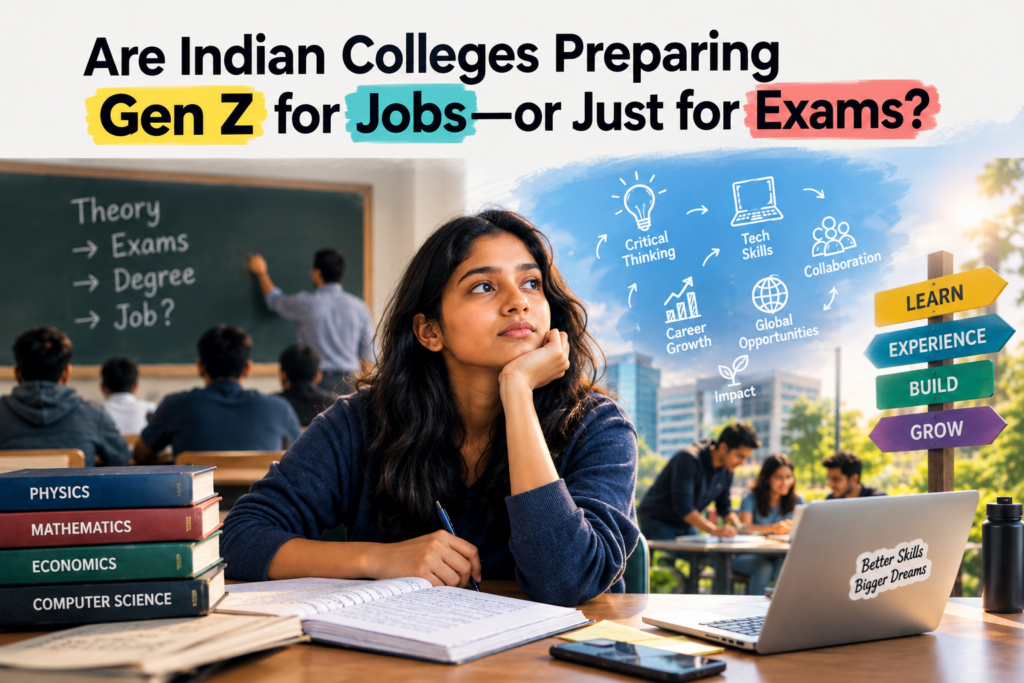
From competitive entrance tests to campus placements, India’s education system has long focused on academic achievement. But as artificial intelligence reshapes the workplace and employers demand new skills, an important question remains: are young Indians learning how to think, solve problems and adapt—or simply how to clear the next examination?
For millions of young Indians, education follows a familiar script. Clear the entrance examination, secure admission to a good college, earn a degree, participate in placement drives and find a job that offers financial stability.
It is a path that has shaped generations of aspirations. For many families, a college degree represents much more than a qualification. It is an investment in security, upward mobility and a better future.

Yet the world awaiting today’s students is changing faster than the expectations surrounding their education.
Artificial intelligence is altering how work gets done. Employers are looking for people who can communicate, collaborate, solve unfamiliar problems and learn new tools. Meanwhile, young people are increasingly exposed to alternative ways of acquiring knowledge, from online courses and open-source communities to internships, personal projects and AI-powered learning assistants.

This creates a difficult question for India’s education system: Is academic success translating into real-world readiness?
The issue is not whether colleges still matter. They do. The question is whether the learning experience they offer is keeping pace with the world their students are preparing to enter.

The Exam Is Over. But Can the Student Apply What They Learned?
India’s examination culture has an understandable foundation. With a large student population competing for limited seats in prestigious institutions and sought-after courses, standardised assessments offer a way to evaluate students at scale.
Examinations can build discipline, test subject knowledge and provide a common benchmark. The problem begins when performance in an examination becomes the primary measure of learning itself.
A student may memorise economic theories, score well in an examination and still struggle to apply those concepts to a business decision. An engineering student may understand a programming concept but find it difficult to build a working application. A management graduate may know the terminology of marketing without having experience researching customers or evaluating a campaign.
These examples do not mean that students lack ability. They raise a different question: have students been given enough opportunities to practise what they have learned?
Knowledge and application are not competing priorities. Strong practical understanding often depends on a solid theoretical foundation. However, students also need opportunities to experiment, make mistakes, receive feedback and discover how concepts work outside textbooks.
Project-based assignments, practical laboratories, case studies, fieldwork and internships can help bridge this gap. Instead of asking students only to explain a concept, educators can also ask them to use it to solve a problem.
The distinction matters because professional life rarely presents challenges in the format of a question paper. Problems are often incomplete, constraints change and the right answer is not always obvious.
Preparing students for that reality requires more than helping them remember the correct answers.
The Employability Question Begins Before Graduation
For many Indian students, college is closely linked to one overriding expectation: employability.
Families invest time, money and emotional energy in education partly because they expect it to open doors to employment. Students, in turn, often evaluate institutions through their placement records, internship opportunities and perceived reputation among employers.
But employability is not simply the ability to secure a first job.
It also involves learning unfamiliar systems, communicating ideas, working with people from different backgrounds, managing uncertainty and adapting when an existing skill becomes less valuable.
These capabilities are difficult to develop through classroom instruction alone.
Consider a student interested in digital marketing. Understanding consumer behaviour, brand positioning and advertising theory is important. But so is learning how to interpret campaign data, write for different audiences, work within a budget and explain results to a client.
Similarly, a computer science student benefits from understanding algorithms and programming fundamentals. Building projects, reviewing other people’s code, collaborating with a team and troubleshooting unexpected failures can help turn that knowledge into practical capability.
The same principle applies across disciplines.
Colleges cannot be expected to train every student for every possible job. Nor should higher education become narrowly focused on the immediate requirements of employers. Its purpose includes intellectual development, independent thought and a broader understanding of society.
Nevertheless, students should graduate with opportunities to connect what they have studied with the challenges they may encounter beyond campus.
That requires a stronger relationship between academic learning, practical experience and the world of work.
AI Has Changed the Learning Equation
The arrival of widely accessible generative AI tools has made this conversation more urgent.
Students can now use AI assistants to explain difficult concepts, summarise material, generate examples, debug code and explore subjects beyond their formal syllabus. Used thoughtfully, these tools can provide additional support to learners who may not always have access to individual tutoring.
They also introduce difficult questions for educators.
If a student can generate an essay, write a basic piece of code or summarise a chapter using AI, what exactly should an examination measure? How can teachers distinguish genuine understanding from work produced with substantial assistance? And how should students learn to use these tools without becoming dependent on them?
Simply banning AI does not resolve these questions. Neither does allowing unrestricted use without teaching students how to evaluate the results.
AI systems can produce inaccurate information, overlook context and present incorrect answers with considerable confidence. Students therefore need the ability to question outputs, check sources, identify weaknesses and make independent judgements.
In this environment, foundational knowledge becomes more important, not less. A student cannot reliably evaluate an AI-generated answer without knowing enough about the subject to recognise when something is wrong.
Education must consequently move beyond the false choice between traditional learning and technological adoption.
Students need subject knowledge, critical thinking and the ability to use new tools responsibly. They also need to understand when not to rely on AI.
The goal should not be to produce graduates who can merely operate the latest technology. It should be to develop people who can use technology to think, create and solve problems more effectively.
The Opportunity Gap: Not Every Student Gets the Same College Experience
Discussions about education reform often focus on introducing new technologies, modern laboratories or innovative teaching methods. These can be valuable, but they also raise an important question of access.
Not every student has the same opportunities.
Some institutions have established industry partnerships, well-equipped laboratories, active alumni networks and access to internships. Others operate with fewer resources and more limited connections to employers.
Students from smaller cities and less-connected communities may have to work harder to discover opportunities that their peers can access through institutional networks or family contacts.
Even within the same college, students can have very different experiences. One may participate in research projects, competitions and internships, while another may have limited exposure to practical work outside the classroom.
A student’s ability to succeed should not depend entirely on whether their institution happens to provide these opportunities.
Colleges can help by creating accessible project programmes, inviting industry professionals to mentor students, supporting student-led initiatives and building partnerships with organisations beyond their immediate geography. Online resources can extend access, although internet connectivity, affordability, language and digital literacy remain important considerations.
Employers can also contribute by offering structured internships, real-world assignments and mentoring opportunities that do not rely exclusively on a student’s college reputation or personal connections.
Technology may help widen access, but it cannot substitute for thoughtful institutional support.
Should Every College Become More Industry-Oriented?
Closer collaboration between colleges and employers is often presented as an obvious solution. It has real advantages, but the relationship needs to be designed carefully.
Industry projects can expose students to actual constraints, professional expectations and unfamiliar problems. Internships allow them to observe how teams function and how decisions are made. Mentorship can help students understand career options that may not be visible through conventional classroom teaching.
However, higher education should not be reduced to short-term recruitment needs.
The skills required by employers will continue to evolve. A curriculum built too narrowly around current job descriptions could become outdated as quickly as the technologies it teaches.
Colleges must therefore strike a balance between immediate relevance and long-term capability.
Students need practical skills, but they also need conceptual understanding. They need exposure to current technologies, but they should not be encouraged to treat every new tool as essential. They need career preparation, but education should also help them become thoughtful citizens capable of questioning assumptions and understanding the world around them.
The strongest industry-academia partnerships would support these objectives rather than replace academic independence.
For example, a business student could study consumer behaviour while investigating a real customer problem. An engineering student could learn technical fundamentals while developing a practical prototype. A humanities student could combine research and writing with a project examining a social issue.
Such approaches allow students to apply their knowledge without reducing education to vocational training alone.
What Should Change in the Classroom?
Reforming education does not necessarily mean abandoning examinations, replacing teachers with AI or asking every student to become an entrepreneur.
The changes can begin with how learning is designed and assessed.
First, practical application should complement theoretical knowledge. Courses should include opportunities to solve real problems, develop projects, conduct experiments and explain the reasoning behind decisions.
Second, assessment should measure understanding more effectively. Examinations will continue to have a role, but presentations, portfolios, practical demonstrations and project reviews can provide additional evidence of what students know and can do.
Third, students should have more opportunities to explore their interests. Within a sound academic framework, interdisciplinary electives, independent projects and student-led initiatives can help them discover strengths that conventional examinations may not capture.
Fourth, AI literacy should become part of learning across disciplines. Students need to understand how these tools work, where they are useful, what their limitations are and how to use them ethically.
Fifth, career exposure should begin before the final semester. Mentorship, workplace visits, internships, alumni interactions and industry projects can help students make more informed choices rather than discovering professional expectations only when placements begin.
Finally, teachers must be supported in making these changes. Meaningful reform requires time, training, resources and institutional encouragement. Asking educators to redesign learning without providing that support is unlikely to produce lasting results.
The Student’s Responsibility Matters Too
It would be unfair to place the entire responsibility for career readiness on educational institutions.
Students also have a role to play in their own development.
They can explore subjects beyond their syllabus, build projects, participate in student organisations, seek internships and learn to communicate their ideas. They can use digital resources to deepen their understanding and treat AI as a tool for learning rather than merely a shortcut to completing assignments.
Not every student will have the time or financial flexibility to pursue unpaid internships or expensive additional courses. That is precisely why institutions must provide accessible opportunities.
Still, students who actively connect their education with practical experience may gain a clearer understanding of their strengths, interests and areas for improvement.
The important point is not that everyone must develop a portfolio, launch a startup or master a new technology before graduation. It is that learning should not stop at the boundary of the prescribed syllabus.
Curiosity, initiative and the willingness to keep learning will remain valuable even as specific jobs and technologies change.
Education Needs to Prepare Students for More Than Their First Job
There is a risk that the debate around employability becomes too narrow.
If colleges focus exclusively on immediate placement outcomes, they may overlook the qualities that help people navigate an entire career: judgement, resilience, communication, ethical reasoning and the ability to learn from failure.
Young people entering the workforce today may move across roles, industries and technologies during their working lives. Some will become specialists; others will build businesses, pursue research, work in public service or choose paths that do not fit conventional career ladders.
No institution can predict every future opportunity. It can, however, help students build the foundations to navigate change.
That means treating education as more than a sequence of examinations leading to a degree. It means giving students opportunities to develop knowledge, apply it, question it and build upon it.
It also means recognising that academic achievement and practical capability should reinforce one another.
India’s education system has made higher education an aspiration for millions. The next challenge is to ensure that the experience students receive prepares them not only to earn qualifications, but also to use what they learn.
The Question India Needs to Ask
The debate should not be framed as a choice between traditional education and a radically different future. Nor should Gen Z be portrayed as a generation unwilling to work hard or learn difficult subjects.
Young people need rigorous education. They also need education that recognises the world in which they will apply it.
A degree should represent more than the successful completion of a prescribed course. It should reflect a student’s growing ability to understand a subject, think independently, communicate effectively and engage with unfamiliar challenges.
Achieving that requires effort from institutions, educators, employers, policymakers and students themselves.
The most useful question for every college may therefore be a simple one: when students leave the campus, what are they able to do that they could not do when they arrived?
The answer should include what they know, but it should also include how they think, what they can create, how they solve problems and how prepared they are to keep learning.
India does not need to choose between academic excellence and real-world readiness. It needs an education system that takes both seriously.
Because preparing young people for the future is not simply about helping them pass the next examination. It is about helping them navigate the questions that come after it.