

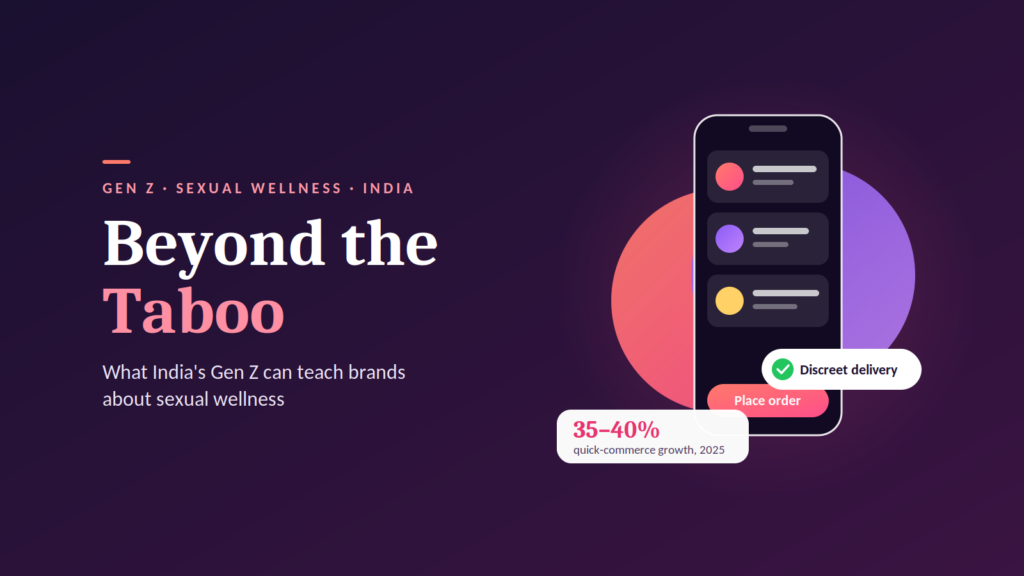
From discreet digital purchases to changing conversations around pleasure, India’s sexual wellness market is evolving. But how much of this shift is being driven by Gen Z—and what should brands understand about the young consumers they want to reach?
For a category long associated with hushed conversations at pharmacy counters, sexual wellness is finding a new place in India’s consumer economy: alongside everyday essentials in digital shopping carts.
Condoms, lubricants and other intimacy products are increasingly available through e-commerce and quick-commerce platforms. Brands are expanding their digital presence, experimenting with product formats and making privacy a central part of the shopping experience.
The shift is commercially significant. But it raises a more interesting question for marketers: are Indian consumers simply finding it easier to purchase products they previously bought discreetly, or are attitudes towards sexual wellness themselves changing?
For India’s Gen Z, now entering adulthood and beginning to make independent purchasing decisions, the distinction matters.
The available evidence suggests that sexual wellness is becoming a more visible consumer category. Yet the evidence does not establish that Gen Z alone is driving this transformation. Understanding what is changing—and what remains difficult to measure—is essential for brands seeking to connect with young Indian consumers.
What the MyMuse research reveals
One of the useful starting points is Laid in India, the sexual wellness report released by MyMuse in 2025.
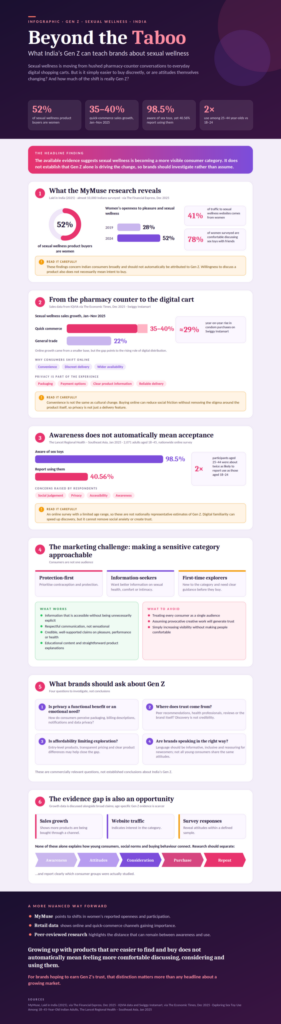
According to findings reported by The Financial Express, the study surveyed almost 10,000 Indians and examined attitudes towards pleasure and sexual wellness. Among its reported findings, women accounted for 52% of sexual wellness product buyers and 41% of traffic to sexual wellness websites. The report also indicated that women’s openness towards pleasure and sexual wellness had increased from 28% in 2019 to 52% in 2024. Additionally, 78% of women surveyed said they were comfortable discussing sex toys with friends. Source: The Financial Express, December 2025.
These findings offer an important indication of how conversations and purchasing behaviour in the category may be changing.
However, they need to be interpreted carefully. The published findings cited here concern Indian consumers broadly; they should not automatically be attributed to Gen Z. Nor does greater willingness to discuss a product necessarily translate into an intention to buy it.
For marketers, this distinction is the starting point for a more meaningful investigation.
The opportunity is not simply to establish that consumers are talking more openly about sexual wellness. It is to understand how awareness, comfort, trust and access translate into consumer behaviour.
From the pharmacy counter to the digital cart
One of the clearest developments in the category is the changing purchase experience.
A December 2025 report by The Economic Times, citing IQVIA data, found that sales of sexual wellness products on quick-commerce platforms grew by 35–40% between January and November 2025, compared with 22% in general trade. The online growth rate came from a smaller base, but the difference points to the growing importance of digital distribution.
Swiggy Instamart also reported that condom purchases on its platform had increased by nearly 29% year-on-year. The report identified convenience, discreet delivery and wider product availability as important factors in the shift. Source: The Economic Times, December 2025.
For a digitally accustomed generation, the appeal of online shopping is easy to understand. A consumer can explore product descriptions, compare options and complete a purchase without having to ask questions at a physical counter.
But there is an important distinction between convenience and cultural change.
A consumer who purchases a product online rather than at a pharmacy may not necessarily feel more comfortable discussing it with friends or family. Digital channels can reduce the social friction associated with purchasing a sensitive product without eliminating the stigma surrounding the product itself.
For brands, this suggests that privacy is not merely a delivery feature. It can be an integral part of the consumer experience.
Packaging, payment options, the clarity of product information and the reliability of delivery can all influence whether a consumer feels comfortable completing a purchase.
Awareness does not automatically mean acceptance
A peer-reviewed study published in The Lancet Regional Health – Southeast Asia in January 2025 offers a useful counterpoint to the narrative of growing openness.
The research, titled Exploring Sex Toy Use Among 18–45-Year-Old Indian Adults: Insights from a Nationwide Online Survey, examined awareness and reported use of sex toys among Indian adults.
Of the 2,071 participants, 98.5% reported awareness of sex toys, while 40.56% reported using them. The study found that participants aged 25–44 were about twice as likely to report use as those aged 18–24. Respondents also identified social judgement, privacy, accessibility and awareness as relevant concerns. Read the study.
The findings must be interpreted in the context of the study’s online survey methodology and age range. They are not nationally representative estimates of Gen Z behaviour.
Nevertheless, the age difference is worth examining. Familiarity with a product does not necessarily translate into usage, and younger adults may face different financial, social or practical barriers from older consumers.
For brands, this challenges a common assumption: that a digitally connected generation will automatically be more willing to explore every category available online.
Digital familiarity can accelerate product discovery. It cannot, by itself, remove social anxieties or establish consumer trust.
The marketing challenge: making a sensitive category approachable
Sexual wellness brands operate in a distinctive communications environment. They must make products discoverable and explain their benefits while navigating consumer sensitivities and restrictions on advertising.
Industry executives quoted in The Financial Express‘s December 2025 coverage described digital-first communication, influencer-led content and discreet purchasing as important elements of the category’s development. The same report highlighted the growing role of quick commerce in product sales.
For marketers, the challenge is to build a brand without making consumers uncomfortable.
This requires a different approach from simply increasing visibility. Product information must be accessible without being unnecessarily explicit. Communication must be respectful rather than sensational. And claims about pleasure, performance or health must be credible and appropriately supported.
There is also an opportunity to distinguish between different consumer needs.
Some consumers may prioritise contraception and protection. Others may seek better information about sexual health, comfort or intimacy. Still others may be exploring unfamiliar product categories and need clear guidance before making a purchase.
Treating all these consumers as a single audience risks overlooking the different motivations and concerns that influence their decisions.
For brands seeking to reach young adults, educational content and straightforward product explanations may be more useful than assuming that provocative creative work will generate trust.
What brands should understand about Gen Z
The evidence available today points towards several questions that sexual wellness marketers should investigate rather than assume.
1. Is privacy a functional benefit or an emotional need?
Discreet delivery can remove a practical barrier to purchasing. But brands should also understand how consumers perceive packaging, billing descriptions, notifications and data privacy. These details can influence confidence in a sensitive transaction.
2. Where does trust come from?
Social media, creators and online reviews can help consumers discover products. Yet discovery is not the same as credibility. Brands need to understand when consumers rely on peer recommendations, professional health information, product reviews or direct brand communication.
3. Is affordability limiting exploration?
A consumer may be aware of a product and curious about trying it but unwilling or unable to pay for it. Entry-level products, transparent pricing and clear explanations of product differences may help brands address this gap without relying on assumptions about purchasing power.
4. Are brands speaking to consumers in the right way?
Communication that works for an established customer may not work for someone encountering the category for the first time. Brands need to consider whether their language is informative, inclusive and reassuring, rather than assuming that all young consumers share the same attitudes.
These are not established conclusions about India’s Gen Z. They are commercially relevant questions emerging from the combination of existing consumer research and the changing retail environment.
The evidence gap is also an opportunity
There is a limitation in the current conversation about India’s sexual wellness market: evidence of category growth is often discussed alongside broad claims about changing social attitudes, while age-specific evidence about Gen Z remains less readily available.
Sales growth can establish that more products are being purchased through a particular channel. Website traffic can indicate interest. Survey responses can reveal attitudes within a defined sample. None of these measures, on its own, explains the complete relationship between young consumers, social norms and purchasing behaviour.
For marketers, that gap matters.
A brand may be able to reach a young adult through a quick-commerce platform, but that does not tell it what prompted the purchase, what concerns the consumer had beforehand or what would encourage a repeat purchase.
Similarly, a consumer’s willingness to discuss sexual wellness in an anonymous survey may differ from their willingness to discuss it publicly.
Understanding these differences requires research that separates awareness, attitudes, consideration, purchase and repeat behaviour—and reports clearly which consumer groups were actually studied.
A more nuanced way forward
India’s sexual wellness market is changing in ways that are commercially meaningful. MyMuse’s published findings suggest shifts in women’s reported openness and participation in the category. Retail reporting indicates that online and quick-commerce channels are becoming increasingly important. Peer-reviewed research, meanwhile, highlights the distance that can remain between awareness and use.
Taken together, these findings offer a more nuanced picture than the idea of a straightforward sexual wellness revolution.
For brands, the opportunity is to make products easier to discover, understand and purchase while respecting the concerns that make the category sensitive in the first place.
For those targeting Gen Z, the next step is more specific: establish what is genuinely different about young adult consumers, rather than treating broader market trends as proof of generational change.
India’s younger consumers may be growing up in a world where sexual wellness products are easier to find and buy. Whether that also means they feel more comfortable discussing, considering and using them is a question that deserves better evidence.
And for brands hoping to earn their trust, that distinction may be more important than any headline about a growing market.