Gaming was once treated as an awareness channel. But conversations with 200+ Indian Gen Z students, alongside emerging global research, suggest something more interesting: when brands become part of the gaming experience rather than interrupt it, gaming can influence what young consumers engage with, explore — and buy.
For years, brands entered gaming with a fairly simple objective: get noticed.
Put the brand inside a game. Sponsor a tournament. Build an in-game experience. Run an advertisement between levels.
Gaming was another place where brands could reach young people — particularly an audience that was becoming increasingly difficult to reach through traditional media.
But the relationship between gaming and brands is changing.
The question is no longer simply whether a gamer sees a brand.
It is whether they experience it.
And increasingly, whether that experience can influence what they eventually buy.
When we spoke to more than 200 Gen Z students in India about gaming, brands and the way they discover things, the conversation pointed towards the same broader shift emerging in global research: young consumers don’t necessarily experience gaming, content and commerce as separate worlds.
They move between them.
They discover something while playing. They search for it later. They discuss it with friends. They encounter it again on social media. And sometimes, the journey ends with a purchase.
Gaming isn’t merely an awareness medium. A gaming experience can trigger a transaction.
From the advertisement to the experience
Traditional advertising has largely worked on interruption.
A consumer is watching something — the brand appears.
A consumer is reading something — the brand appears.
A consumer is playing a game — the brand appears.
But gaming is different because the consumer isn’t merely consuming the environment.
They are participating in it.
That distinction matters.
A logo placed on a virtual billboard is still an advertisement.
But a branded object that a player can use, a virtual product they can customise, a reward they can earn, a world they can explore or an experience they can share with friends begins to behave differently.
The brand is no longer sitting outside the experience asking for attention.
It becomes part of the experience itself.
And Gen Z, having grown up moving fluidly between physical and digital environments, is increasingly comfortable with this overlap.
Our conversations with 200+ Gen Z students suggest that what matters is not necessarily whether a brand enters gaming, but how it enters.
If it feels like an interruption, it can be ignored.
If it feels native to the experience, it has a chance to become memorable.
That distinction is supported by recent research from Deloitte and Google AdMob. Their global study of 7,000 gamers found that high-quality advertising experiences were associated with stronger engagement, retention and purchase behaviour. Among the heavy gamers surveyed, positive ad experiences were associated with a two-to-three-times greater likelihood of extending sessions and making purchases.
The message is fairly simple:
Don’t interrupt the game. Give the player a reason to engage.
The new consumer journey may begin inside a game
For a long time, marketers imagined the purchase funnel as something relatively linear:
Awareness → Consideration → Purchase
Gaming introduces another possibility:
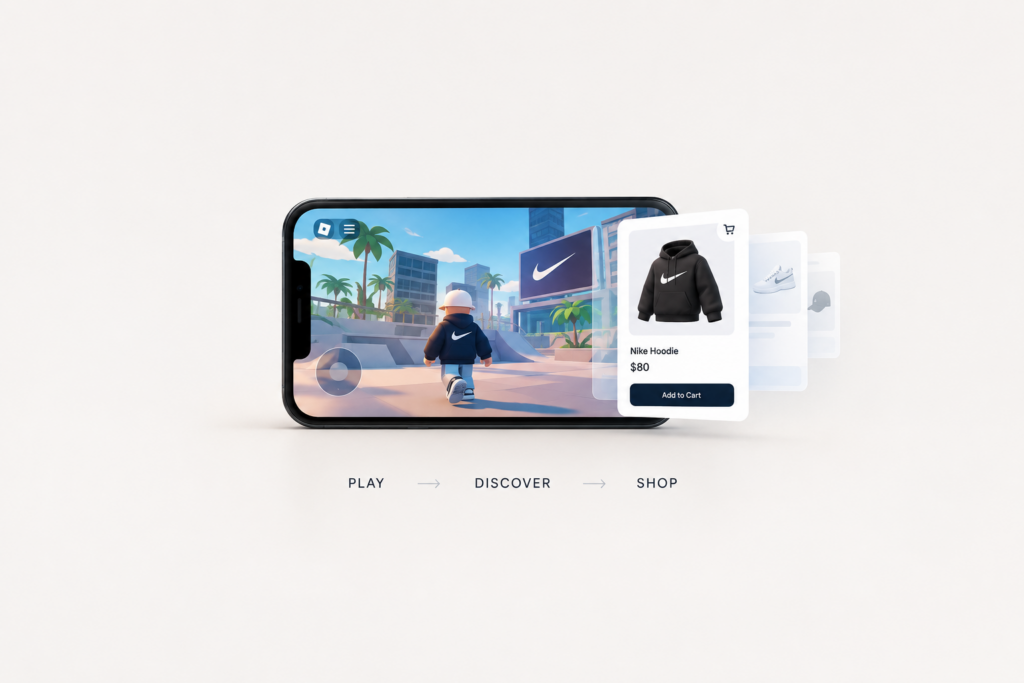
Play → Discover → Experience → Desire → Purchase
That difference is important.
Because a game can give consumers something conventional advertising often cannot: a chance to interact with an idea before buying into it.
Consider fashion.
A consumer doesn’t just see a jacket on an advertisement. In a virtual environment, they can potentially put something similar on their avatar.
They can see how it looks.
They can express themselves through it.
Their friends can see it.
And suddenly, a product that existed as an advertisement becomes part of their digital identity.
Research from Roblox illustrates this emerging relationship between digital and physical consumption. In its 2025 research, 69% of Gen Z Roblox users surveyed said digital trends influence their physical purchasing decisions, while 88% said they use digital fashion as a preview before buying physical clothing. Sixty-four percent said they were extremely or very likely to consider a brand in the physical world after wearing it virtually.
That is a very different proposition from simply placing a logo inside a game.
The virtual experience can become part of the consideration process.
The physical world isn’t disappearing. It’s being influenced by the digital one.
There is sometimes a tendency to frame this conversation as physical versus digital.
But Gen Z doesn’t necessarily see it that way.
For them, the two increasingly coexist.
A digital outfit can influence physical style.
A creator can influence an offline purchase.
A game can introduce a brand.
A social post can reinforce it.
A review can validate it.
And a physical product can eventually find its way back into the digital world.
Roblox’s research found that 84% of surveyed users said their physical style is influenced by their digital self, while 87% said experimenting with avatar style made them more comfortable expressing themselves offline.
Earlier Roblox research similarly found that 84% of surveyed Gen Z users who were active on the platform said they would be at least somewhat likely to consider a brand in the physical world after wearing or trying its item virtually.
The interesting part isn’t the virtual clothing itself.
It is the direction of influence.
For years, marketers assumed the physical world would influence what happened online.
Increasingly, influence is moving in both directions.
Gaming is also becoming social commerce
Shopping has traditionally been thought of as an individual act.
But Gen Z’s shopping journey is increasingly social.
Friends recommend products.
Creators demonstrate them.
Communities discuss them.
Reviews validate them.
And gaming can bring all of these behaviours into the same environment.
A player isn’t necessarily playing alone anymore. They are playing with friends, talking through chat, watching others play, following gaming creators and participating in communities around the games they love.
That makes gaming particularly interesting for brands.
Because the most powerful product recommendation may not come from an advertisement.
It may come from another player.
A digital product that makes someone stand out.
A branded object that becomes desirable inside a game.
A reward that friends notice.
A virtual experience worth sharing.
The transaction may happen later, somewhere else.
But the desire can begin inside the game.
And this is where brands need to be careful
There is a temptation for marketers to hear all this and conclude:
“Great. Let’s put more ads inside games.”
That may be precisely the wrong lesson.
Deloitte’s research found that disruptive advertising can have the opposite effect. One in five gamers surveyed said they would abandon a game because of poor-quality ad experiences, while disruptive features were associated with increased churn.
In other words, gaming does not automatically make advertising more effective.
Context does.
The player has entered the game for an experience.
A brand that improves that experience has an opportunity.
A brand that gets in the way of it risks becoming part of the problem.
This is perhaps one of the most important lessons for marketers looking at Gen Z.
They don’t necessarily reject brands.
They reject irrelevant brand behaviour.
The next opportunity isn’t advertising in games. It’s building for games.
This could eventually change the question brands ask.
Instead of:
“How can we advertise to gamers?”
The question could become:
“What can our brand enable gamers to do?”
For a fashion brand, perhaps it is digital expression.
For a food brand, perhaps it is a reward or social experience.
For a technology brand, perhaps it is utility inside the game.
For an entertainment brand, perhaps it is a new world or character.
For a consumer brand, perhaps it is simply creating something players actually want to interact with.
The distinction sounds subtle.
It isn’t.
One approach treats gaming as media.
The other treats gaming as a consumer environment.
And those are two very different opportunities.
India’s Gen Z could make this even more interesting
India brings another dimension to the conversation.
Gaming is increasingly embedded in everyday digital behaviour among young Indians, particularly through smartphones. Our own earlier YouthTalks gaming pulse found that 89% of respondents played on smartphones and 64% reported playing every day, illustrating how deeply gaming can fit into the daily digital routine of young Indians.
That doesn’t automatically mean Indian Gen Z will spend heavily inside games.
In fact, our earlier research showed a significant gap between engagement and spending.
And that gap may actually be where the bigger opportunity lies.
Because commerce doesn’t begin with spending.
It begins with discovery.
A young consumer doesn’t have to immediately purchase a virtual item for a gaming experience to influence their eventual behaviour.
They may remember the brand.
Search for it.
Talk about it.
Follow it.
Try it later.
Or recognise it when they encounter it somewhere else.
The transaction can happen outside the game.
The influence may have started inside it.
From attention to action
For decades, brands have competed for attention.
But attention alone is becoming an increasingly fragile currency.
Gen Z moves between platforms, creators, communities, games and social feeds almost effortlessly.
The more interesting question is therefore not:
Where can brands get Gen Z’s attention?
It is:
What can brands do with that attention once they have it?
Gaming offers one possible answer.
It can turn attention into interaction.
Interaction into experience.
Experience into desire.
And, potentially, desire into purchase.
That is why gaming deserves to be looked at differently.
Not simply as another media channel.
Not simply as another place to advertise.
And certainly not simply as something young people do for entertainment.
It is becoming part of how a generation discovers, experiences and expresses brands.
The consumer journey may no longer begin when someone walks into a store, opens an app or searches Google.
Sometimes, it may begin when they enter a game.
They may not think they are shopping.
They may simply be playing.
But if the right brand becomes part of that experience, something interesting can happen.
The game ends.
The experience stays.
And somewhere outside the game, the shopping journey may just have begun.