
Beyond attraction and chemistry, young Indians may be looking for something more from relationships: emotional security, shared ambition and a partner who makes the future seem more achievable. Is the idea of growing together becoming the new definition of love?
For a generation that has grown up hearing about situationships, ghosting, dating fatigue and the pressure to find the perfect match, Gen Z’s relationship expectations may be entering an interesting new phase.
The search for a romantic partner is increasingly being discussed in terms that go beyond attraction, chemistry or even compatibility. Young daters are beginning to consider another question: Can this person help me become the person I want to be?
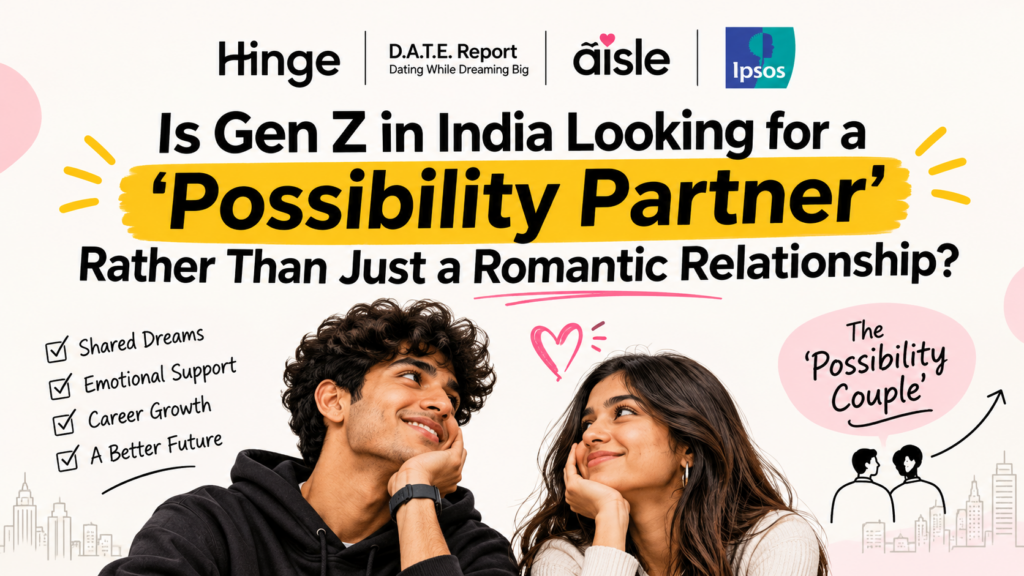
A recent report by dating platform Hinge has given this idea a name: the ‘possibility couple’.
According to Hinge’s latest D.A.T.E. (Data, Advice, Trends and Expertise) Report, titled Dating While Dreaming Big, 76% of Gen Z respondents imagine the person they want to become alongside their ideal partner. Another 67% prefer a partner who makes them feel hopeful and inspired.
The July 2026 survey, which covered more than 13,000 people globally, including Gen Z and millennial daters, suggests that young people are increasingly viewing relationships as part of their personal growth and future aspirations.
Only 7% of Gen Z respondents believed they would achieve their life goals entirely on their own.
Hinge describes a ‘possibility couple’ as a relationship in which being together makes both individuals feel more hopeful about what lies ahead.
While the findings are global rather than India-specific, they raise an interesting question for the Indian dating landscape: Is Gen Z beginning to look for a partner who can grow alongside them, rather than someone who simply fits their idea of romance?
Indian Gen Z appears to be taking relationships more seriously
The Indian context offers some interesting evidence.
A September 2026 Human Connection Survey commissioned by Match Group and conducted by Ipsos among 1,000 Indian singles aged 18–45 found that 85% were looking for a long-term relationship. Among Gen Z respondents, the figure increased to 89%.
The findings also suggest that young Indians are becoming more selective about whom they date.
Around 72% of respondents said they would only date someone with whom they could see a long-term future, while 63% said they would rather continue looking than settle for an imperfect match.
The findings challenge the popular assumption that Gen Z is primarily interested in casual relationships or short-term dating.
For many young Indians, the objective may still be a meaningful relationship, but the expectations attached to that relationship are changing.
The idea of finding someone simply because two people are attracted to each other may no longer be enough. Shared values, emotional availability, life ambitions and the ability to understand each other’s priorities appear to be becoming increasingly important considerations.
This does not necessarily mean that every young Indian is looking for a relationship that leads to marriage. Rather, it suggests that even when commitment is not immediate, the possibility of a meaningful future matters.
Love is increasingly being associated with personal growth
There is another interesting dimension to this shift.
An Aisle Network report, Better Because of Love, based on responses from 5,868 Indians, including 43% Gen Z respondents, found that 84% believed love had made them better people.
Among respondents, 63.6% associated love with becoming more patient, 49.1% with becoming better communicators and 44.2% with becoming more confident.
These findings suggest that relationships are increasingly being evaluated not just by how they make people feel in the moment, but also by how they influence their emotional development.
For young people navigating college, early careers, financial uncertainty and changing personal aspirations, a supportive relationship could represent an important source of stability.
A partner who encourages someone to pursue a difficult career opportunity, supports their decision to study further, understands their financial ambitions or simply provides emotional reassurance during a difficult period can become an important part of their personal journey.
The possibility couple, therefore, is not necessarily about two high-achieving individuals building a successful life together.
It could be about two people creating an environment in which neither feels the need to compromise their individual ambitions to sustain the relationship.
The Indian Gen Z dilemma: Wanting a relationship but fearing the wrong choice
However, the growing emphasis on finding the right partner comes with its own complications.
The same Match Group-Ipsos research found that 35% of Indian singles feel lonely often or always. Meanwhile, 58% said they feel connected to people online but lonely in real life.
The contradiction is particularly interesting for a generation that has more opportunities to meet people through dating applications, social media and digital communities than previous generations.
More choices do not automatically translate into better connections.
In fact, the pressure to find someone compatible with one’s future ambitions could make dating more complicated.
The possibility of a better match is always around the corner. A person might be emotionally compatible but have different career priorities. Another might share similar ambitions but struggle with communication. Someone else might offer stability but not necessarily inspire personal growth.
The question then becomes: How much compatibility is enough?
The pressure to find the right person also connects with findings from TheYouthTalks’ own March 2026 survey of 100 Gen Z respondents aged 18–27.
The survey found that 84% expressed some level of fear about marriage, even though 72% wanted to get married someday.
For 42%, choosing the wrong partner was their biggest fear. Another 21% identified losing their freedom or independence as their primary concern.
The findings suggest that young Indians are not necessarily rejecting long-term relationships. They are increasingly conscious of the consequences of choosing the wrong one.
This is where the idea of a possibility partner becomes particularly relevant. A relationship is expected to provide companionship without restricting individuality, and stability without limiting personal ambitions.
Is the perfect partner becoming another Gen Z pressure?
There is, however, a potential downside to this new relationship expectation.
When young people begin looking at a partner as someone who should support their emotional wellbeing, understand their ambitions, share their values and contribute to their ideal future, the expectations can become overwhelming.
Hinge’s report highlights this contradiction.
Nearly 60% of Gen Z respondents said dating outside their ideal preferences felt risky, while 44% felt that doing so would amount to lowering their standards.
This raises an important question: Has the search for a meaningful relationship also become a search for perfection?
There is a difference between knowing what matters in a relationship and expecting another person to meet every expectation.
A partner may not have the same career ambitions, financial circumstances or timeline for achieving personal goals. They may bring different experiences and perspectives to a relationship.
And that does not necessarily make the relationship less valuable.
As Moe Ari Brown, Hinge’s love and connection expert, suggests in the report, leaving room for the person in front of you can reveal possibilities that a predetermined checklist might miss.
For Gen Z, this distinction could become increasingly important.
The right partner may not necessarily be the person who matches every item on a dating checklist. It could be someone with whom two people can negotiate differences, support each other’s aspirations and develop a shared understanding of the future.
What does a possibility couple look like in India?
The concept also takes on a slightly different meaning in the Indian context.
Young Indians are navigating a combination of traditional family expectations and increasingly individual definitions of success.
For some, a supportive partner could mean someone who respects their decision to pursue a career in another city or country. For others, it could mean having the freedom to build a business, pursue further education or delay marriage without feeling pressured.
For young women, it could mean finding a partner who supports professional independence and shares domestic responsibilities.
For young men, it could mean having a relationship in which emotional vulnerability is accepted rather than judged.
The idea is not necessarily about finding a power couple in the conventional sense, where both partners have impressive careers, financial success or social standing.
It is about finding someone who makes personal growth feel possible.
Research published in July 2026 by Youth Ki Awaaz and Rohini Nilekani Philanthropies, based on 3,072 young Indians, offers another perspective on the emotional side of relationships.
Two in three respondents said they felt lonely in a relationship or situationship. The findings suggest that simply being in a relationship does not guarantee emotional connection.
This distinction is important.
A possibility couple cannot simply be defined by two people having similar ambitions or being in a relationship. The emotional environment they create together matters just as much.
Is this the next chapter of Gen Z dating?
The idea of a possibility couple may be new, but the underlying expectation is not entirely unfamiliar.
Previous generations also wanted supportive partners, shared aspirations and stable relationships. What may be changing is the extent to which young people are openly discussing these expectations and treating them as essential parts of partner selection.
For Gen Z, relationships are unfolding alongside career uncertainty, rising living costs, changing gender roles and greater conversations around emotional wellbeing.
A partner is increasingly expected to understand these realities rather than exist separately from them.
Yet there is an important distinction between expecting someone to support your future and expecting them to be responsible for making it happen.
A healthy relationship should provide encouragement, not become a substitute for individual ambition or personal responsibility.
Perhaps that is the real opportunity behind the possibility couple.
It is not about finding someone who has everything figured out. It is about finding someone with whom the uncertainties of the future feel easier to navigate.
For Indian Gen Z, the question may no longer be simply whether someone is attractive, interesting or compatible.
It could increasingly be whether life feels more hopeful with that person in it.
And that might be a more meaningful way of thinking about love.