


For many Indian students, going to bed is not simply the end of the day.
It can feel like giving up time that could have been used to study.
One more chapter. One more assignment. One more coding problem. One more mock test. One more hour preparing for placements.
Sleep may be necessary, but in a culture built around academic performance and constant productivity, it can sometimes feel like something that has to be earned.
New research by TheYouthTalks and Happy Heart & Soul suggests that this mindset may be an important part of understanding why students struggle to switch off at night.
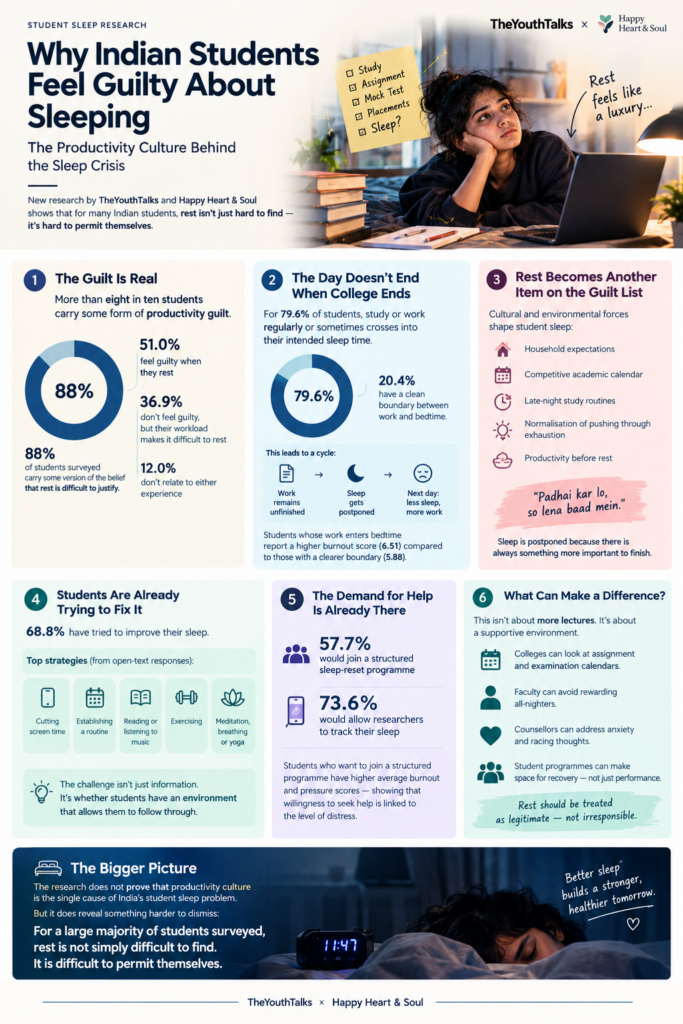
More than eight in ten students carry some form of productivity guilt
When students were asked about resting, 51.0% said they feel guilty when they rest, while another 36.9% said that they do not exactly feel guilty, but their workload makes it difficult to rest.
Only around 12% said they did not relate to either experience.
In other words, 88% of students surveyed carry some version of the belief that rest is difficult to justify.
That is a striking finding because it changes the nature of the sleep conversation.
If a student believes every hour not spent studying is an hour wasted, telling them to simply “sleep more” does not address the belief underneath the behaviour.
The day doesn’t always end when college ends
The research found that 79.6% of students said their study or work regularly or sometimes crosses into their intended sleep time.
Only 20.4% reported having a clean boundary between work and bedtime.
That creates a familiar student cycle.
The day runs late.
Work remains unfinished.
Sleep gets postponed.
The student eventually goes to bed physically tired but mentally occupied.
And the next morning begins with less sleep — followed by another day in which there is even more work to complete.
The research found a relationship between work crossing into bedtime and burnout: students whose work regularly or sometimes entered their bedtime reported a burnout score of 6.51, compared with 5.88 among those who maintained a clearer boundary.
The study does not establish that blurred boundaries cause burnout. It is a cross-sectional survey, so the relationship could work in multiple directions.
But it does show that the two problems are appearing together.
“Rest” becomes another item on the guilt list
This is where the Indian context matters.
The report identifies several cultural and environmental forces that can shape student sleep: household expectations, the competitive academic calendar, late-night study routines, the normalisation of pushing through exhaustion and the idea that productivity should come before rest.
There is also a familiar message many students encounter while growing up:
“Padhai kar lo, so lena baad mein.”
Sleep is postponed because there is always something more important to finish first.
For students preparing for competitive examinations or placements, the logic can become particularly difficult to escape.
There is always another test.
Another skill to learn.
Another project to complete.
Another interview to prepare for.
Another student who appears to be doing more.
The result can be a strange contradiction: students know sleep matters, but their daily environment keeps teaching them that productive students should be able to sacrifice it.
And students are already trying to fix the problem
This is not a population that is unaware of sleep hygiene.
68.8% of students had tried to improve their sleep.
Among substantive open-text responses, the most common strategies included cutting screen time, establishing a routine, reading or listening to music, exercising, and meditation, breathing exercises or yoga.
Yet the report argues that the issue may be less about information and more about support.
Students already know many of the things they are supposed to do.
The harder question is whether they have an environment that allows them to do them consistently.
A student can put the phone away at 11 PM.
But what happens when an assignment is unfinished?
A student can decide to sleep at midnight.
But what happens when tomorrow’s placement preparation still needs two hours?
A student can schedule rest.
But what happens when resting produces guilt?
The demand for help is already there
Perhaps the most encouraging finding is that students are not rejecting intervention.
57.7% said they would join a structured sleep-reset programme, while 73.6% said they would allow researchers to track their sleep.
The report also found that students who wanted to join a structured sleep programme had higher average burnout and pressure scores than those who did not — suggesting that willingness to seek help is itself connected with the level of distress students are experiencing.
That points towards a different kind of intervention.
Not another lecture telling students to sleep eight hours.
Not another poster about putting phones away.
But an environment in which rest is treated as legitimate rather than irresponsible.
Colleges could examine assignment and examination calendars. Faculty could avoid creating an implicit reward system for all-nighters. Counsellors could address the anxiety and racing thoughts that follow students into bed. And student programmes could make space for recovery rather than treating it as an obstacle to performance.
Because if students are taught that success means constantly doing more, then sleep will always be competing with success.
Perhaps the first step in fixing student sleep is therefore not teaching young people how to sleep.
It is teaching them that they do not have to feel guilty for doing it.
The research does not prove that productivity culture is the single cause of India’s student sleep problem.
But it does reveal something harder to dismiss:
For a large majority of students surveyed, rest is not simply difficult to find. It is difficult to permit themselves.