

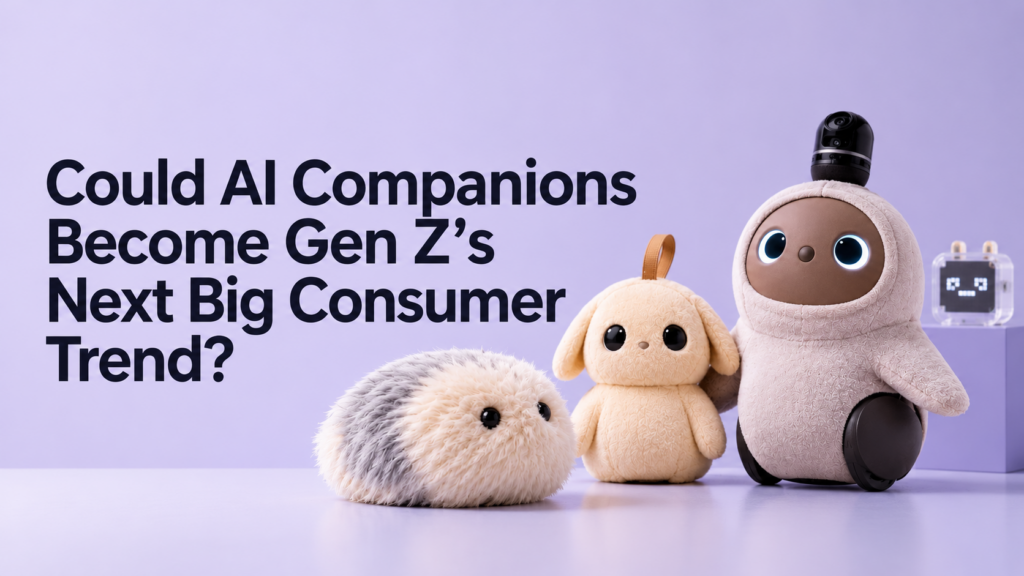
From fluffy robots that respond to touch to virtual pets that develop personalities, a new generation of AI-powered companions is changing how consumers think about comfort, connection and technology. Could emotional companionship become the next big consumer category?
A small, fluffy creature sits on someone’s desk. It has no conventional purpose. It cannot make coffee, answer emails or help with homework. It does not even look particularly intelligent. Yet, when its owner speaks, it responds. When touched, it reacts. Over time, it begins to develop behavioural patterns that make the interaction feel increasingly personal.
It is not a conventional pet. It is not quite a toy either. It is an AI-powered robotic companion.
Meet Moflin, a furry companion developed by Japanese electronics company Casio. Designed to respond to touch, sound and its owner’s voice, Moflin is built around the idea that a machine can offer something beyond utility: a sense of emotional connection.
Another example is Mirumi, developed by Japanese robotics company Yukai Engineering. Designed to attach to handbags, the small robotic creature turns its head and responds to movement and sounds around it, creating moments of spontaneous interaction.
These products may appear unusual, even whimsical. But they point towards a more interesting development in consumer technology. Artificial intelligence is beginning to enter a space traditionally occupied by pets, toys and human relationships: companionship.
And as Gen Z grows up in a world where digital interaction is already part of everyday life, an important question emerges: could AI-powered companions become the next big consumer category?
From smart devices to emotional companions
For years, technology companies competed on functionality. Smartphones became smarter, applications became more personalised and digital assistants learned to respond to increasingly complex instructions.
The arrival of generative AI has changed that relationship. Consumers are no longer interacting with technology only to retrieve information or complete tasks. They are increasingly using conversational AI to discuss personal concerns, seek reassurance, explore ideas and simply have someone—or something—to talk to.
AI companions represent the next step in this evolution.
Unlike conventional digital assistants, which are primarily designed to perform tasks, companion technologies are built to encourage ongoing interaction. They may remember preferences, respond to emotional cues, develop distinct personalities or simulate affection.
Robotic pets take this idea a step further by giving the interaction a physical presence. A user can hold one, touch it, carry it around or place it beside their bed. The experience becomes more tangible than chatting with an application on a screen.
The distinction matters. A virtual pet offers a digital experience, an AI chatbot offers conversation, while a physical robotic companion attempts to combine interaction with the familiarity of a physical object.
The technology may still be developing, but the underlying proposition is clear: consumers could increasingly pay for products that make them feel something, rather than simply products that do something.
Why might Gen Z find this appealing?
It would be simplistic to suggest that young people are replacing human relationships with robots. There is little evidence to support such a sweeping conclusion.
However, Gen Z’s relationship with technology, social interaction and emotional well-being offers an interesting context for the emergence of AI companions.
Today’s young consumers have grown up with smartphones, social media, online communities and increasingly sophisticated digital experiences. They are comfortable interacting with virtual identities and AI-powered services. For some, talking to an AI companion may feel less unfamiliar than it would to an older generation.
There is also the appeal of interaction without the perceived pressure of human judgement.
A robotic companion does not demand a social performance, expect an immediate response to a message or introduce the complexities that can accompany friendships and relationships. It can be available when someone wants a moment of distraction or interaction.
For young adults navigating academic pressure, early careers, changing relationships and periods of living independently, the idea of a low-maintenance companion may have appeal.
But this should not be confused with evidence that AI companions can resolve loneliness or improve mental health. They may provide moments of comfort or entertainment, but the extent of their emotional benefits remains an open question.
The attraction may be less about replacing people and more about having another form of interaction available when human company is not immediately accessible.
Japan is already experimenting with the idea
Japan offers some of the most interesting examples of this emerging category.
Casio’s Moflin is designed to develop an individual personality through repeated interactions. Its responses can change over time, making the experience feel less like operating a gadget and more like building familiarity with a companion.
The company has positioned it around emotional comfort. The Daily Mail has reported that Casio sold more than 10,000 Moflin units globally and that a significant proportion of Japanese buyers cited healing and comfort as their motivation for purchasing it.
Yukai Engineering’s Mirumi takes a different approach. It is a small, expressive robotic creature that attaches to a bag and reacts to its surroundings. Its appeal lies partly in its ability to surprise people and create playful interactions in everyday settings.
Then there is LOVOT, another Japanese robotic companion designed around warmth, touch and emotional interaction.
These products are not necessarily competing with smartphones or conventional smart-home devices. They are attempting to create a category of their own, where personality, appearance and emotional engagement are central to the value proposition.
For brands, this represents a potentially important shift. A product does not always need to solve a practical problem to find a market. Sometimes, the experience it creates is the product.
Is India ready for AI companions?
India’s relationship with AI companionship is still evolving, and it is important to distinguish between interest in virtual companions and demand for physical robotic pets.
A January 2026 Mint report, titled Would You Raise an AI Pet? India’s New Digital Companions Are Here, explored the emergence of AI-powered companions in the country. It discussed virtual pets, AI personalities and the growing ecosystem of digital companionship.
The report cited an Indian AI companion market valued at more than $150 million, although this broader category includes virtual humans and companion applications, not just robotic pets.
It also highlighted an example of a Mumbai mother and daughter sharing the experience of raising a virtual pet.
This is an important starting point, but it does not establish that India already has a substantial market for physical AI pets like Moflin. That market remains to be tested.
Nevertheless, India’s large young, digitally connected population offers an interesting potential audience. The country’s familiarity with mobile applications, gaming, social platforms and AI tools could make digital companionship an accessible concept for many young consumers.
The more difficult question is whether Indian consumers would pay a meaningful premium for a physical companion robot.
A product that attracts attention on social media may not necessarily become a purchase. Price, availability, reliability, language support and the quality of interaction will all influence adoption.
For a market as price-conscious as India, the difference between a fascinating technology demonstration and a commercially successful consumer product could be significant.
The business of selling emotional experiences
Perhaps the most interesting aspect of this trend is what it tells us about the changing nature of consumer demand.
For decades, toy companies largely sold entertainment, imagination and play. Technology companies sold convenience, connectivity and productivity. The emergence of AI companions brings these worlds together.
Consider the evolution of products that have created emotional connections with consumers.
Collectible toys such as Labubu have demonstrated how personality, scarcity and social identity can turn a relatively simple object into a cultural phenomenon. Plush toy brands such as Jellycat have built strong appeal around comfort, character and collectibility. Virtual pets have made interaction and nurturing part of the digital experience.
AI companions add another dimension: responsiveness.
A toy that simply sits on a shelf can be admired. A toy that responds to its owner can become part of a routine. A companion that remembers interactions and changes its behaviour over time may create an even stronger sense of attachment.
For marketers, this opens up several possibilities.
First, personalisation could become a differentiator. Products that respond differently to individual users may feel more distinctive than mass-produced toys.
Second, companionship could become a premium proposition. Consumers may be willing to pay more for products that offer ongoing interaction rather than a one-time entertainment experience.
Third, the category could expand beyond children. The appeal of robotic companions may extend to students, young professionals, collectors and adults who enjoy technology-led lifestyle products.
Finally, the business model could evolve. Beyond the initial purchase, companies may explore accessories, personalisation, software updates and new interaction experiences.
However, brands will need to be careful. Emotional connection is not the same as a novelty feature that can be switched on and off. The more a product encourages users to form attachments, the greater the responsibility to be transparent about what it is and how it works.
Can a robot really replace the comfort of a real pet?
This is where the conversation becomes more complicated.
For someone who cannot keep a real pet because of housing restrictions, travel, allergies or a demanding schedule, a robotic companion may offer an attractive alternative.
There is no feeding, walking, grooming or veterinary care. It does not require the same long-term commitment as an animal. For some consumers, that convenience may be precisely the point.
But a real pet offers something fundamentally different. Animals have needs, behaviours and personalities that exist independently of their owners. The relationship involves care, responsibility and an emotional connection that cannot simply be programmed into a device.
A robotic pet can simulate certain responses, but it does not experience affection or attachment in the human sense.
That distinction should not diminish the comfort someone might derive from interacting with one. It simply means that consumers should understand what they are buying.
The more sophisticated these products become, the more important it will be to communicate the limits of artificial companionship honestly.
The questions brands cannot afford to ignore
There are also privacy and ethical questions surrounding AI-powered companions.
Products that respond to voice, movement and touch may rely on microphones, sensors, connected applications and cloud-based processing. Consumers need to understand what information is collected, where it is stored and whether interactions are used to train AI systems.
Emotional attachment introduces another challenge. If a product is designed to encourage affection, how should companies communicate its limitations? What happens when a product stops receiving software support or a subscription ends? Should users be told clearly that its apparent emotional responses are generated by technology?
These questions become even more important when products are marketed to children.
The industry will need to balance innovation with responsible design. A product that promises comfort should not rely on misleading claims about its ability to understand or care for its owner.
For brands entering this category, trust may ultimately matter as much as technology.
Is companionship becoming the next frontier for consumer technology?
AI-powered robotic pets may still be a niche category, and it is too early to predict whether they will become mainstream purchases among India’s Gen Z.
But the broader direction is worth watching.
Technology has already changed how young people discover products, maintain friendships, consume entertainment and express their identities. AI companions suggest that the next phase could involve products designed not just to assist or entertain consumers, but to participate in their emotional lives.
For brands, this presents an unusual opportunity: to build products around comfort, connection and personal experiences.
For consumers, it raises a more fundamental question about what companionship means in an increasingly digital world.
Perhaps Gen Z is not looking to replace human relationships with robotic pets. Perhaps it is simply open to new forms of interaction that previous generations would have found difficult to imagine.
And as artificial intelligence becomes increasingly capable of simulating affection, the next big consumer technology opportunity may not be a device that makes us more productive.
It may be one that makes us feel a little less alone.