A meme starts as a Reel.
A dialogue becomes a caption. A viral character becomes a costume. A trending sound becomes a dance. And sometimes, an internet joke becomes a reason for a group of strangers to meet in the real world.
For Indian Gen Z, the boundary between what happens online and what happens offline is becoming increasingly difficult to see.
That is not because young people are abandoning the physical world for their screens. In some cases, the opposite may be happening.
The internet is increasingly giving them reasons to step outside it.
A meme can become a party. A viral character can become a dress code. A fandom can become a community. A Reel can inspire a college event. And an inside joke understood by thousands of strangers can become the basis for an evening spent together.
The meme is leaving the internet.
And Gen Z is taking it with them.
From scrolling to showing up
A recent example from Delhi captures this shift almost perfectly.
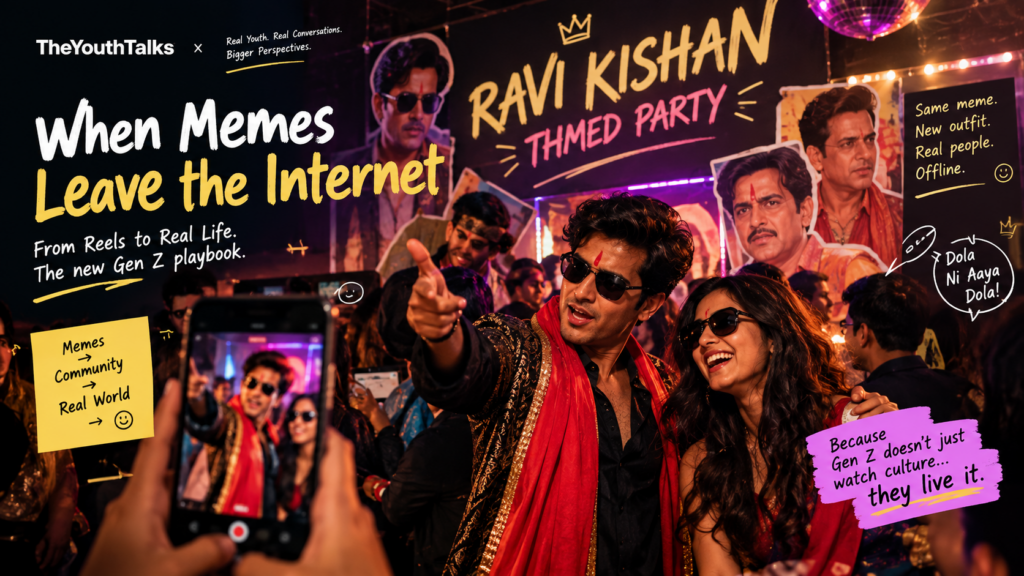
In September 2026, a group of Gen Z participants gathered at SOCIAL in Civil Lines for a Ravi Kishan-themed party. Ravi Kishan’s expressions, outfits, dance moves and dialogues had become recurring material for memes online. The organisers decided to take that internet fascination offline.
Guests arrived dressed as different viral versions of the actor. Some recreated his Gucci-inspired look; others channelled his viral “Dola Ni Aaya Dola” appearance. There were dance battles, dialogue challenges, photo opportunities and even fake Ravi Kishan currency hidden around the venue as part of a game.
The event was organised by Cinergy, a Delhi-based pop-culture community and experience platform. India Today reported that the event had nearly 80 registrations, while ThePrint reported that 77 people had registered, with additional guests on the list.
The interesting part was not simply that someone organised a themed party.
It was what the theme was.
There was no traditional movie release, concert or festival at the centre of the gathering. The cultural object bringing people together was essentially an internet meme.
Something people had encountered through their feeds had become a physical experience.
That transition tells us something important about the way Gen Z is consuming culture.
The old digital journey was:
See → Like → Share → Move on.
The emerging one can look more like:
See → Share → Identify → Find others who get it → Experience it offline → Share it again.
And suddenly, the meme has a life beyond the screen.
The meme is becoming a social handshake
Why would someone attend a party built around an internet meme?
The obvious answer is that it is funny.
But there is something deeper happening.
Shared internet culture gives strangers a common language.
You may not know the person standing next to you. You may come from a completely different college, neighbourhood or social circle. But if both of you recognise the same meme, understand the same reference or can finish the same viral dialogue, there is an instant point of connection.
It is almost a social handshake.
“You know this too?”
That question can be enough to start a conversation.
This matters particularly for a generation whose social lives are often distributed across multiple digital communities. College students may have friends from school, gaming communities, Instagram circles, Discord groups, fandoms and professional networks — many of whom may never meet each other offline.
Memes can provide common ground.
They compress an entire cultural reference into a few seconds.
A facial expression. A line of dialogue. A song. A screenshot. A strange piece of internet humour.
You either understand it or you don’t.
And when you do, you are suddenly part of the same conversation.
The meme, therefore, isn’t always the destination.
The connection is.
India doesn’t simply consume internet culture. It remixes it.
There is another reason this phenomenon becomes particularly interesting in India.
Indian Gen Z rarely consumes global internet culture exactly as it arrives.
It gets remixed.
A global meme becomes Hinglish. A Western fashion aesthetic gets paired with Indian clothing. An international audio trend gets used to describe a very specific college experience. A Hollywood moment gets combined with a Bollywood reference. A global internet joke gets translated into a distinctly Indian social context.
That process of remixing is becoming a defining characteristic of youth culture.
Instagram’s India Year in Review for 2025 highlighted exactly this crossover: Indian culture travelled outward while global trends were simultaneously being absorbed and adapted in India. The platform pointed to everything from Kolhapuris and Indian music finding global visibility to nostalgia, everyday viral moments and memes shaping what people were talking about online.
The result is a kind of cultural mash-up.
The internet provides the raw material.
Indian Gen Z adds context.
And somewhere between the two, something new emerges.
That is why a meme that begins with a global format can end up looking, sounding or behaving completely different once it enters an Indian college campus.
When the meme becomes an experience
Perhaps the most interesting question is no longer:
“What is trending?”
It is:
“What can we do with what is trending?”
That is a subtle but significant change.
A viral song can become a college performance.
A meme can become a themed party.
A popular character can become a costume.
A Reel format can become a campus challenge.
A viral food trend can become a pop-up.
A fandom can become a physical community.
The internet supplies the cultural spark.
The physical world provides the experience.
Then the experience travels back online.
Someone photographs it.
Someone posts a Reel.
Someone creates a meme about what happened.
Someone in another city sees it.
And the cycle begins again.
Internet → Reality → Internet.
This may be one of the more important evolutions in meme culture.
The meme is no longer necessarily the finished product.
Sometimes, it is the starting point.
The camera is always part of the room
There is another layer to this shift.
For Gen Z, an offline experience does not necessarily end when the event ends.
The experience can have a second life online.
A café visit becomes a photo dump.
A concert becomes a Reel.
A college fest becomes a series of Stories.
A themed party becomes content.
An unusual outfit becomes a conversation starter.
A funny interaction becomes tomorrow’s meme.
In other words, the physical and digital versions of an experience are increasingly connected.
This does not necessarily mean that young people are incapable of enjoying something without documenting it. Rather, sharing has become one of the ways experiences acquire cultural momentum.
Something happens.
Someone posts it.
Others react.
The reaction creates another layer of content.
And that content encourages more people to participate.
The loop looks something like this:
Trend → Experience → Content → Conversation → More participation.
The internet does not replace the experience.
It amplifies it.
From memes to communities
The Ravi Kishan party offers a particularly useful example because the organisers were not simply reproducing a viral video.
They were building an environment around it.
There was a dress code.
There were games.
There were photo opportunities.
There was participation.
There was a reason to talk to strangers.
In other words, the meme became a community-building device.
That distinction is important.
A meme has a short life when people simply consume it.
It can have a much longer life when people can do something with it.
This is also why internet culture can increasingly influence physical spaces — cafés, college campuses, concerts, festivals, retail stores and pop-ups.
The question for experience designers is changing.
It is no longer only:
What would young people like to see?
It is also:
What would young people want to participate in?
And participation is often where culture becomes memorable.
The physical world is becoming content-ready
There is perhaps another reason this works so well.
Gen Z has grown up in a world where the physical and digital versions of identity constantly overlap.
A college outfit is an outfit — but it can also be a post.
A café is a place to eat — but it can also be a backdrop.
A concert is a performance — but it is also a collection of Stories.
A party is an evening out — but it can also become a shared visual memory online.
This creates an interesting design challenge for brands and event organisers.
A physical experience increasingly has two audiences:
the people in the room, and the people who will see the room online.
The best experiences can work for both.
They feel enjoyable to the people actually present, while also producing moments that are interesting enough to travel.
That could be a particularly important consideration for college activations.
The activation is no longer just about the 500 students who attend.
It may also be about the thousands who subsequently see the content created by those students.
What this means for brands
This shift creates an obvious opportunity for brands.
But it also creates a trap.
The temptation is to look at meme culture and say:
“Let’s make a meme.”
That is usually the wrong starting point.
Young audiences can often tell the difference between something that emerged organically from culture and something that was constructed in a boardroom to look culturally relevant.
A brand that jumps onto a meme after everyone has already moved on isn’t necessarily participating in culture.
It is documenting culture after the fact.
The more interesting opportunity is to create something that young people can make their own.
Instead of manufacturing every part of the joke, give them something to play with.
Instead of controlling every frame, create a setting where they can create their own frames.
Instead of asking, “How can we make Gen Z talk about our brand?”, perhaps ask:
“What could we give Gen Z that they would genuinely want to talk about?”
That is a very different creative brief.
And it may be where the next generation of youth marketing gets more interesting.
The meme doesn’t need to be the idea
There is an important distinction here.
Brands should not necessarily chase every viral meme.
In fact, they probably shouldn’t.
Memes move too quickly. Context changes. The joke can disappear almost as quickly as it appeared.
What brands can learn from the phenomenon is something broader:
Young people increasingly want to participate in culture rather than simply receive it.
The meme is merely one mechanism through which that participation happens.
A campus challenge.
A creator-led event.
A fandom gathering.
A pop-up.
A music experience.
A community competition.
A physical space designed around a shared cultural reference.
The opportunity is to create an environment where young people can contribute to the story.
Because when they do, the brand is no longer the only storyteller.
The audience becomes one too.
And sometimes, memes become more than entertainment
There is an even broader implication.
In 2026, Indian Gen Z has demonstrated how naturally online cultural language can move into physical spaces.
During the youth-led protests in Delhi earlier this year, memes, satire, costumes and familiar internet formats were also used as forms of offline expression. Indian Express and Hindustan Times documented how the protest language deliberately drew on the visual vocabulary of memes, GIFs, gaming and Reels.
That example is different from a meme party. It carries very different stakes and should not be treated as the same phenomenon.
But culturally, it demonstrates the same underlying shift:
the language Gen Z uses online does not stay online.
It travels.
It can become humour.
It can become fashion.
It can become identity.
It can become community.
And, in some circumstances, it can become a way of expressing something much more serious.
The boundary between the feed and the street is becoming porous.
The bigger shift
For years, conversations about Gen Z and technology have focused on screen time.
How long are young people online?
How many Reels do they watch?
How much of their social life happens through their phones?
Those questions remain relevant.
But perhaps a more interesting question is:
What happens after the screen?
Because the internet may not simply be replacing physical culture.
Increasingly, it is helping create it.
The internet tells young people what is happening.
Memes tell them what is funny.
Creators tell them what to notice.
Fandoms tell them what they have in common.
And physical experiences give them somewhere to take all of that.
That is why a viral character can become a costume.
Why an internet joke can become a party.
Why a Reel can become a college challenge.
Why a fandom can turn strangers into a community.
And why a 15-second piece of content can sometimes lead to an evening that lasts several hours.
The meme may have started on a screen.
But for Indian Gen Z, the screen may simply be the beginning.
The more interesting cultural story starts when they decide to take it outside.