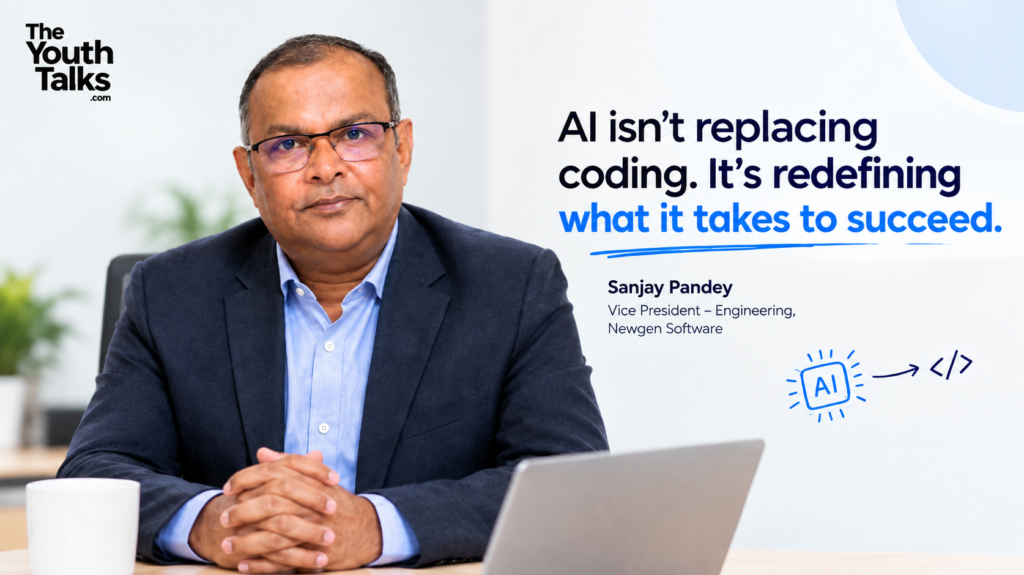
AI is changing how organisations work—but for students entering the workforce, the answer isn’t to abandon coding or chase every new AI tool. According to Sanjay Pandey, Vice President – Engineering at Newgen Software, the real advantage will come from combining strong fundamentals, domain expertise, practical exposure and the ability to work intelligently with AI.
Watch the full conversation with Sanjay Pandey here:
For years, engineering students have been told to follow a familiar formula: maintain a strong CGPA, learn programming, prepare for coding interviews, collect certifications and eventually land a job.
Artificial intelligence is now forcing that formula to be reconsidered.
But perhaps not in the way many students think.
The arrival of AI does not mean coding is becoming irrelevant. Nor does it mean students should stop learning technical fundamentals and simply become good at prompting AI tools.
Instead, the expectations are becoming broader.
That was one of the central messages from Sanjay Pandey, Vice President – Engineering at Newgen Software, during a conversation with TheYouthTalks on what AI means for jobs, engineering education and the next generation entering India’s workforce.
Pandey believes organisations are already undergoing a fundamental shift in three areas: how people work, how products are built and how decisions are made.
AI is already taking over or accelerating several repetitive activities—including coding, testing, documentation and analytics—allowing employees to spend more time on higher-value work.
At the same time, products themselves are becoming more intelligent. AI systems can increasingly understand context, recommend actions and, in some cases, execute tasks.
But Pandey believes the biggest change is not technological.
It is a change in mindset.
Organisations are moving away from simply asking, “Where can we use AI?” towards a much more consequential question: “How should we redesign the way we work with AI?”
And that shift has major implications for students.
The AI revolution has only just begun
There is a tendency to think that the AI transformation has already happened—that companies have adopted copilots, developers are using generative AI and employees are experimenting with AI tools.
Pandey sees it differently.
According to him, organisations have moved beyond the experimentation phase, but they are still at the beginning of a much larger transformation.
AI is already being used across everyday tasks such as writing, analytics, coding, research and customer support. But the bigger change could come as AI agents become more capable and organisations begin redesigning entire workflows around them.
That could fundamentally change jobs and operating models.
In other words, today’s AI adoption may eventually look less like the destination and more like the first chapter.
For a country such as India, where millions of young people enter the workforce every year, this raises an obvious question: Are students actually being prepared for this new world of work?
Pandey’s answer is that preparation cannot simply mean learning more AI tools.
It has to happen at three levels.
AI literacy + domain expertise + human skills
Pandey identifies three capabilities that students and working professionals increasingly need.
The first is basic AI literacy.
Students need to understand what AI can and cannot do, how to use AI tools effectively and, crucially, how to validate what AI produces.
That last point is particularly important.
The ability to generate an answer using AI is becoming increasingly easy. The ability to determine whether that answer is correct, useful, secure or appropriate is much harder.
The second capability is domain expertise.
Pandey’s argument is straightforward: AI becomes far more powerful when combined with deep knowledge of an industry, function or subject.
An AI tool can provide information. Domain expertise helps a person ask the right questions and make the right decisions.
The third is the set of human skills that become even more important when machines can handle more execution—critical thinking, creativity, communication and problem-solving.
The objective, therefore, isn’t to turn every student into an AI expert.
It is to create experts in their respective fields who know how to work effectively with AI.
That distinction could become one of the most important ideas for the next generation of professionals.
Coding is still fundamental
Perhaps one of the most reassuring messages for engineering students is that Pandey does not believe coding has become obsolete.
AI can write code. But someone still needs to understand what good code looks like, what problem is being solved and whether the solution actually works.
Programming fundamentals continue to teach logic, structure and problem-solving.
The role of coding may change, but the ability to think like an engineer remains fundamental.
This also applies to programming languages and traditional computer science fundamentals.
Students don’t necessarily need to obsess over mastering every programming language. What matters more is understanding the underlying fundamentals—data structures, logical thinking and how to approach a problem.
As AI takes over more of the actual programming work, the advantage could increasingly shift towards people who combine programming capabilities with AI capabilities and deep knowledge of their chosen domain.
The 9.5 CGPA student versus the 7.5 CGPA builder
The conversation becomes particularly interesting when the discussion moves from skills to hiring.
Imagine two candidates.
One has a 9.5 CGPA but relatively little experience with hackathons, internships or live projects.
The other has a 7.5 CGPA but has spent considerable time building products, participating in hackathons and working on real-world problems.
Who gets the job?
For Pandey, the answer is clear: practical exposure matters.
That does not mean academic performance is irrelevant. Strong fundamentals remain important.
But employers increasingly need people who can take those fundamentals and apply them to ambiguous, real-world problems.
Pandey says that if he were hiring a fresh graduate today, he would particularly look for three things:
Strong fundamentals. Curiosity. And the ability to learn quickly.
He would not expect a fresher to know everything.
Instead, he would want someone who can think logically, ask good questions, use AI intelligently and challenge and validate what AI produces.
Communication and teamwork also matter because engineering has become increasingly collaborative.
The strongest candidate, therefore, is not necessarily the one who can demonstrate the longest list of technical achievements.
It is someone who combines fundamentals with curiosity, adaptability and a genuine desire to solve problems.
From passing examinations to solving problems
This is where Pandey’s observations intersect with one of the oldest criticisms of engineering education in India.
Students often learn for examinations rather than for solving real problems.
India’s education system has traditionally placed significant emphasis on theoretical knowledge and examinations, while industry increasingly demands application, problem-solving and adaptability.
Pandey believes this gap is improving—but it still needs to be addressed.
The answer isn’t to eliminate fundamentals.
It is to connect fundamentals with application.
Students need more opportunities to work on real projects, collaborate with industry and experiment with modern AI tools.
That is also why hackathons and industry-led programmes can become more than extracurricular activities.
They can become a bridge between the classroom and the workplace.
What students can learn outside the classroom
Pandey points to initiatives such as OI Questra, through which students can get access to Newgen’s platform and experiment with industry-level problems.
The important part, however, isn’t whether every student emerges with a perfect solution.
It is the process.
Students are encouraged to be curious, experiment, learn quickly and use AI thoughtfully while attempting to solve real problems.
They also have to think about something that is rarely tested in a conventional examination: what is the actual business problem?
That distinction is critical.
A student may be capable of building a technically impressive feature. But product thinking requires going one step further—understanding the real customer or business problem and creating continuous value rather than simply completing a task or shipping a feature.
That is a very different way of thinking.
And it is one that students may struggle to develop if most of their academic experience revolves around textbooks and examinations.
Hackathons aren’t just about winning
There is another important lesson here.
A successful hackathon, according to Pandey, should not necessarily be judged only by the quality of the final product.
He is looking for curiosity, creativity, experimentation, teamwork and the ability to connect technology with business outcomes.
For team participants, collaboration becomes important.
For individuals, the willingness to experiment matters.
And for everyone, communication can make a significant difference.
This is especially relevant because some technically excellent students struggle to communicate their ideas.
The ability to build something is valuable.
The ability to explain why you built it, what problem it solves, what assumptions you made and what you learned can be just as valuable in the workplace.
Don’t chase certificates. Build something.
The same philosophy extends to certifications.
Pandey does not dismiss certifications. They can demonstrate that a student has learned something.
But they cannot substitute for applying that knowledge.
For a hiring manager, a candidate who can demonstrate what they built, which problem they solved and what they learned from the experience may be far more compelling than someone presenting a long list of certificates.
The question students should therefore ask is not:
“How many certifications do I have?”
It should be:
“What can I show that I can actually do?”
That shift—from collecting credentials to building evidence of capability—could become increasingly important in an AI-enabled job market.
Internships should be about learning first
Pandey takes a similar view when discussing internships.
The debate around paid versus unpaid internships has become increasingly intense among students and startups.
His advice to students is pragmatic: compensation matters, but during the student years, the primary question should be what are you going to learn and what problem are you going to solve?
Students should evaluate the quality of the internship, the exposure it provides and the actual learning they will take away from it.
If it is paid, that’s an added benefit.
But the internship should not be reduced to pocket money or another line on a résumé.
The real value lies in exposure to how work happens outside the classroom.
Open source can provide another reality check
Pandey also encourages students to explore open-source projects.
Open source provides exposure to a global community of developers and technologies. Students can learn from people working across geographies, participate in discussions and experience how real-world software evolves collaboratively.
It can offer a very different learning environment from the classroom.
Instead of solving a problem because it appeared in an examination, students are contributing to systems that other people actually use.
That experience can build technical skills, collaboration, communication and an understanding of how software is developed in the real world.
The mentor advantage
There is one more piece of the puzzle that often gets overlooked: mentorship.
Pandey believes mentorship always helps.
At Newgen, he points out, new employees are assigned mentors to help them navigate their early days in the organisation.
For students, finding mentors can similarly provide access to perspectives that may not be available within their immediate academic environment.
But mentorship cannot replace initiative.
Students still need to expose themselves to real problems, experiment with AI tools, work in teams and build things.
The mentor can accelerate the learning—but the student still has to do the learning.
The bigger challenge for India
Ultimately, Pandey’s argument extends beyond individual students.
India has no shortage of young people or engineering graduates.
The larger question is whether industry-academia collaboration can bridge India’s AI skills gap at scale.
His answer is optimistic—but conditional.
It will require sustained collaboration rather than isolated initiatives.
Industry can bring real business problems, current technologies and practical exposure.
Academia can bring strong fundamentals, research and fresh thinking.
The opportunity is to bring the two together more consistently through real-world projects, internships, industry-led learning and AI experimentation.
That could mean changing what students spend their four years of engineering doing.
Not replacing classroom learning.
But supplementing it with experiences that force them to build, experiment, collaborate, fail, communicate and solve.
The engineer of 2027
So what does an organisation like Newgen want from an engineering graduate entering the workforce in 2027?
Not an AI expert.
Not someone who knows every programming language.
Not someone with a résumé full of certificates.
And not necessarily the student with the highest CGPA.
Instead, the emerging profile is more interesting.
Someone with strong fundamentals, who is curious, adaptable, understands their domain, knows how to use AI intelligently, can validate its output, communicates well, works with others and—perhaps most importantly—knows how to approach a real problem.
The future, as Pandey puts it, belongs to people who know how to work with AI, rather than compete with it.
For India’s students, that may be the most useful takeaway of all.
The AI era does not necessarily demand that they learn less.
It demands that they learn differently.
And perhaps the biggest transition is this:
From learning to pass an examination → to learning to solve a problem.
That may ultimately be what separates an AI-ready graduate from everyone else.